

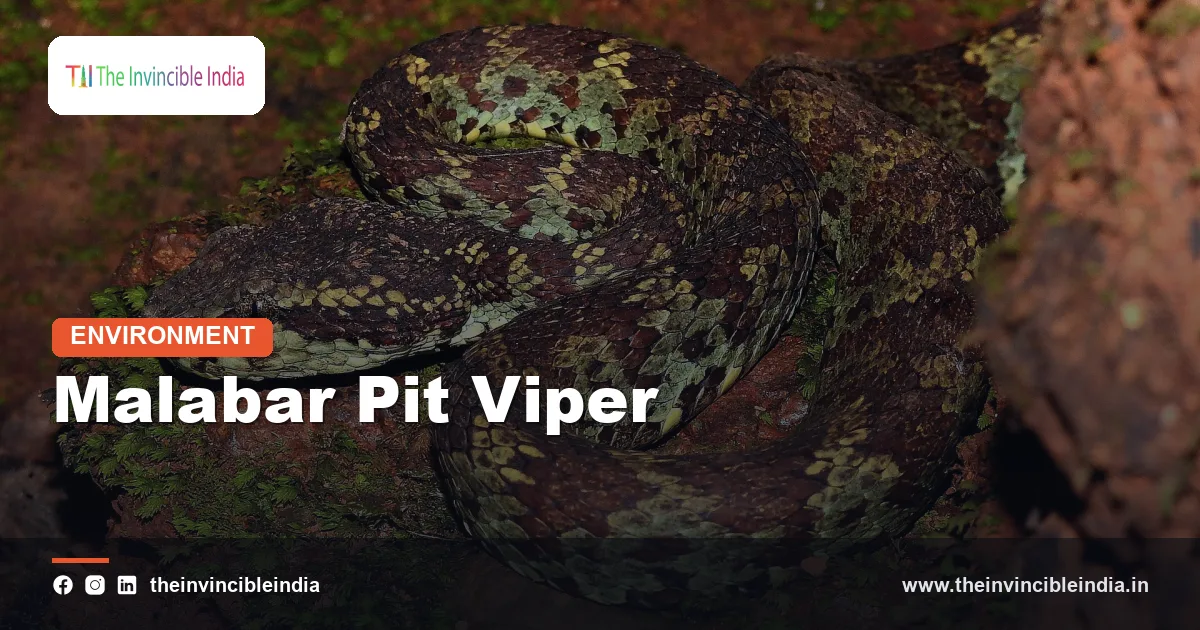
The Malabar pit viper (Craspedocephalus malabaricus) is a medium-sized, nocturnal venomous snake of the family Viperidae, found only in the Western Ghats of India, and it is known for the remarkable range of colours it shows and for the heat-sensing pits on its face. Older books place it in the genus Trimeresurus, and many sources still use that name.
The Malabar pit viper is an ambush predator that waits in shrubs, on rocks and among leaf litter for frogs, lizards and small mammals. Its venom is much less dangerous than that of the large vipers of the plains, and fatal bites are very rare. This article explains how to identify the Malabar pit viper, where it lives, how its heat pits work, what its venom does and how to respond to a bite.
| Common name | Malabar pit viper |
|---|---|
| Scientific name | Craspedocephalus malabaricus (formerly Trimeresurus malabaricus) |
| Family | Viperidae, subfamily Crotalinae (pit vipers) |
| Typical size | About 50 to 80 centimetres, rarely approaching a metre |
| Range in India | Endemic to the Western Ghats and adjoining hills, from Maharashtra and Goa through Karnataka and Kerala to Tamil Nadu |
| Habitat | Evergreen and semi-evergreen forests, shola edges, shrubs, rocky slopes and plantations |
| Venom type | Haemotoxic (acts on blood and tissue), with mainly local effects |
| Diet | Frogs, lizards, small rodents and occasionally small birds |
| Conservation status | Not globally threatened (IUCN: Least Concern); protected under the Wildlife (Protection) Act, 1972 |
Key Takeaways
- The Malabar pit viper (Craspedocephalus malabaricus) is endemic to the Western Ghats, which means it is found naturally nowhere else in the world.
- The Malabar pit viper is famous for its colour variation, ranging from green and yellow to brown, grey and reddish forms, often with dark blotches or bands.
- The Malabar pit viper has a heat-sensing pit between each eye and nostril, which helps it detect warm-blooded prey in darkness.
- Malabar pit viper venom is haemotoxic and usually causes pain and swelling around the bite, and deaths are very rare with prompt medical care.
- After a bite, the victim should stay calm, keep the limb still and go to hospital, and should not cut, suck or tie a tourniquet on the wound.
- The Malabar pit viper controls frogs, lizards and rodents in forest and plantation ecosystems and is legally protected in India.
What is the Malabar pit viper?
The Malabar pit viper is a venomous, mostly nocturnal snake in the pit viper subfamily, restricted to the forests and hills of the Western Ghats in south-western India. It was described scientifically by the British zoologist Thomas Jerdon in 1854 from specimens collected in the Malabar region, which is why the name refers to that coast.
Pit vipers are a group of vipers (Viperidae, subfamily Crotalinae) that possess a pair of small, deep heat-sensing pits on the face. They include rattlesnakes in the Americas and many green and brown vipers in Asia. In India, the group is represented by the genera Trimeresurus, Craspedocephalus, Hypnale and others, which live mainly in the hills of the Western Ghats and in the northeast.
Taxonomists have revised the classification of Asian pit vipers several times as genetic studies have improved. The Malabar pit viper is now widely listed under Craspedocephalus, but earlier field guides, hospital records and websites may refer to it as Trimeresurus malabaricus. Both names refer to the same species.
How can you identify a Malabar pit viper?
A Malabar pit viper can be identified by its broad, triangular head, vertically elliptical pupils, a visible heat pit between the eye and nostril, rough keeled scales and a stout body that tapers to a short, grasping tail. Its colour, however, is so variable that shape and pits are more reliable guides than pattern.
Key identification features
- Head: distinctly triangular and clearly wider than the neck, covered with small scales.
- Eyes: vertical, cat-like pupils, which suit its night-time habits.
- Heat pits: a small hole on each side of the face, lying between the nostril and the eye.
- Body: relatively thick for its length, with keeled scales that give a rough texture.
- Tail: short and partly prehensile, helping the snake grip branches.
- Colour: green, olive, yellowish, grey, brown, orange or reddish, often with dark spots, blotches, bars or a cream stripe along the lip.
This variation led to different colour forms being treated as separate snakes in the past. Young snakes often have pale or reddish tails and slightly different tones from adults. Green forms are easily confused with harmless green snakes, which is a reminder that nobody should handle any snake based on its colour alone.
Where does the Malabar pit viper live?
The Malabar pit viper lives in the Western Ghats, the mountain range running along India’s western coast from Maharashtra and Goa through Karnataka and Kerala to Tamil Nadu. It occurs from the foothills to cooler highlands and is especially frequent in wet evergreen and semi-evergreen forests.
Within these forests, the snake uses a variety of micro-habitats. It rests coiled on low branches, in bushes, on rocks and boulders, among fallen leaves, in crevices and on the banks of streams. It is also encountered in coffee, tea, cardamom and rubber plantations that border natural forest, as well as in gardens near forest edges.
Because the species depends on the humid, shaded conditions of the Western Ghats, it is considered a regional endemic. The Western Ghats are recognised as a global biodiversity hotspot and a UNESCO World Heritage property, and the Malabar pit viper is one of many reptiles and amphibians that are found only in this landscape.
How do heat-sensing pits work?
Heat-sensing pits detect infrared radiation, which allows a pit viper to sense the body heat of nearby warm-blooded animals even in complete darkness. Each pit contains a thin membrane packed with nerve endings that respond to tiny temperature differences, and the signals are combined in the brain with information from the eyes.
The Malabar pit viper has a pit on each side of its face, so it can judge both the direction and approximate distance of a warm object such as a rat. This ability makes it highly effective at ambushing small mammals and birds at night. Cold-blooded prey such as frogs are mostly found by sight, smell and vibration instead.
The pits are also the clearest field mark of the whole pit viper group. When someone is deciding whether a snake is a pit viper, a facial pit between the eye and the nostril is a more reliable indicator than colour.
What does the Malabar pit viper eat?
The Malabar pit viper eats frogs, lizards, small rodents and occasionally small birds, which it catches by ambush. It typically waits motionless for hours in a coiled position, strikes quickly when prey comes within reach and then releases the animal so that it can follow the scent trail while the venom works.
- Frogs and toads: a major food item, especially in the monsoon when amphibians are abundant.
- Lizards: including forest geckos and garden lizards, taken from shrubs and rocks.
- Rodents: small forest and field rats and mice.
- Birds and other prey: small birds, nestlings and large insects on occasion.
After the prey has died, the snake swallows it whole, normally headfirst. A single meal can sustain the snake for a long time, because pit vipers have a slow metabolism and do not need to feed often. Predators of the Malabar pit viper include birds of prey, other snakes such as the king cobra, and mammals such as civets and mongooses.
How does the Malabar pit viper reproduce?
The Malabar pit viper is viviparous, which means the female gives birth to live young rather than laying eggs. Breeding is linked to the seasons, and litters are typically born around the monsoon, when food is plentiful for newborns.
The young are born fully formed, measure about 15 to 20 centimetres and carry functioning venom from birth. They receive no parental care. At first they eat small frogs, lizards and insects, and some individuals have pale or bright tail tips that may help to lure prey, a habit known as caudal luring and seen in several pit vipers.
How dangerous is Malabar pit viper venom?
Malabar pit viper venom is mildly to moderately dangerous, because it mainly causes local pain, swelling and sometimes bruising, and deaths are very rare. The venom is haemotoxic, which means it acts on blood and tissue rather than on the nervous system.
Typical effects of a bite
- Local effects: pain, swelling, redness and bruising around the bite, sometimes with blistering.
- Blood effects: in some cases, a temporary disturbance of blood clotting, which doctors check with simple tests.
- Dry bites: some bites inject little or no venom.
- Complications: secondary infection or tissue damage if the wound is mishandled or treatment is delayed.
Bites on people are not common, but they do occur, mostly when someone reaches into a bush, steps on a camouflaged snake or handles one. Plantation workers, trekkers and farmers in the Western Ghats are most at risk during the monsoon and at night.
The standard Indian polyvalent antivenom is made against the “Big Four” snakes of the plains and is not designed for pit viper venoms. Medical treatment of Malabar pit viper bites is therefore usually supportive, with pain relief, monitoring of blood clotting, care of the limb and observation. Doctors decide whether any antivenom is appropriate, which is a reason to go to a hospital rather than manage the bite at home.
How is the Malabar pit viper different from similar snakes?
The Malabar pit viper differs from similar Western Ghats snakes mostly in its heat pits, its triangular head and its short, stout body, which set it apart from harmless green snakes and from other pit vipers.
| Snake | Key features | Venomous? |
|---|---|---|
| Malabar pit viper | Triangular head, heat pits, vertical pupils, stout body, variable colour | Yes, mainly local effects |
| Hump-nosed pit viper (Hypnale species) | Upturned, humped snout, brownish body, mostly ground-dwelling | Yes, can be serious, with kidney injury reported |
| Green vine snake | Very slender, long pointed head, keyhole pupils, no pits | Mildly, rear-fanged and rarely harmful to people |
| Green keelback | Slim body, round pupils, no pits, narrow head | Harmless to people |
The practical lesson is that snake identification in the field is difficult, even for experts. Observers should keep a safe distance and use a camera zoom if they want a record.
What should you do after a Malabar pit viper bite?
After a Malabar pit viper bite, the person should stay calm, the limb should be kept still and at about heart level, and the victim should be taken promptly to the nearest hospital for assessment. India’s snakebite guidance uses the phrase “Do it RIGHT”: reassure, immobilise, get to hospital immediately and tell the doctor about symptoms.
Responsible first-aid steps
- Reassure the person and move away from the snake.
- Immobilise the limb with a splint or sling, as for a fracture.
- Remove rings, bangles, watches and tight footwear before swelling starts.
- Travel to hospital promptly, preferably to one with a laboratory and antivenom stocks.
- Report details to the doctor, such as the time of the bite, how the snake looked and the progression of swelling.
What not to do
- Do not cut the wound or try to suck out venom.
- Do not apply a tourniquet or tie a tight band, which can worsen tissue damage.
- Do not use herbs, stones, ice, charms or other folk remedies.
- Do not try to catch or kill the snake, and do not waste time looking for it.
Even though most Malabar pit viper bites are not fatal, hospital assessment is important because swelling can be severe, blood clotting can change and bite wounds can become infected. Where antivenom is considered, it must be administered by trained staff.
How can people avoid bites in the Western Ghats?
People can avoid pit viper bites in the Western Ghats by looking where they place their hands and feet, wearing boots and long trousers, using a torch at night and not handling any snake. Most bites occur when a camouflaged snake is touched by accident.
- Wear sturdy closed footwear and long trousers while trekking or working in plantations.
- Check branches and shrubs before gripping them or pushing through them.
- Use a torch after dark, especially during the monsoon, when snakes are most active.
- Do not put hands into crevices, rock piles, leaf heaps or bamboo clumps without looking.
- Keep plantation paths and homes clear of rubbish and dense undergrowth.
- Stay at a distance from any snake and never try to pick one up for a photograph.
Why does the Malabar pit viper matter, and is it protected?
The Malabar pit viper matters because it helps keep frog, lizard and rodent populations in balance and is part of the unique wildlife of the Western Ghats, and it is protected in India under the Wildlife (Protection) Act, 1972. The IUCN lists the species as Least Concern, but its range is small and tied to forest habitat.
Habitat loss from clearing forests, plantation expansion, roads and development is a long-term concern for all Western Ghats endemics. Road traffic and killing out of fear also cause local losses. Snakes of every kind are ecologically valuable, and killing them is unnecessary, as the Malabar pit viper tends to rely on camouflage and stillness instead of attack.
The best approach is coexistence: keep a respectful distance, learn local snake species and seek proper medical treatment for any bite. This protects both the people who live in the Western Ghats and the animals that make the region ecologically distinctive.
Bottom Line
The Malabar pit viper is a colourful, heat-sensing ambush hunter that exists only in the Western Ghats. Its venom causes mostly local damage, and bites are rarely fatal, but they still need prompt hospital assessment. The species is protected, ecologically useful and best observed from a distance.
Frequently Asked Questions
What is a Malabar pit viper?
The Malabar pit viper (Craspedocephalus malabaricus) is a venomous, nocturnal pit viper found only in the Western Ghats of India. It has a triangular head, heat-sensing pits and a highly variable colour. It was formerly classified in the genus Trimeresurus.
Is the Malabar pit viper deadly?
No, the Malabar pit viper is rarely deadly, because its haemotoxic venom mainly causes local pain, swelling and bruising. Fatal bites are very rare. Every bite should still be assessed in a hospital because swelling and blood clotting problems can develop.
Where is the Malabar pit viper found?
The Malabar pit viper is found in the Western Ghats, from Maharashtra and Goa through Karnataka and Kerala to Tamil Nadu. It lives in evergreen forests, shrubs, rocky slopes and nearby plantations. It occurs naturally nowhere else in the world.
Why does the Malabar pit viper come in so many colours?
The Malabar pit viper comes in many colours because the species naturally shows a wide range of colour forms, including green, yellow, brown, grey and reddish, often with dark patterns. This variation probably helps with camouflage in different micro-habitats. Because of it, snake experts rely on head shape, heat pits and pupils to identify the species.
What should I do if a Malabar pit viper bites someone?
Keep the person calm, immobilise the bitten limb and take them to a hospital quickly. Do not cut the wound, suck out the venom, tie a tourniquet or use folk remedies. Indian polyvalent antivenom is not made for pit viper venom, so the doctors decide on supportive treatment and monitoring.
Is the Malabar pit viper protected in India?
Yes, the Malabar pit viper is protected under the Wildlife (Protection) Act, 1972, and killing or capturing it without permission is an offence. The species is also ecologically valuable because it feeds on frogs, lizards and rodents. The best response to meeting one is to keep a safe distance and let it move away.
{“@context”:”https://schema.org”,”@graph”:[{“@type”:”FAQPage”,”mainEntity”:[{“@type”:”Question”,”name”:”What is a Malabar pit viper?”,”acceptedAnswer”:{“@type”:”Answer”,”text”:”The Malabar pit viper (Craspedocephalus malabaricus) is a venomous, nocturnal pit viper found only in the Western Ghats of India. It has a triangular head, heat-sensing pits and a highly variable colour. It was formerly classified in the genus Trimeresurus.”}},{“@type”:”Question”,”name”:”Is the Malabar pit viper deadly?”,”acceptedAnswer”:{“@type”:”Answer”,”text”:”No, the Malabar pit viper is rarely deadly, because its haemotoxic venom mainly causes local pain, swelling and bruising. Fatal bites are very rare. Every bite should still be assessed in a hospital because swelling and blood clotting problems can develop.”}},{“@type”:”Question”,”name”:”Where is the Malabar pit viper found?”,”acceptedAnswer”:{“@type”:”Answer”,”text”:”The Malabar pit viper is found in the Western Ghats, from Maharashtra and Goa through Karnataka and Kerala to Tamil Nadu. It lives in evergreen forests, shrubs, rocky slopes and nearby plantations. It occurs naturally nowhere else in the world.”}},{“@type”:”Question”,”name”:”Why does the Malabar pit viper come in so many colours?”,”acceptedAnswer”:{“@type”:”Answer”,”text”:”The Malabar pit viper comes in many colours because the species naturally shows a wide range of colour forms, including green, yellow, brown, grey and reddish, often with dark patterns. This variation probably helps with camouflage in different micro-habitats. Because of it, snake experts rely on head shape, heat pits and pupils to identify the species.”}},{“@type”:”Question”,”name”:”What should I do if a Malabar pit viper bites someone?”,”acceptedAnswer”:{“@type”:”Answer”,”text”:”Keep the person calm, immobilise the bitten limb and take them to a hospital quickly. Do not cut the wound, suck out the venom, tie a tourniquet or use folk remedies. Indian polyvalent antivenom is not made for pit viper venom, so the doctors decide on supportive treatment and monitoring.”}},{“@type”:”Question”,”name”:”Is the Malabar pit viper protected in India?”,”acceptedAnswer”:{“@type”:”Answer”,”text”:”Yes, the Malabar pit viper is protected under the Wildlife (Protection) Act, 1972, and killing or capturing it without permission is an offence. The species is also ecologically valuable because it feeds on frogs, lizards and rodents. The best response to meeting one is to keep a safe distance and let it move away.”}}]}]}


