

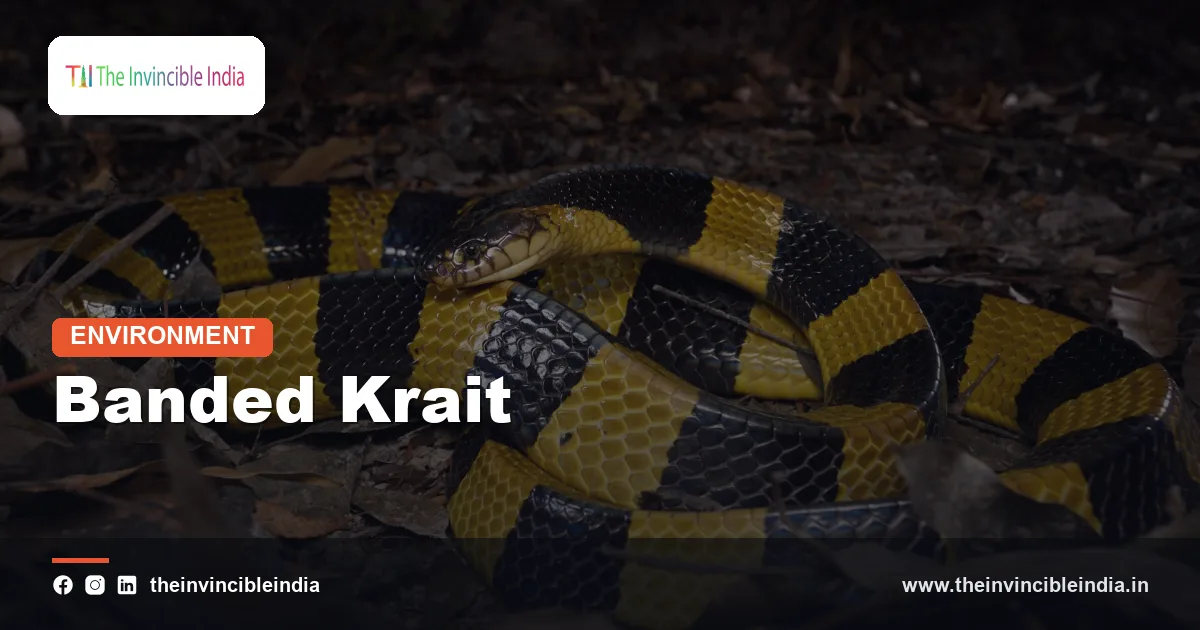
The banded krait (Bungarus fasciatus) is a large, highly venomous snake of the family Elapidae, easily recognised by broad alternating black and yellow bands that run around its body and by a distinct ridge along its back. It is found in eastern and northeast India and across Southeast Asia, and it is mostly nocturnal, shy and reluctant to bite.
The banded krait is one of the most striking snakes in the Indian subcontinent, and its bold colours act as a warning to predators. Although its venom is potent, bites on people are uncommon. This article explains how to recognise the banded krait, where it lives, what it eats, how it differs from the common krait, what its venom does and how to respond responsibly to a snakebite.
| Common name | Banded krait |
|---|---|
| Scientific name | Bungarus fasciatus |
| Family | Elapidae (cobras, kraits and their relatives) |
| Typical size | About 1.2 to 1.8 metres; the largest individuals exceed 2 metres |
| Range in India | Eastern and northeast India, including West Bengal, Odisha, Assam and other northeastern states; also Nepal, Bangladesh and Southeast Asia |
| Habitat | Forest edges, grassland, wetlands, paddy fields, plantations and village outskirts, usually near water |
| Venom type | Neurotoxic, acting on nerve-to-muscle signals and causing paralysis |
| Diet | Mainly other snakes; also lizards, frogs, fish and eggs |
| Conservation status | Least Concern globally (IUCN); protected under the Wildlife (Protection) Act, 1972 |
Key Takeaways
- The banded krait (Bungarus fasciatus) is identified by wide alternating black and yellow bands and a raised ridge along its spine that gives its body a triangular cross-section.
- The banded krait lives mainly in eastern and northeast India, in lowland forests, grasslands, wetlands and farmland, and is most active at night.
- Banded krait venom is neurotoxic and can cause paralysis, so any suspected bite needs emergency hospital care even if the wound looks minor.
- The banded krait is generally docile and non-aggressive, and bites on humans are rare compared with those from the common krait or cobras.
- The banded krait feeds largely on other snakes, which makes it an important natural controller of snake populations.
- Killing a banded krait is illegal in India, and the safe response to one in a home is to keep away and call trained rescuers.
What is the banded krait?
The banded krait is a large, nocturnal, front-fanged venomous snake in the genus Bungarus, native to South and Southeast Asia and known for its bold black and yellow banding. Its species name, fasciatus, comes from the Latin word for banded, and it was described scientifically in 1801 by the German naturalist Johann Gottlob Schneider.
The genus Bungarus contains the kraits, a group of elapid snakes found across the Indian subcontinent and Southeast Asia. India has several krait species, including the common krait (Bungarus caeruleus), the banded krait, the lesser black krait and the greater black krait, among others. The banded krait is the largest of the kraits found in the region.
Within the family Elapidae, the banded krait is related to cobras and sea snakes. Like them, it has short, fixed fangs at the front of the upper jaw and a venom made mostly of toxins that act on the nervous system.
How can you identify a banded krait?
A banded krait can be identified by its complete, broad bands of black and bright yellow or yellowish white that encircle the body from head to tail, together with a pronounced vertebral ridge and a short, blunt tail. No other large snake in eastern India has such a regular and contrasting pattern.
Key identification features
- Banding: alternating black and yellow bands of nearly equal width, usually extending around the whole body.
- Body shape: a triangular cross-section with a prominent ridge along the backbone, which is especially visible in larger adults.
- Head: broad and slightly flattened, with a yellow snout and a dark mark on the crown, barely distinct from the neck.
- Tail: short and blunt, ending in a rounded tip rather than a fine point.
- Eyes: small, dark and set with round pupils, which suits a nocturnal lifestyle.
Young banded kraits have the same pattern as adults but are slimmer. Some harmless snakes, such as certain wolf snakes of the genus Lycodon, have banded patterns that resemble kraits at first sight. The safest assumption is that any banded snake could be dangerous and should be left alone.
Where does the banded krait live in India?
The banded krait lives mainly in eastern and northeast India, including West Bengal, Odisha, Bihar, Assam, Meghalaya, Tripura, Manipur, Mizoram, Nagaland and Arunachal Pradesh, and it extends through Nepal, Bangladesh, Myanmar and Southeast Asia to southern China, Malaysia and Indonesia. It is typically a species of low-lying and foothill country.
The banded krait prefers places with water and plentiful cover. Typical habitats include forest edges, bamboo thickets, grassland, wetlands, river valleys, paddy fields and plantations. Its daytime shelters include rodent burrows, termite mounds, hollow logs, piles of leaf litter and the spaces under rocks or buildings.
The snake may enter villages and farm buildings, particularly in wet weather, when flooding drives it from its normal hiding places. Because it is secretive and nocturnal, many people live alongside banded kraits for years without ever seeing one.
Is the banded krait aggressive?
No, the banded krait is generally a docile and non-aggressive snake that tends to hide its head under its coils and retreat when disturbed, especially during the day. It is much more placid than many cobras and vipers and rarely strikes unless it is handled, trodden on or severely provoked.
This calm behaviour is one reason why bites from banded kraits are uncommon. At night, however, the snake is more alert and active, and it can bite if it is pinned or if a person steps on it in the dark. A gentle reputation should never be taken as a reason to pick up, tease or photograph the animal at close range.
Many snake bites around the world happen when people try to handle or kill a snake. Leaving a krait alone is the single most effective way to avoid being bitten by one.
What does the banded krait eat?
The banded krait eats mainly other snakes, a feeding habit known as ophiophagy, but it also takes lizards, skinks, frogs, fish and eggs. It hunts mostly at night, searching burrows, leaf litter and the edges of water by smell and touch.
- Snakes: both non-venomous species such as rat snakes and keelbacks, and sometimes smaller venomous snakes, including other kraits.
- Lizards and skinks: caught in crevices and burrows.
- Frogs and fish: taken near ponds, streams and flooded fields.
- Eggs and small animals: eaten opportunistically.
Its venom works quickly on prey. After biting, it holds on until the victim stops moving and then swallows it, usually headfirst. Because it reduces the number of snakes, including some that are dangerous to people, the banded krait has a quiet but real role in the balance of local food webs.
How does the banded krait reproduce?
The banded krait is oviparous, so the female lays eggs, typically a small clutch of about 4 to 14 eggs placed in a hollow, burrow or a heap of decaying leaves. Breeding takes place in the warmer and wetter part of the year in most of its range, and the female usually stays with the eggs until they hatch.
The incubation period lasts roughly two months. Hatchlings measure about 30 centimetres, carry venom from birth and fend for themselves. They feed on small lizards, skinks and snakes at first, and grow quickly during their first years.
How dangerous is banded krait venom?
Banded krait venom is dangerous because it is a potent neurotoxin that can paralyse the muscles used for breathing, and an untreated bite can be fatal. Kraits as a group produce venom containing powerful toxins that block nerve signals at the junction between nerve and muscle.
What a bite can look like
- Little local pain: the bite site may show minimal swelling and may hurt very little, which can lead people to dismiss the bite.
- Delayed symptoms: abdominal pain, vomiting, drooping eyelids, double vision and difficulty swallowing may start after minutes or hours.
- Progressive paralysis: muscle weakness spreads, and breathing can fail without treatment.
Because a krait bite can be painless and symptoms may appear late, a person who might have been bitten, for example while asleep or after waking with a mark on the skin, should be taken to hospital for observation. Treatment may involve antivenom and, when needed, mechanical ventilation until the paralysis wears off.
Indian polyvalent antivenom is made against the “Big Four” snakes, which include the common krait, and how well it neutralises banded krait venom is uncertain. Doctors therefore treat the patient according to symptoms and may use antivenom together with breathing support. This is another strong reason to go directly to a well-equipped hospital.
How is the banded krait different from the common krait?
The banded krait differs from the common krait mainly in size, colour and range, because it is larger, boldly black and yellow and mostly eastern, while the common krait is smaller, steel-blue to black with thin white bands and found across most of India.
| Feature | Banded krait | Common krait |
|---|---|---|
| Scientific name | Bungarus fasciatus | Bungarus caeruleus |
| Colour | Broad black and yellow bands | Blue-black with narrow white bands |
| Typical length | About 1.2 to 1.8 metres | About 0.9 to 1.2 metres |
| Main range in India | East and northeast | Most of the Indian mainland |
| Medical importance | Occasional bites | Part of the “Big Four”, with many bites |
| Temperament | Docile, especially by day | Docile by day, more alert at night |
Both species are dangerous and both are nocturnal. The common krait is responsible for far more recorded bites because it is widespread and often enters houses at night.
What should you do after a banded krait bite?
After a suspected banded krait bite, the person should be kept calm and still, the bitten limb should be immobilised and the person should be taken to the nearest hospital with antivenom and intensive care without delay. India’s snakebite guidance summarises this as “Do it RIGHT”: reassure, immobilise, get to hospital immediately and tell the doctor about symptoms.
Responsible first-aid steps
- Keep the person calm and lying down, since movement and panic help venom spread.
- Immobilise the limb like a fractured limb, with a splint or sling.
- Remove rings, bangles and tight clothing before swelling develops.
- Go to hospital immediately, and do not wait for symptoms, because paralysis can appear late.
- Tell the doctor the time of the bite and any changes such as drooping eyelids or trouble swallowing.
What not to do
- Do not cut the wound or suck out the venom.
- Do not apply a tight tourniquet or any chemical to the skin.
- Do not use herbs, charms or other folk remedies, and do not delay hospital care for a traditional healer.
- Do not try to catch or kill the snake, which risks another bite.
Antivenom, given in a hospital under medical supervision, remains the specific treatment for krait envenoming, along with ventilatory support where required. Early treatment is the main factor in survival.
How can people stay safe around kraits?
People can stay safe around kraits by keeping sleeping areas free of gaps and clutter, using a tucked-in mosquito net, carrying a light at night and wearing footwear outdoors. Kraits are nocturnal, so most precautions focus on the hours after dark.
- Sleep on a raised cot or bed instead of the floor, and tuck the mosquito net under the mattress.
- Seal cracks and holes in walls and floors and keep rodents out of the home.
- Use a torch when walking outdoors at night and wear closed shoes.
- Do not leave clothes, shoes or bags on the floor where a snake could shelter.
- Keep the area around houses free of rubbish, woodpiles and long grass.
- Never touch, tease or photograph a snake from close range.
If a banded krait is found indoors, people should keep away, close doors to the room and call the forest department or a trained, registered snake rescuer.
Why does the banded krait matter, and is it protected?
The banded krait matters because it preys on other snakes and rodent-eating reptiles and forms part of balanced wetland and forest food webs, and it is protected in India under the Wildlife (Protection) Act, 1972. Globally, the International Union for Conservation of Nature (IUCN) classifies the species as Least Concern because it is widely distributed.
Local populations, however, can decline because of habitat conversion, road deaths and killing by people who fear snakes. The banded krait is also targeted in some regions for the wildlife trade. Protecting wetlands, hedgerows and forest patches helps the species and many others.
Snakes are ecologically valuable, and a krait that is left alone poses little risk. Education about snake identification, safe habits at night and fast access to antivenom reduces both snakebite deaths and unnecessary killing.
Bottom Line
The banded krait is a large, boldly banded and generally calm snake of eastern and northeast India, with a potent neurotoxic venom. Bites are rare but serious, and any suspected bite needs immediate hospital care. The snake feeds on other snakes, is legally protected and should be left undisturbed.
Frequently Asked Questions
What is a banded krait?
The banded krait (Bungarus fasciatus) is a large venomous snake of the family Elapidae with broad black and yellow bands and a ridged back. It lives in eastern and northeast India and Southeast Asia. It is mostly nocturnal and feeds mainly on other snakes.
Is the banded krait dangerous to humans?
Yes, the banded krait is dangerous because its neurotoxic venom can cause paralysis and breathing failure. However, the snake is usually docile and bites on people are rare. Any suspected bite needs urgent treatment in a hospital.
Where is the banded krait found in India?
The banded krait is found mainly in eastern and northeast India, including West Bengal, Odisha, Assam and neighbouring states. It also occurs in Nepal, Bangladesh and across Southeast Asia. It prefers lowland forests, grasslands, wetlands and farmland near water.
What does a banded krait eat?
The banded krait eats mainly other snakes, and it also takes lizards, frogs, fish and eggs. It hunts mostly at night by following scent in burrows and leaf litter. Its habit of eating snakes helps regulate local snake populations.
What should I do if a banded krait bites someone?
Keep the person calm, immobilise the bitten limb and take them to a hospital with antivenom and breathing support immediately. Do not cut the wound, suck out venom, apply a tight tourniquet or rely on folk remedies. Krait bites may be painless with delayed symptoms, so hospital care is needed even if the person feels well.
How can I tell a banded krait from a common krait?
The banded krait has wide black and yellow bands, while the common krait is blue-black with thin white bands. The banded krait is also larger and lives mainly in the east and northeast, whereas the common krait occurs across most of India. Both are venomous and should never be handled.
{“@context”:”https://schema.org”,”@graph”:[{“@type”:”FAQPage”,”mainEntity”:[{“@type”:”Question”,”name”:”What is a banded krait?”,”acceptedAnswer”:{“@type”:”Answer”,”text”:”The banded krait (Bungarus fasciatus) is a large venomous snake of the family Elapidae with broad black and yellow bands and a ridged back. It lives in eastern and northeast India and Southeast Asia. It is mostly nocturnal and feeds mainly on other snakes.”}},{“@type”:”Question”,”name”:”Is the banded krait dangerous to humans?”,”acceptedAnswer”:{“@type”:”Answer”,”text”:”Yes, the banded krait is dangerous because its neurotoxic venom can cause paralysis and breathing failure. However, the snake is usually docile and bites on people are rare. Any suspected bite needs urgent treatment in a hospital.”}},{“@type”:”Question”,”name”:”Where is the banded krait found in India?”,”acceptedAnswer”:{“@type”:”Answer”,”text”:”The banded krait is found mainly in eastern and northeast India, including West Bengal, Odisha, Assam and neighbouring states. It also occurs in Nepal, Bangladesh and across Southeast Asia. It prefers lowland forests, grasslands, wetlands and farmland near water.”}},{“@type”:”Question”,”name”:”What does a banded krait eat?”,”acceptedAnswer”:{“@type”:”Answer”,”text”:”The banded krait eats mainly other snakes, and it also takes lizards, frogs, fish and eggs. It hunts mostly at night by following scent in burrows and leaf litter. Its habit of eating snakes helps regulate local snake populations.”}},{“@type”:”Question”,”name”:”What should I do if a banded krait bites someone?”,”acceptedAnswer”:{“@type”:”Answer”,”text”:”Keep the person calm, immobilise the bitten limb and take them to a hospital with antivenom and breathing support immediately. Do not cut the wound, suck out venom, apply a tight tourniquet or rely on folk remedies. Krait bites may be painless with delayed symptoms, so hospital care is needed even if the person feels well.”}},{“@type”:”Question”,”name”:”How can I tell a banded krait from a common krait?”,”acceptedAnswer”:{“@type”:”Answer”,”text”:”The banded krait has wide black and yellow bands, while the common krait is blue-black with thin white bands. The banded krait is also larger and lives mainly in the east and northeast, whereas the common krait occurs across most of India. Both are venomous and should never be handled.”}}]}]}


