

Mangalyaan, formally the Mars Orbiter Mission (MOM), is the Indian Space Research Organisation’s first interplanetary spacecraft and, for many Indians, its most celebrated one. Launched on 5 November 2013 from Sriharikota, it slipped into orbit around Mars on 24 September 2014, making India the first country in the world to reach Mars orbit on its very first attempt. The name comes from Sanskrit: “Mangal” means Mars and “yaan” means craft.
What made the mission remarkable was not only the destination but the price tag and the discipline behind it. A spacecraft that cost roughly Rs 450 crore travelled about 680 million kilometres by the route it took, arrived exactly on schedule, and kept working long after its six-month design life. This explainer walks through how Mangalyaan was planned, launched and flown, what its instruments did, and why it still matters to India’s space story.
| Fact | Detail |
|---|---|
| Official name | Mars Orbiter Mission (MOM), popularly Mangalyaan |
| Agency | Indian Space Research Organisation (ISRO) |
| Launch date | 5 November 2013, from Sriharikota, Andhra Pradesh |
| Launch vehicle | PSLV-XL (PSLV-C25) |
| Mars orbit insertion | 24 September 2014 |
| Approximate cost | About Rs 450 crore (roughly US $74 million) |
| Scientific payload | Five instruments totalling about 15 kg |
| Planned life | Six months in Mars orbit; operated for several years |
| Key first | First nation to reach Mars orbit on its first attempt; first in Asia |
Why India Went to Mars
By the early 2010s, ISRO had proved itself in launching satellites for communication, remote sensing and navigation, and had sent Chandrayaan-1 to the Moon in 2008. A Mars mission was the natural next step: a way to test whether India could navigate a spacecraft across hundreds of millions of kilometres, communicate with it over long delays, and operate it autonomously when Earth could not respond in real time.
Technology first, science second
ISRO described Mangalyaan primarily as a technology demonstrator. The central challenge was to design, plan, manage and operate an interplanetary mission, from the launch pad to Mars orbit. Scientific returns were an important secondary goal, and the payload was chosen accordingly, but the headline objective was proving the capability.
The Mars launch window
Earth and Mars line up favourably for an efficient transfer only once in about 26 months. Missing the late-2013 window would have meant waiting until 2016. This fixed deadline compressed the development schedule, and the project was cleared and built in a remarkably short period compared with typical planetary missions.
Launch: PSLV-XL from Sriharikota
Mangalyaan lifted off on 5 November 2013 aboard the Polar Satellite Launch Vehicle in its XL configuration, designated PSLV-C25, from the Satish Dhawan Space Centre at Sriharikota. The XL version uses six extended strap-on boosters and is the most powerful variant of the PSLV, the workhorse that had already earned a reputation for reliability.
A spacecraft of modest size
The orbiter’s lift-off mass was roughly 1,350 kg, including its propellant. Its structure was derived from the I-1K bus used on earlier ISRO satellites, and its design borrowed heavily from experience gained on Chandrayaan-1. Reusing proven components was one of the central reasons the project stayed on budget and on time.
Why not a direct shot to Mars?
The PSLV cannot throw a spacecraft of this mass directly onto a path towards Mars. Larger launchers, such as the GSLV, were not yet available in a form suitable for the task. ISRO therefore had to devise a cleverer plan in which the spacecraft did much of the work itself, which leads to the most interesting part of the mission profile.
The Journey: Orbit Raising and the Trans-Mars Injection
After separation from the rocket, Mangalyaan was placed in a highly elliptical orbit around Earth. Over the following weeks, ISRO used the spacecraft’s own liquid apogee motor and thrusters to raise the high point of that orbit step by step, in a sequence of six engine burns. Each burn increased the spacecraft’s speed at its closest approach to Earth, stretching the orbit further out.
The slingshot from Earth orbit
When the orbit was large enough and the timing was right, a final burn on 1 December 2013 pushed Mangalyaan out of Earth’s gravitational influence and onto a trajectory towards Mars. This is known as the trans-Mars injection. The approach is a practical adaptation of the classic Hohmann-style transfer, a fuel-efficient path that takes a spacecraft from one planet’s orbit to another’s in a long curve around the Sun.
Nearly ten months of cruise
The heliocentric cruise lasted about 300 days. During this period ISRO performed trajectory correction manoeuvres, including one in December 2013, to keep the spacecraft precisely on course. For most of the journey the main engine stayed idle, which raised a real concern: would it fire reliably after sitting unused for so long?
Talking across space
Signals from Earth take many minutes to reach Mars, and the delay grows and shrinks as the planets move. The spacecraft was therefore designed with onboard autonomy to detect and respond to faults. Ground contact was handled through ISRO’s Deep Space Network at Byalalu near Bengaluru, supported by ISRO’s tracking network and, at critical moments, by international ground stations.
24 September 2014: Mars Orbit Insertion
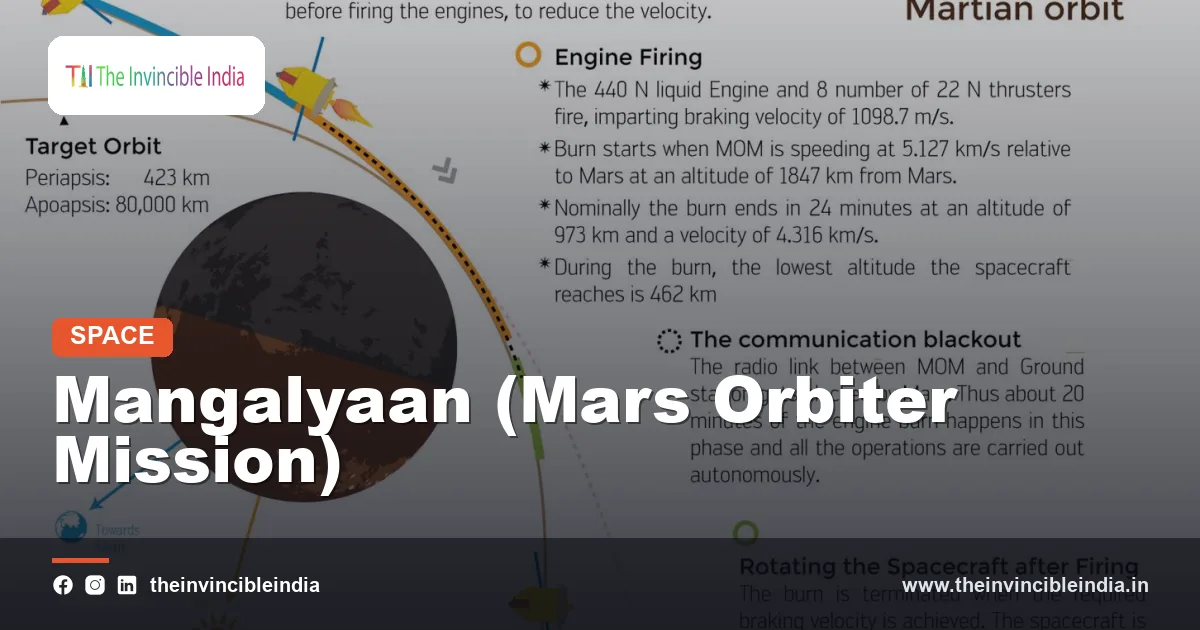
The most nerve-wracking day of the mission was the arrival. To be captured by Mars, the spacecraft had to slow down through a precise engine burn; too little braking and it would fly past, too much and it might crash or enter the wrong orbit. On 24 September 2014, the 440-newton liquid apogee motor, dormant for roughly ten months, fired for about 24 minutes as planned, and the spacecraft settled into a long elliptical orbit around Mars.
Because of the signal delay, the burn happened before controllers on Earth even knew whether it had begun. The confirmation, when it came, triggered scenes of celebration at ISRO’s control centre in Bengaluru. Success on a first attempt was a rarity; a large share of all Mars missions attempted by various countries have failed or been lost.
The orbit around Mars
Mangalyaan was placed in a strongly elliptical orbit that brought it within a few hundred kilometres of the surface at its nearest point and out to tens of thousands of kilometres at its farthest. This orbit was well suited to the mix of instruments on board, since it allowed both close-up imaging and full-disc views of the planet.
The Historic Firsts
Several distinctions attach to Mangalyaan, and it is worth stating them carefully.
- First on the first try: India became the first country to reach Mars orbit in its maiden attempt.
- First in Asia: India was the first Asian nation to place a spacecraft in Martian orbit. Earlier Asian attempts, such as Japan’s Nozomi and China’s Yinghuo-1, did not succeed.
- Fourth space programme at Mars: Before India, only the Soviet/Russian, American and European programmes had successfully reached Mars orbit.
- Reliable arrival: The spacecraft entered Mars orbit on the planned date after a journey of nearly ten months.
Since then, the United Arab Emirates and China have also reached Mars orbit, which shows how the field has widened, but Mangalyaan remains the mission that opened that door for Asia.
The Low-Cost Story: Frugal Engineering
The cost of the Mars Orbiter Mission was approximately Rs 450 crore, or roughly US $74 million. That figure is often compared with the budgets of big-screen space films; it was widely noted that it came in below the reported cost of the Hollywood film Gravity. Comparisons with other agencies’ Mars missions, which typically cost many times more, added to the interest.
How ISRO kept the budget down
- Heritage hardware: Many subsystems were adapted from earlier ISRO satellites and Chandrayaan-1, reducing design and testing costs.
- Modular, staged approach: The spacecraft was built in a modular way, and the mission was planned in clear phases with defined checkpoints.
- Existing launcher: Using the proven PSLV-XL avoided the expense of developing a new rocket.
- Compact payload: Limiting the instruments to about 15 kg kept mass and cost under control.
- Lean team and fast decisions: A tight schedule and streamlined approvals kept the project moving through the narrow launch window.
- Existing ground infrastructure: ISRO relied on tracking and control facilities it had already built.
Frugality here did not mean cutting safety corners. It meant careful reuse, simple designs and disciplined planning, which is why the mission became a case study in efficient space engineering.
The Five Scientific Instruments
Mangalyaan carried five instruments with a combined mass of about 15 kg. Together they were meant to study the Martian surface, its morphology, mineralogy and atmosphere, and to look for signs of methane, a gas that on Earth is closely linked to biological activity, though it can also have geological sources.
| Instrument | Abbreviation | What it studies |
|---|---|---|
| Mars Colour Camera | MCC | Colour images of the surface and atmosphere, terrain features, and the moons Phobos and Deimos |
| Methane Sensor for Mars | MSM | Measures methane in the Martian atmosphere, aimed at mapping its sources |
| Thermal Infrared Imaging Spectrometer | TIS | Surface temperature and emissivity, used to infer mineral composition |
| Lyman Alpha Photometer | LAP | Measures hydrogen and deuterium in the upper atmosphere to study how water was lost |
| Mars Exospheric Neutral Composition Analyser | MENCA | Analyses the neutral particles in the very thin outer atmosphere, or exosphere |
What Mangalyaan Studied and Found
Surface and morphology
The Mars Colour Camera returned a steady stream of images, including full-disc views of the planet that were possible because of the spacecraft’s elongated orbit. It photographed large features such as Valles Marineris, the vast canyon system, and the giant volcano Olympus Mons, as well as dust storms and the two small Martian moons. ISRO later compiled its data into a Mars Atlas, a reference for researchers and students.
Atmosphere and escape
The Lyman Alpha Photometer and MENCA looked at the upper atmosphere, helping scientists understand how Mars gradually lost much of its air and water to space over billions of years. This question is central to explaining why Mars, once warmer and wetter, became the cold, dry world we see today.
The methane question
The search for methane is one of the most debated areas of Mars science, because reported detections have varied between missions. Mangalyaan’s methane sensor added to the data available for this ongoing discussion, although a definitive answer requires many more observations from multiple spacecraft.
Six Months Became Years
Mangalyaan was designed to operate for only six months in Mars orbit. In practice, careful management of fuel and systems allowed it to keep working for several years, well beyond its planned life. ISRO used the extra time to gather long-term observations of Martian seasons and dust behaviour.
Surviving eclipses
One of the risks in a long orbit is an eclipse, when Mars blocks sunlight and the solar panels stop generating power. Long eclipses can drain a spacecraft’s battery, which was designed for shorter periods. ISRO carried out orbit adjustments to avoid the most demanding eclipses, and this was part of how the mission was extended.
The end of contact
Around 2022, communication with the orbiter was eventually lost, and the mission is generally regarded as having reached the end of its operational life. A spacecraft that was meant to last half a year had instead delivered several years of data, and the outcome is usually described as a success rather than a failure.
Mission Milestones at a Glance
| Date | Milestone |
|---|---|
| 2008 | Chandrayaan-1 flies to the Moon, providing spacecraft heritage |
| 5 November 2013 | PSLV-XL launches Mangalyaan from Sriharikota |
| November 2013 | Series of Earth orbit-raising burns |
| 1 December 2013 | Trans-Mars injection sends the spacecraft towards Mars |
| December 2013 onwards | Trajectory correction manoeuvres during the cruise |
| 24 September 2014 | Mars orbit insertion achieved on the first attempt |
| 2014 to 2022 | Years of observations, well beyond the six-month plan |
| Around 2022 | Contact with the orbiter is eventually lost |
Why Mangalyaan Matters
National pride and inspiration
The mission gave the country a moment of shared pride. One image from the control room became iconic: women scientists and engineers of ISRO, dressed in colourful sarees, celebrating the successful arrival. It became a lasting symbol of women’s contribution to Indian science, and it inspired many students to think about careers in space and technology.
ISRO’s global reputation
Mangalyaan reinforced ISRO’s image as an agency that delivers reliable missions at a low cost. That reputation helps ISRO’s commercial launch business, since international customers look for dependable, affordable rides to orbit for their satellites.
Lessons for later missions
Skills gained in deep-space navigation, long-distance communication, autonomous fault management and mission planning fed into ISRO’s later work. They benefited lunar missions, and they laid groundwork for future ambitions that stretch beyond Earth orbit.
Mangalyaan in ISRO’s Roadmap
Mangalyaan sits within a broader progression of Indian space exploration. After Chandrayaan-1 in 2008 came Mangalyaan in 2013 and 2014, followed by Chandrayaan-2 in 2019 and the landing of Chandrayaan-3 near the Moon’s south pole on 23 August 2023. Alongside these, ISRO has developed the Gaganyaan human spaceflight programme and the Aditya-L1 solar observatory.
Mangalyaan-2
ISRO has spoken of a follow-up, often called Mars Orbiter Mission-2 or Mangalyaan-2. Plans discussed for it included a more capable orbiter with a heavier and more advanced set of instruments and possibly new techniques such as aerobraking, in which a spacecraft uses the planet’s thin atmosphere to lower its orbit. As of now, the mission is a planned concept rather than a launched one, and its timeline has not been fixed publicly with certainty.
What a sequel could add
- Higher-resolution imaging and more sensitive atmospheric instruments.
- Better tools to follow up on the methane question.
- Technologies that could eventually support a lander or rover.
Conclusion
Mangalyaan showed that a carefully planned mission, built on proven hardware and executed with discipline, could reach another planet on a modest budget. It achieved a first-attempt Mars orbit, delivered years of data from a spacecraft meant to last six months, and gave Indian science one of its most enduring images. Its greatest legacy may be confidence: the belief that India can plan, build and fly complex missions to the far reaches of the solar system.
Frequently Asked Questions
What is Mangalyaan?
Mangalyaan is the popular name of the Mars Orbiter Mission, ISRO’s first interplanetary spacecraft. It was launched on 5 November 2013 and entered Mars orbit on 24 September 2014. It carried five scientific instruments to study the planet’s surface, atmosphere and methane.
Why is Mangalyaan considered a historic mission?
India became the first country to reach Mars orbit on its very first attempt, and the first Asian nation to do so. Before India, only the Soviet/Russian, American and European programmes had reached Mars orbit successfully.
How much did the Mars Orbiter Mission cost?
The mission cost about Rs 450 crore, roughly US $74 million. This was low by international standards, and it was achieved through frugal engineering, reuse of heritage hardware from Chandrayaan-1, a modular approach and the use of the existing PSLV-XL launcher.
Why did ISRO raise Mangalyaan’s orbit around Earth before heading to Mars?
The PSLV was not powerful enough to send the spacecraft straight to Mars. ISRO instead raised the orbit through a series of engine burns over several weeks, and then fired a final trans-Mars injection burn on 1 December 2013 to set the spacecraft on its way.
What instruments did Mangalyaan carry?
It carried the Mars Colour Camera, the Methane Sensor for Mars, the Thermal Infrared Imaging Spectrometer, the Lyman Alpha Photometer and the Mars Exospheric Neutral Composition Analyser (MENCA). Together they weighed about 15 kg.
What happened to Mangalyaan at the end?
It was designed for six months but operated for several years. Contact with the orbiter was eventually lost around 2022, and the mission is considered to have ended its life. ISRO has discussed a follow-up called Mangalyaan-2, though it is still at the planning stage.
{“@context”:”https://schema.org”,”@graph”:[{“@type”:”FAQPage”,”mainEntity”:[{“@type”:”Question”,”name”:”What is Mangalyaan?”,”acceptedAnswer”:{“@type”:”Answer”,”text”:”Mangalyaan is the popular name of the Mars Orbiter Mission, ISRO’s first interplanetary spacecraft. It was launched on 5 November 2013 and entered Mars orbit on 24 September 2014. It carried five scientific instruments to study the planet’s surface, atmosphere and methane.”}},{“@type”:”Question”,”name”:”Why is Mangalyaan considered a historic mission?”,”acceptedAnswer”:{“@type”:”Answer”,”text”:”India became the first country to reach Mars orbit on its very first attempt, and the first Asian nation to do so. Before India, only the Soviet/Russian, American and European programmes had reached Mars orbit successfully.”}},{“@type”:”Question”,”name”:”How much did the Mars Orbiter Mission cost?”,”acceptedAnswer”:{“@type”:”Answer”,”text”:”The mission cost about Rs 450 crore, roughly US $74 million. This was low by international standards, and it was achieved through frugal engineering, reuse of heritage hardware from Chandrayaan-1, a modular approach and the use of the existing PSLV-XL launcher.”}},{“@type”:”Question”,”name”:”Why did ISRO raise Mangalyaan’s orbit around Earth before heading to Mars?”,”acceptedAnswer”:{“@type”:”Answer”,”text”:”The PSLV was not powerful enough to send the spacecraft straight to Mars. ISRO instead raised the orbit through a series of engine burns over several weeks, and then fired a final trans-Mars injection burn on 1 December 2013 to set the spacecraft on its way.”}},{“@type”:”Question”,”name”:”What instruments did Mangalyaan carry?”,”acceptedAnswer”:{“@type”:”Answer”,”text”:”It carried the Mars Colour Camera, the Methane Sensor for Mars, the Thermal Infrared Imaging Spectrometer, the Lyman Alpha Photometer and the Mars Exospheric Neutral Composition Analyser (MENCA). Together they weighed about 15 kg.”}},{“@type”:”Question”,”name”:”What happened to Mangalyaan at the end?”,”acceptedAnswer”:{“@type”:”Answer”,”text”:”It was designed for six months but operated for several years. Contact with the orbiter was eventually lost around 2022, and the mission is considered to have ended its life. ISRO has discussed a follow-up called Mangalyaan-2, though it is still at the planning stage.”}}]}]}


