

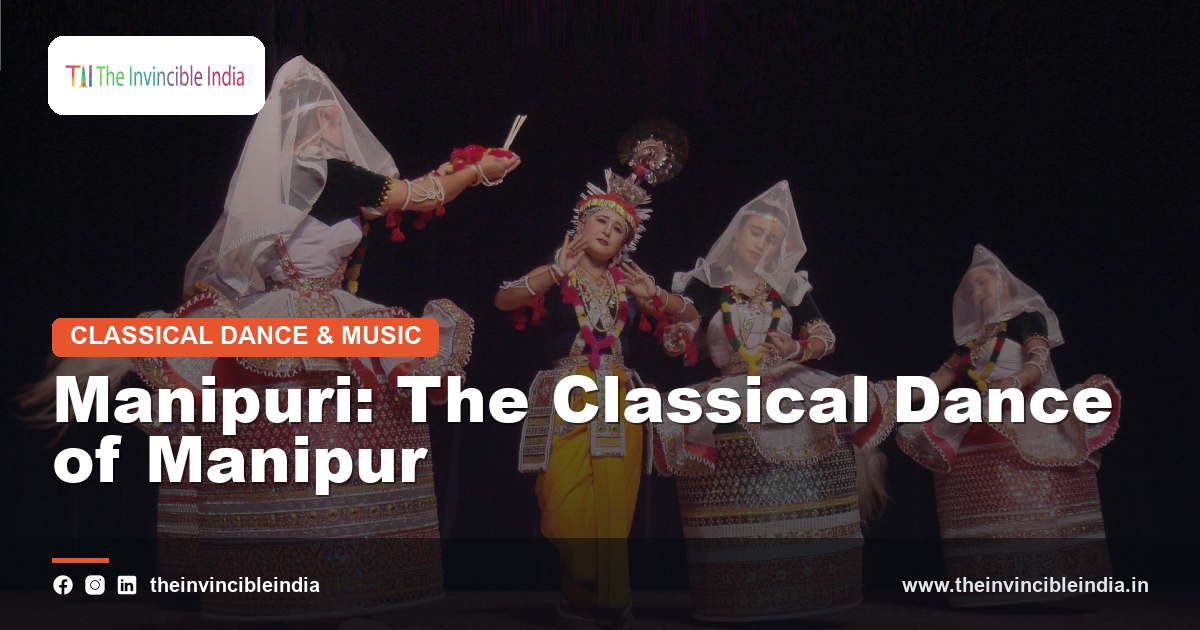
Manipuri is one of the eight classical dance forms of India and the classical dance of Manipur, in the country’s north-east, renowned for its gentle, graceful and deeply devotional character. Unlike the vigorous footwork and sharp lines of some other classical styles, Manipuri flows in soft, rounded movements, and its most beloved theme is the Ras Lila, the divine dance of Krishna and the gopis. Bound closely to the Vaishnavite faith of the region and to community worship, the dance is at once a religious offering and an art of great beauty, distinguished by its serene expression and its unmistakable costume. This guide explores the history, technique, music and living tradition of Manipuri.
Quick Facts
| Detail | Information |
|---|---|
| Type | One of India’s eight classical dance forms |
| Origin | Manipur, north-east India |
| Central theme | The Ras Lila of Krishna and the gopis |
| Character | Gentle, graceful, rounded and devotional |
| Signature costume | The Kumil, a stiff, embroidered cylindrical skirt |
| Key drum | The Pung |
A Dance from the North-East
Manipuri is the classical dance of Manipur, a state in the north-eastern corner of India, and it stands apart from the other classical forms in both spirit and style. Where several traditions emphasise vigorous rhythm and sharp, geometric lines, Manipuri is marked by softness, roundness and restraint, with gentle, flowing movements and a serene, meditative quality. It is among the most devotional of the classical dances, woven into the religious life of the region, and its themes, movements and music all express a deep spirituality. This distinctive character gives Manipuri a beauty all its own within the rich family of Indian classical dance.
Ancient Roots and Lai Haraoba
The dance traditions of Manipur reach back into antiquity, long predating the arrival of Vaishnavism, and are rooted in the region’s own ritual and cultural life. Among the oldest of these is the Lai Haraoba, an ancient ritual festival honouring local deities, which preserves early forms of dance and movement and is considered a foundation of the Manipuri tradition. These indigenous roots gave the dance its distinctive vocabulary of graceful, rounded movement before it was later shaped by devotional themes. The layering of ancient ritual tradition with later Vaishnavite devotion is central to understanding the depth and richness of Manipuri dance.
The Coming of Vaishnavism
The Manipuri dance as it is best known today was shaped by the spread of Vaishnavism, the devotional worship of Krishna, in the region from around the eighteenth century. As the faith took root, the stories of Krishna, and above all his divine dance with Radha and the gopis, became the central theme of the dance, and the art was drawn into the heart of religious life and temple worship. This devotional transformation gave Manipuri its enduring subject matter and its spiritual purpose, blending the region’s ancient movement traditions with the tender, mystical themes of Krishna devotion to create the classical form celebrated across India.
The Ras Lila
The jewel of Manipuri dance is the Ras Lila, the enactment of the divine, circular dance of Krishna with Radha and the gopis, a theme of love and spiritual longing at the heart of the tradition. Performed as an act of devotion, often through the night at temple festivals, the Ras Lila unfolds with grace and serenity, its dancers moving in gentle, flowing patterns that express the beauty and ecstasy of divine love. The role of Krishna is often danced by a young performer, and the gopis in their shimmering costumes create an image of great loveliness. The Ras Lila is the supreme expression of Manipuri’s devotional spirit.
Gentle, Rounded Movement
The most distinctive feature of Manipuri is its quality of movement, gentle, rounded and continuous, without the sharp angles or forceful stamping found in some other classical forms. The dancer’s body seems to sway and glide, the feet moving softly so that the footwork is subtle rather than percussive, and there is little emphasis on the loud ankle bells that mark other styles. This restraint and smoothness lend the dance a serene, floating grace, well suited to its devotional themes. The result is a form of great delicacy and poise, in which beauty lies in flow and softness rather than in speed or force.
The Distinctive Costume
Manipuri has one of the most instantly recognisable costumes in all of Indian dance. For the female role, the dancer wears the Kumil, a stiff, barrel-shaped skirt richly embroidered and decorated with small mirrors that catch the light, topped by a fitted blouse and a translucent veil that softly frames the face. The costume, elaborate and jewel-like, creates a distinctive silhouette quite unlike the flowing garments of other classical forms. The dancer playing Krishna wears a costume with a peacock-feather crown. This unique and beautiful attire is inseparable from the identity of Manipuri and adds greatly to the visual enchantment of the Ras Lila.
The Pung and Its Cholom
The Pung, a barrel drum, is the heartbeat of Manipuri music and the centre of one of the tradition’s most thrilling forms, the Pung cholom, or drum dance. In this vigorous male dance, performers play the Pung slung around the neck while dancing, leaping and spinning, combining rhythmic drumming with acrobatic movement in a dazzling display of energy and coordination. This lively, athletic form provides a striking contrast to the gentle grace of the Ras Lila and shows another side of the Manipuri tradition. The Pung cholom is a celebrated highlight of Manipuri performance and a testament to the skill and stamina of its dancers.
The Kartal Cholom
Alongside the drum dance is the Kartal cholom, or cymbal dance, another energetic male form in which performers dance while playing kartals, or hand cymbals. Like the Pung cholom, it combines music-making with vigorous, coordinated movement, and the two often feature together in the devotional performances known as Sankirtana. These lively forms, full of rhythm and energy, balance the softer grace of the Ras Lila and demonstrate the range of the Manipuri tradition, which encompasses both gentle, flowing devotional dance and dynamic, athletic music-dance. Together they express the rich devotional culture from which Manipuri springs.
Sankirtana: Ritual Music and Dance
Central to the religious life of Manipur is the Sankirtana, a tradition of devotional singing and drumming performed in temples and at ceremonies to narrate and celebrate the lives and deeds of Krishna. Performers sing, play the Pung and cymbals, and dance, drawing the community into an act of collective worship that marks the great occasions of life. The Sankirtana of Manipur has been recognised by UNESCO on its list of the Intangible Cultural Heritage of Humanity, in acknowledgement of its cultural and spiritual importance. This tradition forms the devotional foundation from which the classical Manipuri dance and its cholom forms have grown.
Music and Song
Manipuri dance is accompanied by its own devotional music, in which the Pung and cymbals drive the rhythm and vocalists sing the songs that tell the stories of Krishna. The music is gentle and devotional in the Ras Lila and vigorous in the cholom forms, always closely bound to the movement of the dance. The lyrics, drawn from devotional poetry, express the themes of divine love and longing that lie at the heart of the tradition. The seamless unity of music, song and movement, all in the service of devotion, is essential to the character of Manipuri and to the spiritual atmosphere of its performances.
A Community Tradition
Manipuri dance is deeply woven into the community and religious life of Manipur, far more than a stage art alone. Performances of the Ras Lila and Sankirtana mark temple festivals and important occasions, and the whole community takes part as performers and devotees. Dance and music are learned within families and temples as part of a shared devotional culture, and the art expresses the identity and faith of the people. This close bond between the dance and the living community has helped preserve the tradition through the centuries and gives Manipuri its authenticity and depth, as an art that remains rooted in the devotion and daily life from which it grew.
The Modern Stage
In the twentieth century, Manipuri gained wider recognition as one of India’s classical dances and moved beyond its home region onto the national and international stage. Cultural figures and institutions helped bring the dance to new audiences, and it was embraced for its unique grace and devotional beauty. The great writer and thinker Rabindranath Tagore admired Manipuri and introduced its teaching at his institution, helping to spread awareness of the form. Today Manipuri is taught in academies across India and performed around the world, its serene loveliness and its vigorous drum dances alike winning admiration far beyond the valleys of Manipur where it was born.
Training in Manipuri
Learning Manipuri requires long and dedicated training under the guidance of a guru, through which students absorb not only the technique but the devotional spirit of the dance. They develop the soft, controlled, rounded movements that define the style, master the rhythms of the Pung and cymbals, and learn the repertoire of the Ras Lila and the cholom forms. Alongside physical skill, the training instils an understanding of the music, poetry and religious meaning of the art. This transmission, from teacher to student and within families and temples, has preserved the subtleties of the tradition and continues to sustain Manipuri as a living devotional and classical art.
Manipuri Today
Today Manipuri flourishes as one of India’s cherished classical dances, performed both in its traditional devotional settings in Manipur and on stages across the country and the world. Its gentle grace, its beautiful costumes and its vigorous drum dances continue to enchant audiences, while the Ras Lila remains a profound expression of devotion. Taught in academies and carried abroad by the diaspora, the dance keeps its deep roots in the faith and community of Manipur even as it reaches new admirers. In its serene beauty and spiritual depth, Manipuri preserves a unique and precious strand of India’s rich heritage of classical dance.
Sources & Further Reading
- Sangeet Natak Akademi, national academy for music, dance and drama, on the classical dance forms of India (sangeetnatak.gov.in).
- UNESCO, Representative List of the Intangible Cultural Heritage of Humanity, on Sankirtana of Manipur (ich.unesco.org).
- Ministry of Culture, Government of India, on the performing-art traditions of Manipur (indiaculture.gov.in).
Frequently Asked Questions
What is Manipuri dance?
Manipuri is one of the eight classical dance forms of India and the classical dance of Manipur in the north-east. It is a gentle, graceful and devotional form centred on the Ras Lila of Krishna and the gopis, known for its rounded movements and distinctive costume.
What is the Ras Lila in Manipuri dance?
The Ras Lila is the central theme of Manipuri dance, enacting the divine circular dance of Krishna with Radha and the gopis. Performed as an act of devotion, often at temple festivals, it expresses the beauty and longing of divine love through gentle, flowing movement.
What is special about the Manipuri costume?
The Manipuri female costume features the Kumil, a stiff, barrel-shaped embroidered skirt decorated with small mirrors, topped by a fitted blouse and a translucent veil. This jewel-like attire creates a distinctive silhouette unlike any other Indian classical dance costume.
What is the Pung cholom?
The Pung cholom is a vigorous male drum dance of Manipur in which performers play the Pung, a barrel drum, while dancing, leaping and spinning. It contrasts with the gentle Ras Lila and displays energy, rhythm and athletic skill.
Is Manipuri Sankirtana recognised by UNESCO?
Yes. The Sankirtana ritual singing, drumming and dancing of Manipur has been inscribed by UNESCO on its Representative List of the Intangible Cultural Heritage of Humanity, in recognition of its cultural and spiritual importance.


