

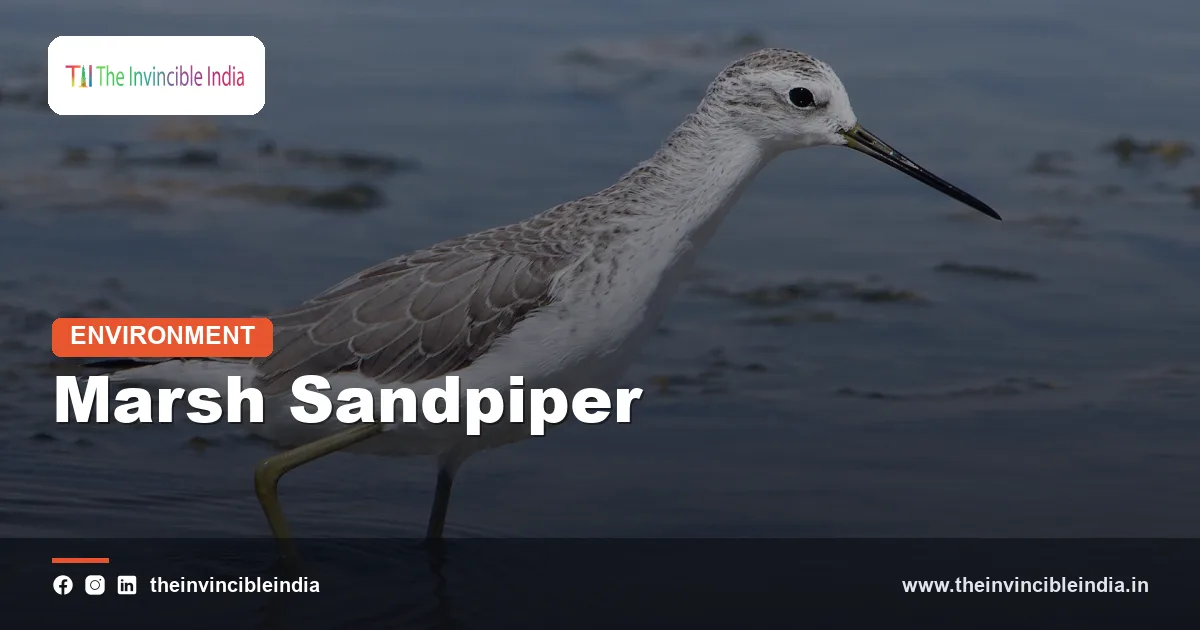
The marsh sandpiper (Tringa stagnatilis) is a slim, long-legged wader with a fine, straight, needle-like bill that visits India in winter and feeds delicately in shallow freshwater and brackish wetlands. Often described as a miniature greenshank, the marsh sandpiper breeds on the steppe wetlands of Eastern Europe and Central Asia and travels thousands of kilometres to spend the cold months in South Asia, Africa and Australasia.
Across India the marsh sandpiper is a familiar but easily overlooked winter visitor on jheels, sewage ponds, salt pans, paddy fields and coastal lagoons. This explainer covers how to recognise the bird, where it lives, what it eats, how it migrates, and why its wintering wetlands matter.
| Attribute | Details |
|---|---|
| Common name | Marsh sandpiper (also called little greenshank) |
| Scientific name | Tringa stagnatilis |
| Family | Scolopacidae (sandpipers, curlews, snipes and relatives) |
| Size | About 22 to 25 cm long, with a wingspan of roughly 55 cm |
| Range and habitat in India | Winter visitor across much of the country; freshwater marshes, jheels, lagoons, salt pans, paddy fields and estuaries |
| Diet | Aquatic insects and larvae, small crustaceans, molluscs and worms |
| Breeding and migration | Breeds from Eastern Europe across the Central Asian steppe; long-distance migrant that reaches India from roughly August to May |
| Conservation status | Least Concern on the IUCN Red List, with a very large global range |
Key Takeaways
- The marsh sandpiper is a slender wader of the family Scolopacidae, recognised by its long greenish legs and thin, straight, needle-like black bill.
- Marsh sandpipers breed on steppe wetlands from Eastern Europe to Central Asia and winter in South Asia, Africa and Australasia, including across India.
- A marsh sandpiper looks like a smaller, daintier common greenshank, but it is smaller, paler and finer-billed, with a more upright and elegant stance.
- In flight, the marsh sandpiper shows a long white wedge up its back and rump, and its toes project well beyond the tail tip.
- Marsh sandpipers feed by picking and gently probing in shallow water, taking insects, small crustaceans and other invertebrates.
- The marsh sandpiper is classified as Least Concern globally, yet it depends on shallow wetlands that are shrinking in many parts of India.
What is a marsh sandpiper?
A marsh sandpiper is a medium-small wader belonging to the genus Tringa, the group that also includes the common greenshank, common redshank, green sandpiper and wood sandpiper. The species name stagnatilis comes from the Latin word for a standing pool, which neatly describes the still, shallow water where the bird is usually found.
The marsh sandpiper is one of the most elegantly proportioned shorebirds. Its body is small and compact, but its legs are very long relative to its size, and its neck is slim and mobile. The bill is finer than that of almost any other Tringa species, which gives the bird a delicate, almost fragile appearance when it stands next to a stocky redshank.
Because the bird is so often mistaken for a young greenshank, many casual observers in India record it only after careful comparison. The species has no strong regional dialect of plumage in India; the birds that arrive are all of the same breeding population type, with variation arising mainly from age and season.
How do you identify a marsh sandpiper in the field?
A marsh sandpiper is identified by its needle-fine straight black bill, very long yellowish-green legs, small round head and pale grey-brown upperparts. In winter, the plumage is clean and pale, with a whitish face, a faint pale eyebrow stripe and white underparts, giving the bird a washed-out, silvery look.
Several features separate the marsh sandpiper from similar waders:
- Bill: thin, straight and needle-like, with no upward tilt; the common greenshank has a thicker, slightly upturned bill.
- Size: noticeably smaller than a common greenshank, which stands taller and heavier.
- Legs: long and greenish-yellow, extending clearly beyond the tail in flight.
- Back and rump in flight: a broad white wedge from the lower back to the upper tail, contrasting with dark wings.
- Posture: a more upright, graceful stance with a long neck and a small head.
In breeding plumage, seen in India mainly in the weeks before departure, the upperparts become spotted and barred with black, and the neck and breast show dark streaks and spots. These birds look darker and more patterned than the pale winter birds.
Where do marsh sandpipers live in India?
Marsh sandpipers live on shallow, open-edged wetlands across India during the non-breeding season, from inland lakes and marshes to coastal lagoons and saltpans. The species is widespread as a winter visitor and passage migrant, and it is recorded in most states, with notable concentrations on large wetland systems.
Typical Indian habitats include:
- Freshwater jheels and village ponds with muddy margins
- Reservoir edges where water levels drop in winter
- Sewage farms and treatment ponds
- Rice fields during flooding and harvest
- Salt pans and tidal creeks along the coast
- Estuarine lagoons and brackish backwaters
The marsh sandpiper prefers water that is shallow enough for wading but rich in small animals. It is less tied to open tidal mudflats than many shorebirds, and it is just as likely to be found on a temporary inland pool as on the coast. Famous Indian wetlands such as Keoladeo National Park, Chilika Lake, Nal Sarovar and the Sambhar Salt Lake region regularly host the species in season.
What does the marsh sandpiper eat and how does it feed?
The marsh sandpiper eats small aquatic animals, mainly insects and their larvae, tiny crustaceans, molluscs and worms, which it picks from the water surface and from soft mud. Its fine bill is well suited to catching small, quick prey rather than digging deep for buried animals.
Feeding behaviour is lively and graceful. The bird walks steadily through shallow water, often belly-deep on its long legs, and picks items from the surface or just below it. It sometimes makes quick dashes after fast-moving prey such as small aquatic insects or tiny fish fry, and it may even swim briefly in deeper pools. When food is plentiful, several birds spread out across a pool and feed within sight of one another.
The bird is also capable of sweeping its bill sideways through water to catch floating or swimming invertebrates, a technique shared by some other Tringa waders. Because marsh sandpipers feed on small organisms, they are useful indicators of healthy invertebrate life in shallow wetlands.
How does the marsh sandpiper migrate to India?
The marsh sandpiper migrates to India along the Central Asian Flyway, flying south from its breeding grounds on the steppe wetlands of Eastern Europe and Central Asia after the short northern summer. Birds begin appearing in India from about August, with numbers building through the autumn and peaking in the winter months.
Migration is a demanding journey. The marsh sandpiper must cross mountain ranges and deserts or skirt them, using a chain of stopover wetlands to rest and refuel. Reliable stopover sites in Central Asia and northern India are therefore as important to the species as its breeding and wintering areas.
Most marsh sandpipers leave India by April or May to return north for breeding, although some non-breeding individuals may linger through the summer. The timing matches the pattern of other long-distance waders: birds depart when day length lengthens and wetlands in the north thaw and green up.
Where and how does the marsh sandpiper breed?
The marsh sandpiper breeds in the temperate and steppe zones of Eurasia, nesting on the ground beside shallow lakes, marshy meadows and wet grassland. The breeding range stretches from Eastern Europe, including parts of Ukraine and Russia, eastward across Kazakhstan and southern Siberia towards Mongolia and Manchuria.
The nest is a simple scrape on the ground, usually hidden in tall grass or sedge near water, and the typical clutch is of about four eggs. Both parents take part in incubating the eggs and guarding the young, which are active and leave the nest soon after hatching. They feed themselves under parental supervision, a pattern common to shorebirds.
None of this breeding takes place in India, so Indian observers see only the non-breeding side of the bird’s life. Even so, protecting the quality of Indian wintering habitat supports the survival of the adults that must return north in good condition to nest.
What does the marsh sandpiper sound like?
The marsh sandpiper has a soft, clear call, often written as a short, sharp “chip” or “tew”, and it gives a more repeated “yeup” when alarmed or in flight. The calls are lighter and less ringing than the loud, ringing triple-note of the common greenshank.
The bird is generally quiet while feeding, but it often calls as it takes off or when a flock is disturbed by a raptor or a human. Birdwatchers use the call, together with the long white back wedge, to confirm identification in flight.
During the breeding season, males give a fluty song in display flight over the nesting marsh, a sound that Indian winter visitors do not usually reveal. In India, voice is mainly an aid for locating birds in scattered flocks on large wetlands.
How is the marsh sandpiper different from similar birds?
The marsh sandpiper differs from similar waders mainly in its fine straight bill, small size and delicate proportions. The comparison below helps separate it from the three species with which it is most often confused.
| Species | Size | Bill | Key difference |
|---|---|---|---|
| Marsh sandpiper | Small to medium, about 22 to 25 cm | Very thin, straight, needle-like | Slender build, very long legs, pale plumage |
| Common greenshank | Larger, about 30 to 35 cm | Thicker, slightly upturned | Heavier body, loud ringing call |
| Common redshank | About 27 to 29 cm | Shorter, red at base | Orange-red legs, white trailing edge on wings |
| Wood sandpiper | About 19 to 21 cm | Short, straight | Spotted brown back, shorter legs |
Only the marsh sandpiper combines a very fine bill with long legs and a plain pale wash across the upperparts in winter. A direct side-by-side view with a greenshank makes the difference obvious within seconds.
Is the marsh sandpiper endangered, and why do wetlands matter?
The marsh sandpiper is not endangered; the International Union for Conservation of Nature (IUCN) lists it as Least Concern because it has an enormous range and a large global population. Its numbers, however, depend on shallow wetlands that face pressure from drainage, pollution, reclamation and changing water management across Asia.
In India, the species is protected indirectly through the protection of wetlands, national parks and sanctuaries, and through the country’s commitments under the Ramsar Convention on Wetlands, which India joined in 1982. Counts of waterbirds such as the Asian Waterbird Census, run by Wetlands International, help track how species like the marsh sandpiper use Indian sites over time.
Specific threats include the conversion of village ponds and marshes to farmland or housing, untreated effluent, invasive aquatic plants that choke open water, and disturbance from dogs, vehicles and people at roosting sites. Seasonal wetlands that dry early can also leave migrants short of food. Simple measures such as keeping some muddy margins open and maintaining water levels help.
How can you watch marsh sandpipers responsibly?
Marsh sandpipers are best watched from a distance with binoculars or a spotting scope, early in the morning or late in the afternoon when the light is soft and the birds are feeding. Keeping a respectful distance allows the birds to feed and rest undisturbed during a period when they need every calorie.
Good practice for waderwatchers includes:
- Approach slowly and stay behind cover, such as embankments or reeds, rather than walking onto open mud.
- Do not flush flocks deliberately for photographs, since repeated disturbance wastes energy.
- Record sightings on a citizen-science platform with date and place to support bird monitoring.
- Learn the field marks before you go, especially the needle-fine bill and white back wedge.
Winter, from November to February, is the best season in most of India, although passage birds appear earlier and linger later. Patient observation is usually rewarded with a close view of one of the most graceful waders on the subcontinent.
Bottom Line
The marsh sandpiper is a delicate, long-legged winter visitor whose thin straight bill and clean pale plumage make it one of the most elegant waders in India. Though globally secure, the marsh sandpiper relies on a network of shallow wetlands from Central Asia to peninsular India, so looking after those wetlands is how people look after the bird.
Frequently Asked Questions
What is a marsh sandpiper?
A marsh sandpiper is a slim, long-legged wader of the family Scolopacidae that has a fine, straight, needle-like bill. It breeds on the steppe wetlands of Eastern Europe and Central Asia and spends the winter in South Asia, Africa and Australasia, including across India.
How can I tell a marsh sandpiper from a common greenshank?
The marsh sandpiper is smaller, paler and more slender than the common greenshank, with a much finer, perfectly straight bill. The greenshank is heavier and has a thicker, slightly upturned bill and a loud, ringing call.
When can marsh sandpipers be seen in India?
Marsh sandpipers can be seen in India mainly from August to May, with the best numbers in the winter months of November to February. Some birds leave by April, when they start the return journey to their northern breeding grounds.
What do marsh sandpipers eat?
Marsh sandpipers eat small aquatic animals, chiefly insects and their larvae, tiny crustaceans, molluscs and worms. They pick prey from the surface of shallow water or from soft mud, and they sometimes chase fast-moving small prey.
Does the marsh sandpiper breed in India?
No, the marsh sandpiper does not breed in India. It nests on the ground beside shallow lakes and marshy meadows in Eastern Europe and Central Asia, and visits India only as a winter visitor and passage migrant.
Is the marsh sandpiper a threatened species?
The marsh sandpiper is not threatened globally and is listed as Least Concern by the IUCN. Even so, its dependence on shallow wetlands means that loss of ponds, marshes and mudflats in India and along its flyway remains a concern.
{“@context”:”https://schema.org”,”@graph”:[{“@type”:”FAQPage”,”mainEntity”:[{“@type”:”Question”,”name”:”What is a marsh sandpiper?”,”acceptedAnswer”:{“@type”:”Answer”,”text”:”A marsh sandpiper is a slim, long-legged wader of the family Scolopacidae that has a fine, straight, needle-like bill. It breeds on the steppe wetlands of Eastern Europe and Central Asia and spends the winter in South Asia, Africa and Australasia, including across India.”}},{“@type”:”Question”,”name”:”How can I tell a marsh sandpiper from a common greenshank?”,”acceptedAnswer”:{“@type”:”Answer”,”text”:”The marsh sandpiper is smaller, paler and more slender than the common greenshank, with a much finer, perfectly straight bill. The greenshank is heavier and has a thicker, slightly upturned bill and a loud, ringing call.”}},{“@type”:”Question”,”name”:”When can marsh sandpipers be seen in India?”,”acceptedAnswer”:{“@type”:”Answer”,”text”:”Marsh sandpipers can be seen in India mainly from August to May, with the best numbers in the winter months of November to February. Some birds leave by April, when they start the return journey to their northern breeding grounds.”}},{“@type”:”Question”,”name”:”What do marsh sandpipers eat?”,”acceptedAnswer”:{“@type”:”Answer”,”text”:”Marsh sandpipers eat small aquatic animals, chiefly insects and their larvae, tiny crustaceans, molluscs and worms. They pick prey from the surface of shallow water or from soft mud, and they sometimes chase fast-moving small prey.”}},{“@type”:”Question”,”name”:”Does the marsh sandpiper breed in India?”,”acceptedAnswer”:{“@type”:”Answer”,”text”:”No, the marsh sandpiper does not breed in India. It nests on the ground beside shallow lakes and marshy meadows in Eastern Europe and Central Asia, and visits India only as a winter visitor and passage migrant.”}},{“@type”:”Question”,”name”:”Is the marsh sandpiper a threatened species?”,”acceptedAnswer”:{“@type”:”Answer”,”text”:”The marsh sandpiper is not threatened globally and is listed as Least Concern by the IUCN. Even so, its dependence on shallow wetlands means that loss of ponds, marshes and mudflats in India and along its flyway remains a concern.”}}]}]}


