

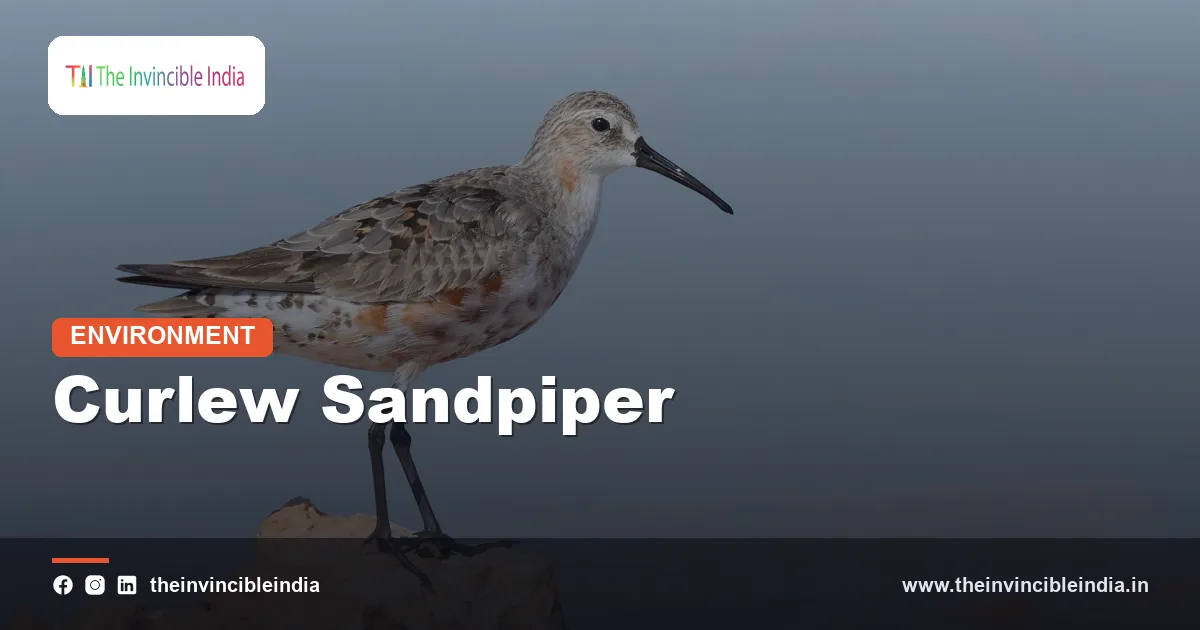
The curlew sandpiper (Calidris ferruginea) is a medium-sized wader with a gently down-curved bill that breeds in the Arctic tundra of Siberia and winters in large flocks on Indian mudflats, estuaries and coasts. Named for a bill that resembles a small curlew’s, the curlew sandpiper is among the most numerous winter shorebirds along India’s long coastline, although its global numbers have declined.
In India the curlew sandpiper arrives from about August, feeds on tidal flats and brackish lagoons through the winter, and starts to show rusty-red breeding plumage before it leaves in spring. This article explains how to identify the species, where it winters, how it feeds and migrates, and why it is now treated as a species of conservation concern.
| Attribute | Details |
|---|---|
| Common name | Curlew sandpiper |
| Scientific name | Calidris ferruginea |
| Family | Scolopacidae (sandpipers, curlews, snipes and relatives) |
| Size | About 18 to 23 cm long, with a wingspan of roughly 38 to 41 cm |
| Range and habitat in India | Winter visitor mainly along the coast; tidal mudflats, estuaries, salt pans, lagoons and some inland wetlands |
| Diet | Marine and freshwater invertebrates such as worms, small molluscs, crustaceans and insect larvae |
| Breeding and migration | Breeds on the Arctic tundra of central Siberia; long-distance migrant along the Central Asian and East Asian-Australasian flyways |
| Conservation status | Near Threatened on the IUCN Red List, with a declining global population |
Key Takeaways
- The curlew sandpiper is a medium-sized shorebird of the family Scolopacidae, identified by its slender, down-curved black bill and a white rump visible in flight.
- Curlew sandpipers breed on the high-Arctic tundra of Siberia and winter in Africa, South Asia and Australasia, with large flocks along India’s coasts.
- The curlew sandpiper wades in shallow tidal water and probes soft mud with its curved bill to catch worms, small molluscs and crustaceans.
- In spring the curlew sandpiper moults into brick-red breeding plumage, a colour change often visible in India shortly before departure.
- The International Union for Conservation of Nature (IUCN) lists the curlew sandpiper as Near Threatened because its global population has fallen significantly.
- Conservation of the curlew sandpiper depends on protecting tidal flats and stopover wetlands along the entire flyway, not only at its Indian wintering sites.
What is a curlew sandpiper?
A curlew sandpiper is a small to medium shorebird in the genus Calidris, the same group that contains the dunlin, red knot, sanderling, little stint and many other familiar waders. It is called a curlew sandpiper because its long, downward-curving bill resembles a tiny version of the bill of the much larger curlews.
The curlew sandpiper is slightly larger than a dunlin and a good deal more elegant, with longer legs, a longer neck and a smoother, more graceful profile. In flight, the species shows a conspicuous white patch above the tail, which is a reliable field mark and also the origin of its Latin name ferruginea, which refers to the rusty colour of its breeding feathers.
Its world range is huge, but the global population is concentrated into a small number of breeding areas and a limited set of coastal wintering grounds. That concentration is the reason the species is sensitive to habitat loss at critical sites.
How do you identify a curlew sandpiper?
A curlew sandpiper is identified by its slim, down-curved black bill, longish black legs, pale grey upperparts in winter and a bold white rump in flight. The bill curves smoothly along its whole length, unlike the straight bill of the dunlin-like stints.
The most useful features are:
- Bill: long, fine and evenly down-curved, with a slightly tapering tip.
- Legs: black and relatively long, which lets the bird feed in deeper water than a stint.
- Winter plumage: pale grey-brown above, white below, with a clear white eyebrow stripe.
- Breeding plumage: deep chestnut-red head and underparts with a mottled dark and rufous back.
- Flight: a clean white rump and a narrow white wing bar.
Juvenile birds, which arrive in India in autumn, have scaly buff-tinged upperparts and a peachy wash across the breast. These young birds are often the first curlew sandpipers seen in a season.
Where does the curlew sandpiper spend the winter in India?
The curlew sandpiper spends the winter chiefly on India’s coastal mudflats, estuaries, lagoons and salt pans, with smaller numbers on inland wetlands. The species is widespread along both the east and west coasts and around larger brackish lakes.
Important Indian wintering and stopover areas include:
- Chilika Lake in Odisha, one of Asia’s largest brackish lagoons
- The Gulf of Kachchh and the coast of Gujarat
- Pulicat Lake on the Andhra Pradesh and Tamil Nadu border
- Point Calimere and the Gulf of Mannar in Tamil Nadu
- The Sundarbans and other estuaries of West Bengal
- Coastal wetlands of Maharashtra, Goa and Kerala
Flocks in India can number in the hundreds or thousands at the best sites. The birds often feed and roost alongside little stints, dunlins, Kentish plovers and other shorebirds, so a large flock is an excellent place to practise telling similar species apart.
What does the curlew sandpiper eat?
The curlew sandpiper eats small invertebrates, mainly worms, small molluscs, crustaceans and the larvae of insects, which it finds in soft mud and shallow water. Its curved bill is a precision tool for probing, and the tip is sensitive enough to detect prey by touch.
Feeding styles include:
- Probing the mud repeatedly with rapid, sewing-machine-like jabs
- Wading belly-deep and sweeping the bill through the water
- Picking items from the surface of wet mud
The species is often seen feeding at the edge of the tide, advancing and retreating with each wave. Because it relies on invertebrate-rich mudflats, any change to the quality of the sediment, such as pollution, siltation or reclamation, immediately affects its food supply.
On the breeding grounds the diet shifts to insects, particularly midge and crane-fly larvae and adults, which are abundant during the brief Arctic summer.
How does the curlew sandpiper migrate?
The curlew sandpiper migrates thousands of kilometres each year between its Siberian breeding grounds and its southern wintering areas, using the Central Asian Flyway and the East Asian-Australasian Flyway. Birds that reach India are largely from the western part of the breeding range and follow the Central Asian Flyway across Central Asia and the Indian subcontinent.
The journey depends on a string of stopover sites where the birds fatten up, since a long flight burns enormous amounts of fuel. Typical stopovers include wetlands in Central Asia, the Caspian region and northwest India. At each stop, birds may gain a large fraction of their body weight in fat in a few weeks.
Adults often depart for the north in April and May, while many juveniles remain in India through their first summer. The timing of departure is linked to the Arctic thaw: birds that arrive too early may find snow-covered ground, while those that arrive too late may lose breeding opportunities.
How and where does the curlew sandpiper breed?
The curlew sandpiper breeds in the high-Arctic tundra of central and northern Siberia, with the Taimyr Peninsula as a key stronghold. Pairs nest on dry, well-drained tundra ridges near wet ground rich in insects, and they never breed in India.
The nest is a shallow scrape lined with leaves and lichens, and a typical clutch is four eggs. Males perform a display flight over the nesting territory, and incubation and care of the chicks are shared, with the male often taking the larger role in tending the young. The chicks leave the nest within a day and feed themselves on tundra insects.
Breeding success varies greatly from year to year. In years when lemmings, the main prey of Arctic foxes and other predators, are scarce, predators switch to eggs and chicks, and few young curlew sandpipers survive. This cyclical pattern helps explain why numbers on the wintering grounds fluctuate between seasons.
How is the curlew sandpiper different from the dunlin and the little stint?
The curlew sandpiper differs from the dunlin and the little stint in its longer legs, more curved bill and bold white rump. The table below compares the three waders most often seen together on Indian mudflats.
| Species | Size | Bill shape | Distinctive feature |
|---|---|---|---|
| Curlew sandpiper | About 18 to 23 cm | Long, evenly down-curved | White rump, long legs, rusty breeding colour |
| Dunlin | About 17 to 21 cm | Shorter, drooping at the tip | Dark centre to the rump, black belly patch when breeding |
| Little stint | About 12 to 14 cm | Short and straight | Very small, restless feeder, pale V on back |
The curlew sandpiper stands out because it combines long legs with a long curved bill. A bird of this shape in a flock of small waders is very likely to be a curlew sandpiper.
What happens to the curlew sandpiper’s plumage through the year?
The curlew sandpiper changes from a plain pale grey winter plumage to a vivid brick-red breeding plumage each year, and the change is partly completed in India before the northward migration. This seasonal moult is one of the most striking transformations among Indian shorebirds.
From August to about February, adult curlew sandpipers in India look subdued: pale grey above, white below, with a neat white eyebrow. Beginning in late winter, new rusty feathers push through on the face, neck, breast and belly, and the back becomes mottled with black, chestnut and pale buff. By April, some birds are nearly fully red, and a flock containing a mix of grey and chestnut individuals is a common sight on coastal flats.
The moult is energetically costly, so the birds need rich feeding grounds to complete it while also building fat reserves for departure. Young birds hatched the previous summer usually stay pale and often remain on the wintering grounds, because they do not breed in their first year. For observers, the changing colours also provide a useful way to estimate the season and the age structure of a flock.
Is the curlew sandpiper threatened?
Yes, the curlew sandpiper is considered threatened enough to be listed as Near Threatened by the IUCN, because its global population has declined substantially over recent decades. Researchers have recorded steep falls in numbers at key sites along the flyway, and the species is now a focus of shorebird conservation.
The main causes of decline are:
- Loss of intertidal mudflats to land reclamation, ports and aquaculture, especially at stopover sites in East Asia
- Pollution of coastal sediment and water
- Disturbance of roosting and feeding sites by people, dogs and vehicles
- Changes in sea level and climate that affect both tundra breeding grounds and coastal habitats
Because the curlew sandpiper depends on several widely separated regions, protecting only one country’s wetlands is not enough. International cooperation through the Convention on Migratory Species, the Ramsar Convention and flyway partnerships is essential.
Why do Indian wetlands matter for the curlew sandpiper?
Indian wetlands matter for the curlew sandpiper because India hosts a large share of the wintering birds of the Central Asian Flyway, and the quality of this habitat determines whether the birds survive to breed. India lies at the southern end of this flyway, so its coastal lagoons and estuaries serve as the final destination for many migratory waders.
India has designated many wetlands as Ramsar sites, including Chilika Lake, which in 1981 became one of the first two Indian sites to be listed. Bird sanctuaries and Important Bird and Biodiversity Areas along the coast add further protection. Local actions that help include keeping mudflats free of waste, managing salt pans in ways that leave shallow feeding areas, and limiting disturbance at high-tide roosts.
Citizen science is also valuable. Regular counts, such as the Asian Waterbird Census, supply long-term data that scientists use to detect declines early.
Bottom Line
The curlew sandpiper is a graceful Arctic breeder that depends on India’s tidal flats and lagoons for the winter. With its Near Threatened status, the curlew sandpiper is a reminder that coastal wetlands are working habitats for migrants and that conserving them is a shared responsibility across the flyway.
Frequently Asked Questions
What is a curlew sandpiper?
A curlew sandpiper is a medium-sized shorebird of the genus Calidris with a long, evenly down-curved black bill. It breeds on the Siberian Arctic tundra and winters on coastal mudflats and lagoons in Africa, South Asia and Australasia, including India.
How do I recognise a curlew sandpiper in India?
The curlew sandpiper is recognised by its slender down-curved bill, longish black legs and a bold white rump in flight. In late winter and spring, adults turn rusty chestnut-red on the head and underparts.
Where can I see curlew sandpipers in India?
Curlew sandpipers can be seen on coastal wetlands such as Chilika Lake, the Gulf of Kachchh, Pulicat Lake, Point Calimere and the Sundarbans. The best season is from October to March, when large flocks gather on tidal mudflats.
What do curlew sandpipers eat?
Curlew sandpipers eat small invertebrates, mainly marine worms, small molluscs, crustaceans and insect larvae. They find prey by probing soft mud with their sensitive curved bills and by wading in shallow water.
Is the curlew sandpiper endangered?
The curlew sandpiper is not formally endangered, but the IUCN lists it as Near Threatened because the global population has declined. The main threats are loss of tidal flats, pollution and disturbance along its migration route.
Does the curlew sandpiper breed in India?
No, the curlew sandpiper does not breed in India. It nests on the high-Arctic tundra of Siberia and visits India only as a non-breeding winter visitor and passage migrant.
{“@context”:”https://schema.org”,”@graph”:[{“@type”:”FAQPage”,”mainEntity”:[{“@type”:”Question”,”name”:”What is a curlew sandpiper?”,”acceptedAnswer”:{“@type”:”Answer”,”text”:”A curlew sandpiper is a medium-sized shorebird of the genus Calidris with a long, evenly down-curved black bill. It breeds on the Siberian Arctic tundra and winters on coastal mudflats and lagoons in Africa, South Asia and Australasia, including India.”}},{“@type”:”Question”,”name”:”How do I recognise a curlew sandpiper in India?”,”acceptedAnswer”:{“@type”:”Answer”,”text”:”The curlew sandpiper is recognised by its slender down-curved bill, longish black legs and a bold white rump in flight. In late winter and spring, adults turn rusty chestnut-red on the head and underparts.”}},{“@type”:”Question”,”name”:”Where can I see curlew sandpipers in India?”,”acceptedAnswer”:{“@type”:”Answer”,”text”:”Curlew sandpipers can be seen on coastal wetlands such as Chilika Lake, the Gulf of Kachchh, Pulicat Lake, Point Calimere and the Sundarbans. The best season is from October to March, when large flocks gather on tidal mudflats.”}},{“@type”:”Question”,”name”:”What do curlew sandpipers eat?”,”acceptedAnswer”:{“@type”:”Answer”,”text”:”Curlew sandpipers eat small invertebrates, mainly marine worms, small molluscs, crustaceans and insect larvae. They find prey by probing soft mud with their sensitive curved bills and by wading in shallow water.”}},{“@type”:”Question”,”name”:”Is the curlew sandpiper endangered?”,”acceptedAnswer”:{“@type”:”Answer”,”text”:”The curlew sandpiper is not formally endangered, but the IUCN lists it as Near Threatened because the global population has declined. The main threats are loss of tidal flats, pollution and disturbance along its migration route.”}},{“@type”:”Question”,”name”:”Does the curlew sandpiper breed in India?”,”acceptedAnswer”:{“@type”:”Answer”,”text”:”No, the curlew sandpiper does not breed in India. It nests on the high-Arctic tundra of Siberia and visits India only as a non-breeding winter visitor and passage migrant.”}}]}]}


