

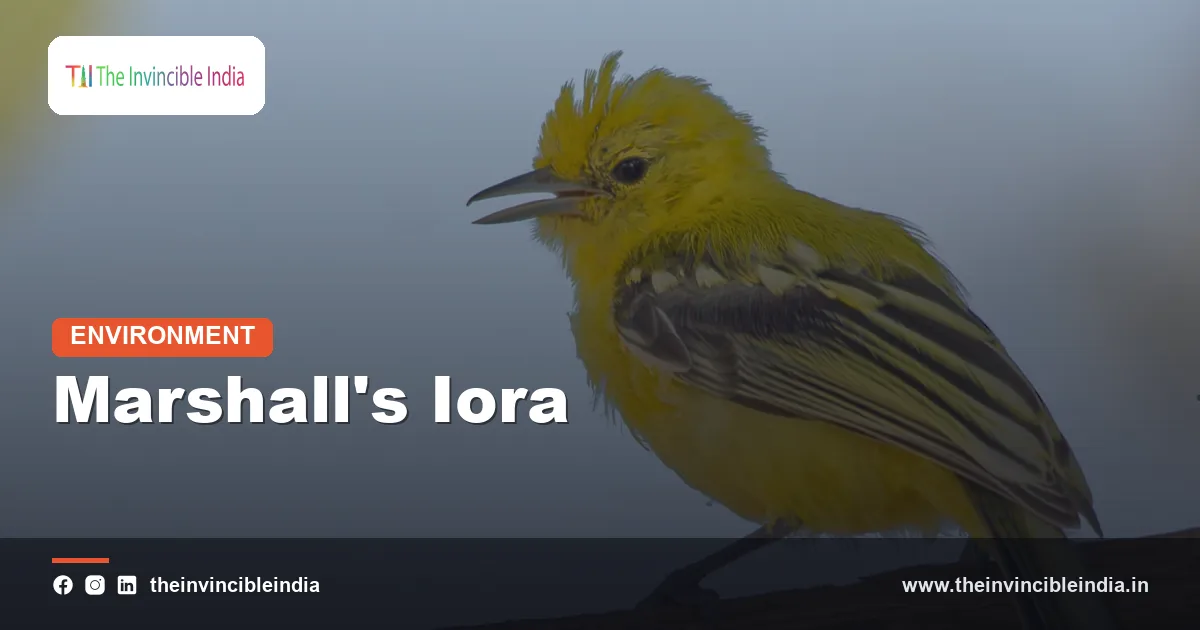
The Marshall’s iora (Aegithina nigrolutea) is a small, yellow-and-white songbird of dry scrub and thorn forest in the Indian subcontinent, closely related to the common iora and distinguished from it mainly by its bold white wing markings. Found in the drier parts of north-western, western and central India, the Marshall’s iora spends its days gleaning insects from the foliage of acacia, neem and other thorny trees.
Because the Marshall’s iora looks very much like a common iora at a quick glance, it is often overlooked, even by regular birdwatchers. Learning how to tell the two apart, where each lives and what each does through the year turns a familiar-looking garden bird into a genuine identification challenge.
| Quick Fact | Details |
|---|---|
| Common name | Marshall’s iora (also called the white-tailed iora in some older texts) |
| Scientific name | Aegithina nigrolutea |
| Family | Aegithinidae (the ioras), order Passeriformes |
| Size | About 12 to 14 cm long, a little smaller than a sparrow in bulk |
| Range and habitat in India | Dry thorn scrub, open deciduous woodland and wooded farmland across north-western, western and central India, including Rajasthan, Gujarat and Madhya Pradesh |
| Diet | Small insects, caterpillars, bugs, beetles and spiders picked from leaves and twigs |
| Breeding | Small cup nest bound with spider silk on a tree fork; usually two or three eggs; breeding mainly in the rainy season |
| Conservation status | Least Concern on the IUCN Red List; a resident, non-migratory species |
Key Takeaways
- The Marshall’s iora is a small, resident songbird of dry thorn scrub and open woodland in north-western, western and central India.
- The Marshall’s iora was long treated as a form of the common iora, but it is now generally recognised as a separate species, Aegithina nigrolutea.
- The most reliable field mark of the Marshall’s iora is its extensive white in the wing, which makes the folded wing look pale and strongly patterned.
- Marshall’s iora feeds almost entirely on insects and spiders, so the bird acts as a natural controller of leaf-eating pests in scrub and farmland.
- Male Marshall’s ioras in breeding plumage perform a fluttering display flight in which the white rump feathers are puffed out like a small ball.
- The Marshall’s iora is listed as Least Concern, although loss of thorn scrub and wooded field boundaries can reduce local numbers.
What is the Marshall’s iora?
The Marshall’s iora is a small insect-eating songbird belonging to the iora family, Aegithinidae, a group of just four species found in South and Southeast Asia. Its scientific name, Aegithina nigrolutea, refers to the black and yellow colours of the breeding male. The bird is named after a nineteenth-century British naturalist in India, in keeping with the older tradition of naming species after collectors.
Ioras are neat, compact birds with a short, slightly hooked bill, a short tail and strong legs for clinging to twigs. The four species are the common iora, the Marshall’s iora, the green iora and the great iora. Of these, the common iora and the Marshall’s iora are the two found in the open, drier landscapes of India, while the green iora and the great iora prefer wetter forests further east and south-east.
The Marshall’s iora is a medium-small member of this family. Weighing only about 10 to 15 grams, it moves lightly through the outer branches of trees and is easier to hear than to see in dense foliage.
How does the Marshall’s iora differ from the common iora?
The Marshall’s iora differs from the common iora mainly in its much larger area of white in the wing, a clearer black-and-white pattern in the male, and a preference for drier habitat. The two birds look alike in shape and behaviour, which is why the Marshall’s iora was lumped with the common iora for many years.
Plumage differences
In the common iora, the wing carries two thin white wing bars that stand out against a blackish or greenish wing. In the Marshall’s iora, the white in the wing is broader and the folded wing looks strikingly pale. The male in breeding dress has a black back and tail, bright yellow underparts and a conspicuous white wing patch.
Habitat differences
The common iora is a bird of gardens, mango groves, village trees and moist deciduous forest, whereas the Marshall’s iora is typically a bird of the drier western and central regions. Where their ranges approach each other, careful observers can find both within the same region, but they do not generally share the same patch of habitat in large numbers.
| Feature | Marshall’s iora | Common iora |
|---|---|---|
| Scientific name | Aegithina nigrolutea | Aegithina tiphia |
| Wing pattern | Broad white panel; folded wing looks pale | Two narrow white wing bars |
| Typical habitat | Dry scrub, thorn forest, open woodland | Gardens, groves, moist and dry deciduous forest, mangroves |
| Main range in India | North-western, western and central India | Most of India, from the Himalayan foothills to the south |
| Breeding male | Black back and tail, strong yellow below | Variable, from green-backed to black-backed depending on region |
| Conservation status | Least Concern | Least Concern |
Where is the Marshall’s iora found in India?
The Marshall’s iora is found mainly in the drier belt of north-western, western and central India, covering parts of Rajasthan, Gujarat, Madhya Pradesh, Maharashtra and neighbouring regions. It is a resident bird, meaning that it stays in the same general area through the year rather than migrating.
Its range lies largely on the dry side of the country, away from the wet Western Ghats and the damp north-east. Within that belt, the bird is patchy rather than uniform. It appears in suitable pockets of scrub and woodland and may be absent from nearby areas that look similar to the human eye.
The Marshall’s iora is a bird of the plains and low hills. It is rarely seen at high altitude, and it generally avoids closed, dense evergreen forest. Ornithologists note that the exact edges of its distribution, especially where it meets the range of the common iora, are still being refined through citizen-science records.
What habitat does the Marshall’s iora prefer?
The Marshall’s iora prefers open, dry habitats with scattered trees, including thorn scrub, dry deciduous forest, orchards and wooded farmland. It does best where acacia, ber, neem, khejri and similar hardy trees offer a steady supply of leaves and insects.
Typical places to look for the bird include the following:
- Thorn forest and scrub jungle on rocky ground, where Acacia and Prosopis species dominate.
- Open dry deciduous woodland with teak, dhak and other trees that shed leaves in summer.
- Mango and other orchards in semi-arid districts.
- Tree-lined field boundaries, canal banks and village groves.
- The edges of wildlife sanctuaries and forest reserves in dry regions.
The common thread in these habitats is a layer of leafy canopy at mid-height, which is where the Marshall’s iora forages. A tree line with insect-rich foliage can support the bird even in a farming landscape, as long as the trees are left standing.
How does the Marshall’s iora look and sound?
The Marshall’s iora is a compact, short-tailed bird with a bright yellow underside, a black or dark upper side in the breeding male, and a boldly white-marked wing. Its colouring is among the most attractive of any Indian scrub bird, though the small size makes it easy to miss.
Male, female and juvenile
The breeding male is the showiest, with deep yellow underparts, a black back, tail and crown, and a clear white wing patch. Outside the breeding season the male becomes duller and greener on the back. The female is paler and greener, with olive upperparts and a dull yellow breast, and she retains clear white in the wing. Juveniles resemble the female and are even more muted.
Voice
The Marshall’s iora is a vocal bird. Its song is a series of clear, musical whistles that rise and fall, often ending in a drawn-out, somewhat plaintive note. Ioras in general are known for a long, mournful whistle that carries well in open scrub, and the Marshall’s iora shares this quality. The bird also gives short chattering notes while moving through the canopy.
Because the bird is small and active among leaves, birdwatchers often detect the Marshall’s iora by ear first. Listening for a sweet, repeated whistle in a thorn thicket, and then scanning the mid-canopy, is the usual way to find one.
What does the Marshall’s iora eat?
The Marshall’s iora eats insects and other small invertebrates, mainly caterpillars, bugs, beetles, flies and spiders, which it picks directly off leaves and twigs. It is an almost wholly insectivorous bird and does not depend on fruit or seeds.
The bird forages methodically through the outer foliage of trees and shrubs. It hops from twig to twig, hangs briefly under leaves, and sometimes flutters to snatch an insect from a leaf surface. Pairs and small family groups often forage together, and ioras frequently join mixed hunting parties made up of tits, tailorbirds, white-eyes and other small insect-eaters.
This diet gives the Marshall’s iora a useful role in dry-land ecosystems. By removing caterpillars and other leaf-eating insects, ioras help keep scrub and orchard trees healthy. A thorn forest that supports a healthy population of ioras is usually one with a good supply of insects and intact canopy.
How does the Marshall’s iora breed?
The Marshall’s iora breeds mainly in the rainy season, building a small, neat cup nest in the fork of a tree and laying a clutch of about two to three eggs. The timing follows the flush of insects that comes with the monsoon, which provides plenty of food for the chicks.
The display
Ioras are famous for a courtship display in which the male launches himself from a branch, fluttering upward with his white rump feathers fluffed out. He then spirals down on spread wings, appearing almost like a small ball of white and yellow before settling back on his perch. The display is usually accompanied by a sweet, trilling song.
Nest and young
The nest is a small, shallow cup made of fine grass, plant fibres and cobweb, often camouflaged with lichen or bits of bark and placed on a thin horizontal fork. The eggs are pale and finely marked. Both parents are generally involved in incubation and in feeding the young, which leave the nest after a couple of weeks. After fledging, the young stay close to their parents and are fed for a while longer.
Details of the breeding cycle of the Marshall’s iora are less thoroughly documented than those of its widespread relative, the common iora. Much of what is known comes from field notes in the dry regions of Rajasthan, Gujarat and Madhya Pradesh.
What is the conservation status of the Marshall’s iora?
The Marshall’s iora is assessed as a species of Least Concern on the IUCN Red List, meaning that it is not currently considered under serious threat of extinction. It remains reasonably widespread across its dry-country range.
Even so, the bird depends on a landscape that is changing. The main pressures include the following:
- Clearing of thorn scrub and open woodland for agriculture and urban expansion.
- Felling of old field-boundary trees and village groves.
- Heavy use of pesticides in orchards and farmland, which cuts the insect supply.
- Overgrazing and degradation of dry forest in some districts.
The Marshall’s iora is protected in India under the Wild Life (Protection) Act, 1972, along with most other native wild birds. Wildlife sanctuaries in dry regions provide safe habitat, but much of the bird’s population lives outside protected areas, in working landscapes where tree retention matters.
How can you spot a Marshall’s iora?
The best way to spot a Marshall’s iora is to look for a small, bright yellow-and-white bird in the mid-canopy of dry scrub or open woodland, and to check the wing pattern for a broad white panel. Early morning is usually the best time, when the bird is most active and vocal.
A few practical tips can help:
- Listen first. The whistling song often reveals the bird long before it comes into view.
- Scan the outer leaves of acacia, neem and similar trees rather than the trunks or the ground.
- Note the wing. A broad white panel points to the Marshall’s iora; two thin wing bars point to the common iora.
- Check the habitat and the region. In Rajasthan, Gujarat and Madhya Pradesh, dry scrub is the right setting.
- Take a photograph if possible, and record location and date, since citizen-science records help clarify the bird’s range.
Binoculars are very useful, as the bird is small and often partly hidden by leaves. Patience in a good patch of scrub usually pays off, because ioras tend to return to favourite trees.
Why does the Marshall’s iora matter?
The Marshall’s iora matters because it is a sensitive indicator of healthy dry-country woodland and a natural predator of leaf-eating insects. Its presence suggests that thorn forests and farm trees still provide enough canopy and insect life to support small songbirds.
The bird also illustrates a broader point about Indian biodiversity. Dry scrub and open woodland are sometimes dismissed as wasteland, yet they hold distinctive species found nowhere else. Protecting these habitats, and the small birds that depend on them, is part of conserving India’s full range of ecosystems rather than only its tropical forests and wetlands.
For birdwatchers, the Marshall’s iora is a rewarding species to learn. It teaches careful attention to wing patterns, habitat and range, and it shows how a bird that seems familiar can turn out to be a different species on closer inspection.
Bottom Line
The Marshall’s iora is a small, resident, insect-eating songbird of dry scrub and open woodland in north-western, western and central India, identified by its broad white wing panel and sweet whistled song. It is not threatened at present, but it relies on the thorn forests, orchards and field-boundary trees that are steadily being cleared.
Frequently Asked Questions
What is a Marshall’s iora?
A Marshall’s iora is a small yellow-and-white songbird of the iora family that lives in dry scrub and open woodland in India. It is closely related to the common iora and is distinguished by a broad white panel in the wing. The scientific name is Aegithina nigrolutea.
How is the Marshall’s iora different from the common iora?
The Marshall’s iora has much more white in the wing than the common iora, which shows only two narrow wing bars. It also prefers drier habitat in north-western, western and central India. The two birds were once treated as a single species.
Where can you see a Marshall’s iora in India?
You can see a Marshall’s iora in dry thorn scrub and open deciduous woodland, mainly in Rajasthan, Gujarat, Madhya Pradesh and nearby regions. Early morning visits to scrub-covered hills, orchards and sanctuary edges give the best chance. The bird is resident, so it can be looked for throughout the year.
What does the Marshall’s iora eat?
The Marshall’s iora eats small insects and spiders, including caterpillars, bugs and beetles, which it picks from leaves and twigs. It rarely eats fruit or seeds. It often forages in pairs or joins mixed flocks of small insect-eating birds.
Is the Marshall’s iora endangered?
No, the Marshall’s iora is not endangered and is listed as Least Concern on the IUCN Red List. Its numbers are considered reasonably stable across its dry-country range. Local declines can still occur when thorn scrub and old trees are cleared.
How does the Marshall’s iora breed?
The Marshall’s iora breeds mainly during the rainy season, building a small cup-shaped nest of grass and cobweb in a tree fork. It lays about two to three eggs, and both parents help raise the young. The male performs a fluttering display flight with his white rump feathers puffed out.
{“@context”:”https://schema.org”,”@graph”:[{“@type”:”FAQPage”,”mainEntity”:[{“@type”:”Question”,”name”:”What is a Marshall’s iora?”,”acceptedAnswer”:{“@type”:”Answer”,”text”:”A Marshall’s iora is a small yellow-and-white songbird of the iora family that lives in dry scrub and open woodland in India. It is closely related to the common iora and is distinguished by a broad white panel in the wing. The scientific name is Aegithina nigrolutea.”}},{“@type”:”Question”,”name”:”How is the Marshall’s iora different from the common iora?”,”acceptedAnswer”:{“@type”:”Answer”,”text”:”The Marshall’s iora has much more white in the wing than the common iora, which shows only two narrow wing bars. It also prefers drier habitat in north-western, western and central India. The two birds were once treated as a single species.”}},{“@type”:”Question”,”name”:”Where can you see a Marshall’s iora in India?”,”acceptedAnswer”:{“@type”:”Answer”,”text”:”You can see a Marshall’s iora in dry thorn scrub and open deciduous woodland, mainly in Rajasthan, Gujarat, Madhya Pradesh and nearby regions. Early morning visits to scrub-covered hills, orchards and sanctuary edges give the best chance. The bird is resident, so it can be looked for throughout the year.”}},{“@type”:”Question”,”name”:”What does the Marshall’s iora eat?”,”acceptedAnswer”:{“@type”:”Answer”,”text”:”The Marshall’s iora eats small insects and spiders, including caterpillars, bugs and beetles, which it picks from leaves and twigs. It rarely eats fruit or seeds. It often forages in pairs or joins mixed flocks of small insect-eating birds.”}},{“@type”:”Question”,”name”:”Is the Marshall’s iora endangered?”,”acceptedAnswer”:{“@type”:”Answer”,”text”:”No, the Marshall’s iora is not endangered and is listed as Least Concern on the IUCN Red List. Its numbers are considered reasonably stable across its dry-country range. Local declines can still occur when thorn scrub and old trees are cleared.”}},{“@type”:”Question”,”name”:”How does the Marshall’s iora breed?”,”acceptedAnswer”:{“@type”:”Answer”,”text”:”The Marshall’s iora breeds mainly during the rainy season, building a small cup-shaped nest of grass and cobweb in a tree fork. It lays about two to three eggs, and both parents help raise the young. The male performs a fluttering display flight with his white rump feathers puffed out.”}}]}]}


