

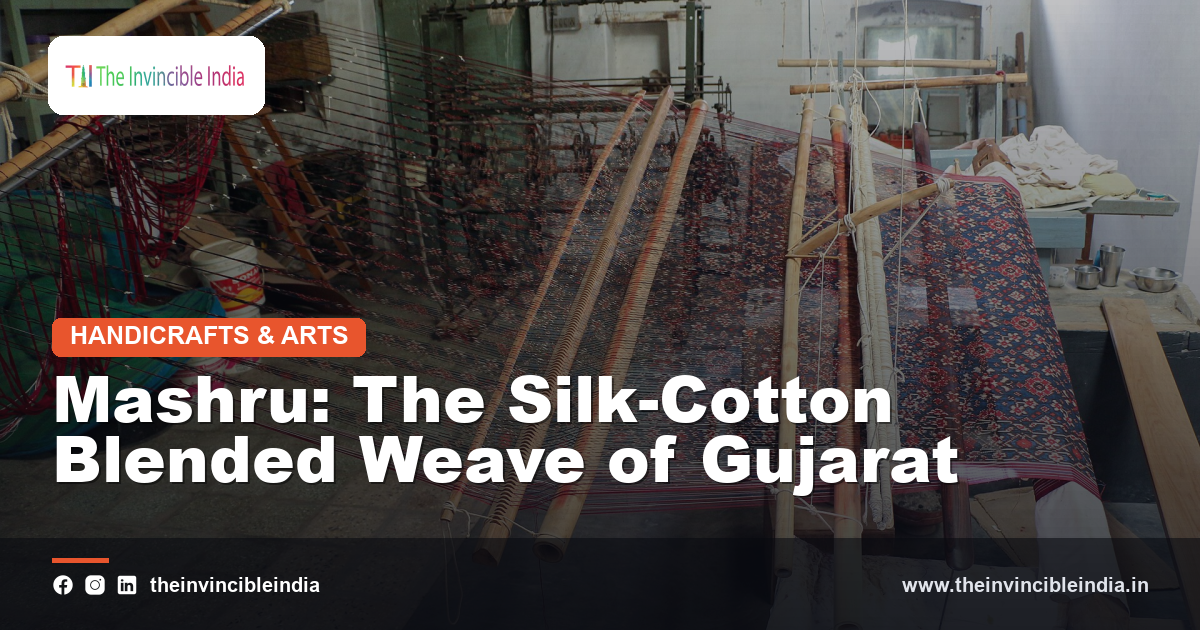
Mashru, also spelled mashroo or misru, is a traditional blended handloom fabric of Gujarat with a lustrous silk surface and a soft cotton underside. It is a warp-faced satin weave, meaning that the silk warp threads dominate the face of the cloth while the cotton weft sits mostly on the reverse, so that silk shows on the outside and cotton touches the skin. The name is traditionally linked to the idea of silk being permitted, or shariah-compliant, when it does not directly touch the body, which is how the cloth is often explained. Mashru was historically woven in towns such as Patan and Mandvi in Gujarat and in parts of the Deccan, and it is known for its bright stripes and ikat patterns. Readers who admire the woven brilliance of Pochampally ikat will find in Mashru a related but distinct blended tradition. This guide describes the fabric, its history, materials, technique, patterns, artisans and legacy.
Quick answer: Mashru is a traditional silk-cotton blended handloom fabric of Gujarat, India, woven as a warp-faced satin so that a glossy silk surface shows on the face while a soft cotton layer lines the reverse. It is known for bright stripes and ikat patterns and was historically woven in Patan, Mandvi and parts of the Deccan. The name is linked to the idea of silk being permitted when it does not touch the skin.
Key Takeaways
- Mashru, also spelled misru or mashroo, is a traditional silk-cotton blended weave of Gujarat, India.
- It is a warp-faced satin: silk warp threads show on the face while cotton weft lines the underside.
- This structure gives a glossy silk surface on the outside and a soft cotton layer that touches the skin.
- The name is traditionally linked to the idea of silk being permitted without directly touching the body.
- It was historically woven in Gujarat towns such as Patan and Mandvi and in parts of the Deccan.
- Mashru is known for bright stripes, zig-zag borders and ikat patterning.
The sections below explain what Mashru is, how it is woven, where it was made, what its patterns mean and why it still matters.
Quick Facts
| Detail | Information |
|---|---|
| Craft type | Blended silk-cotton handloom weave |
| Region of origin | Gujarat (Patan, Mandvi) and the Deccan |
| Also known as | Mashroo, misru |
| Materials | Silk warp and cotton weft |
| Technique | Warp-faced satin weave on a handloom |
| Known for | Glossy silk surface, cotton underside, bright stripes |
| GI status | Patan is a recognised traditional Mashru centre |
| Community | Hereditary handloom weaving families |
What Is Mashru Fabric?
Mashru is a traditional blended fabric that combines a silk surface with a cotton underside in a single woven cloth. It is made as a warp-faced satin, a weave in which the lengthwise silk warp threads float over the surface and largely hide the crosswise cotton weft, so that silk dominates the face while cotton lines the back. This gives the cloth a smooth, glossy appearance on the outside and a soft, breathable feel against the skin. Mashru is usually woven in bright colours, often as vivid stripes running along the length of the fabric, sometimes with ikat or zig-zag patterns. Historically it was used for garments, linings, borders and furnishings. The fabric is both economical and comfortable, blending the richness of silk with the practicality of cotton. Its clever structure is the heart of its identity.
Why Is Mashru Called a Permitted Cloth?
Mashru is traditionally explained as a permitted cloth because its structure allows the wearer to enjoy a silk surface while only cotton touches the skin. The name mashru is widely linked to an Arabic word meaning permitted or lawful, reflecting a traditional idea that pure silk worn directly against the body was discouraged in some communities, while a silk-faced cloth lined with cotton was acceptable. By placing cotton on the reverse, Mashru offered the look and sheen of silk without the silk resting directly on the skin. This explanation is part of the fabric”s cultural story and is best understood as the traditional account of its name and purpose. Whatever its exact origin, the clever structure met a real social and practical need. It allowed silk”s beauty to be worn comfortably and acceptably.
How Did Mashru Originate and Spread?
Mashru is an old blended weave with roots in the wider trade and textile culture of western India and the Deccan, though its precise early history is not documented in exact detail. The fabric was historically produced in several centres and was traded both within India and beyond, including to markets in West Asia. In Gujarat, towns such as Patan and Mandvi became well known for the craft, while weaving also took place in parts of the Deccan. The cloth served the needs of communities who wanted the richness of silk in an acceptable, affordable and comfortable form. Over time, demand shifted and the number of Mashru weavers declined, but the tradition survived in pockets. Its origins are best described in general terms as part of India”s long textile heritage. The craft reflects centuries of exchange and adaptation.
Where Was Mashru Traditionally Woven?
Mashru was traditionally woven in several parts of western and central India, with Gujarat as a major centre. Within Gujarat, the town of Patan, long famous for its textile crafts, and Mandvi in the Kutch region were known for Mashru weaving. Parts of the Deccan also produced the fabric. These centres combined access to silk and cotton yarn, skilled weaving communities and trading networks that carried the cloth to distant markets. Patan in particular is celebrated for its handloom heritage, and Mashru is one of the traditional fabrics associated with the region. The concentration of skilled weavers in such towns helped the craft develop its distinctive stripes and patterns. These places gave Mashru both its character and its reputation. The fabric remains linked to this western Indian weaving tradition.
What Materials Are Used in Mashru?
Mashru is woven from two main fibres, silk for the warp and cotton for the weft, which together give the fabric its blended character. The silk warp threads, dyed in bright colours, form the glossy surface, while the cotton weft provides the soft, breathable underside and the body of the cloth. In some modern versions, art silk or other synthetic yarns may replace pure silk to reduce cost, though traditional Mashru uses real silk on the face. Natural and later synthetic dyes give the fabric its characteristic vivid stripes. The yarns are prepared, dyed and wound before weaving. Because practices vary between weavers and periods, the exact fibres and dyes differ. The combination of silk and cotton is the essential feature that defines Mashru. These materials create its unique look and feel.
How Is Mashru Woven Step by Step?
Mashru is woven on a handloom using a warp-faced satin structure that places silk on the face and cotton on the back. The weaver first prepares and dyes the silk warp and cotton weft yarns, then sets up a long, dense warp of coloured silk threads on the loom. In weaving, the loom is set so that each silk warp thread floats over several cotton weft threads before being bound down, which keeps silk on the surface and cotton underneath. Stripes are created by arranging warp threads of different colours, and ikat effects by dyeing yarns before weaving. The weaver passes the cotton weft back and forth, beating each pick firmly into place. The result is a smooth, satiny silk face over a cotton base. The process demands skill in setting and managing the warp.
What Is a Warp-Faced Satin Weave?
A warp-faced satin weave is a cloth structure in which the lengthwise warp threads dominate the surface, floating over several weft threads before being tied down. In Mashru, this means the silk warp threads float across the face of the fabric, largely covering the cotton weft, which stays mostly on the reverse. The long floats give the surface its smooth, glossy, satin-like sheen, while the hidden weft provides strength and softness underneath. This is different from a plain weave, in which warp and weft show equally, and it is what allows Mashru to be silk on top and cotton beneath. The density of the warp and the pattern of floats are carefully controlled by the weaver. This structure is the technical key to Mashru. It makes the fabric both lustrous and comfortable.
What Patterns and Colours Define Mashru?
Mashru is defined by bright colours and bold patterns, most famously its vivid stripes running along the length of the cloth. The stripes are often set in strong contrasting colours such as red, yellow, green, orange, blue and white, giving the fabric a festive look. Many pieces also feature small zig-zag or arrow-like motifs along the edges of the stripes, and some include ikat patterning where yarns are tie-dyed before weaving. The glossy silk surface makes the colours appear rich and lustrous. These patterns are traditional and recognisable, marking Mashru out from plain satins. The combination of stripes, zig-zags and sheen gives the fabric its lively character. Colour and pattern are central to its appeal. They make Mashru both distinctive and cheerful.
How Was Mashru Traditionally Used?
Mashru was traditionally used for clothing, borders, linings and furnishings across several communities in western India. It was made into garments such as blouses, kurtas, skirts, jackets and the bodices of dresses, where its silk surface gave a rich look and its cotton back kept the wearer comfortable. The fabric was also used for linings, for decorative borders on other textiles, and for items such as quilts and covers. Its acceptability as a silk-faced but cotton-backed cloth made it popular among those who avoided wearing pure silk next to the skin. Trade carried Mashru to markets within and beyond India. In the present day, designers also use it for accessories, bags and contemporary garments. These varied uses show the fabric”s practicality. They helped keep the tradition in demand.
Who Are the Weavers of Mashru?
The weavers of Mashru are skilled handloom artisans, traditionally from communities that have practised weaving for generations in Gujarat and other centres. The craft requires careful preparation of silk and cotton yarns, setting up a dense coloured warp and managing the satin weave on the loom, so knowledge is usually passed down within families. Over time, the number of active Mashru weavers declined as demand fell and other fabrics became popular, leaving the tradition in the hands of a smaller community. Craft bodies, designers and cooperatives have worked to revive interest and support the remaining weavers with materials and markets. The survival of the craft depends on these artisans and their willingness to continue. Their skill in the warp-faced satin weave is the craft”s core knowledge. The weaving community sustains the tradition.
Is Mashru Recognised as a Traditional Craft?
Mashru is recognised as a traditional handloom fabric of Gujarat and is associated with centres such as Patan that are known for their protected textile heritage. India”s system of Geographical Indications protects certain place-linked textiles, and Patan in particular is celebrated for traditional weaving traditions. Because the exact scope and status of any formal recognition for Mashru can vary and may change over time, the precise details are best confirmed with the official Geographical Indications Registry and state handicraft authorities. Whatever the formal position, Mashru is clearly identified with Gujarat”s handloom tradition and its historic weaving towns. Recognition and revival efforts help protect the craft and support its weavers. They also encourage buyers to seek genuine handwoven Mashru. The link between the fabric and its region remains central to its identity.
How Does Mashru Compare with Other Indian Weaves?
Mashru differs from other Indian handloom fabrics in its deliberate blending of a silk face with a cotton back. Pure silk weaves such as Kanjeevaram or Banarasi use silk throughout and are prized for their full richness and weight. Ikat traditions such as Pochampally and Patola create their patterns by tie-dyeing yarns before weaving, a technique Mashru sometimes borrows in part. Plain cotton handlooms are cool and simple but lack the silk sheen of Mashru. What sets Mashru apart is its clever structure that offers silk”s look with cotton”s comfort and acceptability. Comparing these fabrics shows the inventiveness of Indian weaving. Mashru fills a particular niche born of social custom and practical need. It stands as a distinctive solution within a rich textile family.
What Challenges Does Mashru Weaving Face?
Mashru weaving faces serious challenges, including a long decline in demand, competition from power looms and the shrinking number of skilled weavers. As tastes changed and cheaper machine-made fabrics spread, the market for handwoven Mashru narrowed, leaving fewer artisans able to earn a living from it. The cost of silk and the time the craft demands add further pressure. Younger people from weaving families often move to other work, which threatens the survival of the skill. Imitations made with synthetic yarns can also be sold as Mashru, confusing buyers. At the same time, renewed interest from designers, craft revival projects and conscious consumers offers hope. Fair pricing and honest labelling help genuine weavers. The tradition”s survival depends on reviving demand for authentic handwoven Mashru.
How Can You Buy Authentic Mashru?
Authentic handwoven Mashru can be bought from handloom cooperatives, state emporiums, craft fairs and trusted stores that name Gujarat and its weaving centres as the source. A genuine piece has a glossy silk face and a visibly different soft cotton reverse, with bright woven stripes and small zig-zag motifs rather than printed patterns. Power-loom or synthetic imitations may feel uniformly slippery, lack the distinct cotton back or show printed rather than woven stripes. Buyers can turn the cloth over to check the two-sided structure and ask about the fibres and the weaver. Buying directly from weaver cooperatives helps income reach the makers. Gentle washing and careful storage preserve the silk surface. Careful buying rewards genuine craftsmanship and supports a fragile tradition. It also ensures a true example of Mashru.
Mashru Weaving Today
Mashru weaving today survives as a cherished but fragile handloom tradition of Gujarat, kept alive by a small community of weavers and by renewed interest in heritage textiles. Designers and craft revival efforts have introduced the glossy striped fabric to new audiences, using it for contemporary garments, accessories and furnishings. This attention has helped some weavers find fresh markets and fair prices. At the same time, the craft faces real challenges of declining numbers, competition from machine-made cloth and the need to attract young weavers. Readers can support Mashru by learning about its clever silk-and-cotton structure, visiting handloom outlets and choosing authentic handwoven pieces. The fabric endures as a clever and beautiful answer to an old social need. Mashru remains a shining thread in the handloom heritage of western India. It continues to deserve its revival.
Sources & Further Reading
- Development Commissioner (Handicrafts), Ministry of Textiles, Government of India (handicrafts.nic.in).
- Office of the Development Commissioner (Handlooms), Ministry of Textiles, Government of India (handlooms.nic.in).
Frequently Asked Questions
What is Mashru fabric?
Mashru is a traditional silk-cotton blended handloom fabric of Gujarat, woven as a warp-faced satin so that a glossy silk surface shows on the face while a soft cotton layer lines the reverse. It is known for bright stripes and ikat patterns. The structure gives silk”s look with cotton”s comfort against the skin.
Why is Mashru called a permitted cloth?
Mashru is traditionally called a permitted cloth because its name is linked to an Arabic word meaning lawful, reflecting the idea that silk could be worn when it did not directly touch the skin. By placing cotton on the reverse, Mashru offered a silk surface with a cotton lining. This explanation is the traditional account of the fabric”s name and purpose.
Where is Mashru woven?
Mashru was historically woven in Gujarat, especially in towns such as Patan and Mandvi, and in parts of the Deccan. These centres combined skilled weavers with access to silk and cotton yarn. Today only a smaller community of weavers continues the craft.
What is a warp-faced satin weave?
A warp-faced satin weave is a cloth structure in which the lengthwise warp threads float over several weft threads to dominate the surface. In Mashru, the silk warp floats on top while the cotton weft stays mostly on the reverse. This gives a glossy silk face over a soft cotton back.
What is Mashru known for?
Mashru is known for its glossy silk surface, soft cotton underside and bright woven stripes, often with small zig-zag motifs and sometimes ikat patterning. It combines the look of silk with the comfort of cotton. It was traditionally used for garments, borders and furnishings.
How can I identify authentic handwoven Mashru?
Authentic handwoven Mashru has a glossy silk face and a visibly different soft cotton reverse, with woven stripes and zig-zag motifs rather than printed patterns. Power-loom or synthetic imitations feel uniformly slippery and may lack the distinct cotton back. Buying from handloom cooperatives or emporiums helps ensure authenticity.


