

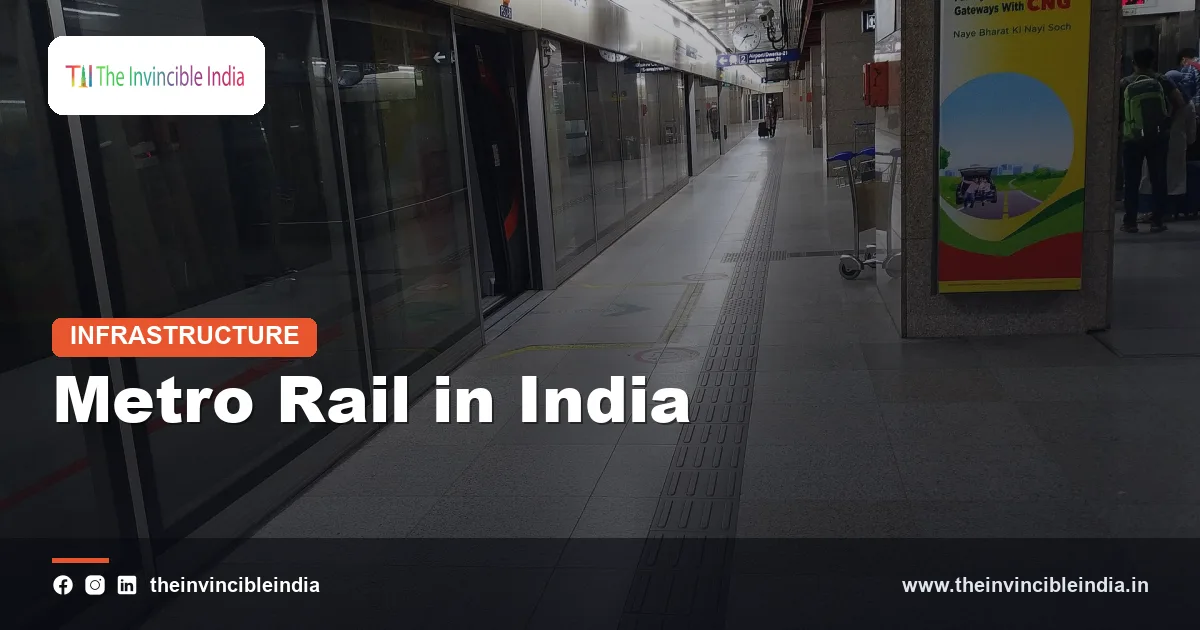
Few pieces of infrastructure have changed the daily life of Indian cities as visibly as the metro. Over the last four decades, metro rail in India has grown from a single short line in Kolkata into a network spread across more than twenty cities, carrying millions of commuters every day. What began as an experiment in easing traffic on one crowded corridor is now seen as a core part of how the country plans its urban future.
This explainer traces that journey from the first trains of 1984, through the Delhi Metro revolution of 2002, to the funding models, policies and technologies that shape the sector today. It also looks at the newer lighter systems and regional rail corridors, and weighs the real benefits of metros against the challenges that still hold some projects back. Figures given here are approximate and dated, because network lengths keep changing as new sections open. Last reviewed: 30 September 2026.
Quick Facts
| Topic | Detail |
|---|---|
| India’s first metro | Kolkata Metro, first section opened on 24 October 1984 |
| First section | About 3.4 km between the Esplanade and Bhowanipore (Netaji Bhavan) area |
| Kolkata Metro status | Became a full zone of Indian Railways in 2010 (Metro Railway, Kolkata) |
| Delhi Metro opened | 25 December 2002 (Shahdara to Tis Hazari section) |
| Delhi Metro builder | Delhi Metro Rail Corporation (DMRC), set up in 1995 |
| “Metro Man” | E. Sreedharan, the engineer who led DMRC |
| National policy | Metro Rail Policy, 2017 |
| Regional rapid rail | Namo Bharat (RRTS), first section opened in October 2023 |
| Network size | Over 900 km in operation across many cities (approximate, mid-2020s) |
Why India Turned to Metro Rail
India’s cities have grown far faster than their road systems. Vehicle numbers have multiplied, footpaths have shrunk, and buses often crawl through the same jammed junctions as cars and two-wheelers. Long commutes cost people hours every week, burn fuel and add to the air pollution that affects many large cities, especially in winter.
The case for rail-based transit
A single metro line can move as many passengers as several lanes of road traffic, on a strip of land only a few metres wide when elevated. Trains run on electricity, so they produce no exhaust in the streets, and the power can increasingly come from cleaner sources. Metros are also fast and predictable, since they do not share space with other vehicles.
- Capacity: high-frequency trains moving tens of thousands of people per hour in each direction.
- Reliability: a dedicated right of way, so schedules are not hostage to traffic.
- Space efficiency: elevated or underground tracks leave the ground level free for roads and pedestrians.
- Cleaner air: lower per-passenger emissions than private cars and two-wheelers.
Planners recognised these advantages early. The National Urban Transport Policy of 2006 encouraged cities to prioritise mass transit and public transport over private vehicles, and this thinking pushed state governments to plan metros rather than more flyovers alone.
The Beginning: Kolkata Metro, India’s First
The story of the Indian metro starts in Kolkata, then Calcutta, one of the country’s most densely populated cities. The idea of an underground railway there was floated as far back as the late 1940s, when the city’s chief minister Dr B.C. Roy is remembered as an early advocate, but progress was slow. Construction began in the early 1970s, with the foundation stone laid in 1972, and work was repeatedly delayed by funding shortages, technical difficulties and the challenge of tunnelling through a crowded, low-lying city.
24 October 1984
The first section finally opened on 24 October 1984, running for roughly 3.4 km from the Esplanade area to Bhowanipore, now known as Netaji Bhavan. It made India the first country in South Asia with an underground urban metro. Further stretches were added gradually, and the full north-south line between Dum Dum and Tollygunge (later extended to Kavi Subhas) came together in the mid-1990s.
A metro that is also a railway zone
The Kolkata Metro is unusual because it is owned and run by Indian Railways rather than by a separate city or state company. In 2010 it was made an independent railway zone, Metro Railway, Kolkata, with its own general manager. No other Indian metro has this status, and it reflects the fact that the project grew directly out of the Railways’ own planning. The system has since expanded with the East-West corridor, which includes India’s first tunnel built beneath a major river, the Hooghly, with sections opened to passengers in the 2020s.
The Game-Changer: The Delhi Metro
For nearly two decades Kolkata stood alone, and the slow, costly experience of building it made many planners wary. That perception changed with the Delhi Metro. The Delhi Metro Rail Corporation was incorporated in 1995, and its first section, from Shahdara to Tis Hazari on the Red Line, opened on 25 December 2002. The line was completed on time and within budget, which was almost unheard of for a large public project in India at that point.
What set Delhi apart
- Delivery discipline: phases were completed on or ahead of schedule, building public trust.
- Punctuality and cleanliness: stations and trains were maintained to standards commuters had not seen before.
- Engineering scale: a mix of elevated, underground and at-grade sections, with long river crossings and deep stations.
- Integration: feeder buses, e-rickshaws and, later, the Airport Express Line that opened in 2011.
- Automation: modern signalling, and from 2020 driverless operation on parts of the network.
The Delhi Metro also earned recognition for environmental performance, including carbon credit certification under a United Nations mechanism for its regenerative braking, which returns energy to the grid.
E. Sreedharan, the Metro Man
The project’s success is closely linked to E. Sreedharan, an engineer who had earlier worked on Kolkata’s first metro and led the rebuilding of the Pamban bridge after a cyclone in the 1960s. As managing director of DMRC, he insisted on strict timelines, transparent tendering, and a culture of accountability that resisted political and bureaucratic interference. He became widely known as the “Metro Man” and received several national and international honours, including the Padma Vibhushan. His approach came to be called the “Delhi Metro model”, and other cities sought his advice or borrowed his methods.
How Metros Are Built and Funded
Metro projects are expensive, and no city can fund one from its own revenue. The typical arrangement in India is to create a Special Purpose Vehicle (SPV), a separate company set up solely to plan, build and operate the metro. This structure keeps the project accountable and lets it borrow money in its own name.
The 50:50 model
In many cases the SPV is a joint venture with equal shareholding between the Union government and the respective state government. This was the pattern for the Delhi Metro Rail Corporation and has been followed, with variations, for companies in Bengaluru, Chennai, Kochi and other cities. Both governments contribute equity, and often also pay for land and taxes, while the SPV raises the balance through debt.
International financing
Soft loans from foreign agencies have been crucial. The Japan International Cooperation Agency (JICA) has been the best-known partner, offering long-term, low-interest loans to Delhi and several other metros. Other lenders and development banks, including the Asian Development Bank, the World Bank, the European Investment Bank, and agencies from France and Germany, have supported various projects.
Other models
- Public-private partnership (PPP): Hyderabad Metro was built and run by a private concessionaire, and Mumbai’s first line was a PPP as well.
- State-funded projects: some cities, such as Lucknow, have been financed largely by the state government with loans.
- Railway-funded: Kolkata’s original network was built by Indian Railways.
At the national level, the Ministry of Housing and Urban Affairs is the nodal ministry, and the Commissioner of Metro Rail Safety inspects new lines before they are opened to passengers.
Rapid Spread Across Cities
After Delhi showed what was possible, other cities lined up. The 2010s saw a wave of openings, and the pace has continued since. By the mid-2020s, India had one of the largest metro networks in the world, with well over 900 km in operation and many more kilometres under construction. The table below lists major city systems by the year their first section opened; the systems have all grown since then.
| City | Operator or agency | First section opened |
|---|---|---|
| Kolkata | Metro Railway, Kolkata (Indian Railways) | 1984 |
| Delhi and NCR | Delhi Metro Rail Corporation (DMRC) | 2002 |
| Bengaluru (Namma Metro) | Bangalore Metro Rail Corporation (BMRCL) | 2011 |
| Gurugram | Rapid Metro (privately run) | 2013 |
| Mumbai | Mumbai Metro One and MMRDA lines; later underground Line 3 | 2014 |
| Jaipur | Jaipur Metro Rail Corporation | 2015 |
| Chennai | Chennai Metro Rail Limited (CMRL) | 2015 |
| Kochi | Kochi Metro Rail Limited (KMRL) | 2017 |
| Hyderabad | Hyderabad Metro Rail (L&T concession) | 2017 |
| Lucknow | Lucknow Metro Rail Corporation | 2017 |
| Noida | Noida Metro Rail Corporation | 2019 |
| Nagpur | Maharashtra Metro Rail Corporation (Maha-Metro) | 2019 |
| Ahmedabad | Gujarat Metro Rail Corporation (GMRC) | 2019 |
| Pune | Maha-Metro (Pune Metro) | 2022 |
Additional cities, including Bhopal, Indore, Kanpur, Agra, Patna and Surat, have also opened priority sections or have projects under construction. Kochi has even added a Water Metro of electric boats connecting islands, launched in 2023, showing how the “metro” idea is being adapted to local geography. Opening years are approximate as first-section dates, and readers should check current operator websites for the latest status.
Metro Rail Policy 2017 and Make in India
By the middle of the 2010s, more than a dozen cities were demanding metros, and the Union government felt the need for a common framework. The Metro Rail Policy of 2017 sought to bring discipline to how projects are proposed, assessed and financed.
Key ideas of the policy
- Alternatives analysis: cities must compare metro with buses, bus rapid transit and light rail before choosing, so that heavy investment goes only where demand justifies it.
- Private participation: encouraging PPP structures and private investment to reduce the burden on public funds.
- Value capture financing: raising money from the rise in land values and property development near stations.
- Independent appraisal: stricter checks on ridership forecasts and economic viability.
- Standardisation: common technical norms, including standard gauge and interoperable systems.
The National Transit Oriented Development (TOD) policy, also announced in 2017, encouraged compact, mixed-use development around stations. Fare payments were unified through the National Common Mobility Card, launched in 2019, letting one card work across metros, buses and other services.
Indigenous rolling stock
The policy also gave a push to domestic manufacturing under the “Make in India” initiative. Early Delhi and other metro coaches were imported or built under licence, but Indian factories now build a large share of coaches, using local plants of global manufacturers and Indian public sector companies. Localisation reduces costs, shortens delivery times, and creates skilled jobs, while also making it easier to maintain fleets over their long lives.
Types of Systems and Technology
Not every Indian city needs, or can afford, a full-scale metro. Over time, planners have developed a menu of options matched to city size and travel demand.
Heavy metro
The standard metro is a high-capacity system with long trains, typically running on standard-gauge tracks with electrified overhead or third-rail power. It suits big cities with very high passenger demand. Modern lines use communications-based train control (CBTC), which allows trains to run closer together and enables driverless operation.
Metrolite and Metro Neo
For smaller cities and lighter corridors, the Union government has promoted cheaper alternatives.
- Metrolite: a lighter-capacity rail system with shorter trains, smaller stations and lower construction cost, meant for cities where full metro demand is not expected.
- Metro Neo: a rubber-tyred, electric-powered system running on an elevated guideway, often described as a cross between a bus and a metro, designed to be significantly cheaper per kilometre.
- Other options: monorail, light rail, and tram-style systems have also been tried or proposed in certain corridors, though heavy metro remains the dominant form.
These lighter formats were proposed as part of a strategy to extend rapid transit to second-tier cities without overburdening budgets. Some proposals have moved slowly, and their success depends on realistic ridership and careful financial planning.
Regional Rapid Transit: Namo Bharat and the RRTS
As cities expand into regions, commuters increasingly travel between towns rather than only within one. The Regional Rapid Transit System (RRTS) is designed for this purpose. It is a fast, high-frequency rail service linking a major city with its surrounding towns, faster than a metro but more frequent than traditional intercity trains.
Delhi-Ghaziabad-Meerut corridor
The first RRTS project links Delhi, Ghaziabad and Meerut, and is being built by the National Capital Region Transport Corporation (NCRTC), a joint venture of the Union and NCR state governments. The line is designed for a maximum speed of about 180 km/h, with operational speeds lower than that. The first priority section, between Sahibabad and Duhai, was opened in October 2023, and the service branded as Namo Bharat began carrying passengers. Further sections are being added toward Meerut and Delhi.
Why it matters
RRTS aims to make it practical to live in one town and work in another, spreading housing and economic activity across a wider region. Additional RRTS corridors have been proposed from Delhi toward places such as Alwar and Panipat, though timelines can change.
Benefits of Metro Rail
The benefits of metros go well beyond moving people from one place to another.
- Reduced congestion: each metro line takes a significant number of cars, two-wheelers and buses off busy roads.
- Lower emissions: electric traction produces fewer local pollutants and lower carbon emissions per passenger-kilometre than road vehicles.
- Time savings: predictable journey times help workers, students and small businesses.
- Safety: rail-based transit is considerably safer than road travel per passenger.
- Inclusion: metros usually provide lifts, tactile paths and reserved coaches or seats for women and persons with disabilities.
- Urban transformation: around stations, land use often becomes denser and more walkable, with new commercial and residential activity.
Many cities have also seen improvements in quality of life and property value near metro corridors, which is where Transit Oriented Development plays a role. When combined with good pedestrian and cycling infrastructure, a metro can reshape how a neighbourhood functions.
Challenges and Criticisms
For all their success, metros are not a universal solution, and several projects have struggled.
- High capital cost: underground lines in particular cost many times more per kilometre than elevated ones, and cost overruns are common when delays occur.
- Ridership and viability: some systems have carried fewer passengers than forecast, leaving them dependent on subsidies. Realistic forecasting and fare structures remain a concern.
- Last-mile connectivity: a metro is only useful if people can reach the station easily, which needs feeder buses, footpaths, cycle lanes and shared mobility options.
- Land acquisition and disruption: acquiring land, shifting utilities, and managing years of construction affect residents and traders along the route.
- Operations and maintenance: keeping ageing fleets, signalling and stations in top condition requires continuous funding.
- Fare policy: setting fares that cover costs while remaining affordable is a delicate balance, handled by fare fixation committees under the metro railway laws.
The lesson often drawn is that metros work best as part of an integrated public transport system rather than as stand-alone projects.
Conclusion
From the modest 3.4 km stretch opened in Kolkata in 1984 to the multi-city networks of today, metro rail in India has changed how Indians move, work and think about urban planning. The Delhi Metro showed that large public projects could be delivered on time, the 2017 policy tried to bring order to a fast-growing sector, and newer formats like Metro Neo and Namo Bharat are extending the idea to smaller cities and wider regions. The challenge now is to keep costs realistic, connect stations to neighbourhoods, and ensure that the metro remains a service for everyone.
Frequently Asked Questions
Which was India’s first metro?
The Kolkata Metro was India’s first, with its first section opening on 24 October 1984 between the Esplanade and Bhowanipore area. It is also unique because it was built and is run by Indian Railways, and since 2010 it has been a separate railway zone.
When did the Delhi Metro start operating?
The Delhi Metro opened on 25 December 2002, with its first section running from Shahdara to Tis Hazari. It was built by the Delhi Metro Rail Corporation, which was set up in 1995 under the leadership of E. Sreedharan.
Who is called the Metro Man of India?
E. Sreedharan is known as the Metro Man of India. As the head of the Delhi Metro Rail Corporation, he led the project to completion on time and on budget, and his working style became a model for other Indian metro projects.
How are metro projects in India funded?
Most are built by Special Purpose Vehicles, often 50:50 joint ventures between the Union and the state government. Funding usually combines equity from both governments, soft loans from agencies such as JICA, and, in some cases, private investment through public-private partnerships.
What are Metrolite, Metro Neo and RRTS?
Metrolite and Metro Neo are lighter, cheaper systems designed for smaller cities where a full metro would be too expensive. The Regional Rapid Transit System, branded Namo Bharat, is a faster regional rail service linking a city with nearby towns, such as the Delhi-Ghaziabad-Meerut corridor.
How long is India’s metro network?
As of the mid-2020s, the operational network is described as over 900 km spread across more than twenty cities, making it one of the largest in the world. The figure keeps growing as new sections open, so it should be treated as approximate.


