

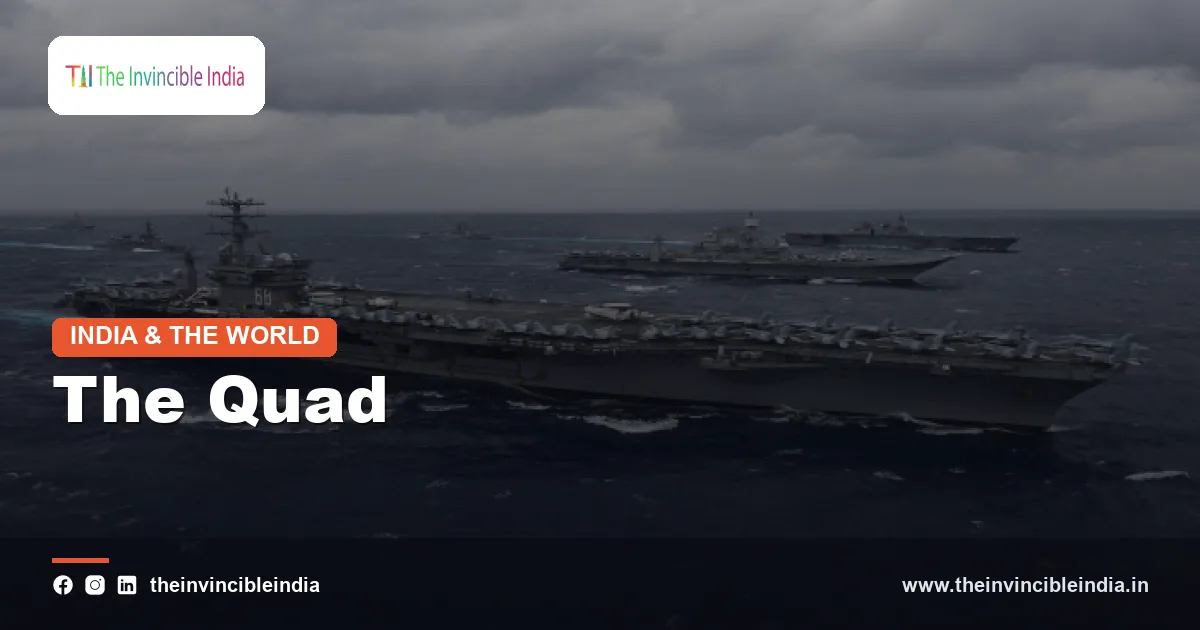
Few groupings have shaped conversations about Asian geopolitics in recent years as much as the Quad. Formally the Quadrilateral Security Dialogue, the Quad brings together four large democracies, India, the United States, Japan and Australia, around a shared interest in a free, open, inclusive and rules-based Indo-Pacific. It is often described in headlines as a security bloc, yet its actual character is far more flexible, consultative and wide-ranging than that label suggests.
This explainer sets out what the Quad is and what it is not, how it began after a natural disaster, why it stalled and returned, what it does beyond defence, and how India fits it into its broader foreign policy of strategic autonomy. It is written to remain useful as summits and announcements come and go, so it concentrates on the structure, history and logic of the partnership. Last reviewed: 30 September 2026.
| Full name | Quadrilateral Security Dialogue (the Quad) |
|---|---|
| Members | India, the United States, Japan and Australia |
| Stated purpose | A free, open, inclusive and rules-based Indo-Pacific |
| Legal nature | Informal, consultative grouping; not a treaty alliance |
| Secretariat | None; coordinated through meetings and working groups |
| Precursor | Tsunami Core Group, formed after the December 2004 Indian Ocean tsunami |
| First Quad initiative | 2007, championed by Japan’s Shinzo Abe; lapsed in 2008 |
| Revival | November 2017, at senior-official level on the sidelines of ASEAN meetings in Manila |
| Levels of engagement | Foreign ministers from 2019; leaders’ summits from 2021 |
What the Quad Is, and What It Is Not
At its simplest, the Quad is a forum in which four countries with shared democratic values and overlapping interests in the Indo-Pacific region meet regularly to coordinate ideas, projects and positions. The Indo-Pacific here means the connected maritime space stretching from the eastern coast of Africa across the Indian Ocean to the western and central Pacific, a region that carries a large share of the world’s trade, energy shipments and population.
Not a military alliance
The Quad is not a treaty-based alliance like NATO. There is no mutual-defence clause under which an attack on one member obliges the others to respond, no joint command, and no permanent headquarters or secretariat. Decisions are taken by consensus, and each member remains free to pursue its own policies. This is precisely why the grouping has been able to attract India, which has historically been wary of formal military blocs.
What it does instead
- Holds leaders’ meetings, foreign-ministers’ meetings and regular meetings of senior officials.
- Runs working groups and initiatives on practical themes such as health, technology, climate and infrastructure.
- Issues joint statements setting out shared principles, including respect for sovereignty, territorial integrity, freedom of navigation and the peaceful settlement of disputes.
- Offers regional partners, especially in the Indian Ocean and Pacific islands, capacity-building and public goods.
Origins: From Tsunami Relief to a Strategic Idea
The roots of the Quad lie in humanitarian cooperation. When the Indian Ocean earthquake and tsunami struck on 26 December 2004, devastating coastlines from Indonesia to Sri Lanka and India, four navies and governments rapidly mobilised relief. India, the United States, Japan and Australia formed an informal arrangement often called the Tsunami Core Group to coordinate aid, logistics and rescue. It was temporary and purely humanitarian, but it showed that the four could work together quickly and interoperably.
That experience mattered because it demonstrated practical trust. It also coincided with a period in which India’s relations with the United States and Japan were improving markedly, and in which India’s navy was expanding its reach in the Indian Ocean. The Core Group was wound down once relief efforts were complete, but the idea that these four capable democracies could cooperate on regional public goods had taken root.
The 2007 Initiative and Why It Lapsed
The concept acquired a strategic flavour under Japanese Prime Minister Shinzo Abe. In an August 2007 address to India’s Parliament titled “Confluence of the Two Seas”, Abe spoke of the Pacific and Indian Oceans as a dynamic coupling of seas of freedom and prosperity, an early and influential statement of the Indo-Pacific idea. In May 2007, officials of the four countries had also held a first informal meeting on the margins of an ASEAN-linked gathering in Manila.
Malabar 2007
Later that year, the Malabar naval exercise was expanded into a larger drill in the Bay of Bengal that involved India, the United States, Japan and Australia, along with Singapore. The scale and symbolism of that exercise drew close attention across the region.
The pause
The first Quad did not last. Several governments felt uncomfortable about how the grouping might be perceived, and concerns about regional reactions and about balancing relationships led to hesitation. Australia stepped back from the format in 2008, and the dialogue effectively went dormant for close to a decade. Historians of the period generally point to a mix of domestic political changes, caution about provoking neighbours, and uncertainty about what the group was actually for.
The 2017 Revival and Rise to Leaders’ Level
The Quad returned in November 2017 when senior officials of the four countries met on the sidelines of ASEAN-related meetings in Manila. By then, the strategic setting had changed: maritime tensions in the South China Sea had grown, questions about freedom of navigation and the rule of law at sea had sharpened, and the Indo-Pacific had become a widely used policy frame in all four capitals.
The subsequent upgrades were steady rather than dramatic. In September 2019, the four foreign ministers met for the first time in New York on the sidelines of the United Nations General Assembly. A stand-alone ministerial followed in Tokyo in October 2020. In March 2021 the leaders of the four countries held their first summit, virtually, and later that year they met in person for the first time. Since then the Quad has operated at leaders’, ministers’ and senior-officials’ levels, supported by working groups.
A Timeline of the Quad’s Evolution
| Year | Milestone |
|---|---|
| 2004 | Tsunami Core Group formed by India, the US, Japan and Australia for relief after the Indian Ocean tsunami |
| 2007 | Shinzo Abe’s “Confluence of the Two Seas” speech; first informal Quad meeting; expanded Malabar exercise |
| 2008 | Australia withdraws from the format; dialogue goes dormant |
| 2017 | Quad revived at senior-official level in Manila |
| 2019 | First meeting of foreign ministers, on the sidelines of the UN General Assembly |
| 2020 | Stand-alone foreign ministers’ meeting in Tokyo; Australia rejoins the Malabar exercise |
| 2021 | First leaders’ summit (virtual), Quad Vaccine Partnership announced, first in-person leaders’ summit |
| 2022 | Launch of the Indo-Pacific Partnership for Maritime Domain Awareness (IPMDA) announced at the Tokyo summit |
| 2023 | The Quad Fellowship for STEM graduate students begins its first cohort |
The Strategic Context: Why the Quad Matters
To understand the Quad’s revival, it helps to look at the wider environment in the Indo-Pacific. The rapid growth of China’s economic and military capabilities over the past two decades has altered the regional balance. Several countries, including India, Japan, the Philippines, Vietnam and others, have disputes or points of friction with China over land boundaries or maritime claims. In the South China Sea, overlapping claims, island-building and the presence of coast guard and maritime militia vessels have raised concerns among many littoral states about freedom of navigation and the peaceful resolution of disputes under international law, including the United Nations Convention on the Law of the Sea (UNCLOS).
Alongside security worries, there are economic concerns about coercion, dependence on concentrated supply chains, and debt-financed infrastructure. The Quad members have generally avoided naming any single country in their joint statements. Instead they frame their agenda around principles: sovereignty, territorial integrity, the rule of law, freedom of navigation and overflight, transparency, and the idea that smaller states should be free from pressure in their choices.
Why each member cares
- India: a long Indian Ocean coastline, dependence on sea lanes for trade and energy, and unresolved land boundary issues.
- Japan: heavy reliance on maritime trade routes, and concern about stability in the East and South China Seas.
- Australia: a trading nation with vital interests in Indo-Pacific sea lanes and in the security of its neighbourhood.
- United States: long-standing security commitments and a stake in an open regional order.
The four members at a glance
| Member | Role and approach in the Quad |
|---|---|
| India | The only member that is not a treaty ally of the others; emphasises strategic autonomy, a broad non-military agenda and inclusiveness; a resident power of the Indian Ocean |
| United States | Provides the largest military and technological capacity; links the Quad to its wider alliances and partnerships in Asia |
| Japan | Originator of the Indo-Pacific concept and of the 2007 initiative; contributes development finance, infrastructure expertise and technology |
| Australia | A maritime and resource-rich middle power; a full participant in the Malabar exercise since 2020; active in Pacific-island engagement |
The United States, Japan and Australia already have deep security ties with one another through separate arrangements. India’s distinct position, as a partner rather than an ally, is one reason the Quad has been framed as consultative rather than treaty-based.
Beyond Security: The Quad’s Wider Agenda
A defining feature of the modern Quad is that its work programme is much broader than defence. The leaders have repeatedly stressed that the Quad is a “force for good” that delivers practical benefits to the region. Among the main strands:
Health and vaccines
During the COVID-19 pandemic, the Quad announced a Vaccine Partnership in 2021 to expand manufacturing capacity in India, using American and Japanese financing and Australian logistics support to help supply vaccines to Indo-Pacific countries. The initiative later broadened into wider health-security cooperation.
Critical and emerging technologies
Working groups address areas such as artificial intelligence, semiconductors, telecommunications and standards-setting, with an emphasis on trusted supply chains and open technology ecosystems.
Climate, infrastructure and resilience
The Quad has set up cooperation on clean energy, disaster response and climate adaptation, and on quality infrastructure financing that stresses transparency, sustainability and local ownership. Supply-chain resilience, especially for critical minerals and semiconductors, is a recurring theme.
Cyber, space and education
- Cybersecurity cooperation, including protecting critical infrastructure and sharing best practices.
- Space cooperation, including satellite data for climate monitoring and disaster management.
- The Quad Fellowship, which supports graduate students in science, technology, engineering and mathematics from the four countries.
Maritime domain awareness and the IPMDA
One of the more concrete Quad initiatives is the Indo-Pacific Partnership for Maritime Domain Awareness, known as IPMDA. Announced at the 2022 leaders’ summit in Tokyo, it aims to help partners in the Indian Ocean, Southeast Asia and the Pacific islands build a clearer picture of activities in their waters. This includes tracking illegal, unreported and unregulated fishing, detecting suspicious vessel behaviour and improving responses to natural disasters and humanitarian emergencies.
The initiative works by providing satellite-based data and analytical tools to regional information-sharing centres, rather than by deploying Quad forces. This design reflects the Quad’s preference for supporting the capacities of coastal states so that they can monitor their own exclusive economic zones. Maritime domain awareness is also politically sensitive in a good sense: it is a public-goods approach that benefits countries irrespective of their alignments.
The Malabar Exercise: The Military Dimension
If the Quad has a military face, it is the Malabar naval exercise. Malabar began in 1992 as a bilateral drill between the Indian and United States navies. Japan first joined in 2007 and became a regular, permanent participant from 2015. Australia took part in 2007, stayed out for years, and rejoined in 2020, making Malabar an exercise involving all four Quad navies once more.
What Malabar involves
- Anti-submarine warfare, anti-air and anti-surface drills.
- Maritime interdiction, search and rescue, and seamanship.
- Interoperability training among ships, aircraft and submarines.
It is important to note that Malabar is formally a navy-to-navy exercise, not a Quad activity by treaty. It is nevertheless the clearest example of how the four countries practise operating together, and its expansion tracks the wider political warming among them.
India’s Approach: Strategic Autonomy and Multi-Alignment
For India, participation in the Quad reflects a long-standing foreign policy principle: strategic autonomy, the freedom to take decisions in the national interest without being bound to any bloc. In recent decades this has often been described as multi-alignment, meaning that India builds issue-based partnerships with many countries at the same time rather than choosing sides.
One partnership among many
India participates in the Quad while also being a member of BRICS, the Shanghai Cooperation Organisation and other forums, and it maintains a long-standing strategic partnership with Russia and close ties with countries in the Gulf, Europe, Africa and Southeast Asia. Indian officials often say that the Quad should be seen as one of several instruments and not as a replacement for any other relationship.
Emphasis on inclusiveness and ASEAN centrality
India consistently emphasises that the Indo-Pacific should be open and inclusive, and that ASEAN centrality, meaning the central role of the Association of Southeast Asian Nations in regional architecture, should be respected. It also links the Quad with its own regional initiatives such as the Indo-Pacific Oceans Initiative and its “Act East” policy, and it presents the grouping as a development-and-public-goods platform as much as a security one.
Criticism, Challenges and Debates
The Quad has attracted both praise and scepticism, and a balanced view should note the main arguments.
External reactions
China has criticised the Quad, at times describing it as an “Asian NATO” or a bloc designed to contain it, and has argued that group-based approaches can heighten tensions. The Quad members reject this characterisation, saying that the grouping is not directed against any country and that its agenda is open to all who share its principles.
Internal challenges
- Differing threat perceptions: the four members do not always see the same risks with equal urgency; India faces a land border with China, Japan and Australia are treaty allies of the United States, and each has different economic relationships.
- Different political priorities: domestic politics and changing governments can alter emphasis and tempo.
- Delivery: critics ask whether ambitious announcements are matched by sustained, measurable results, and whether the Quad can fund projects at scale.
- Sustainability: the lapse of 2008 is a reminder that the grouping depends on ongoing political will.
- Relations with Southeast Asia: some ASEAN members worry about being drawn into great-power competition and want the Quad to complement, not overshadow, ASEAN-led forums.
Conclusion
The Quad shows how modern diplomacy can produce durable cooperation without a formal treaty. It began as a relief effort, stumbled on caution and shifting politics, then returned as a leaders’-level forum with a broad practical agenda ranging from vaccines to maritime awareness. For India, it is a platform that adds to, rather than replaces, its wide network of partnerships, consistent with its long tradition of strategic autonomy. Whether it endures will depend less on declarations than on delivering visible, shared benefits to the wider Indo-Pacific.
Frequently Asked Questions
What is the Quad?
The Quad, or Quadrilateral Security Dialogue, is an informal strategic grouping of India, the United States, Japan and Australia. It works to promote a free, open, inclusive and rules-based Indo-Pacific through regular meetings, working groups and joint initiatives.
Is the Quad a military alliance?
No. The Quad has no treaty, no mutual-defence commitment and no permanent secretariat. It is a consultative partnership, and India in particular stresses that it is not a military bloc. The closest military element is the Malabar naval exercise, which is conducted by the members’ navies.
How did the Quad begin?
Its precursor was the Tsunami Core Group formed by the four countries after the December 2004 Indian Ocean tsunami. The first Quad initiative followed in 2007, championed by Japan’s Shinzo Abe, but it lapsed in 2008 after Australia withdrew. It was revived in 2017 and raised to foreign-minister level in 2019 and leaders’ level from 2021.
What does the Quad do besides security?
Its agenda includes vaccines and health, critical and emerging technologies, climate cooperation, quality infrastructure, supply-chain resilience, cyber and space cooperation, maritime domain awareness through IPMDA, and education through the Quad Fellowship.
What is the Malabar exercise?
Malabar is a naval exercise that began in 1992 as an India-US drill. Japan became a permanent participant in 2015 and Australia rejoined in 2020, so it now involves the navies of all four Quad countries. It focuses on interoperability, anti-submarine warfare and maritime security.
Why does India take part in the Quad if it follows strategic autonomy?
India sees the Quad as a flexible, issue-based partnership that serves its interests in a stable Indo-Pacific without binding it to a bloc. It participates alongside other groupings such as BRICS and the SCO, consistent with its multi-alignment approach.


