

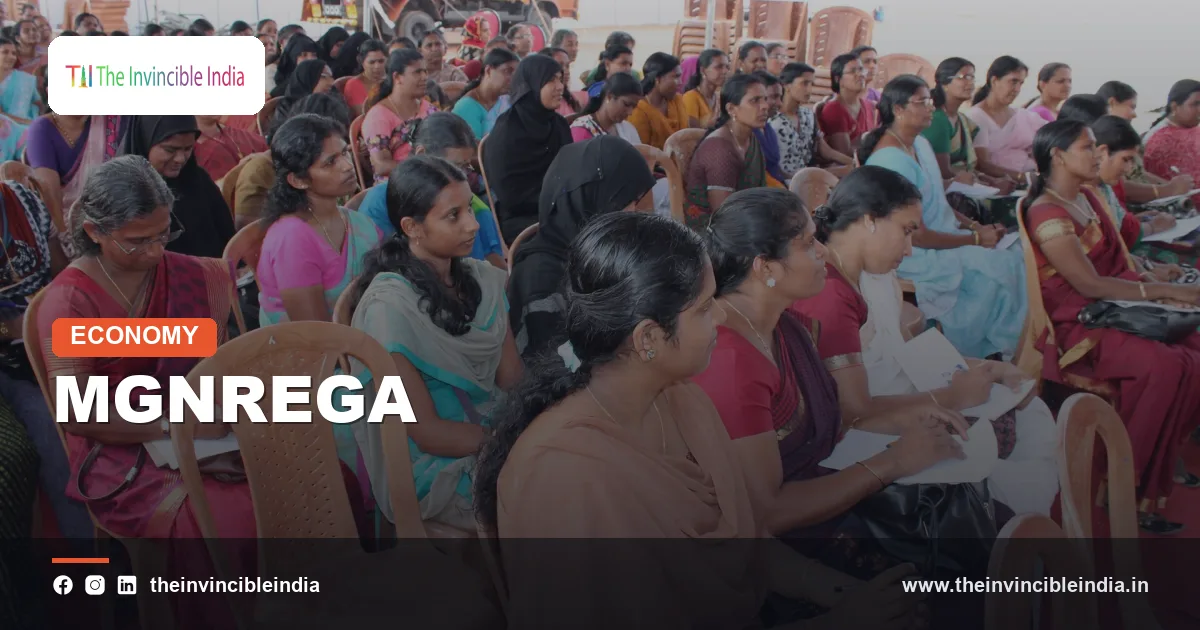
MGNREGA, the Mahatma Gandhi National Rural Employment Guarantee Act, is widely described as the largest work-guarantee programme in the world. Enacted by Parliament in 2005, it does something unusual for a welfare measure: it turns employment into a legal entitlement. Any rural household whose adult members are willing to do unskilled manual work can ask for a job, and the State is legally bound to provide it.
Most government programmes run on budgets and targets. MGNREGA runs on demand. Work is supposed to follow the worker, not the other way round, and a failure to provide it carries a penalty in the form of an unemployment allowance. This explainer walks through how the law came about, what it guarantees, how it is implemented in villages, what it has achieved and where it has struggled.
Quick Facts
| Full name | Mahatma Gandhi National Rural Employment Guarantee Act (MGNREGA) |
|---|---|
| Originally enacted | 2005, as the National Rural Employment Guarantee Act (NREGA) |
| Rolled out | From 2 February 2006 in selected districts; extended to all rural districts by 2008 |
| Renamed | 2 October 2009, after Mahatma Gandhi |
| Core guarantee | At least 100 days of wage employment in a financial year per rural household |
| Type of work | Unskilled manual work on permissible public works |
| Nodal ministry | Ministry of Rural Development, Government of India |
| Main implementing body | Gram panchayats, with the gram sabha as the planning forum |
| Women’s share | At least one-third of the workers must be women |
The Road to a Right to Work
India had experimented with rural employment programmes long before 2005. Schemes such as the Rural Works Programme, the Food for Work Programme, the Jawahar Rozgar Yojana, the Employment Assurance Scheme and later the Sampoorna Grameen Rozgar Yojana all tried to create wage work in the countryside. Maharashtra’s Employment Guarantee Scheme, started in the 1970s, was a particularly influential model because it tied employment to a legal promise.
What most of these earlier schemes shared was discretion. They were funded within a fixed allocation, and once the money was spent, the work stopped. Activists, economists and civil society groups, including the Mazdoor Kisan Shakti Sangathan in Rajasthan and members of the National Advisory Council, argued that rural livelihood security needed a firmer footing. The idea of a legally enforceable right to work, rooted in the Directive Principles of State Policy on the right to work under Article 41 of the Constitution, gained wide political support.
From a bill to a nationwide law
- 2005: Parliament passed the National Rural Employment Guarantee Act and it was notified in September of that year.
- 2 February 2006: The programme began in 200 of the most backward districts, with Anantapur in Andhra Pradesh as the launch site.
- 2007-08: It was extended in phases to more districts.
- 1 April 2008: Coverage reached all rural districts of the country.
- 2 October 2009: The Act was renamed after Mahatma Gandhi, becoming MGNREGA.
What the Law Guarantees
The central promise of MGNREGA is simple. A rural household whose adult members volunteer to do unskilled manual work is entitled to at least 100 days of wage employment in a financial year. The household is the unit of entitlement, which means the 100 days are shared among its adult members rather than being guaranteed to each individual.
Participation is voluntary and self-selecting. There is no income test and no separate list of eligible families. Anyone who is a resident of a rural area and willing to do manual work may register. This universal access is a deliberate design choice, intended to avoid the exclusion errors that often affect targeted schemes. The expectation is that only those who genuinely need the work, usually at a wage close to the minimum, will turn up for it.
Key entitlements at a glance
| Entitlement | What it means |
|---|---|
| Job card | A registered household receives a job card, which records its entitlement and the work it does |
| Work on demand | Work should be provided within 15 days of a written or oral application |
| Unemployment allowance | If work is not provided in time, the applicant is entitled to a daily allowance |
| Work near home | Work should be within 5 km of the village; beyond that, extra wages are payable to cover travel and living costs |
| Fair wages | Wages are paid for work done, and equal pay applies to men and women |
| Timely payment | Wages are due on a weekly basis and, in any case, within a fortnight; delay attracts compensation |
| Worksite facilities | Drinking water, shade, first aid and a crèche where enough young children are present |
| Transparency | Public access to records and mandatory social audits |
Why a Rights-Based Design Matters
The word “guarantee” in the title is not rhetorical. It signals the difference between a scheme and a statutory right. A scheme can be wound down or capped by an executive order. A right created by an Act of Parliament can be claimed, and its denial can be challenged through complaint mechanisms and, ultimately, the courts.
Demand-driven, not supply-driven
Under MGNREGA the volume of work is meant to respond to how many people ask for it. In a drought year or after a crop failure, demand rises and the system is expected to expand to meet it. In a good agricultural season, demand falls on its own. In principle, this makes the programme counter-cyclical, acting as an automatic stabiliser for rural incomes.
Accountability through entitlements
Two provisions give the law its teeth. The first is the 15-day rule: if work is not provided within 15 days of a valid demand, the State must pay an unemployment allowance. The second is compensation for delayed wages. These penalties are meant to shift the burden onto the administration, which then has an incentive to keep work available. In practice, enforcement has been uneven, and the gap between legal promise and ground reality is a recurring theme in debates about the Act.
How MGNREGA Works on the Ground
The process begins with registration. An adult member of a household applies to the gram panchayat, which verifies the details and issues a job card, generally with a photograph of the household’s members. The card is a household’s key document, recording days of work demanded, days provided and wages paid.
Applying for and getting work
- The household submits an application for work, ideally for a minimum continuous stretch of about two weeks.
- The panchayat or programme officer issues a dated receipt for the application, a step meant to prove that demand was made.
- Work is allotted at a worksite, normally within 5 km, and workers are told when and where to report.
- Attendance is recorded and wages are calculated according to the work measured.
Contractors are barred from the programme, and the use of heavy machinery is discouraged, because the whole purpose is to put wages in the hands of local labour. The Act also stipulates that a substantial share of the works, by value, must be executed by gram panchayats themselves.
The Role of Gram Panchayats and Gram Sabhas
MGNREGA is one of the most visible examples of decentralised governance in action. The gram panchayat, the elected body at the village level, is the principal implementing agency. It registers households, receives applications, allots work and executes a large share of projects. Higher tiers, such as the block and district administrations, plan, coordinate and monitor, while the Ministry of Rural Development oversees the programme nationally.
Planning from below
The gram sabha, the assembly of all adult voters in a village, has a statutory role. It recommends which works should be taken up and in what order of priority, and it reviews what has been done. The aim is that villagers, not distant officials, decide whether a pond, a field bund or a road is more urgent for their community. Each year, panchayats are expected to prepare a shelf of projects so that work can be opened quickly when demand arises.
Division of financial responsibility
As a rule, the Centre bears the wage cost of unskilled labour and a major portion of the material and administrative costs. States contribute a share of the material cost and are responsible for the unemployment allowance. This division means that states have a financial reason to ensure that work is provided on time.
Permissible Works and Rural Assets
MGNREGA is not just a cash transfer. Every rupee of wages is supposed to buy a durable public asset. The list of permissible works has expanded over the years, but its core focus remains on natural resource management and rural livelihoods.
| Category | Typical examples |
|---|---|
| Water conservation and harvesting | Farm ponds, check dams, percolation tanks, renovation of traditional water bodies |
| Drought-proofing | Afforestation, tree plantation, watershed activities |
| Irrigation | Micro and minor irrigation canals and structures, dug wells |
| Land development | Land levelling, field bunding, soil conservation |
| Rural connectivity | All-weather village roads linking habitations to larger networks |
| Flood control | Drainage improvement, embankment repairs |
| Individual household assets | Works on lands of specified vulnerable groups, such as livestock sheds and horticulture |
| Rural infrastructure | Anganwadi centres, village-level buildings and other facilities allowed from time to time |
The emphasis on water is particularly important. In large parts of India, rain-fed farming and falling groundwater levels create seasonal distress. Structures that capture rainwater, recharge aquifers and protect soil are meant to raise farm productivity and reduce the need for emergency relief later.
Wages, Banking and Direct Benefit Transfer
Wages under the Act are tied to a notified rate for each state, and the law requires that they be paid for work actually done. Historically, payments were made in cash by local officials, which created room for delays, short payment and fraud. Reform in this area has been among the most significant in the programme’s history.
Over time, wages were shifted into bank and post-office accounts, opened for workers on a large scale. This pushed millions of rural people, many of them women, into the formal banking system for the first time. Wages were later routed through direct benefit transfer, so that money moves electronically from the government to the worker’s account instead of passing through multiple hands.
Benefits of electronic payment
- Reduced opportunity for middlemen to skim wages.
- A digital record of who worked and who was paid.
- Greater financial inclusion, especially for women who had no personal account.
- Easier auditing and tracking of delays.
The shift has not been trouble-free. It requires functioning bank branches or banking correspondents within reach, and when accounts are not linked properly, workers may not receive their money on time.
Transparency, Social Audits and Women’s Participation
MGNREGA has an unusually strong transparency framework for an Indian welfare law. Muster rolls, work estimates and payment details are supposed to be public. Information is to be displayed at worksites and panchayat offices, and the Act contains a provision for periodic social audits, in which villagers examine records, compare them against the physical works on the ground and raise objections in a public meeting.
Social audit as a safeguard
A social audit is not an accounting exercise carried out by officials. It is a participatory review in which beneficiaries and local citizens scrutinise records, check whether a road or a pond actually exists and whether the named workers actually received the stated wages. Several states built dedicated social audit units to carry this out, and the practice has been cited in public policy discussions as a model for other schemes.
Women at the centre
The Act stipulates that at least one-third of the workers should be women. In many states women have exceeded this share, drawn by the availability of work close to home, equal wages and the provision of crèche facilities. For many rural women, MGNREGA wages represented their first independent earnings, which has implications for household decision-making and bargaining power.
MGNREGA as a Safety Net
Because it is open to all rural households and responds to demand, MGNREGA works as a safety net in times of stress. When a monsoon fails, or farm incomes collapse, families can fall back on public works wages rather than selling assets or going into debt.
Droughts and local shocks
In drought-prone regions, the programme has been used to extend employment and to take up water-conservation works that tackle the cause of the problem. Governments have, at times, allowed extra days of work in areas declared drought-affected or hit by natural calamities.
The COVID-19 period
The importance of the programme became very visible in 2020, when a national lockdown led to a large-scale return of migrant workers to their villages. Demand for work rose sharply in the months that followed, and the programme absorbed returning workers when few other jobs were available. Many observers pointed to this episode as a demonstration of why a standing, demand-driven employment guarantee is valuable during a crisis.
Impact: Wages, Migration and Rural Livelihoods
Assessing MGNREGA’s impact is complex, because it operates alongside many other forces in the rural economy. Still, a range of studies and field observations have pointed to several broad effects.
- Income support: It provides additional wage income to poor households, especially during the agricultural lean season, which helps smooth consumption.
- Rural wages: By offering an alternative to low-paid farm labour, it is widely seen as having strengthened workers’ bargaining position, with some upward pressure on rural wages.
- Distress migration: Local work has helped some households avoid migrating in search of seasonal jobs, though the extent varies by region and the quality of implementation.
- Financial inclusion: Bank and post-office accounts for wage payments brought many first-time account holders into formal finance.
- Asset creation: Water harvesting structures, land improvements and rural roads have added to local infrastructure, with positive effects on groundwater recharge and agricultural productivity in places where works were well planned.
- Social empowerment: Participation of women and of marginalised communities has been significant in many states.
The strength of these effects depends heavily on how well the programme is run locally. Where planning, wage payment and supervision work well, the benefits are visible. Where they do not, the programme can disappoint.
Criticisms, Challenges and the Productivity Debate
Like any very large public programme, MGNREGA has drawn criticism. A balanced picture needs to take these concerns seriously alongside the achievements.
Delays in wage payment
The most persistent complaint is delayed payment. Wages are legally due within a fortnight, but delays have been reported for long stretches in many places. Late payment erodes the value of the work, particularly for households that depend on daily earnings, and discourages participation.
Corruption and leakages
Fake muster rolls, inflated measurements, ghost workers and diverted material funds have been reported in several audits and investigations. Social audits and electronic payment have reduced some forms of leakage, though not all.
Funding constraints
Because the programme is demand-driven, its financial needs cannot be known in advance. Critics have noted that allocations have sometimes proved insufficient, leading to pending liabilities and informal rationing of work, which sits uneasily with the idea of a legal guarantee.
Technology and exclusion
The use of Aadhaar-based payments and mobile-based attendance tracking, through the National Mobile Monitoring System (NMMS) app, was introduced to improve transparency. However, workers and activists have raised practical concerns: poor connectivity, mismatches between job cards and Aadhaar details, failed authentication and difficulties in uploading attendance photographs, all of which can lead to rejected or delayed payments. Supporters of the technology argue that it strengthens monitoring and curbs fraud; critics say that the burden of technical errors falls on the poorest workers.
Does it create productive assets?
A longstanding debate concerns whether MGNREGA creates genuinely productive assets or merely provides relief. Sceptics argue that some works are poorly designed or maintained, that unskilled labour limits what can be built, and that the programme may compete for labour during peak farm seasons, raising costs for farmers. Supporters respond that the programme’s primary purpose is income security, that well-planned water and land works can raise agricultural output, and that studies suggest benefits in areas where planning is strong.
Efforts to link MGNREGA works with other schemes, to use scientific planning for assets and to focus on natural resource management reflect an attempt to improve outcomes. Policy details, budgets and administrative rules continue to evolve, so readers who want the current position should consult the Ministry of Rural Development’s official publications. Information on this page was last reviewed on 1 October 2026.
Conclusion
MGNREGA remains one of the most ambitious experiments in social policy anywhere. By tying employment to a legal right, it changed the relationship between rural citizens and the State, giving workers a claim they can assert rather than a favour they must seek. Its record is mixed but meaningful: it has supported incomes, built local assets, drawn women into paid work and provided a cushion in times of crisis, while struggling with payment delays, leakages and technology-related exclusion. How well it performs in the future will depend on timely funds, good local planning and reliable systems that serve the people it was designed for.
Frequently Asked Questions
What does MGNREGA stand for and what is its main aim?
MGNREGA stands for the Mahatma Gandhi National Rural Employment Guarantee Act. Its main aim is to enhance livelihood security in rural areas by guaranteeing at least 100 days of wage employment in a financial year to every rural household whose adult members volunteer to do unskilled manual work.
Who is eligible to work under MGNREGA?
Any adult member of a rural household who is willing to do unskilled manual work can apply. There is no income-based eligibility test. The household registers with the gram panchayat and receives a job card, which it uses to demand work.
What happens if work is not provided on demand?
The law says that work should be provided within 15 days of a valid application. If it is not, the worker is entitled to an unemployment allowance, which is the responsibility of the state government. This provision is what makes MGNREGA a legal entitlement rather than an ordinary scheme.
What kind of work is done under MGNREGA?
The work is mostly unskilled manual labour on public projects, with an emphasis on water conservation, drought-proofing, irrigation, land development, flood control and rural roads. The goal is to create durable assets that benefit the village economy over the long term.
How are MGNREGA wages paid?
Wages are paid into the worker’s bank or post-office account, typically through direct benefit transfer, rather than in cash. The law requires payment weekly and, in any case, within a fortnight of the work being completed, with compensation for delays.
Why is MGNREGA important for women?
The Act requires that at least one-third of workers be women, and it provides for equal wages, work near home and crèche facilities at worksites. For many rural women, it has been the first source of independent, regular earnings and a route into formal banking.
{“@context”:”https://schema.org”,”@graph”:[{“@type”:”FAQPage”,”mainEntity”:[{“@type”:”Question”,”name”:”What does MGNREGA stand for and what is its main aim?”,”acceptedAnswer”:{“@type”:”Answer”,”text”:”MGNREGA stands for the Mahatma Gandhi National Rural Employment Guarantee Act. Its main aim is to enhance livelihood security in rural areas by guaranteeing at least 100 days of wage employment in a financial year to every rural household whose adult members volunteer to do unskilled manual work.”}},{“@type”:”Question”,”name”:”Who is eligible to work under MGNREGA?”,”acceptedAnswer”:{“@type”:”Answer”,”text”:”Any adult member of a rural household who is willing to do unskilled manual work can apply. There is no income-based eligibility test. The household registers with the gram panchayat and receives a job card, which it uses to demand work.”}},{“@type”:”Question”,”name”:”What happens if work is not provided on demand?”,”acceptedAnswer”:{“@type”:”Answer”,”text”:”The law says that work should be provided within 15 days of a valid application. If it is not, the worker is entitled to an unemployment allowance, which is the responsibility of the state government. This provision is what makes MGNREGA a legal entitlement rather than an ordinary scheme.”}},{“@type”:”Question”,”name”:”What kind of work is done under MGNREGA?”,”acceptedAnswer”:{“@type”:”Answer”,”text”:”The work is mostly unskilled manual labour on public projects, with an emphasis on water conservation, drought-proofing, irrigation, land development, flood control and rural roads. The goal is to create durable assets that benefit the village economy over the long term.”}},{“@type”:”Question”,”name”:”How are MGNREGA wages paid?”,”acceptedAnswer”:{“@type”:”Answer”,”text”:”Wages are paid into the worker’s bank or post-office account, typically through direct benefit transfer, rather than in cash. The law requires payment weekly and, in any case, within a fortnight of the work being completed, with compensation for delays.”}},{“@type”:”Question”,”name”:”Why is MGNREGA important for women?”,”acceptedAnswer”:{“@type”:”Answer”,”text”:”The Act requires that at least one-third of workers be women, and it provides for equal wages, work near home and cru00e8che facilities at worksites. For many rural women, it has been the first source of independent, regular earnings and a route into formal banking.”}}]}]}


