

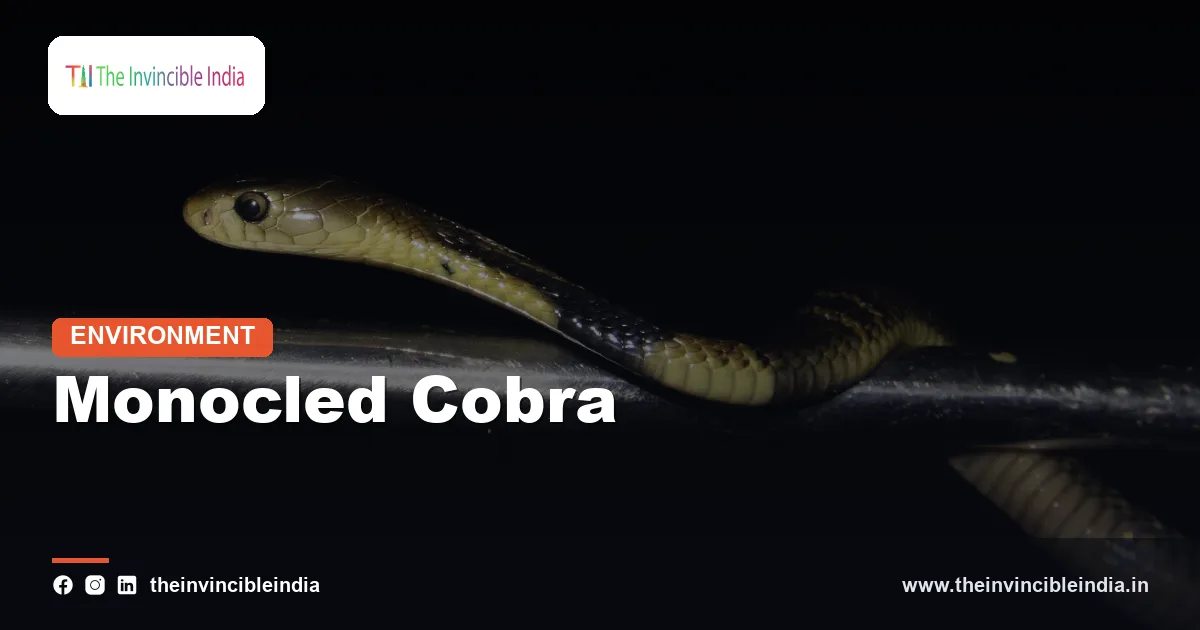
The monocled cobra (Naja kaouthia) is a large venomous cobra of the family Elapidae, found mainly in eastern and northeast India and recognised by a single, ring-shaped O mark on the back of its spread hood. Because that mark looks like a monocle, the snake gets its English name, and the same feature separates it at a glance from the two-ringed “spectacle” pattern of the better-known Indian cobra.
The monocled cobra is common around rivers, paddy fields, ponds and villages across the Gangetic plains and the Brahmaputra valley, which makes it one of the snakes people in these regions are most likely to meet. This article explains how to identify the monocled cobra, where it lives, what it eats, how its venom acts, what to do after a bite and why the species deserves tolerance rather than fear.
| Common name | Monocled cobra (also called the monocellate cobra or Bengal cobra) |
|---|---|
| Scientific name | Naja kaouthia |
| Family | Elapidae (cobras, kraits, mambas and coral snakes) |
| Typical size | About 1 to 1.5 metres; large individuals can approach 2 metres |
| Range in India | West Bengal, Assam and other northeastern states, Bihar, Odisha and nearby eastern regions; also Bangladesh, Nepal and Southeast Asia |
| Habitat | Paddy fields, riverbanks, wetlands, plantations, forest edges and villages |
| Venom type | Mainly neurotoxic, with cytotoxic components that damage tissue around the bite |
| Diet | Rodents, frogs, lizards, fish, birds’ eggs and other snakes |
| Conservation status | Least Concern globally (IUCN); protected under the Wildlife (Protection) Act, 1972 |
Key Takeaways
- The monocled cobra (Naja kaouthia) is identified by one O-shaped ring on the back of its hood, unlike the two-ringed spectacle mark of the Indian cobra.
- The monocled cobra is found mainly in eastern and northeast India, including West Bengal, Assam and Odisha, and lives close to water, farmland and human settlements.
- Monocled cobra venom is chiefly neurotoxic and can cause paralysis, but it also damages local tissue, so a bite needs urgent hospital treatment.
- After any suspected cobra bite, the victim should stay calm, keep the limb still and reach a hospital quickly, because antivenom given under medical supervision is the proven treatment.
- The monocled cobra eats large numbers of rats and other pests, which makes it a useful ally of farmers.
- Killing a monocled cobra is illegal under Indian wildlife law and is rarely necessary, because most bites happen when the snake is stepped on, cornered or handled.
What is the monocled cobra?
The monocled cobra is a medium-to-large, front-fanged, venomous snake that belongs to the true cobra genus Naja and is native to South and Southeast Asia. Its scientific name, Naja kaouthia, was published by the French naturalist René Lesson in 1831, and the species is also known as the monocellate cobra or the Bengal cobra because of the region where it is most familiar.
Like all cobras, the monocled cobra can raise the front part of its body off the ground and flatten its neck into a broad hood by spreading elongated ribs. This display is a warning, not an attack. A cobra that hoods is telling a larger animal to keep away, and in many encounters the snake would rather retreat than bite.
The monocled cobra is one of several cobra species in India. Others include the Indian or spectacled cobra (Naja naja), the central Asian cobra (Naja oxiana) in the far north-west, the Andaman cobra (Naja sagittifera) and the king cobra (Ophiophagus hannah), which belongs to a separate genus. The monocled cobra is the dominant cobra over much of the eastern part of the country.
How can you identify a monocled cobra?
A monocled cobra can be identified by a single circular or ring-shaped mark, often pale with a dark centre, on the back of the hood. The ground colour of the body varies from olive brown and yellowish brown to dark grey or almost black, and some individuals are uniformly dark without a clear hood mark, which can make identification harder.
Key identification features
- Hood mark: one O-shaped monocle, in contrast to the paired spectacle marks joined by a curved line in the Indian cobra.
- Head: short, rounded and only slightly wider than the neck, with a rounded snout and large eyes with round pupils.
- Throat and neck: often a pale throat with one or two dark bands on the underside of the neck when the hood is spread.
- Scales: smooth and glossy, giving the snake a polished look.
- Size and build: a robust body that tapers to a fairly short tail, usually between one and one and a half metres in length.
Young monocled cobras are often more strongly patterned than adults, with pale crossbands on a darker body. Colour and pattern vary between regions, and a snake should never be identified from a single photograph or a quick glance. If a bite occurs, the hospital treats the symptoms, so identifying the species matters less than getting medical help.
Where does the monocled cobra live in India?
The monocled cobra lives mainly in eastern and northeast India, including West Bengal, Assam, Meghalaya, Tripura, Manipur, Mizoram, Nagaland, Arunachal Pradesh and Odisha, with its range extending west towards Bihar and the eastern plains. Beyond India, the species occurs in Nepal, Bangladesh, Myanmar, Thailand, Laos, Cambodia, Vietnam and southern China.
The monocled cobra thrives in wet, low-lying country. Typical habitats include paddy fields, river and canal banks, marshes, ponds, mangrove edges, bamboo groves, tea gardens and plantations. It also shelters in rat burrows, termite mounds, woodpiles, ruins, stone walls and the gaps under old buildings, which brings it close to villages and farmhouses.
The snake is mostly terrestrial, but it climbs well and swims strongly. It tends to be most active at dusk and during the night, although it is also seen foraging in the early morning and on cloudy days. Populations are generally denser where food and cover are abundant, which is why irrigated farmland with plenty of rodents is such a favourable habitat.
What does the monocled cobra eat and how does it hunt?
The monocled cobra eats mainly rodents, frogs, toads, lizards, fish, birds’ eggs and other snakes, which it kills with venom and swallows whole. It is an active forager that follows scent trails and enters burrows, and it is just as comfortable hunting in shallow water as on land.
After biting, the monocled cobra often holds its prey until the venom takes effect. The snake then swallows the animal headfirst, using flexible jaws that stretch around a meal larger than its own head. Rats form an important share of the diet in farmland, so a monocled cobra living near a granary may remove many more pests than a farmer realises.
- Rodents: field rats, bandicoots and house mice, often caught in burrows.
- Amphibians: frogs and toads around ponds and flooded fields.
- Reptiles: lizards and smaller snakes, including non-venomous species.
- Others: fish, nestling birds and eggs.
The monocled cobra is also hunted in turn. Mongooses, monitor lizards, birds of prey and the king cobra take adults and young, while eggs and hatchlings face many more predators. A cobra that reaches adulthood has usually spent years avoiding danger by staying hidden.
How does the monocled cobra breed?
The monocled cobra is oviparous, meaning the female lays eggs rather than giving birth to live young. Mating takes place in the cooler months, and the female typically lays a clutch of roughly 8 to 45 eggs, usually between the late dry season and the early monsoon, in a hollow, burrow or pile of decaying vegetation.
Female monocled cobras are known to stay near the nest and guard it, a behaviour shared by several cobras. The eggs hatch after about two months, depending on temperature. Hatchlings are around 20 to 30 centimetres long, are fully venomous from birth and receive no parental care once they emerge.
Young monocled cobras eat small frogs, lizards and insects at first. They grow quickly in their first years, shedding their skin several times annually, and may live for well over a decade in the wild if they avoid predators and road traffic.
How dangerous is monocled cobra venom?
Monocled cobra venom is mainly neurotoxic, meaning it interferes with nerve signals to the muscles, but it also contains cytotoxic components that destroy tissue at the bite site. A serious bite can therefore cause both paralysis and painful local swelling and necrosis, and untreated envenoming can be fatal.
What the venom does
- Neurotoxic effects: drooping eyelids, blurred or double vision, difficulty swallowing and speaking, and weakening of the breathing muscles. Paralysis of respiration is the main cause of death.
- Cytotoxic effects: pain, swelling, blistering and darkening of the skin near the bite, which can progress to dead tissue and may need surgical care.
- Dry bites: a cobra does not always inject venom when it bites, so some bites cause no poisoning, although this can never be assumed.
Some populations of the monocled cobra can also spit venom towards the eyes of a threat. Spat venom is not harmful on intact skin, but it can cause intense pain and inflammation if it reaches the eyes, and the eyes should be rinsed with plenty of clean water for a long period before medical care.
The monocled cobra is not part of the “Big Four” snakes of medical importance in India, which are the Indian cobra, the common krait, Russell’s viper and the saw-scaled viper. It is nevertheless a significant cause of snakebite in the east and northeast. The standard Indian polyvalent antivenom is prepared against the Big Four, and doctors in the east judge its use by the patient’s symptoms, which is another reason to reach a hospital with a trained team.
How does the monocled cobra differ from the Indian cobra?
The monocled cobra differs from the Indian cobra mainly in its hood mark, which is a single O-shaped ring instead of a pair of spectacle-like rings, and in its range, which is centred on eastern and northeast India rather than the peninsula and the west.
| Feature | Monocled cobra | Indian (spectacled) cobra |
|---|---|---|
| Scientific name | Naja kaouthia | Naja naja |
| Hood mark | A single O-shaped ring | Two rings joined by a curved line, like spectacles |
| Main range in India | East and northeast | Most of the peninsula, west and north |
| Venom action | Neurotoxic with notable tissue damage | Neurotoxic with tissue damage |
| Medical importance | Major in the east and northeast | Part of the “Big Four” |
The two species belong to the same genus and look alike in general shape and behaviour, so the practical advice is the same for both. Because hood patterns vary and some snakes lack clear marks, people should treat every cobra with the same caution.
What should you do after a monocled cobra bite?
After a monocled cobra bite, the person should be kept calm and still, the bitten limb should be immobilised, and the victim should be taken to the nearest hospital with antivenom as quickly as possible. India’s snakebite guidance describes this approach with the phrase “Do it RIGHT”: reassure, immobilise, get to hospital immediately and tell the doctor about symptoms.
Responsible first-aid steps
- Move away from the snake and keep the person calm, because panic and movement speed the spread of venom.
- Immobilise the limb as if it were fractured, using a splint or sling, and keep it at about heart level.
- Remove rings, bangles, watches and tight clothing before swelling begins.
- Go to a hospital immediately, preferably one that stocks antivenom and has facilities for breathing support, and do not wait for symptoms to appear.
- Note the time of the bite and any symptoms, and, if it can be done safely, take a photograph of the snake from a distance to help the doctors.
What not to do
- Do not cut the wound, suck the venom or apply chemicals.
- Do not tie a tight tourniquet, which can cause serious damage to the limb.
- Do not use herbs, stones, charms or other folk remedies, and do not delay treatment to visit a traditional healer.
- Do not try to catch or kill the snake, which risks a second bite.
Antivenom, given in a hospital under medical supervision, is the specific treatment for cobra envenoming, and patients with breathing difficulty may need ventilator support. Early treatment greatly improves the chance of full recovery.
How can people avoid conflict with monocled cobras?
People can avoid conflict with monocled cobras mainly by reducing rodents and hiding places near homes, lighting paths at night, wearing footwear in fields and never trying to handle or kill the snake. Most bites happen when someone steps on or reaches near a snake they have not seen.
- Keep grain stored in sealed containers and clear rubbish, because rats attract snakes.
- Trim long grass and clear woodpiles, bricks and debris from around houses.
- Carry a torch after dark and wear closed shoes or gumboots in paddy fields and bushy areas.
- Use a stick or a long tool to move vegetation before reaching in with a hand.
- Sleep on a raised bed with a mosquito net tucked in, particularly during the monsoon.
- If a cobra enters a house, keep people and pets away and call the local forest department or a trained, registered snake rescuer.
Snakes found in homes are usually looking for food or shelter and are often more afraid of people than people are of them. Standing still at a safe distance until the snake moves away is a better response than panic.
Why is the monocled cobra important for ecology and culture?
The monocled cobra is important because it controls rodent populations, forms a link in wetland and farmland food webs and holds a place in the cultural life of eastern India. A single cobra can eat many rats in a season, which reduces crop losses and the spread of rodent-borne disease.
Snakes are part of the traditions of many communities in the region. The cobra is associated with festivals such as Nag Panchami in many parts of India and with the folk goddess Manasa, who is widely worshipped in Bengal, Assam and neighbouring areas as the protector against snakebite. These traditions show a long history of respect for snakes, even among people who live with the real risk of bites.
Cobra venom itself has scientific value. Components of cobra venoms have been studied for pain research and for understanding how nerves and blood work. These uses depend on the animals staying alive in healthy habitats.
Is the monocled cobra protected in India?
Yes, the monocled cobra is protected in India under the Wildlife (Protection) Act, 1972, which makes killing, capturing or trading wild cobras without permission a punishable offence. Globally, the International Union for Conservation of Nature (IUCN) lists the species as Least Concern, because it is widespread and fairly common.
Even so, local populations face pressure from habitat loss, road deaths, killing out of fear and illegal trade in skins and for entertainment. Snake charming was banned in India under wildlife law, and cobras are also listed under international trade controls, because wild animals were taken in large numbers and often suffered badly in captivity.
Snakes are essential to healthy ecosystems, and they should not be killed on sight. Conservation here means keeping enough habitat, reducing the reasons for conflict, and giving rural communities access to quick, effective snakebite treatment so that both people and snakes are safer.
Bottom Line
The monocled cobra is a powerful but generally shy snake of eastern and northeast India, identified by the single O mark on its hood. Its venom is dangerous, and any bite needs immediate hospital care with antivenom, but bites are largely preventable with simple precautions. The species controls pests, is legally protected, and is best left alone.
Frequently Asked Questions
What is a monocled cobra?
The monocled cobra (Naja kaouthia) is a venomous cobra of eastern and northeast India that has a single ring-shaped mark on the back of its hood. It belongs to the family Elapidae and usually grows to about 1 to 1.5 metres. It is common near water, farmland and villages.
Where is the monocled cobra found in India?
The monocled cobra is found mainly in West Bengal, Assam, other northeastern states, Odisha and nearby eastern regions. It also lives in Nepal, Bangladesh and much of Southeast Asia. It prefers wet, low-lying habitats such as paddy fields, riverbanks and village outskirts.
Is the monocled cobra venomous to humans?
Yes, the monocled cobra is venomous, and its bite can be life-threatening. The venom is mainly neurotoxic, causing weakness and breathing failure, and it can also damage tissue around the bite. Any suspected bite needs urgent treatment in a hospital with antivenom.
How is the monocled cobra different from the Indian cobra?
The monocled cobra has one O-shaped mark on its hood, while the Indian cobra has a paired spectacle pattern. The two also differ in range, as the monocled cobra is mainly eastern and northeastern and the Indian cobra is more widespread across the peninsula. Both are dangerous and need the same first-aid response.
What should I do if a monocled cobra bites someone?
Keep the person calm, immobilise the bitten limb and take them to a hospital that has antivenom as fast as possible. Do not cut the wound, suck out venom, tie a tight tourniquet or use folk remedies. Tell the doctors when the bite happened and what symptoms have appeared.
Is it legal to kill a monocled cobra in India?
No, killing or capturing a wild monocled cobra is an offence under the Wildlife (Protection) Act, 1972. The snake is also useful because it eats rats and other pests. If one enters a home, the safe course is to keep away and call the forest department or a trained snake rescuer.
{“@context”:”https://schema.org”,”@graph”:[{“@type”:”FAQPage”,”mainEntity”:[{“@type”:”Question”,”name”:”What is a monocled cobra?”,”acceptedAnswer”:{“@type”:”Answer”,”text”:”The monocled cobra (Naja kaouthia) is a venomous cobra of eastern and northeast India that has a single ring-shaped mark on the back of its hood. It belongs to the family Elapidae and usually grows to about 1 to 1.5 metres. It is common near water, farmland and villages.”}},{“@type”:”Question”,”name”:”Where is the monocled cobra found in India?”,”acceptedAnswer”:{“@type”:”Answer”,”text”:”The monocled cobra is found mainly in West Bengal, Assam, other northeastern states, Odisha and nearby eastern regions. It also lives in Nepal, Bangladesh and much of Southeast Asia. It prefers wet, low-lying habitats such as paddy fields, riverbanks and village outskirts.”}},{“@type”:”Question”,”name”:”Is the monocled cobra venomous to humans?”,”acceptedAnswer”:{“@type”:”Answer”,”text”:”Yes, the monocled cobra is venomous, and its bite can be life-threatening. The venom is mainly neurotoxic, causing weakness and breathing failure, and it can also damage tissue around the bite. Any suspected bite needs urgent treatment in a hospital with antivenom.”}},{“@type”:”Question”,”name”:”How is the monocled cobra different from the Indian cobra?”,”acceptedAnswer”:{“@type”:”Answer”,”text”:”The monocled cobra has one O-shaped mark on its hood, while the Indian cobra has a paired spectacle pattern. The two also differ in range, as the monocled cobra is mainly eastern and northeastern and the Indian cobra is more widespread across the peninsula. Both are dangerous and need the same first-aid response.”}},{“@type”:”Question”,”name”:”What should I do if a monocled cobra bites someone?”,”acceptedAnswer”:{“@type”:”Answer”,”text”:”Keep the person calm, immobilise the bitten limb and take them to a hospital that has antivenom as fast as possible. Do not cut the wound, suck out venom, tie a tight tourniquet or use folk remedies. Tell the doctors when the bite happened and what symptoms have appeared.”}},{“@type”:”Question”,”name”:”Is it legal to kill a monocled cobra in India?”,”acceptedAnswer”:{“@type”:”Answer”,”text”:”No, killing or capturing a wild monocled cobra is an offence under the Wildlife (Protection) Act, 1972. The snake is also useful because it eats rats and other pests. If one enters a home, the safe course is to keep away and call the forest department or a trained snake rescuer.”}}]}]}


