

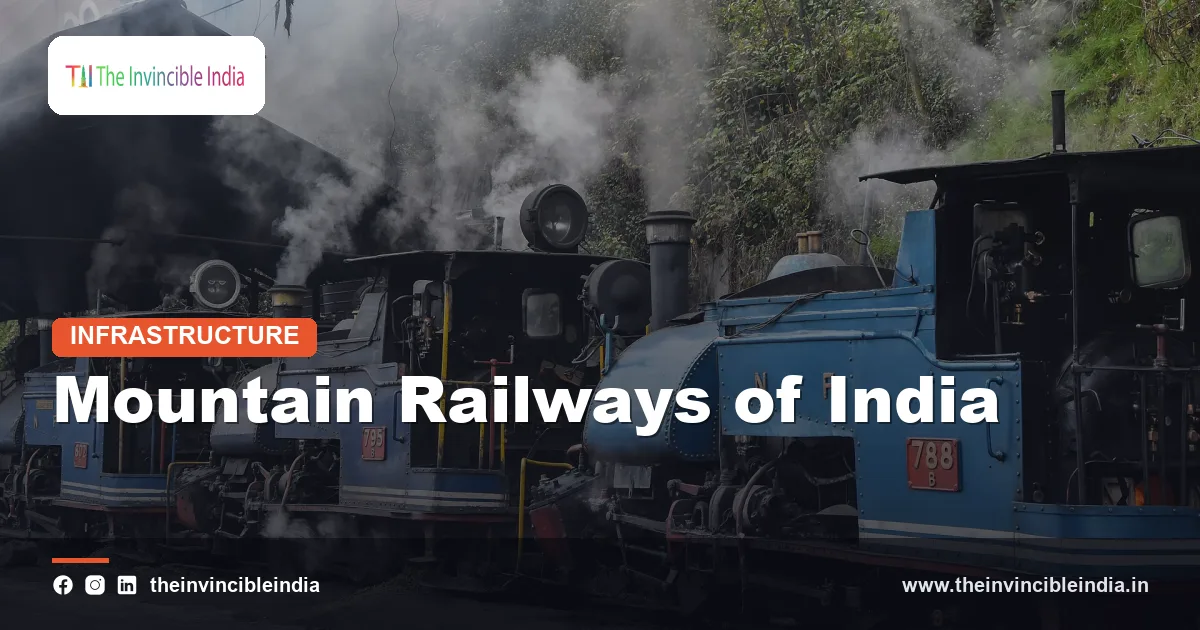
The mountain railways of India are among the most celebrated examples of railway engineering anywhere in the world. Built mostly between the 1880s and the early twentieth century, these narrow-gauge lines wind through the Himalayan foothills and the Nilgiri hills, climbing steep slopes with loops, reversing zig-zags, rack-and-pinion tracks and long chains of tunnels. Three of them, the Darjeeling Himalayan Railway, the Nilgiri Mountain Railway and the Kalka-Shimla Railway, together form a single UNESCO World Heritage Site titled “Mountain Railways of India”.
These railways were created to connect colonial hill stations with the plains, but today they matter for different reasons. They are living museums of steam-era technology, a source of livelihood for the communities along their routes, and a major draw for domestic and foreign travellers. This explainer looks at how they came about, how they work, what makes each line special, and what keeps them running more than a century later.
| Fact | Detail |
|---|---|
| UNESCO site name | Mountain Railways of India (cultural site) |
| Darjeeling Himalayan Railway | Inscribed 1999; 2 ft (610 mm) gauge; opened 1881 |
| Nilgiri Mountain Railway | Added 2005; metre gauge; rack-and-pinion section; fully opened 1908 |
| Kalka-Shimla Railway | Added 2008; 2 ft 6 in (762 mm) gauge; opened 1903 |
| Other heritage hill lines | Kangra Valley Railway and Matheran Hill Railway |
| Common features | Narrow gauge, tight curves, steep gradients, heritage rolling stock |
| Operator | Indian Railways (various zones) |
| Main purpose today | Heritage tourism and local passenger service |
Why Mountain Railways Were Built in India
In the nineteenth century, British administrators and planters in India sought relief from the heat of the plains. Hill stations such as Darjeeling, Ooty and Shimla grew into summer retreats, sanatoria and, in the case of Shimla, the summer capital of British India. Roads up these slopes were slow, and bullock carts and ponies could carry only limited loads. Tea, timber, cinchona and supplies had to move up and down the hills, and officials needed dependable communication with the plains.
A railway offered the answer, but a conventional broad-gauge line could not climb such terrain without enormous cost. Engineers therefore turned to narrow gauges, which allow sharper curves, lighter bridges and smaller tunnels. A narrow line could hug the contours of a hillside instead of cutting through it.
The Economic Logic
- Tea gardens around Darjeeling needed a cheap way to bring chests down to the plains.
- Hill stations needed food, building material and fuel in bulk.
- Governments wanted faster movement of officials and troops during the hot season.
- The lines opened remote villages to markets, schools and hospitals.
The result was a set of railways that look improbable on a map: tiny trains running on tracks barely wider than a footpath, yet engineered to remarkable standards of precision.
The Darjeeling Himalayan Railway
The Darjeeling Himalayan Railway (DHR), known affectionately as the “Toy Train”, runs in West Bengal between New Jalpaiguri, near Siliguri, and the hill town of Darjeeling. The line is about 88 km long and has a gauge of just 2 feet (610 mm). It was opened in stages: the section to Kurseong came into service around 1880, and the line reached Darjeeling in 1881. The company behind the project was the Darjeeling Himalayan Railway Company, and Franklin Prestage is the engineer most often credited with its planning.
The railway rises from the plains at a few hundred metres above sea level to the high point at Ghum, which stands at roughly 2,258 m and is among the highest railway stations in India. From Ghum the track descends slightly to Darjeeling itself.
Tracks That Share the Road
For much of its length, the DHR runs alongside the Hill Cart Road, crossing it repeatedly. Trains pass through the middle of bazaars, with shops and houses only a few feet from the rails. This closeness to everyday life is part of its charm and part of the reason UNESCO recognised it as an outstanding example of the interchange of ideas between Britain and the Himalayan communities.
The Steam Locomotives
The railway is famous for its small B-class steam locomotives, built in Britain by Sharp, Stewart and Company in the late nineteenth and early twentieth centuries. Their compact 0-4-0 saddle-tank design suits the tight curves of the line. A few of them still haul tourist services, while diesel engines handle other duties. The Tindharia workshops, midway along the route, have historically maintained the locomotives and carriages.
Loops, Reverses and the Batasia Loop
The great problem of a hill railway is gradient. A train can climb only so steeply before its wheels lose grip, so engineers must lengthen the route to reduce the slope. The DHR solved this with two clever devices: spiral loops and zig-zag reverses.
Loops
On a loop, the line crosses over or under itself to gain height within a small area. The most famous is the Batasia Loop, built in 1919 between Ghum and Darjeeling to ease the final climb. Trains wind around a spiral on a gentle gradient, and at the centre of the loop stands a memorial garden dedicated to Gorkha soldiers. Visitors can see the Kanchenjunga range from here on clear days, and many services pause at the loop so that passengers can step out and take in the scene.
Zig-Zag Reverses
Where there is no room for a loop, the track climbs in a zig-zag. The train runs forward up a short slope, stops, and then reverses up the next slope, switching direction at points. The DHR has several such reverses, including the one near Agony Point, whose name speaks to the effort of locomotives climbing in the monsoon.
- Loops reduce the average gradient by lengthening the track.
- Zig-zags allow the same hillside to be climbed in a short horizontal distance.
- Both devices keep the line within the limits of small locomotives.
The Nilgiri Mountain Railway
The Nilgiri Mountain Railway (NMR) climbs from Mettupalayam in Tamil Nadu to Udhagamandalam, better known as Ooty, a distance of about 46 km. Unlike the Darjeeling line, it is a metre-gauge railway, and it is the only rack railway in India. The idea of a hill line in the Nilgiris was floated as early as the 1850s, but the difficulty of the terrain delayed construction. Work began in the 1890s, the line reached Coonoor in 1899, and it was extended to Ooty in 1908.
The route climbs from the plains of Mettupalayam, at a little over 300 m, to Ooty at over 2,200 m. In that short distance it passes through dense forest, tea estates, deep gorges and a chain of tunnels and bridges. Southern Railway manages the line today.
Highlights Along the Route
- Kallar, where the rack section begins.
- Hillgrove and Runneymede, small stations in forested stretches.
- Coonoor, the main intermediate hill town, famed for its tea.
- Wellington and Lovedale, before the final run into Ooty.
The line has also appeared in many films, which has added to its fame beyond the railway community.
How the Rack-and-Pinion System Works
Between Kallar and Coonoor, the gradient is so steep, at around 1 in 12.5 in places, that ordinary wheel-on-rail adhesion would fail. The NMR therefore uses the Abt rack system, invented by the Swiss engineer Carl Roman Abt. A toothed rail is laid between the two running rails. A cogwheel under the locomotive meshes with this toothed rail, so the engine essentially pulls itself up the slope rather than relying on friction.
The Abt Principle
The Abt rack uses two or three parallel toothed bars, set so that their teeth are staggered. This ensures that at least one tooth of the cogwheel is always engaged, which gives a smooth and secure climb. The same system keeps the train under control on the descent, since the cogwheel and brakes prevent runaway movement.
Locomotives of the NMR
The special X-class steam locomotives were built by the Swiss Locomotive and Machine Works in Winterthur and are fitted for rack operation. They push the carriages from below on the way up and lead from the front on the way down. Their design means that the water tank and boiler are inclined to suit the slope, so that the boiler stays level when the engine is on the gradient. Diesel locomotives now assist on the lower section, while steam continues on the rack stretch for heritage services.
The Kalka-Shimla Railway
The Kalka-Shimla Railway connects Kalka, on the edge of the Haryana plains, to Shimla, the capital of Himachal Pradesh. It runs for roughly 96 km on a 2 ft 6 in (762 mm) narrow gauge and was opened in 1903. Shimla had served as the summer capital of British India, and the railway was meant to link it directly to the railhead of Kalka and, through it, to the rest of the network.
The line climbs from about 650 m at Kalka to more than 2,000 m at Shimla. Construction was demanding: the route crosses numerous ravines and ridges, and the builders had to cut through hillsides in a region prone to landslides.
Tunnels and Bridges
The railway is known for its extraordinary number of tunnels, usually cited as over a hundred, and hundreds of bridges and viaducts. Many of the bridges are built in stone, in the style of Roman aqueducts, with multiple arched galleries. The well-known arch-gallery bridge near Kandaghat is a fine example, and the line is also admired for its tidy, fort-like stations.
Rail Motor Cars and Trains
Alongside conventional trains, the line is known for small rail motor cars that offer a more intimate way to see the hills. The Himalayan Queen, a regular morning service, remains one of the best-known services on the route.
Barog Tunnel and Other Engineering Feats
Of all the tunnels on the Kalka-Shimla line, the one at Barog is the most famous. Tunnel number 33 is the longest on the route, at a little over a kilometre. Tradition says it was named after Colonel Barog, the British engineer who first attempted to build it. According to the story, the two teams that began digging from opposite ends of the hill failed to meet in the middle because of a miscalculation, and the officer, embarrassed, took his own life. The tunnel was later completed under the guidance of a local mystic, Baba Bhalku, who is remembered in a railway museum in Shimla.
Historians treat parts of this account as legend, but it has become inseparable from the tunnel’s fame. The nearby station of Barog is a popular halt, where passengers can step off for tea and breakfast.
| Feature | Darjeeling (DHR) | Nilgiri (NMR) | Kalka-Shimla (KSR) |
|---|---|---|---|
| State | West Bengal | Tamil Nadu | Haryana / Himachal Pradesh |
| Gauge | 2 ft (610 mm) | Metre (1,000 mm) | 2 ft 6 in (762 mm) |
| Length | About 88 km | About 46 km | About 96 km |
| Opened | 1881 | 1899 to 1908 | 1903 |
| Signature feature | Batasia Loop, zig-zags | Abt rack section | Tunnels, arched bridges |
| UNESCO year | 1999 | 2005 | 2008 |
UNESCO World Heritage Recognition
The Darjeeling Himalayan Railway became the first railway in Asia, and the second in the world after the Semmering Railway in Austria, to be inscribed as a World Heritage Site, in 1999. In 2005 the Nilgiri Mountain Railway was added as an extension, and in 2008 the Kalka-Shimla Railway joined, converting the site into the serial property now known as the Mountain Railways of India.
What UNESCO Valued
- The lines are outstanding examples of bold, ingenious engineering solutions for establishing an effective rail link through rugged mountainous terrain.
- They show how railway technology influenced social and economic development in multicultural regions.
- They remain in working condition and carry on many of their original functions.
The recognition brings responsibilities. The railways must keep their original character, including gauge, stations, bridges and many operating practices, while meeting modern safety expectations. Conservation of buildings, rolling stock and track alignments is a continuing task, shared among the railway zones and heritage experts.
The Kangra Valley and Matheran Lines
India has other hill railways of heritage value that sit outside the UNESCO listing but share the same spirit. The Kangra Valley Railway runs about 164 km from Pathankot in Punjab to Jogindernagar in Himachal Pradesh, along the foot of the Dhauladhar range. It was completed in 1929 on a 2 ft 6 in gauge. Its route passes through Nagrota, Palampur and Baijnath, and crosses the Chakki river on a long steel bridge. The line is admired for views of snow-capped peaks and for its gentler gradients, which make it a different experience from the steeper Kalka-Shimla route.
The Matheran Hill Railway links Neral with the hill station of Matheran, near Mumbai, over about 20 km on a 2 ft gauge. It was built in the early 1900s, with the line opening in 1907, and its tiny trains pass through sharp curves and short tunnels. Matheran is a vehicle-free hill station, so the toy train is among the main ways to reach the top.
Both lines have been proposed for consideration as future World Heritage nominations, and both rely heavily on tourism and local ridership.
Tourism, Challenges and the Future
Today the mountain railways are less about transport and more about experience. Tourists take the Toy Train for the scenery, the sounds of steam and the sense of travelling through time. Special services such as vistadome coaches, heritage steam charters and joy rides have been introduced to bring in revenue and keep the old engines active.
Challenges
- Landslides and heavy monsoon rain regularly damage tracks, especially in Darjeeling and Shimla.
- Steam locomotives and heritage coaches are ageing, and spare parts must often be made by hand.
- Road competition has reduced everyday ridership on some sections.
- Balancing conservation with passenger comfort is an ongoing difficulty.
Looking Ahead
The lines continue to receive investment in restoration, signalling and rolling stock. Many hill communities depend on the railway for tourism income, which gives local people a strong stake in its survival. Keeping the trains running requires craft skills that are increasingly rare, so training new staff in steam maintenance forms part of the heritage effort.
Conclusion
The mountain railways of India show how determination and ingenuity can overcome difficult terrain. A tiny two-foot-gauge train climbing to Darjeeling, a rack locomotive pulling itself up the Nilgiris and a chain of tunnels leading to Shimla are not just relics. They are working railways that connect the past with the present. For travellers, they offer a slow, rewarding way to see the hills; for engineers, they remain textbook examples of problem-solving. Their continued upkeep is a shared responsibility of railway authorities, local communities and visitors, last reviewed in 2 October 2026.
Frequently Asked Questions
Which railways make up the Mountain Railways of India World Heritage Site?
The site comprises three railways: the Darjeeling Himalayan Railway (inscribed in 1999), the Nilgiri Mountain Railway (added in 2005) and the Kalka-Shimla Railway (added in 2008). Together they represent the finest hill railway engineering in the country.
Why is the Darjeeling Himalayan Railway called the Toy Train?
The railway runs on a very narrow 2 ft gauge, and its locomotives and carriages are small compared with those on regular lines. The small size, together with the winding route through towns and tea gardens, gave it the affectionate nickname Toy Train.
What is special about the Nilgiri Mountain Railway?
It is the only rack-and-pinion railway in India. On the steep stretch between Kallar and Coonoor, a toothed rail laid between the running rails engages a cogwheel under the locomotive, allowing the train to climb gradients that ordinary adhesion could not manage.
What is the Barog tunnel on the Kalka-Shimla line?
Tunnel number 33 at Barog is the longest tunnel on the Kalka-Shimla Railway, at a little over a kilometre. It is named after a British engineer, Colonel Barog, and is surrounded by a local legend about its construction.
Are the Kangra Valley and Matheran railways World Heritage Sites?
No. Both are valued heritage hill railways, and both have been proposed for consideration in the future, but only the Darjeeling, Nilgiri and Kalka-Shimla lines are part of the current UNESCO listing.
Can tourists still ride steam trains on these lines?
Yes. Steam locomotives still operate on selected services on the Darjeeling and Nilgiri lines, usually as tourist or heritage runs, while diesel engines handle much of the regular service. Timetables and availability vary by season, so it is best to check with Indian Railways before travelling.


