

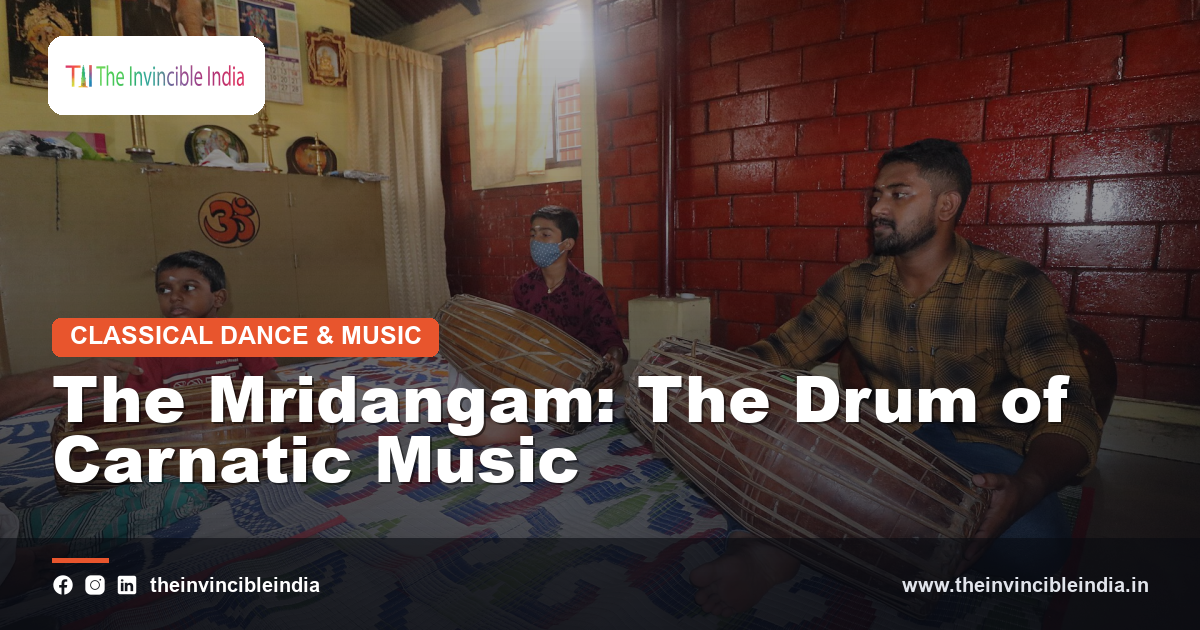
The mridangam is the principal percussion instrument of Carnatic classical music, a double-headed barrel drum whose rich, precisely tuned tones provide the rhythmic foundation for virtually every South Indian classical performance. Occupying in Carnatic music a role comparable to that of the tabla in the Hindustani tradition, the mridangam accompanies vocalists and instrumentalists alike, marking the tala with a combination of steady rhythm and dazzling improvised elaboration. Its two heads, of different sizes and pitches, are played simultaneously by the two hands, producing a wide palette of distinct sounds capable of both subtle accompaniment and virtuosic solo display. This guide explores the mridangam’s construction, its playing technique, its central role in Carnatic ensembles and the training required to master it.
Quick Facts
| Detail | Information |
|---|---|
| Type | A double-headed barrel drum |
| Tradition | The principal percussion instrument of Carnatic music |
| Construction | A hollow wooden barrel with skin heads at both ends |
| Playing | Both heads played simultaneously with the hands |
| Role | Keeps the tala and provides rhythmic accompaniment |
| Tonal preparation | A paste applied to one head to shape its tone |
The Heartbeat of Carnatic Music
The mridangam holds a place in Carnatic music that can fairly be called indispensable, providing the rhythmic pulse against which every vocal or instrumental performance unfolds. No serious Carnatic concert proceeds without a mridangam player seated beside the principal performer, ready to mark the tala, support the melody and, in due course, showcase the drum’s own considerable expressive and technical range. This central, ever-present role has earned the mridangam a reputation as the heartbeat of Carnatic music, an instrument so deeply woven into the tradition that South Indian classical performance is scarcely imaginable without its distinctive, resonant voice.
The Structure of the Mridangam
The mridangam is a barrel-shaped drum, traditionally carved from a single block of wood and hollowed out, with a skin head stretched over each end, the two heads differing in diameter and therefore in pitch. The larger head produces deeper, bass tones, while the smaller head produces higher-pitched sounds, and together the two heads give the player access to a wide and varied range of tonal colours from a single instrument. This barrel form, tapering slightly from the larger end to the smaller, along with the careful selection of wood, is fundamental to the instrument’s characteristic resonance and its ability to sustain a rich, full tone.
The Tuning Paste
A distinctive feature of the mridangam is the application of a black paste, made from a mixture including rice flour and other materials, applied to the centre of the smaller, higher-pitched head to give it a precise, bell-like tone with a clearly defined pitch. This paste must be applied and maintained with considerable skill, since its thickness and placement directly affect the exact pitch and clarity of the drum’s sound, and it may need periodic reapplication or adjustment. This careful tonal preparation is one of the features that gives the mridangam its uniquely clear, musical sound compared to many other drums, allowing it to blend precisely with the pitch of the accompanying melody.
Preparing the Bass Head
The larger, bass head of the mridangam is prepared differently from the treble head, typically requiring the application of a small amount of dough or paste, often prepared fresh before a performance, applied temporarily to the centre of the skin to produce its characteristic deep, resonant bass tone. Unlike the more permanent paste on the treble head, this bass preparation may be adjusted or reapplied during a single sitting to achieve exactly the tone the player desires for a given performance or passage. This attentive, almost ritual preparation of both heads before playing reflects the seriousness with which mridangam players approach the tonal quality of their instrument.
How the Mridangam Is Played
The mridangam is played horizontally, resting across the player’s lap or on a support, with both heads struck simultaneously using the fingers and palms of both hands, one hand on each head. The player produces an extensive vocabulary of distinct strokes by varying finger position, hand shape and the part of the palm or fingers used, each stroke yielding its own characteristic sound and named according to a traditional system of rhythmic syllables. Coordinating the two hands to produce complex, interlocking rhythmic patterns across both heads simultaneously requires years of practice, and this coordinated two-handed technique is central to the instrument’s distinctive and highly developed musical language.
The Language of Rhythmic Syllables
Mridangam technique is built upon a spoken system of rhythmic syllables, known as solkattu, in which each distinct drum stroke corresponds to a specific spoken sound. Students learn to recite these syllables aloud, building up complex rhythmic phrases and compositions through spoken recitation before ever attempting to play them on the drum itself. This vocal-rhythmic language allows intricate percussion compositions to be composed, memorised, taught and discussed with great precision, independent of the instrument, and it forms an essential bridge between rhythmic theory and the physical technique required to execute complex patterns accurately on the mridangam.
Accompanying the Melody
In performance, the mridangam player’s primary responsibility is to support the principal vocalist or instrumentalist, maintaining the chosen tala steadily while remaining sensitively responsive to the shifting moods and phrasing of the melodic line. A skilled accompanist listens closely and adapts, sometimes playing quite simply to support a delicate melodic passage and at other times adding intricate rhythmic elaboration during more energetic sections, always careful never to overwhelm the main performer. This attentive, responsive quality of accompaniment, balancing rhythmic authority with musical sensitivity, is considered one of the true marks of an accomplished mridangam player within the Carnatic tradition.
The Tani Avartanam
A highlight of many Carnatic concerts is the tani avartanam, an extended percussion solo, usually placed towards the end of a major composition, in which the mridangam player, often joined by other percussionists, takes centre stage to display virtuosic rhythmic invention within the chosen tala. During this solo, the drummer explores elaborate rhythmic patterns, intricate variations and dramatic passages that showcase both technical mastery and creative rhythmic imagination, all while remaining anchored to the tala’s cycle and building towards a climactic return to the sam. The tani avartanam is often eagerly anticipated by audiences as a thrilling demonstration of pure rhythmic artistry.
Learning the Mridangam
Training in the mridangam traditionally begins at a young age under the close supervision of an experienced guru, following the guru-shishya model common throughout Indian classical arts. Students first learn to recite the rhythmic syllables of solkattu accurately, building a strong internal sense of rhythm before beginning to translate these spoken patterns onto the drum itself. Physical technique, including hand position, finger strength and the coordination required to play both heads together, is developed gradually over years of disciplined daily practice, and only after this long foundation can a student progress to accompanying full concert performances with confidence and skill.
The Craft of Making a Mridangam
Constructing a fine mridangam is a specialised traditional craft, requiring careful selection and hollowing of a suitable log of wood to form the barrel body, followed by the precise preparation and stretching of skins for both heads to achieve correct tension and tone. Skilled craftsmen, often working within family workshops that have practised the trade for generations, must judge by ear and experience when an instrument’s heads are properly tensioned and balanced against one another. This demanding craftsmanship, largely unchanged in its essential methods over a long period, ensures that each mridangam produced carries the tonal qualities required for serious classical performance.
The Mridangam and Dance
Beyond vocal and instrumental concerts, the mridangam plays an essential role in accompanying Bharatanatyam and other South Indian classical dance performances, where its precise rhythmic patterns support and interact with the dancer’s footwork and choreography. The close coordination required between drummer and dancer, each responding to and anticipating the other, demands considerable skill and rehearsal, and a fine mridangam accompanist can significantly enhance the dramatic and rhythmic impact of a dance performance. This role in dance accompaniment further underscores the mridangam’s broad importance across the full range of South Indian classical performing arts, not confined to music alone.
Ensemble Percussion
While the mridangam is typically the principal percussion instrument in a Carnatic concert, it is often joined by additional percussion instruments such as the ghatam, a clay pot drum, and the kanjira, a small frame drum, particularly during the tani avartanam, creating a rich ensemble of contrasting percussive textures and tones. The mridangam player generally leads this percussion ensemble, coordinating the interplay between the different instruments and their distinct sounds within the shared framework of the tala. This collaborative percussion tradition adds further depth and variety to Carnatic performances, allowing audiences to appreciate a wide spectrum of rhythmic colour and virtuosity within a single concert.
Great Mridangam Players
Over the generations, the mridangam tradition has been shaped and elevated by numerous accomplished players, whose artistry, innovation and teaching have deepened and expanded the instrument’s technical and expressive possibilities. These respected performers have been sought after as accompanists by leading vocalists and instrumentalists, and many have also trained generations of students, ensuring the continuity and vitality of the tradition. Their combined contributions, across performance, composition and pedagogy, have helped secure the mridangam’s stature as far more than a mere accompanying instrument, but as a serious and demanding classical art form in its own right.
The Mridangam Beyond Carnatic Concerts
Though most closely associated with formal Carnatic classical concerts, the mridangam also appears in devotional music, temple rituals and various South Indian cultural and religious occasions, reflecting its deep integration into the broader musical and spiritual life of the region. Its resonant, clearly pitched tones make it well suited to accompanying devotional singing, and its presence at religious gatherings underscores the instrument’s significance beyond the concert hall alone. This wider presence demonstrates how thoroughly the mridangam has become woven into the cultural and religious fabric of South India, extending its importance well past the boundaries of purely classical performance.
The Mridangam Today
Today the mridangam continues to thrive as the essential percussion voice of Carnatic music, performed by dedicated professionals in concerts across India and internationally, and taught rigorously to new generations of students eager to master its demanding technique. Far from static, the tradition continues to develop, with contemporary players exploring new rhythmic ideas and occasionally collaborating across musical genres and traditions, while remaining firmly rooted in the classical technique and repertoire passed down through generations of teachers. As both indispensable accompanist and celebrated solo art, the mridangam remains one of the most vital and admired instruments in the entire landscape of Indian classical music.
Sources & Further Reading
- Sangeet Natak Akademi, national academy for music, dance and drama, on Carnatic percussion instruments (sangeetnatak.gov.in).
- Ministry of Culture, Government of India, on the classical music heritage of South India (indiaculture.gov.in).
Frequently Asked Questions
What is a mridangam?
The mridangam is the principal percussion instrument of Carnatic classical music, a double-headed barrel drum made from hollowed wood with skin heads at both ends, played with the hands to keep the tala and accompany performances.
Why is a paste applied to the mridangam?
A black paste is applied to the centre of the smaller head to give it a precise, clearly pitched, bell-like tone, while a temporary dough is applied to the larger head to produce its characteristic deep bass sound.
What is the tani avartanam?
The tani avartanam is an extended percussion solo, usually held towards the end of a major Carnatic composition, in which the mridangam player and often other percussionists display virtuosic rhythmic improvisation within the chosen tala.
What is solkattu?
Solkattu is the system of spoken rhythmic syllables used to teach and compose mridangam patterns, in which each drum stroke corresponds to a specific spoken sound, learned and recited before being played on the instrument.
Is the mridangam similar to the tabla?
The mridangam and tabla play comparable central accompanying roles in their respective traditions, Carnatic and Hindustani, but they differ in construction, playing technique and repertoire, each shaped by the distinct musical system it serves.


