

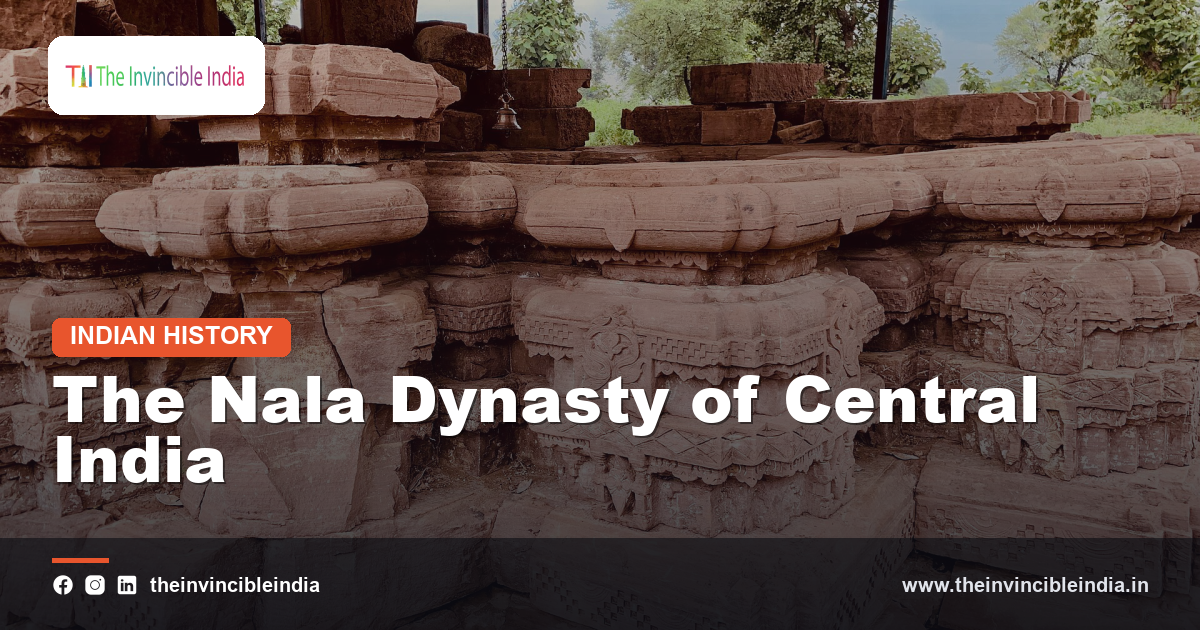
The Nala dynasty, also known as the Nalavamshi, was an early medieval line of central India that ruled over parts of the country now covered by Chhattisgarh, Odisha and eastern Maharashtra, in the borderlands of central India and the Deccan. Generally dated to around the fifth and sixth centuries, with a revival held to have followed in a later period, the dynasty is known mainly from coins and inscriptions rather than from any continuous chronicle, and its chronology is debated among scholars. Its capital is associated in the sources with a centre known as Pushkari, whose identification is discussed by scholars. The Nalas are remembered as one of the lesser-known but notable dynasties of the early history of the region, their memory preserved largely through numismatic and epigraphic evidence. As an early dynasty of central India, the Nalavamshi belong to the broad span that also includes the great power described in our guide to the Gupta Empire. Because the history rests on coins and inscriptions and the chronology is uncertain, this account keeps to general terms where the record is debated.
Quick answer: The Nala dynasty, also known as the Nalavamshi, was an early medieval line of central India that ruled over parts of the country now covered by Chhattisgarh, Odisha and eastern Maharashtra. Generally dated to around the fifth and sixth centuries, with a revival held to have followed in a later period, the dynasty is known mainly from coins and inscriptions, and its chronology is debated. Its capital is associated with a centre known as Pushkari, whose identification scholars discuss.
Key Takeaways
- The Nala dynasty, also known as the Nalavamshi, was an early medieval line of the central Indian and Deccan borderlands.
- It ruled over parts of the country now covered by Chhattisgarh, Odisha and eastern Maharashtra.
- The dynasty is generally dated to around the fifth and sixth centuries, with a revival held to have followed later.
- It is known mainly from coins and inscriptions rather than from any continuous chronicle.
- Its capital is associated in the sources with a centre known as Pushkari.
- The chronology of the dynasty is debated among scholars.
Read on for the history, culture, and legacy in detail.
Quick Facts
| Detail | Information |
|---|---|
| Dynasty | Nala (Nalavamshi) dynasty |
| Period | Around the fifth-sixth centuries; chronology debated |
| Region | Chhattisgarh, Odisha and eastern Maharashtra borderlands |
| Capital | Associated with Pushkari (identification discussed) |
| Known From | Coins and inscriptions |
| Family Name | The Nalavamshi (house of Nala) |
| Later Phase | A revival held to have followed in a later period |
| Legacy | An early dynasty of the central Indian borderlands |
What Was the Nala Dynasty?
The Nala dynasty, also known as the Nalavamshi, was an early medieval line of central India that ruled over parts of the borderlands of central India and the Deccan, in the country now covered by Chhattisgarh, Odisha and eastern Maharashtra. The dynasty is counted among the lesser-known but notable houses of the early history of the region, remembered chiefly through the coins and inscriptions that preserve its memory. Generally dated to around the fifth and sixth centuries, with a revival held to have followed in a later period, the Nalas established their authority over a tract of the forested and hilly borderlands. In the absence of any continuous chronicle, the history of the dynasty is reconstructed from numismatic and epigraphic evidence, and its chronology is debated. As an early dynasty of the central Indian borderlands, the Nalavamshi hold a place in the history of the region alongside the greater powers of the age. Their history is treated with scholarly care, given the uncertainty of the record.
Where Did the Nalas Rule?
The Nalas ruled over parts of the borderlands of central India and the Deccan, in the country now covered by the regions of Chhattisgarh, Odisha and eastern Maharashtra, a land of forests, hills and river valleys. This tract lay in the heart of the subcontinent, in a region long associated with a succession of early dynasties and later with the forested country of the central Indian peoples. The exact extent of the Nala territory is uncertain and is reconstructed from the distribution of their coins and inscriptions, which indicate their presence across this borderland region. Their position placed them among the powers of the early medieval borderlands, in contact and contest with neighbouring dynasties. The forests and hills of the region shaped the character of the kingdom. The centres associated with the dynasty, including the capital linked with Pushkari, anchored it in the historical geography of the region. The Nalas were thus rooted in the forested borderlands of central India and the Deccan.
What Does the Name Nalavamshi Mean?
The name Nalavamshi means the family or house of Nala, the dynasty taking its name from an ancestor or eponymous figure named Nala. The term vamshi, from the Sanskrit for lineage or family, indicates that the dynasty understood and presented itself as the house of Nala, in the manner common among the ruling families of early India. The name Nala carries associations in Indian tradition, including the famous figure of story and epic, though the connection of the dynasty to such traditions is a matter of discussion rather than firm record. The use of the name Nalavamshi reflects the way the dynasty identified its lineage and its place among the ruling houses of the region. As with other early dynasties, the origin and meaning of the name are drawn from the inscriptional record and tradition and are treated with scholarly care. The name Nalavamshi thus preserves the family identity of the dynasty in the history of the central Indian borderlands.
When Did the Nalas Rule?
The Nala dynasty is generally dated to around the fifth and sixth centuries, with a revival held to have followed in a later period, though the chronology is debated among scholars. The early phase of the dynasty is placed in the early medieval period, when the Nalas established their authority over the central Indian borderlands amid the shifting politics of the age. A later phase or revival of the house is held to have occurred, extending the presence of the dynasty in the region, though the dating and nature of this revival are discussed. In the absence of any continuous chronicle, the chronology of the dynasty is reconstructed from coins and inscriptions, which provide the principal evidence but leave many points uncertain. The dating of individual rulers and events is therefore a matter of scholarly reconstruction and debate. The details of the chronology are described in general terms, reflecting the uncertainty of the record. The Nalas thus belong to the early medieval history of central India.
What Was Pushkari?
Pushkari is the name associated in the sources with the capital of the Nala dynasty, a centre from which the rulers governed their territory in the central Indian borderlands. According to the evidence of inscriptions, Pushkari served as a seat of the dynasty, and its identification with a particular site is a matter of scholarly discussion. As the capital, Pushkari would have been the focus of the political and administrative life of the kingdom, though little is known of its character beyond what the sources suggest. The identification of the site has been proposed and discussed by scholars studying the geography of the dynasty. As with other early centres known mainly from inscriptions, the details of Pushkari rest on the epigraphic record and scholarly reconstruction and are treated with care. The capital associated with Pushkari anchored the dynasty in the historical geography of the region. Pushkari thus holds a place in the reconstructed history of the Nala dynasty.
How Do We Know About the Nalas?
We know about the Nala dynasty mainly from coins and inscriptions, which preserve the memory of the rulers and their kingdom in the absence of any continuous chronicle. The coins of the Nalas, a notable source for the dynasty, bear the names of rulers and provide important evidence for the history and extent of the house. Inscriptions, including grants and records, add further evidence of the rulers, their reigns and their activities. Together, this numismatic and epigraphic evidence forms the principal basis on which scholars reconstruct the history of the dynasty. The reliance on coins and inscriptions means that many details are uncertain or debated, and the chronology and sequence of rulers are matters of scholarly reconstruction. Surviving remains and sculpture of the region add further context to the history and culture of the period. The details of the dynasty are thus drawn from numismatics, epigraphy and archaeology and are described in general terms, reflecting the uncertainty of the record.
Who Were the Notable Nala Rulers?
The notable rulers of the Nala dynasty are known chiefly from the coins and inscriptions that preserve their names, which provide the principal evidence for the line of the house. These sources record the names of several rulers of the dynasty, whose reigns and relationships are reconstructed by scholars from the surviving evidence. In the absence of a continuous chronicle, the sequence and dating of the rulers are matters of scholarly discussion, and many details remain uncertain or debated. The rulers are remembered as the figures who established and maintained the authority of the Nalas over the central Indian borderlands in the early medieval period. Their coins, in particular, are a valuable record of the dynasty and its rulers. As with other early dynasties known mainly from numismatic and epigraphic evidence, the details of the individual rulers are treated with scholarly care. The notable Nala rulers thus belong to the reconstructed history of the dynasty, preserved in coins and inscriptions.
How Did the Nalas Relate to the Vakatakas?
The Nalas related to their neighbours, among them the Vakatakas, a major early dynasty of the Deccan and central India, through the patterns of rivalry and conflict that characterised the politics of the early medieval borderlands. According to the generally accepted account, the Nalas and the Vakatakas, as powers of the region, came into contact and contest over territory in the central Indian and Deccan borderlands. Such relations between neighbouring dynasties, involving warfare and the shifting of fortunes, were a feature of the age. The details of these relations are reconstructed from inscriptions and are discussed by scholars, with several points uncertain or debated. The contact with the Vakatakas illustrates the place of the Nalas among the powers of the early medieval region. As with other aspects of the dynasty’s history, these relations are drawn from the epigraphic record and are described in general terms. The relationship with the Vakatakas thus forms part of the reconstructed political history of the Nala dynasty.
Was the Dynasty Revived in a Later Period?
A revival of the Nala dynasty is generally held to have followed in a later period, extending the presence of the house in the central Indian borderlands beyond its early phase, though the dating and nature of this revival are debated. According to the reconstructed history, after the earlier phase of the dynasty around the fifth and sixth centuries, the Nalas or a related line continued or re-emerged in the region in a later period. This later phase is known, like the earlier one, chiefly from inscriptions and the evidence of the period, and its details are discussed by scholars. The revival illustrates the continuity or re-emergence of the Nala name in the history of the region over a long span. As with other aspects of the dynasty, the details of the revival rest on the epigraphic record and scholarly reconstruction and are treated with care. The question of the later revival thus forms part of the debated chronology of the Nala dynasty.
How Was the Kingdom Governed?
The kingdom of the Nala dynasty was governed by its rulers, whose authority rested on control of the territory of the central Indian borderlands, its people and its resources, from the capital associated with Pushkari. The kingdom drew its strength from the resources of a region of forests, hills and river valleys, and the rulers maintained their authority over this borderland country. In the manner of early medieval kingship, the rulers would have depended on officials, nobles and local chiefs who held responsibilities within the administration and the military. The grants and records preserved in inscriptions reflect the forms of government and the patronage of the rulers. In the absence of a continuous chronicle, the details of the administration are reconstructed from the epigraphic record and are treated with scholarly care. The system of governance enabled the Nalas to hold their borderland kingdom through the early medieval period. The details are described in general terms, reflecting the uncertainty of the record.
What Was the Religion and Culture of the Nalas?
The religion and culture of the Nala dynasty reflected the broader traditions of early medieval central India, with the patronage of religion and the arts in keeping with the practice of the ruling houses of the age. As a dynasty of the early medieval period, the Nalas would have patronised the religious traditions of the region, including the worship of the major deities and the support of sacred sites, as was common among the rulers of the time. The sculpture and remains of the region bear witness to the artistic and religious culture of the period, reflecting the traditions that flourished under the dynasties of the borderlands. The culture of the kingdom blended the broader heritage of early medieval India with the distinctive character of the central Indian borderlands. The details of the religion and culture are drawn from coins, inscriptions and surviving remains and are described in general terms. Through this culture the Nalas contributed to the early heritage of the central Indian borderlands.
Why Is the Chronology of the Nalas Debated?
The chronology of the Nala dynasty is debated because the history of the house rests mainly on coins and inscriptions rather than on any continuous chronicle, leaving many points uncertain. In the absence of a detailed narrative source, scholars reconstruct the sequence and dating of the rulers from the surviving numismatic and epigraphic evidence, which does not always provide firm dates. The question of the early phase of the dynasty, the later revival, and the relationships among the rulers are all matters of scholarly discussion and reconstruction. Different scholars have proposed different datings and sequences, reflecting the uncertainty of the evidence. This debated chronology is a common feature of early dynasties known mainly from coins and inscriptions. The details of the chronology are therefore described in general terms, reflecting the ongoing scholarly discussion. The debate over the chronology of the Nalas thus reflects the nature of the evidence for the dynasty.
What Heritage and Remains Survive?
The heritage of the Nala dynasty survives chiefly in the coins and inscriptions that preserve its memory, together with the sculpture and remains of the central Indian borderlands associated with the period. The coins of the Nalas, a notable source for the dynasty, survive as important evidence of the rulers and their kingdom. Inscriptions and grants add to the record of the dynasty and its activities. The sculpture and ancient remains of the region, including temples and carved works of the broader period, bear witness to the artistic and religious culture of the age in which the Nalas ruled. These sources and remains are studied through numismatics, epigraphy and archaeology to reconstruct the history of the dynasty. The heritage of the Nalas thus forms part of the early history of present-day Chhattisgarh and the neighbouring regions. The surviving coins, inscriptions and remains keep alive the memory of the Nala dynasty of the central Indian borderlands.
How Did the Nala Power Decline?
The power of the Nala dynasty, after its early phase and its later revival, in time gave way to the changing politics of the central Indian borderlands, as new dynasties rose in the region. Over the course of the early medieval period, the authority of the Nalas declined, and the region passed under the influence of other powers that came to dominate the borderlands of central India and the Deccan. The details of this decline are reconstructed from inscriptions and the evidence of the period and are discussed by scholars, with several points uncertain or debated. The passing of the Nala power illustrates the shifting fortunes of the dynasties of the region in the early medieval age. As with other aspects of the dynasty, the decline is drawn from the epigraphic record and is described in general terms. The end of the Nala power thus belongs to the wider history of the central Indian borderlands in the early medieval period.
Why Is the Nala Dynasty Significant?
The Nala dynasty is significant as one of the early dynasties of the central Indian and Deccan borderlands, preserving in its coins and inscriptions the memory of the early history of a region often less prominent in the general narrative. As a house known mainly from numismatic and epigraphic evidence, the Nalavamshi illustrate the challenges and rewards of reconstructing the history of early dynasties from such sources. Their presence across the borderlands of Chhattisgarh, Odisha and eastern Maharashtra, and their relations with greater powers such as the Vakatakas, place them within the politics of the early medieval region. Their coins, in particular, are a valuable record of the dynasty. For students of Indian history, the Nala dynasty offers a vivid example of an early regional house reconstructed from coins and inscriptions. Its significance rests on this role in the early history of the central Indian borderlands and on the evidence it provides for a lesser-known chapter of the past.
The Nala Dynasty Today
The Nala dynasty is remembered today chiefly through the coins and inscriptions that preserve its history and through the study of the early past of the central Indian borderlands. The coins of the Nalas, held in collections and studied by numismatists, remain the most notable record of the dynasty and its rulers. The inscriptions associated with the house continue to be examined for the light they shed on the early medieval history of the region. The sculpture and ancient remains of the Chhattisgarh and neighbouring regions add context to the period in which the Nalas ruled. Scholars continue to study the numismatic and epigraphic evidence to refine the understanding of the dynasty and its debated chronology. For readers of Indian history, the Nala dynasty offers a striking example of an early house reconstructed from coins and inscriptions. Its legacy endures in the coins, inscriptions and early heritage of the central Indian borderlands.
Sources & Further Reading
- Archaeological Survey of India (asi.nic.in).
- Ministry of Culture, Government of India (indiaculture.gov.in).
- Directorate of Culture and Archaeology, Government of Chhattisgarh.
Frequently Asked Questions
What was the Nala dynasty?
The Nala dynasty, also known as the Nalavamshi, was an early medieval line of central India that ruled over parts of the country now covered by Chhattisgarh, Odisha and eastern Maharashtra. It is known mainly from coins and inscriptions, and its chronology is debated.
Where did the Nala dynasty rule?
The Nalas ruled over parts of the borderlands of central India and the Deccan, in the regions now covered by Chhattisgarh, Odisha and eastern Maharashtra. The exact extent of their territory is reconstructed from the distribution of their coins and inscriptions.
When did the Nalas rule?
The dynasty is generally dated to around the fifth and sixth centuries, with a revival held to have followed in a later period, though the chronology is debated among scholars. It is reconstructed from coins and inscriptions in the absence of a continuous chronicle.
How do we know about the Nala dynasty?
The dynasty is known mainly from coins and inscriptions, which preserve the names of rulers and provide the principal evidence for its history. This reliance on numismatic and epigraphic evidence means many details are uncertain or debated.
What was the capital of the Nalas?
The capital of the Nala dynasty is associated in the sources with a centre known as Pushkari, whose identification with a particular site is a matter of scholarly discussion. As the capital, it was the focus of the political life of the kingdom.
Why is the chronology of the Nalas debated?
The chronology is debated because the history of the dynasty rests mainly on coins and inscriptions rather than a continuous chronicle, leaving the sequence and dating of rulers uncertain. Different scholars have proposed different datings and reconstructions.


