

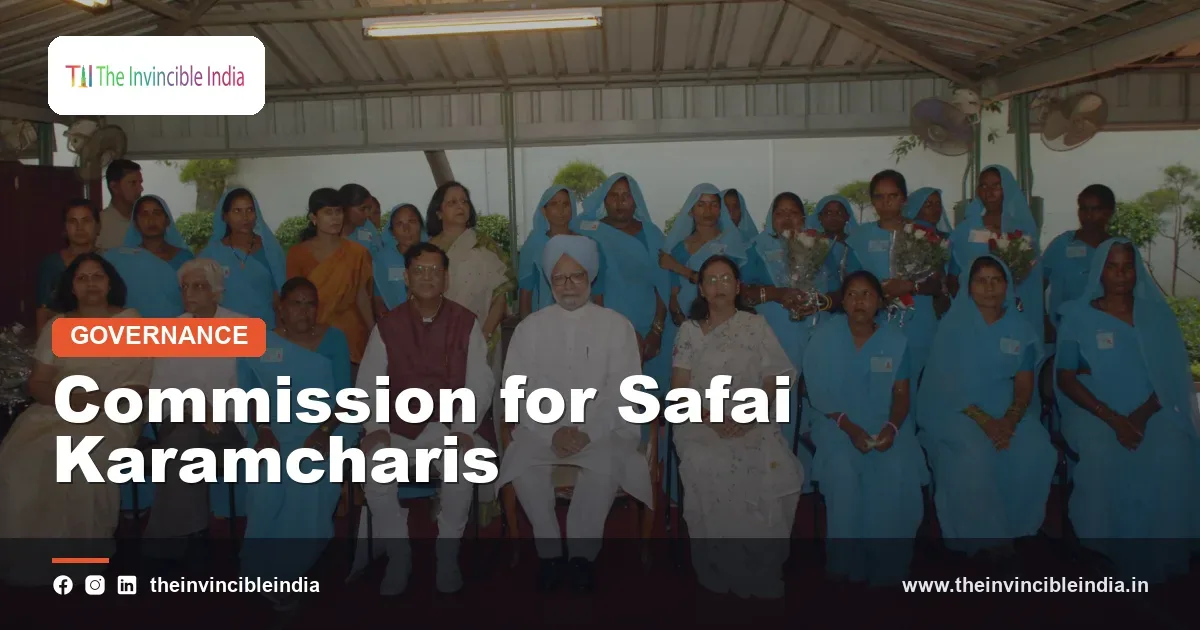
The National Commission for Safai Karamcharis (NCSK) is the Government of India body created in 1993 to safeguard the welfare, rights and dignity of safai karamcharis, the sanitation workers, including those who have been forced into manual scavenging. It studies their working and living conditions, investigates their grievances and recommends measures to the Central and State Governments.
The Commission began as a statutory body under the National Commission for Safai Karamcharis Act 1993 and has been kept alive through repeated extensions of its tenure. It has no power to enforce its views through punishment, but its recommendations and its monitoring role under the Prohibition of Employment as Manual Scavengers and their Rehabilitation Act 2013 make it a central institution in India’s efforts to end manual scavenging. This explainer was last reviewed on 8 October 2026.
| Attribute | Detail |
|---|---|
| Body | National Commission for Safai Karamcharis (NCSK) |
| Established | 1993, under the National Commission for Safai Karamcharis Act 1993 |
| Administrative ministry | Ministry of Social Justice and Empowerment, Government of India |
| Headquarters | New Delhi |
| Nature | Initially statutory; continued for fixed terms through periodic extensions of tenure |
| Core mandate | Welfare and rehabilitation of safai karamcharis and monitoring of laws against manual scavenging |
| Linked laws | Employment of Manual Scavengers and Construction of Dry Latrines (Prohibition) Act 1993; Prohibition of Employment as Manual Scavengers and their Rehabilitation Act 2013 |
| Nature of powers | Advisory and investigative, with civil-court powers for inquiry; no power to punish |
Key Takeaways
- The National Commission for Safai Karamcharis was set up in 1993 under the National Commission for Safai Karamcharis Act 1993 to protect the welfare of sanitation workers.
- The National Commission for Safai Karamcharis works under the Ministry of Social Justice and Empowerment and has its headquarters in New Delhi.
- The Commission recommends welfare programmes, studies working conditions, investigates grievances and monitors implementation of laws against manual scavenging, but it cannot punish offenders itself.
- Manual scavenging was first prohibited by the 1993 Act on employment of manual scavengers and construction of dry latrines, and the Prohibition of Employment as Manual Scavengers and their Rehabilitation Act 2013 replaced it with a stronger law that also covers hazardous cleaning of sewers and septic tanks.
- The 2013 Act assigns the National Commission for Safai Karamcharis the role of monitoring its implementation, inquiring into complaints and advising the Central and State Governments.
- The tenure of the Commission has been extended in blocks of years by Government of India decisions, which means its continuation depends on periodic renewal.
What is the National Commission for Safai Karamcharis?
The National Commission for Safai Karamcharis is a Central Government commission whose purpose is to improve the social and economic condition of safai karamcharis, who are workers engaged in cleaning, sweeping, sewage work and similar sanitation tasks. It is a national-level body that advises the Government of India and the states on the welfare of this group.
The term “safai karamchari” is a Hindi expression meaning sanitation worker or cleaning staff. In practice, the term often refers to workers employed in municipal bodies, railways, hospitals, institutions and private homes, and especially to those traditionally forced by caste into the work of manual scavenging, which is the removal of human excreta by hand. Many of these workers belong to the Scheduled Castes, and the work has long been linked to caste-based discrimination and the practice of untouchability.
The Commission was set up to give the community a national forum, since the problems of these workers cut across states, departments and sectors. It is advisory in character: it does not carry out welfare schemes itself, but it studies the problems, identifies gaps and recommends action to those who have authority to act.
Why was the National Commission for Safai Karamcharis created?
The National Commission for Safai Karamcharis was created because manual scavenging and the poor conditions of sanitation workers persisted despite the constitutional guarantees of equality and dignity. In 1993, the Government of India decided to give the problem a dedicated national body and a dedicated law.
Two laws were enacted in 1993, and their purposes were different:
- The National Commission for Safai Karamcharis Act 1993 created the Commission for a limited term to examine and improve the conditions of safai karamcharis.
- The Employment of Manual Scavengers and Construction of Dry Latrines (Prohibition) Act 1993 banned manual scavenging and the building of dry latrines, which are latrines without a flush system that require human removal of waste.
The first Commission was created for a limited period of three years, and the Act was designed so that it would lapse unless extended. The need for a continuing body was widely felt, and the Government extended its tenure again and again. When the statutory provisions lapsed in 2004, the Commission continued as a non-statutory body through executive decisions of the Union Cabinet, which have been renewed for further blocks of years since then.
Behind this history lies a constitutional background. Article 17 of the Constitution abolishes untouchability, Article 21 guarantees the right to life, which the Supreme Court has read as including the right to live with dignity, and Article 23 prohibits forced labour. Manual scavenging is widely viewed as violating all three.
How is the Commission organised?
The National Commission for Safai Karamcharis is headed by a Chairperson, assisted by a Vice-Chairperson and a small number of Members, all nominated by the Central Government. A Secretary and supporting staff handle administration, and the Commission operates from New Delhi.
The membership has generally included persons with experience of the safai karamchari community or with knowledge of social welfare, law or administration. The Commission can draw on state governments and local bodies for information. Several states have also formed their own commissions or boards for sanitation workers, but the NCSK remains the national authority.
The Commission works through:
- visits to states and local bodies to study conditions on the ground;
- hearings of individual complaints and group grievances;
- meetings with officials of the Centre, states and municipal bodies;
- reports to the Government of India on its findings and recommendations.
The Commission also reports on the working of programmes for safai karamcharis, including schemes run by the National Safai Karamcharis Finance and Development Corporation (NSKFDC), which was set up in 1997 to provide concessional loans and skill training to safai karamcharis and their dependants.
What are the functions of the National Commission for Safai Karamcharis?
The functions of the National Commission for Safai Karamcharis centre on recommending welfare programmes, studying conditions of work, investigating complaints and reporting to the Government. These functions were laid out in the 1993 Act and continue to guide its work.
The major functions can be grouped as follows.
| Function | What it involves |
|---|---|
| Recommend programmes | Suggesting specific programmes of action for the welfare of safai karamcharis to the Central Government |
| Study and evaluate | Reviewing how welfare programmes for sanitation workers are being implemented and how effective they are |
| Investigate grievances | Looking into specific complaints about violations of rights or non-implementation of benefits and schemes |
| Suo motu notice | Taking up matters on its own initiative where serious grievances come to its attention |
| Study working conditions | Examining the conditions in which safai karamcharis work and live, including safety, wages and facilities |
| Report | Giving the Central Government reports on the working of programmes and the measures taken |
| Monitor laws | Monitoring implementation of the 2013 Act and advising governments on its enforcement |
For the purpose of inquiries, the Commission has the powers of a civil court. It can summon and examine witnesses, ask for documents and receive evidence on affidavit. These powers help it collect information from public authorities that might otherwise not respond.
What is the link between the NCSK and the 2013 Act on manual scavenging?
The link between the NCSK and the Prohibition of Employment as Manual Scavengers and their Rehabilitation Act 2013 is that the 2013 Act names the Commission as a monitoring body, tasking it with overseeing implementation, enquiring into complaints and advising governments. The Act received the President’s assent in September 2013 and was brought into force in December 2013.
The 2013 Act replaced the 1993 prohibition law and widened its scope. It prohibits:
- the employment of any person as a manual scavenger;
- the construction or maintenance of insanitary latrines, which are latrines from which human waste must be removed manually;
- the hazardous cleaning of sewers and septic tanks by a person without protective gear and safety precautions.
The Act makes the offences cognizable and non-bailable, which means police can arrest without a warrant and bail is not a matter of right. It provides for imprisonment and fines, with higher penalties on repeat offenders. It also places duties on local authorities, requires surveys to identify manual scavengers, and sets up vigilance committees and district-level monitoring.
The Commission’s role under the Act is to provide an outside check. It can look into complaints that the law is being violated, investigate cases of deaths of sanitation workers in sewers and septic tanks, and write to state governments about lapses. The Act does not turn the NCSK into a court, but it makes the Commission a statutory monitor of a law that has often been criticised for weak enforcement.
What did the 1993 Act and the 2013 Act each do?
The 1993 Act prohibited manual scavenging and dry latrines but focused mainly on the latrines, while the 2013 Act prohibited the employment of manual scavengers and insanitary latrines and added a rehabilitation scheme. The two laws differ in scope, in the definition of the offence and in the support promised to those freed from the practice.
| Feature | 1993 Act | 2013 Act |
|---|---|---|
| Full title | Employment of Manual Scavengers and Construction of Dry Latrines (Prohibition) Act 1993 | Prohibition of Employment as Manual Scavengers and their Rehabilitation Act 2013 |
| Main focus | Banning manual scavengers and dry latrines | Banning manual scavenging, insanitary latrines and hazardous sewer cleaning |
| Rehabilitation | Very limited | Statutory rehabilitation for identified manual scavengers |
| Sewer and septic tank cleaning | Not specifically covered | Hazardous cleaning prohibited unless strict safety rules are followed |
| Monitoring bodies | Weak and mainly state-level | Vigilance committees, district and state monitoring and the NCSK |
| Enforcement | Seldom enforced in practice | Offences cognizable and non-bailable |
The 1993 Act applied to states that adopted it, and few prosecutions followed. The 2013 Act applies across India and was framed with a clear definition of manual scavenger and a duty on the state to rehabilitate those identified.
How are safai karamcharis rehabilitated?
Safai karamcharis who have been engaged as manual scavengers are rehabilitated under the 2013 Act through a set of benefits that includes a one-time cash assistance, training and a way to earn a living. The goal is to give them an alternative to the work they have been forced to do and to protect their dignity.
The rehabilitation framework under the Act and the schemes that followed includes:
- a one-time cash assistance to identified manual scavengers and their families;
- education support, such as scholarships for children of identified manual scavengers;
- training in a skill with a monthly stipend while the training lasts;
- concessional loans or subsidies for those who wish to take up alternative occupations;
- help with housing, such as a residential plot and financial assistance for building a house.
Institutions like the NSKFDC and the central government’s self-employment schemes have been used to deliver loans and training. The NCSK has noted, in its recommendations over the years, that identification of workers and delivery of benefits at the local level is where the programme most often falls short.
The Supreme Court has also acted on the issue. In its 2014 judgment in Safai Karamchari Andolan v Union of India, the Court directed that the families of workers who died while cleaning sewers since 1993 be paid compensation of Rs 10 lakh each. It also directed governments to take steps to end manual scavenging and rehabilitate those affected.
What recommendations does the Commission make?
The National Commission for Safai Karamcharis makes recommendations to the Central and State Governments on policy, enforcement and welfare, and these are not binding on the governments. Its influence comes from the quality of its findings, its reports to the Government and the attention of the public and courts.
Typical themes in its recommendations include:
- stricter enforcement of the ban on manual scavenging and sewer deaths, including registration of cases under the 2013 Act;
- mechanisation of sewer and septic tank cleaning so that human entry is avoided;
- protective equipment, safety training and health checks for sanitation workers;
- regularisation of contract and outsourced workers in municipal bodies, so that they receive wages and benefits;
- timely compensation to families of workers who die in the course of their work;
- better surveys to identify manual scavengers and ensure that rehabilitation reaches them.
Because the Commission lacks the power to enforce its recommendations, its work depends on the response of the executive. Civil society groups have often argued that the Commission would benefit from stronger powers, wider reach and a permanent statutory footing, while the Government has continued to renew its tenure by decision of the Union Cabinet.
Why does the dignity mandate matter?
The dignity mandate matters because the work of safai karamcharis is not only a labour issue but a question of constitutional rights, equality and social justice. The Constitution promises every person equality before the law and the right to live with dignity, and the persistence of manual scavenging is seen as a failure to deliver those promises to a community that has faced caste-based exclusion.
The dignity mandate has several dimensions:
- Safety: workers should not have to enter sewers or septic tanks without equipment, as such work has led to deaths from toxic gases.
- Social inclusion: removing the stigma that has attached to the work and the community for generations.
- Economic security: offering fair wages, regular employment and alternative livelihoods.
- Legal protection: making sure that employers and officials who violate the law are held to account.
The NCSK sits at the intersection of these concerns. Through its field visits, public hearings and reports, it brings attention to cases that would otherwise remain local and invisible, and it provides the community with a channel through which grievances can reach the Government of India.
How can a person approach the Commission?
A person can approach the National Commission for Safai Karamcharis by sending a written complaint to its office in New Delhi, and the Commission can take up the matter after examining it. Complaints may come from individual workers, their families, organisations or any person aware of a violation.
The complaint should state clearly the facts, the place, the authority responsible and the relief sought. The Commission may then seek a report from the concerned state or local authority, hold a hearing and issue recommendations. For serious matters such as the death of a worker in a sewer, the Commission may ask for details of the investigation, the registration of the case and the compensation paid.
It is useful to remember that the Commission is not a court. Where a worker needs enforceable relief, such as the registration of an offence or compensation, the matter can also be taken to the police, the district authorities, the High Court or the Supreme Court. The Commission’s findings can support such action.
Bottom Line
The National Commission for Safai Karamcharis is a national monitor and advisor whose mission is to improve the welfare and dignity of sanitation workers and to support the elimination of manual scavenging. Its strength lies in its mandate, its civil-court inquiry powers and its role under the 2013 Act, while its limitation is that it can recommend but not enforce. The issue remains a test of how far constitutional promises of equality and dignity reach the people who keep Indian cities clean.
Frequently Asked Questions
What is the National Commission for Safai Karamcharis?
The National Commission for Safai Karamcharis is a Government of India commission created in 1993 to safeguard the welfare and dignity of sanitation workers. It studies their conditions, investigates grievances and recommends measures to the Central and State Governments. It works under the Ministry of Social Justice and Empowerment.
When was the NCSK established?
The NCSK was established in 1993 under the National Commission for Safai Karamcharis Act 1993. It was set up for a limited initial period of three years. Its tenure has since been extended repeatedly, and the statutory provisions lapsed in 2004, after which it has continued through executive extensions.
Does the NCSK have the power to punish officials?
No, the NCSK does not have the power to punish officials or to prosecute offenders. It can recommend action, investigate complaints and use civil-court powers to gather evidence. Enforcement and prosecution remain with the police, courts and state authorities.
How is the NCSK linked with the 2013 manual scavenging law?
The Prohibition of Employment as Manual Scavengers and their Rehabilitation Act 2013 names the NCSK as a monitoring body for its implementation. The Commission can enquire into complaints of violations and advise governments on enforcement. The 2013 Act replaced the earlier 1993 prohibition law.
What is the difference between the 1993 and 2013 Acts on manual scavenging?
The 1993 Act banned manual scavengers and dry latrines but was rarely enforced, while the 2013 Act broadened the ban to include insanitary latrines and hazardous cleaning of sewers and septic tanks. The 2013 Act also provides for the rehabilitation of identified manual scavengers. Its offences are cognizable and non-bailable.
Who can complain to the National Commission for Safai Karamcharis?
Any safai karamchari, family member, organisation or concerned person can write to the Commission about a violation of rights or non-delivery of benefits. The Commission reviews the complaint and may seek a report from the authorities concerned. For enforceable relief, the complainant can also approach the police or the courts.
{“@context”:”https://schema.org”,”@graph”:[{“@type”:”FAQPage”,”mainEntity”:[{“@type”:”Question”,”name”:”What is the National Commission for Safai Karamcharis?”,”acceptedAnswer”:{“@type”:”Answer”,”text”:”The National Commission for Safai Karamcharis is a Government of India commission created in 1993 to safeguard the welfare and dignity of sanitation workers. It studies their conditions, investigates grievances and recommends measures to the Central and State Governments. It works under the Ministry of Social Justice and Empowerment.”}},{“@type”:”Question”,”name”:”When was the NCSK established?”,”acceptedAnswer”:{“@type”:”Answer”,”text”:”The NCSK was established in 1993 under the National Commission for Safai Karamcharis Act 1993. It was set up for a limited initial period of three years. Its tenure has since been extended repeatedly, and the statutory provisions lapsed in 2004, after which it has continued through executive extensions.”}},{“@type”:”Question”,”name”:”Does the NCSK have the power to punish officials?”,”acceptedAnswer”:{“@type”:”Answer”,”text”:”No, the NCSK does not have the power to punish officials or to prosecute offenders. It can recommend action, investigate complaints and use civil-court powers to gather evidence. Enforcement and prosecution remain with the police, courts and state authorities.”}},{“@type”:”Question”,”name”:”How is the NCSK linked with the 2013 manual scavenging law?”,”acceptedAnswer”:{“@type”:”Answer”,”text”:”The Prohibition of Employment as Manual Scavengers and their Rehabilitation Act 2013 names the NCSK as a monitoring body for its implementation. The Commission can enquire into complaints of violations and advise governments on enforcement. The 2013 Act replaced the earlier 1993 prohibition law.”}},{“@type”:”Question”,”name”:”What is the difference between the 1993 and 2013 Acts on manual scavenging?”,”acceptedAnswer”:{“@type”:”Answer”,”text”:”The 1993 Act banned manual scavengers and dry latrines but was rarely enforced, while the 2013 Act broadened the ban to include insanitary latrines and hazardous cleaning of sewers and septic tanks. The 2013 Act also provides for the rehabilitation of identified manual scavengers. Its offences are cognizable and non-bailable.”}},{“@type”:”Question”,”name”:”Who can complain to the National Commission for Safai Karamcharis?”,”acceptedAnswer”:{“@type”:”Answer”,”text”:”Any safai karamchari, family member, organisation or concerned person can write to the Commission about a violation of rights or non-delivery of benefits. The Commission reviews the complaint and may seek a report from the authorities concerned. For enforceable relief, the complainant can also approach the police or the courts.”}}]}]}


