

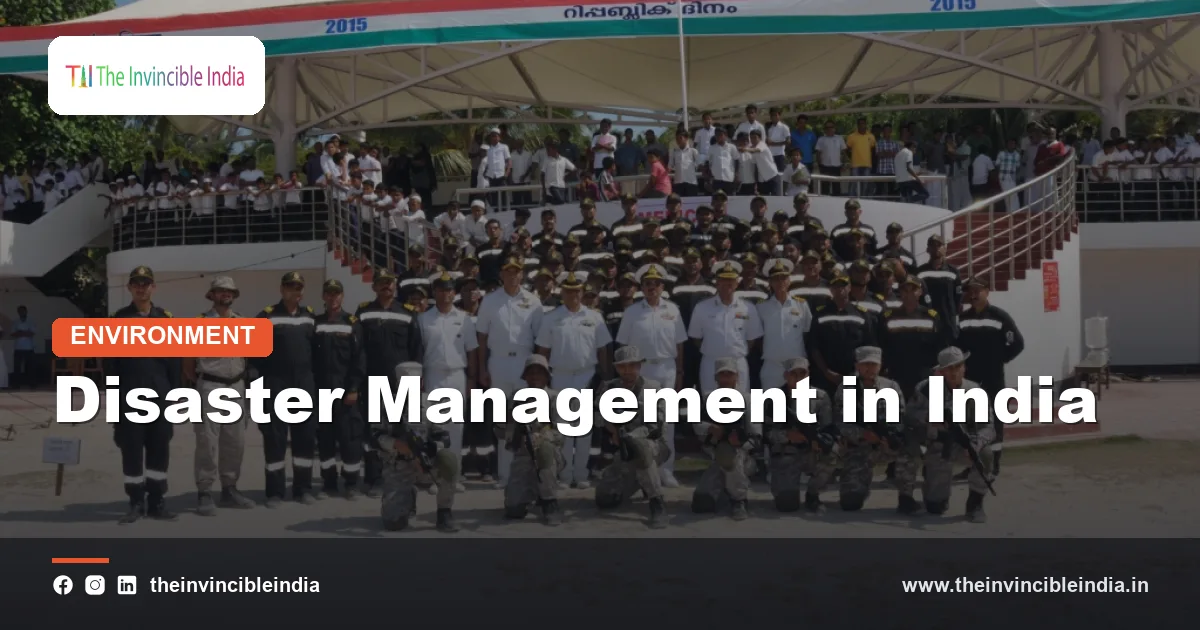
The National Disaster Management Authority is the apex body in India for planning and coordinating the country’s response to natural and human-induced disasters. Created under the Disaster Management Act, 2005, and chaired by the Prime Minister, it is responsible for laying down policies, plans and guidelines so that central ministries, states and districts act in a coordinated way before, during and after a calamity.
The authority was born out of hard experience. Cyclones, earthquakes, floods and a devastating tsunami in the preceding decade showed that a system built around post-disaster relief was no longer enough for a large and densely populated country. The NDMA represents a deliberate shift towards a culture of prevention, mitigation and preparedness, supported by a legal framework that reaches from New Delhi down to the district and the village.
Quick Facts
| Item | Detail |
|---|---|
| Parent law | Disaster Management Act, 2005 (enacted in December 2005) |
| Constituted | 27 September 2006 |
| Chairperson | The Prime Minister of India |
| Composition | Chairperson and up to nine members, one of whom is designated Vice-Chairperson |
| Headquarters | New Delhi |
| Administrative ministry | Ministry of Home Affairs |
| Three-tier structure | NDMA at the national level, State Disaster Management Authorities (SDMAs), District Disaster Management Authorities (DDMAs) |
| Specialised response force | National Disaster Response Force (NDRF) |
| Training institute | National Institute of Disaster Management (NIDM) |
Why India Needed a Disaster Management Authority
India is exposed to a wide variety of hazards. Its long coastline faces cyclones and tsunamis, the Himalayan belt and parts of the peninsula are seismically active, and the great river basins are prone to floods. Large regions face recurring drought, while hill areas see landslides and glacial hazards. Rapid urbanisation and a large rural population living in vulnerable housing increase the loss whenever a hazard strikes.
The older relief approach
For decades, disasters were handled mainly as a matter of relief. Responsibility rested with state governments, supported by relief commissioners and funds recommended by Finance Commissions. The Centre’s role was largely to supply financial aid, and the work was usually organised through the agriculture ministry, which handled drought and crop loss. This model concentrated on compensation and rehabilitation after an event.
The turning point
A series of catastrophes forced a rethink: the Odisha super cyclone of October 1999, the Gujarat earthquake of 26 January 2001, and the Indian Ocean tsunami of 26 December 2004. In 1999 a High Powered Committee was set up to prepare disaster plans, and responsibility for disaster management was moved to the Ministry of Home Affairs in 2002. The Disaster Management Act followed in 2005.
The Disaster Management Act, 2005
The Act provides, for the first time, a comprehensive legal basis for managing disasters across the country. It defines a disaster as a catastrophe, mishap, calamity or grave occurrence in any area, arising from natural or man-made causes, or by accident or negligence, which results in substantial loss of life, human suffering, damage to property or the environment, of such a nature or magnitude as to be beyond the coping capacity of the affected community.
Main provisions
- Creation of the National Disaster Management Authority, State Disaster Management Authorities and District Disaster Management Authorities.
- Establishment of a National Executive Committee, a National Institute of Disaster Management and a specialised National Disaster Response Force.
- Preparation of a national plan, state plans and district plans.
- Creation of response funds and mitigation funds at national, state and district levels.
- Obligations on ministries and departments to prepare their own disaster management plans.
- Penalties for obstruction, false claims and misappropriation of relief.
The Act treats disaster management as a continuous cycle, covering prevention, mitigation, preparedness, response, relief and rehabilitation, and not as an emergency measure alone. The Act has been amended since its enactment, and readers should consult the current text for the latest provisions.
Structure and Composition of the NDMA
The NDMA is headed by the Prime Minister as its chairperson. The Act allows for up to nine other members, and one of them may be designated as the Vice-Chairperson, who holds the rank of a Cabinet Minister. Other members have the rank of Ministers of State. Members are generally drawn from fields such as administration, science, engineering, public health, security and disaster management.
Functions of the authority
- Lay down policies on disaster management and approve the National Disaster Management Plan.
- Approve plans prepared by Union ministries and departments.
- Lay down guidelines for state authorities to follow.
- Recommend provision of funds for mitigation.
- Coordinate enforcement of policies and plans.
- Take measures for the capacity building, training and public awareness.
- Provide support to other countries when requested by the Central Government.
National Executive Committee
The National Executive Committee, headed by the Union Home Secretary, helps the NDMA by assisting in implementation and by acting as the coordinating and monitoring body for the Centre. It includes secretaries of key ministries and departments.
The Three-Tier Structure: NDMA, SDMA and DDMA
The Act envisions disaster management as a federal task, with authorities at each level of government. This arrangement reflects the fact that response is local while policy and resources are often national.
| Tier | Body | Head |
|---|---|---|
| National | National Disaster Management Authority | Prime Minister |
| State / Union Territory | State Disaster Management Authority | Chief Minister (Lieutenant Governor or Administrator in certain union territories) |
| District | District Disaster Management Authority | District Magistrate or Collector, with an elected representative of local authorities as co-chairperson |
Role of states and districts
State authorities prepare state plans, coordinate with departments and oversee spending from state funds. The district authority is the key operational body. It prepares the district disaster management plan, identifies vulnerable areas, coordinates local response and supervises relief. Panchayati Raj institutions and urban local bodies play a role through local plans and awareness work. The principle is that the first responders to any disaster are always the local community and the district administration.
The National Disaster Response Force
Section 44 of the Act provides for the National Disaster Response Force, a specialised force for disaster situations. It was raised in 2006 with battalions drawn from central armed police forces such as the Border Security Force, the Central Reserve Police Force, the Central Industrial Security Force, the Indo-Tibetan Border Police and the Sashastra Seema Bal. Over time the number of battalions has grown, and they are positioned at strategic locations in different regions.
What the NDRF does
- Search and rescue after floods, cyclones, earthquakes, building collapses and landslides.
- Specialised response to chemical, biological, radiological and nuclear emergencies.
- Training of state response forces, civil defence volunteers and communities.
- Community awareness and mock drills.
- Pre-positioning of teams before a predicted event, such as a cyclone landfall.
The force works under the general superintendence and control of the NDMA, and its Director General is usually a senior police officer. States maintain their own State Disaster Response Forces, funded through the State Disaster Response Fund, which handle the first response while NDRF teams assist when the scale of the event demands it.
National Institute of Disaster Management
The National Institute of Disaster Management (NIDM) is India’s main institution for training, research, documentation and capacity building in disaster management. It began in 1995 as the National Centre for Disaster Management within the Indian Institute of Public Administration, and was given statutory status as the NIDM under the 2005 Act.
Its tasks
- Develop training modules for administrators, police, engineers, health workers and others.
- Carry out research and documentation on past disasters and good practice.
- Support state training institutes and administrative training centres.
- Promote education in disaster risk reduction, including work on school and college curricula.
- Build networks with international institutions and regional bodies.
Through the NIDM, India has also offered training to officers from neighbouring and other developing countries, in line with its commitment to regional cooperation on disaster risk reduction.
The Shift from Relief to Prevention, Mitigation and Preparedness
The most important change brought by the 2005 framework was conceptual. Disaster management ceased to be limited to rescue and compensation, and came to be understood as a development issue. A flood, a cyclone or an earthquake becomes a disaster largely because of the vulnerability of people and buildings. Reducing that vulnerability is cheaper and more humane than repairing damage afterwards.
The disaster management cycle
- Prevention and mitigation: building codes, land-use planning, embankments, retrofitting and afforestation.
- Preparedness: early warning systems, evacuation plans, mock drills and stockpiles.
- Response: search, rescue, emergency medical care, shelter and food.
- Recovery and reconstruction: rebuilding in a safer way, often described as building back better.
Linking disasters and development
Under this philosophy, ministries are expected to integrate disaster risk reduction into housing, infrastructure, health and agriculture. Guidelines issued by the NDMA cover specific hazards, including earthquakes, floods, cyclones, urban flooding, landslides, tsunamis, drought, heat waves and nuclear and chemical emergencies, and also issues such as management of the dead, hospital safety and school safety.
The National Disaster Management Plan
The Act requires a national plan to guide the country. The first National Disaster Management Plan was released in 2016, and an updated version followed in 2019. It was the first such plan prepared in India, and it was aligned with the Sendai Framework for Disaster Risk Reduction 2015 to 2030, adopted by the United Nations member states in March 2015.
Key features
- It covers all phases of disaster management, from risk assessment to recovery.
- It assigns specific responsibilities to ministries and agencies for each type of hazard.
- It sets out actions to understand risk, to invest in risk reduction, to strengthen governance and to prepare for effective response.
- It is a dynamic document, to be reviewed and updated at regular intervals.
State and district plans are expected to follow the national plan while reflecting local hazards. The plan also underlines the value of inclusive planning, so that the needs of women, children, older people, persons with disabilities and other vulnerable groups are recognised.
Funds, Early Warning and Technology
The Act provides for dedicated funds at each level. The Disaster Response Fund pays for immediate relief, and the Disaster Mitigation Fund pays for projects that reduce future risk. At the state level, the State Disaster Response Fund is financed mainly by the Centre and the state in agreed proportions, as recommended by Finance Commissions, with a National Disaster Response Fund to supplement it in severe disasters.
Early warning
Warnings come from specialised agencies. The India Meteorological Department tracks cyclones, heat waves and heavy rainfall. The Indian National Centre for Ocean Information Services runs the tsunami early warning system. The Central Water Commission forecasts floods on major rivers, and the Geological Survey of India and the National Centre for Seismology provide landslide and earthquake information. The NDMA integrates these inputs, and uses the Common Alerting Protocol to push warnings to the public through mobile alerts and applications.
Community preparedness
Programmes such as Aapda Mitra train community volunteers in basic rescue skills, and mock drills in schools and offices help build habits of safety. These efforts rest on the idea that a prepared community can save lives in the crucial first hours before outside help arrives.
Challenges and the Way Forward
Despite significant progress, disaster governance in India faces continuing challenges. Capacity varies widely between states, and many district authorities lack full-time staff and technical expertise. Enforcement of building codes and land-use rules is often weak, especially in fast-growing cities and in hilly regions. Funding still tends to favour relief over mitigation.
Priorities for the future
- Strengthening district authorities and local bodies with trained personnel and resources.
- Enforcing safe construction, and retrofitting schools, hospitals and public buildings.
- Planning for climate-related hazards such as intense cyclones, floods, heat waves and glacial lake outbursts.
- Using data, satellite technology and impact-based forecasting for more precise warnings.
- Deepening international cooperation, including through the Coalition for Disaster Resilient Infrastructure, an Indian-led initiative launched in 2019.
Conclusion
The National Disaster Management Authority embodies a major change in how India thinks about calamities. From a system that waited for disaster to strike and then distributed relief, the country has moved to one that tries to anticipate hazards, reduce vulnerability and respond swiftly with trained forces. The three-tier structure, the NDRF, the NIDM and the national plan together form a framework that has been tested repeatedly. Its continued success depends on the strength of local institutions, honest implementation of safety rules and the awareness of ordinary citizens.
Frequently Asked Questions
What is the National Disaster Management Authority?
It is India’s apex body for disaster management, established under the Disaster Management Act, 2005. It lays down policies, plans and guidelines and coordinates disaster preparedness and response across the country. It was constituted in September 2006.
Who heads the NDMA?
The Prime Minister of India is the chairperson of the NDMA. The authority can have up to nine other members, one of whom is designated as Vice-Chairperson. State authorities are headed by Chief Ministers, and district authorities by District Magistrates or Collectors.
What is the three-tier structure of disaster management in India?
The structure consists of the National Disaster Management Authority at the national level, State Disaster Management Authorities in states and union territories, and District Disaster Management Authorities in districts. Each prepares plans and coordinates response at its own level.
What is the NDRF and how is it different from the NDMA?
The National Disaster Response Force is a specialised force of trained personnel, drawn from central armed police forces, which carries out search and rescue and other emergency response. The NDMA is the policy and planning authority, and it exercises general superintendence over the force.
What is the role of the National Institute of Disaster Management?
The NIDM is the national institution for training, research and capacity building in disaster management. It develops training programmes, conducts research and documentation, and supports state-level institutions and international cooperation.
How did India’s approach to disasters change after 2005?
India moved from a relief-centric approach, focused on compensation after an event, to a comprehensive approach that includes prevention, mitigation, preparedness, response and recovery. Disaster risk reduction is now meant to be built into development planning at all levels.


