

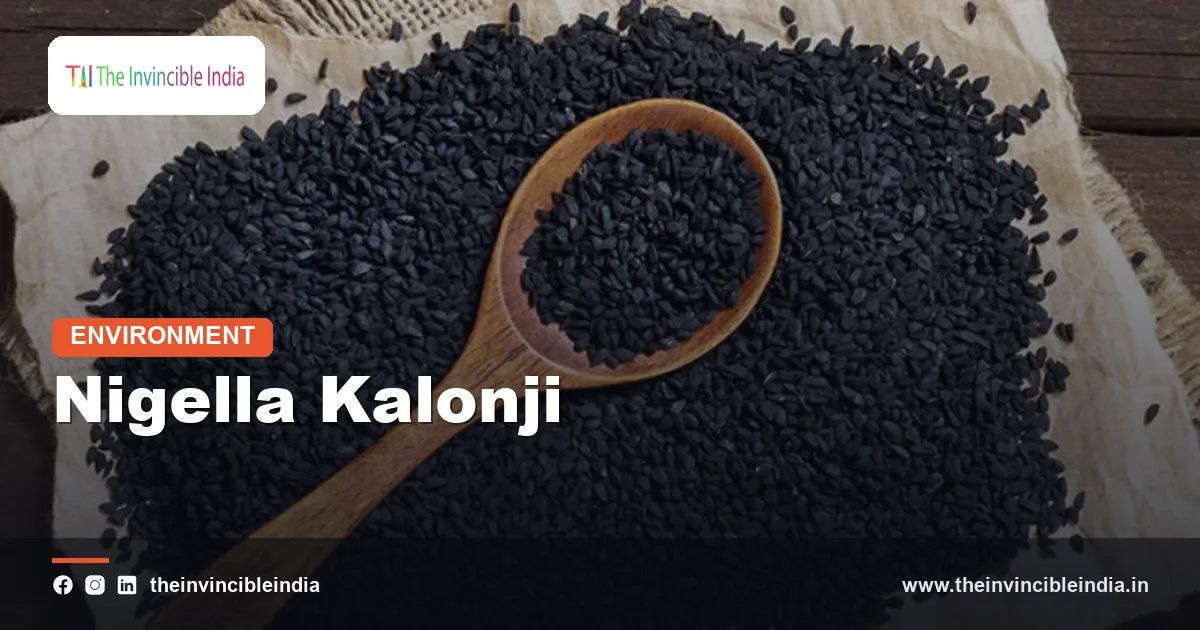
The seed-spice kalonji is the tiny, black, angular seed of Nigella sativa, a delicate annual herb of the buttercup family that is grown as a winter crop across northern and eastern India and sprinkled on breads, pickles and vegetable dishes. The seeds are also called nigella, black seed, black cumin and, in Bengali, kalojira, and they are one of the five spices in the Bengali blend panch phoron.
Despite its modest size, kalonji has a long history in Indian, Middle Eastern and Mediterranean food and in traditional medicine. This explainer describes the plant, where it grows in India, how it is cultivated and harvested, how to tell it from look-alike spices, and how it is used.
Quick Facts
| Common names | Kalonji, nigella, black seed, black cumin, kalojira (Bengali), mangrela (in some regions) |
|---|---|
| Scientific name | Nigella sativa |
| Family | Ranunculaceae (the buttercup family) |
| Origin | South-west Asia and the eastern Mediterranean region |
| Where grown in India | Mainly the northern plains and central regions, including Punjab, Haryana, Rajasthan, Uttar Pradesh, Madhya Pradesh, Bihar and West Bengal |
| Growing season | Winter (rabi) crop: sown around October to November, harvested around March to April |
| Part used | Seeds from the dried, inflated fruit capsule |
| Uses | Flavouring for naan, parathas, pickles and panch phoron; oil; traditional remedies |
Key Takeaways
- Kalonji is the black seed of Nigella sativa, an annual herb in the buttercup family, and it is not related to cumin or onion.
- Kalonji seeds are borne inside an inflated, multi-chambered capsule that follows a pale blue or white flower.
- Kalonji is grown in India as a winter crop, sown in autumn and harvested in spring, mostly in the northern and central plains.
- The seeds taste pungent, slightly bitter and peppery, and are used whole as a topping or in tempering rather than ground.
- Kalonji is often wrongly called onion seed, but onion seed comes from Allium cepa and is a different plant altogether.
- Claims about the health effects of kalonji and its compound thymoquinone remain under study and should not be treated as medical advice.
What is kalonji?
Kalonji is a seed-spice obtained from Nigella sativa, whose matte black, three-cornered seeds are about two to three millimetres long and have a sharp, peppery, slightly bitter flavour with hints of oregano and smoke. The seeds are used whole, usually toasted or fried in oil to bring out their aroma.
The plant is a member of Ranunculaceae, the buttercup family, which also includes larkspur, aconite, anemones and clematis. This is a surprising relationship for a kitchen spice, since most seed-spices come from the carrot or mint families. The genus name Nigella comes from the Latin word for black, referring to the colour of the seeds, and sativa means cultivated.
The same seeds are sold as black seed, black cumin and nigella in international markets, and they have been found in ancient sites in the Mediterranean and West Asia, which shows that they have been used by people for a very long time.
What does the nigella plant look like?
The nigella plant is a slender, branching annual herb about 30 to 60 centimetres tall with finely divided, thread-like leaves, and it bears solitary, star-shaped, pale blue or white flowers. The upright stems and feathery foliage give it a light, airy look, and the flowers are held singly at the tip of each branch.
A close look at the flower shows that it has no true petals. What appear to be petals are coloured sepals, and the small, tubular structures in the centre are modified petals that produce nectar. The flowers are visited by bees and other pollinators. After pollination, the centre of the flower swells into a fruit.
The fruit is a capsule made up of several joined chambers, usually five to seven, each topped with a slender beak. When the capsule dries and turns brown, the chambers open at the top, and the black seeds can fall out. This is why the harvesting time must be judged carefully.
A related species, Nigella damascena, known as love-in-a-mist, is a popular garden ornamental with fine, mist-like bracts around the flower, but it is grown for decoration and is not the culinary seed.
Where is kalonji grown in India?
Kalonji is grown in India mainly in the northern and central plains, with important areas in Punjab, Haryana, Rajasthan, Uttar Pradesh, Madhya Pradesh, Bihar and West Bengal, and smaller plantings in several other states. It is cultivated on a modest scale compared with major spices, often by small farmers as an additional winter crop.
The plant is native to south-west Asia, and the same seed is produced in countries such as Egypt, Iran, Turkey, Syria and Ethiopia, besides the Indian subcontinent. India is both a producer and a heavy consumer, and Indian seed is traded in domestic spice markets and exported in smaller quantities.
Kalonji fits well into rain-fed or lightly irrigated winter cropping in places where winters are cool and dry. In Punjab and Haryana it may be grown after a kharif crop, and in the eastern plains it is part of mixed household farming where seed is also kept for local cooking.
How is kalonji cultivated?
Kalonji is cultivated as a rabi crop by sowing seeds in fine, well-drained soil in October or November, with light irrigation, and harvesting the ripe capsules in spring. It is a short-duration crop that takes roughly five months from sowing to harvest.
Climate and soil
The plant prefers a cool, dry growing season and does best on light to medium soils that drain freely, such as sandy loam. Heavy rain at flowering or harvest can reduce yield and damage the seeds, and waterlogged soil encourages root problems. Mild winter temperatures suit seedling growth, while warm, dry weather at maturity helps the capsules dry cleanly.
Sowing and field care
- The land is ploughed to a fine tilth, because nigella seeds are small and should be sown shallow.
- Seeds are broadcast or sown in lines at a modest depth and covered lightly.
- One or two irrigations are usually given, typically at branching and flowering stages.
- Early weeding is important, as young nigella seedlings grow slowly and can be overrun by weeds.
Common problems include root rot in wet soil, powdery mildew in humid spells, and attacks by some caterpillars and aphids. Crop rotation, healthy seed and good drainage help prevent most of these.
How is kalonji harvested and processed?
Kalonji is harvested when the leaves and capsules turn yellow-brown and begin to dry, after which the plants are cut, dried in the sun and threshed to release the black seeds. Cutting is normally done in the morning, when the plants are slightly damp and less likely to shatter and scatter the seed.
Once the bundles are dry, the capsules are beaten or crushed gently so that the seeds fall out. The seeds are then winnowed to remove chaff, cleaned and graded for size, colour and purity. Good seed is deep black, dry and aromatic, and is free of stalk fragments and weed seeds.
Some of the harvest is also pressed or extracted for nigella oil, which is used in cooking in some regions and in traditional preparations and cosmetics. The seed itself stores well when kept dry in airtight containers, away from heat and light.
How is kalonji used in Indian cooking?
Kalonji is used in Indian cooking as a whole-seed topping and tempering spice, sprinkled on breads or fried briefly in hot oil to flavour vegetables, lentils and pickles. The seeds are almost never ground, because their flavour is best when they are toasted whole.
- Breads: The seeds are scattered on naan, kulcha, paratha and some biscuits and rolls, where they stick to the dough and toast in the oven.
- Panch phoron: In Bengal, Odisha and Assam, kalonji is one of the five whole spices in the blend, along with cumin, fennel, fenugreek and mustard or radhuni.
- Pickles: It is a common ingredient in achar masalas, especially for mango, lemon and mixed vegetable pickles.
- Vegetables and fish: It is used in tempering for brinjal, pumpkin, potato and fish dishes in eastern India.
- Snacks: It appears in namkeen, savoury biscuits and some crackers.
A small pinch is enough, since the seeds have a distinct sharpness. Cooks usually add them to hot oil for a few seconds, taking care not to burn them, as burnt kalonji turns very bitter.
What is the difference between kalonji, black cumin and onion seeds?
The difference is that kalonji is Nigella sativa, black cumin can mean either kalonji or a different Himalayan spice, and onion seeds come from the onion plant. These names are routinely mixed up in shops, recipes and online listings, so botanical names are the only reliable guide.
| Name in use | Plant | Family | Notes |
|---|---|---|---|
| Kalonji | Nigella sativa | Ranunculaceae | Matte black, angular seeds; the spice used on naan and in panch phoron |
| Black cumin (kala jeera) in the Himalaya | Bunium persicum | Apiaceae | Thin, curved, dark brown seeds with a sweet aroma; a Himalayan spice |
| Onion seed | Allium cepa | Amaryllidaceae | Seeds of the onion plant, mostly used for sowing; not the spice kalonji |
| Black sesame | Sesamum indicum | Pedaliaceae | Flat, oval, oily seeds with a nutty taste |
The “black cumin” label is especially confusing, since the term is applied to both Nigella sativa and Bunium persicum. In an Indian grocery, kalonji is the safest word to ask for if you want the tiny angular black seed.
What are the traditional and medicinal claims about kalonji?
Traditional systems of medicine, including Unani, Ayurveda and folk practice, have used kalonji for many ailments, and laboratory research has studied its oil and a compound called thymoquinone. However, scientific evidence for most health claims is limited or preliminary, so kalonji is best regarded as a flavouring and a traditional home ingredient rather than a proven treatment.
Common traditional uses include taking a few seeds with honey or warm water, massaging the oil on the scalp or skin, and adding the seeds to home preparations for digestion and cold. These practices are widely followed, but they differ from region to region and are based on custom.
People who are pregnant, who take regular medicines or who have a medical condition should talk to a doctor before using kalonji or its oil in medicinal amounts. Culinary quantities used for flavouring are generally considered ordinary food use.
How should kalonji be stored and checked for quality?
Kalonji should be kept whole in a dry, airtight jar away from sunlight and heat, where it stays aromatic for many months. Whole seeds retain their oil and flavour much longer than ground seed, and the oil in the seed can turn stale if the container is left open or stored in a warm, humid place.
Good kalonji is matte black, hard, evenly sized and angular in shape, with a sharp peppery smell when a few seeds are crushed. Seeds that look shiny, round or smooth may be a different species, and a dusty or musty smell suggests old or damp stock. A simple home test is to rub a few seeds on a wet white cloth, since colouring added to cheap look-alikes can stain it.
Toasting the seeds briefly in a dry pan just before use revives their aroma, and cooks usually remove the pan from the heat as soon as the first seeds begin to pop and smell fragrant.
Why does kalonji matter to farmers and food culture?
Kalonji matters to farmers because it is a short-duration, low-input winter crop that gives a cash return on small plots, and it matters to food culture because it gives distinctive flavour to breads, pickles and regional cuisines. Demand is steady across India, and it also comes from households that buy kalonji oil and seed for traditional use.
The crop is often grown on small holdings and sold in local spice markets. Prices vary with the size of the harvest, quality and the cost of seed, and because the seed is small and valuable by weight, adulteration with look-alike black seeds is a recognised problem in the trade. Buying from reputable sellers and checking colour, aroma and uniformity helps buyers avoid it.
Research bodies and agricultural universities have released improved nigella varieties with better yield and capsule retention, as seed shattering and uneven ripening are the main challenges for the crop.
Bottom Line
Kalonji is the pungent black seed of Nigella sativa, a buttercup-family herb grown in India as a winter crop. It is used whole on breads, in pickles and in panch phoron, and it should not be confused with onion seed or Himalayan black cumin.
Frequently Asked Questions
What is kalonji called in English?
Kalonji is called nigella or black seed in English, and it is often sold as black cumin. It is the seed of the plant Nigella sativa. The spice has a peppery, slightly bitter flavour.
Is kalonji the same as onion seed?
No, kalonji is not the same as onion seed. Kalonji comes from Nigella sativa, a buttercup-family herb, while onion seed comes from Allium cepa. They look somewhat alike but are different plants, and the confusion is a common labelling error.
Where is kalonji grown in India?
Kalonji is grown in India mainly in the northern and central plains, including Punjab, Haryana, Rajasthan, Uttar Pradesh, Madhya Pradesh, Bihar and West Bengal. It is a winter crop that suits cool, dry weather. Smaller plantings occur in many other states.
When is kalonji sown and harvested?
Kalonji is sown around October to November and harvested around March to April. It is a winter (rabi) crop that takes about five months to mature. Farmers cut the plants when the capsules turn brown and dry.
How do you use kalonji in cooking?
Kalonji is used whole, either sprinkled on dough before baking or fried briefly in hot oil. It flavours naan, kulcha, pickles, vegetables and fish dishes, and is one of the five spices in panch phoron. A small pinch is enough, and it should not be burnt.
Is kalonji a medicine?
No, kalonji is primarily a spice, although it is used in traditional medicine. Research has studied its oil and a compound called thymoquinone, but most health claims are not firmly proven. Anyone using it in medicinal amounts should consult a doctor first.
{“@context”:”https://schema.org”,”@graph”:[{“@type”:”FAQPage”,”mainEntity”:[{“@type”:”Question”,”name”:”What is kalonji called in English?”,”acceptedAnswer”:{“@type”:”Answer”,”text”:”Kalonji is called nigella or black seed in English, and it is often sold as black cumin. It is the seed of the plant Nigella sativa. The spice has a peppery, slightly bitter flavour.”}},{“@type”:”Question”,”name”:”Is kalonji the same as onion seed?”,”acceptedAnswer”:{“@type”:”Answer”,”text”:”No, kalonji is not the same as onion seed. Kalonji comes from Nigella sativa, a buttercup-family herb, while onion seed comes from Allium cepa. They look somewhat alike but are different plants, and the confusion is a common labelling error.”}},{“@type”:”Question”,”name”:”Where is kalonji grown in India?”,”acceptedAnswer”:{“@type”:”Answer”,”text”:”Kalonji is grown in India mainly in the northern and central plains, including Punjab, Haryana, Rajasthan, Uttar Pradesh, Madhya Pradesh, Bihar and West Bengal. It is a winter crop that suits cool, dry weather. Smaller plantings occur in many other states.”}},{“@type”:”Question”,”name”:”When is kalonji sown and harvested?”,”acceptedAnswer”:{“@type”:”Answer”,”text”:”Kalonji is sown around October to November and harvested around March to April. It is a winter (rabi) crop that takes about five months to mature. Farmers cut the plants when the capsules turn brown and dry.”}},{“@type”:”Question”,”name”:”How do you use kalonji in cooking?”,”acceptedAnswer”:{“@type”:”Answer”,”text”:”Kalonji is used whole, either sprinkled on dough before baking or fried briefly in hot oil. It flavours naan, kulcha, pickles, vegetables and fish dishes, and is one of the five spices in panch phoron. A small pinch is enough, and it should not be burnt.”}},{“@type”:”Question”,”name”:”Is kalonji a medicine?”,”acceptedAnswer”:{“@type”:”Answer”,”text”:”No, kalonji is primarily a spice, although it is used in traditional medicine. Research has studied its oil and a compound called thymoquinone, but most health claims are not firmly proven. Anyone using it in medicinal amounts should consult a doctor first.”}}]}]}


