

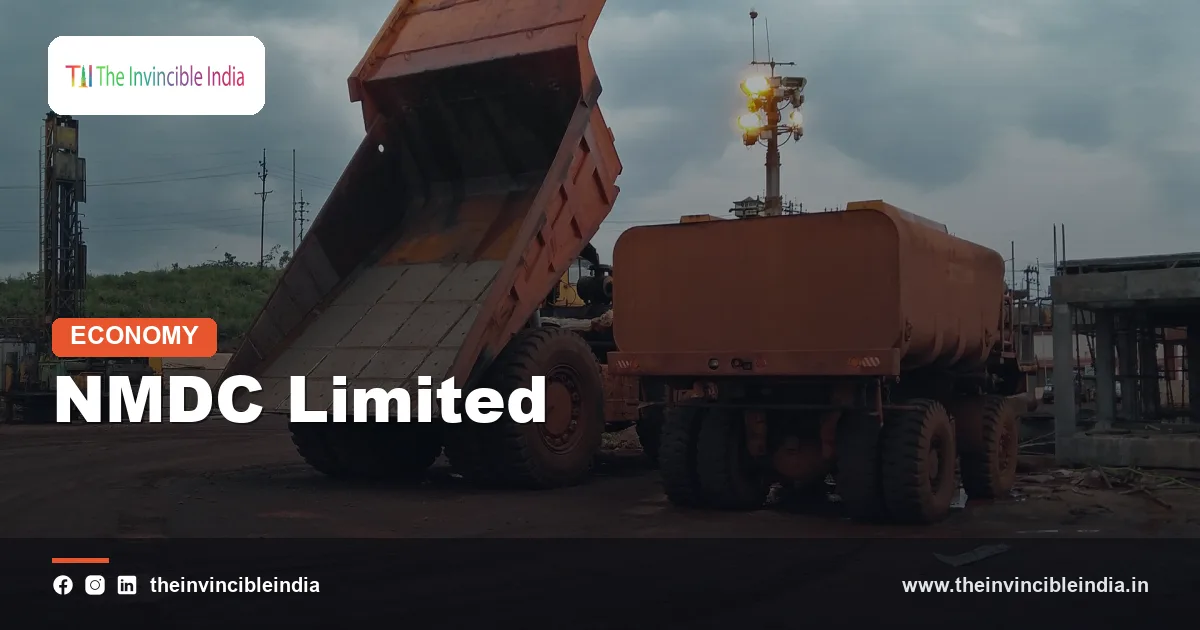
NMDC (formerly the National Mineral Development Corporation) is India’s largest producer of iron ore, a Navratna public sector enterprise under the Ministry of Steel, Government of India, with its headquarters in Hyderabad. NMDC was set up in 1958 to explore and develop the country’s mineral wealth, and today it supplies a very large share of the lump ore and fines that feed Indian steel plants and pellet makers.
The company’s identity rests on two iconic mining complexes: Bailadila in Chhattisgarh and Donimalai in Karnataka. This explainer covers what NMDC does, where it mines, how its business model works, how its steel venture at Nagarnar was structured, and why the company matters for India’s push toward steel self-reliance. Figures are given as rounded, hedged indications because production and financial numbers change every year.
Quick Facts: NMDC at a Glance
| Attribute | Detail |
|---|---|
| Full name | NMDC Limited (earlier National Mineral Development Corporation Limited) |
| Established | 15 November 1958 |
| Administrative ministry | Ministry of Steel, Government of India |
| Status | Navratna central public sector enterprise (CPSE); listed on Indian stock exchanges |
| Headquarters | Hyderabad, Telangana |
| Flagship mines | Bailadila deposits (Chhattisgarh) and Donimalai (Karnataka) |
| Main products | Iron ore lumps and fines, pellets, plus diamonds from Panna (Madhya Pradesh) |
| Scale of output | Typically in the range of 40 million tonnes or more of iron ore a year in recent years (approximate) |
| Steel venture | Nagarnar integrated steel plant near Jagdalpur, Chhattisgarh, run through NMDC Steel Limited |
Key Takeaways
- NMDC is India’s largest iron-ore producing company and operates as a Navratna public sector enterprise under the Ministry of Steel.
- NMDC was established on 15 November 1958 and is headquartered in Hyderabad.
- The Bailadila deposits in Chhattisgarh and the Donimalai mine in Karnataka are the two best-known NMDC mining centres, with Bailadila known for high-grade hematite ore.
- NMDC also produces diamonds at the Panna mine in Madhya Pradesh, making it one of the few Indian state companies in gem-quality diamond mining.
- The Nagarnar steel plant near Jagdalpur in Chhattisgarh was developed by NMDC as a downstream steel project and later restructured into a separate steel company.
- NMDC’s iron ore is central to India’s goal of building domestic steel capacity and reducing dependence on imported raw materials.
What is NMDC?
NMDC is a Government of India enterprise that explores, mines and sells minerals, with iron ore as its dominant product. The company was incorporated in 1958 under the Companies Act, 1956 framework then in force and was built around the idea that a state agency should survey the country’s mineral resources, prove up deposits and open large mechanised mines that private players of the time could not finance.
NMDC is classified as a central public sector enterprise and holds the Navratna status, a category created to give well-performing state companies greater financial and operational autonomy in investment and joint-venture decisions. The Government of India continues to hold the majority of the shares, while the rest are traded publicly on the National Stock Exchange (NSE) and the Bombay Stock Exchange (BSE).
In everyday language, NMDC is best understood as the raw-material arm of Indian steelmaking: it digs ore out of the ground, sizes and grades it, and sells it to integrated steel producers, sponge-iron units and pellet manufacturers.
When and why was NMDC founded?
NMDC was founded on 15 November 1958 because the Government of India wanted a dedicated agency to develop mineral resources for the planned industrialisation of the Second Five Year Plan period. At the time, India was building public sector steel plants at Bhilai, Rourkela and Durgapur and needed a reliable domestic supply of high-quality ore.
Early work involved geological exploration and the development of the Bailadila range in the then undivided Madhya Pradesh. The 1960s saw the beginning of large-scale mechanised mining at Bailadila, supported by a long-distance rail link to the east coast and by export arrangements, notably with Japan, which helped finance the infrastructure with hard-currency earnings.
Over the decades the corporation widened its role from a pure ore supplier to an explorer of several minerals, a pellet producer and, in the 2000s and 2010s, a would-be steelmaker.
Where does NMDC mine iron ore?
NMDC mines iron ore primarily at the Bailadila deposits in the Dantewada and Bijapur region of Chhattisgarh and at the Donimalai complex in the Ballari district of Karnataka. These two clusters, together with a small number of other leases, account for the bulk of the company’s output.
Bailadila (Chhattisgarh)
The Bailadila range lies in the Bastar region of southern Chhattisgarh and is divided into numbered deposits mined from the Kirandul and Bacheli complexes. The name is commonly explained as referring to the hump-like profile of the hills, resembling the hump of an ox. Bailadila ore is high-grade hematite, widely regarded as among the better natural iron ores in the world, with iron content generally in the high-60 per cent range in the best deposits.
Donimalai (Karnataka)
The Donimalai complex sits in the Sandur area of Ballari district and has a long operating history, with a pellet plant and crushing-screening facilities integrated into the complex. A nearby operation, the Kumaraswamy mine, has also been associated with NMDC. The ore here is of somewhat lower grade than Bailadila but is well suited for pelletisation and for steel plants in the south and west of India.
Other assets
- The Panna diamond mine (Majhgawan) in Madhya Pradesh, the only mechanised diamond-mining operation of its kind in India.
- Exploration and mineral blocks in states such as Jharkhand, Madhya Pradesh and others, covering minerals like limestone, dolomite, magnesite, copper and rock phosphate.
- Overseas exploration interests, including critical-mineral initiatives, whose scale and status change frequently and should be checked in current company disclosures.
How does NMDC produce and move iron ore?
NMDC produces iron ore through open-cast mining, using drilling, blasting, loading and hauling equipment, followed by crushing, screening and sometimes beneficiation to sort the ore into lumps and fines. Lump ore is fed directly into blast furnaces and sponge-iron kilns, while fines go into sintering or are converted into pellets.
Moving the ore to customers is as important as mining it. Bailadila ore historically travelled to the east coast through a railway line linking Kirandul with Visakhapatnam in Andhra Pradesh, commonly called the Kottavalasa-Kirandul (KK) line. This rail route, built in the 1960s with Japanese assistance, made large-volume exports and domestic deliveries possible. For deposits in Karnataka, ore moves by rail and road to steel plants and to ports on the west coast.
The company has also explored slurry-pipeline and rail-capacity options to reduce logistics bottlenecks in Bastar, since road and rail constraints are among the main limits on how much ore can be dispatched.
What are pellet plants and why does NMDC build them?
Pellet plants convert iron-ore fines into hardened, uniform balls that can be used in blast furnaces and direct-reduced iron (DRI) units, and NMDC builds them to turn low-value fines into a higher-value product. Fines are produced in large quantities during mining and crushing, and without pelletisation they would be difficult to sell at good prices.
A pellet plant mixes finely ground ore with a binder, rolls it into green balls and indurates them in a furnace. Pellets have consistent size and chemistry, which improves furnace productivity, and they are easier to transport. NMDC has operated a pellet facility at Donimalai and has planned or developed additional pellet capacity, notably around Chhattisgarh, to serve domestic steelmakers. Exact capacities and commissioning stages vary by source and by year, so readers should treat any single number cautiously.
Pellet capacity also supports India’s transition toward gas-based and coal-based DRI routes and toward cleaner steelmaking, because pellets are the preferred feed for such units.
What is the Nagarnar steel plant?
The Nagarnar steel plant is an integrated steel project near Jagdalpur in the Bastar region of Chhattisgarh, developed by NMDC to move the company from selling raw ore into producing finished steel. The plant was planned with a capacity of around three million tonnes per annum, designed to use Bailadila ore sourced just a short distance away.
The project was housed in a separate company, NMDC Steel Limited, which carried out construction, commissioning and early operations. Because the plant faced cost overruns, ramp-up difficulties and a long period of restructuring, the Government of India considered strategic options, including a sale of the government’s stake. A demerger scheme was later pursued to separate the steel business from the mining business, so that NMDC could concentrate on mining and exploration while the steel company stood on its own.
Details of ownership and listing of the steel company have changed over time, and readers should consult the latest stock-exchange filings for the current position.
What role does NMDC play in India’s steel self-reliance?
NMDC plays a foundational role in India’s steel self-reliance by supplying domestic iron ore to the country’s steel and sponge-iron industry, which underpins the national goal of expanding crude steel capacity. India’s National Steel Policy has set long-term ambitions for capacity growth, and ore availability is a prerequisite for hitting those targets.
The company’s contribution can be seen in three ways. First, it provides a reliable source of ore from public sector mines, which can balance prices in periods when private miners restrict supply. Second, it invests in pellets and logistics so that more of the ore reaches steel plants as a value-added input. Third, it explores for other minerals needed for industry, including those classed as critical minerals for batteries and clean energy.
Because steel is a core input for infrastructure, railways, defence and housing, NMDC’s operational stability has a broad economic effect, even though most citizens never see the company directly.
Who owns and governs NMDC?
NMDC is owned mainly by the President of India, acting through the Ministry of Steel, with the remaining shareholding held by public and institutional investors. The company is managed by a Board of Directors headed by a Chairman-cum-Managing Director, with functional directors for production, finance, commercial and technical matters, alongside government nominee directors and independent directors.
As a listed Navratna, NMDC follows the corporate governance rules of the Securities and Exchange Board of India (SEBI) as well as the guidelines of the Department of Public Enterprises (DPE). Its financial performance is audited by statutory auditors appointed with the oversight of the Comptroller and Auditor General of India (CAG), and its mining operations are regulated under the Mines and Minerals (Development and Regulation) Act, 1957 (MMDR Act) and related rules.
Environmental and forest clearances are also essential because many of the leases are in forested and tribal areas, particularly in Bastar.
What are the main milestones in NMDC’s history?
NMDC’s history can be summarised as a progression from exploration to large-scale mining, then to value addition and diversification. The table below lists the broad stages and avoids unverifiable precise dates for events that are often reported differently across sources.
| Period | Broad milestone |
|---|---|
| 1958 | NMDC established on 15 November to develop mineral resources |
| 1960s | Mechanised mining begins at Bailadila; rail link to Visakhapatnam and export arrangements with Japan |
| 1970s-1980s | Expansion of Bailadila production; operations at Donimalai and diamond mining at Panna |
| 1990s-2000s | Liberalisation, listing on the stock exchanges, improved profitability and Navratna recognition |
| 2010s | Pellet plants, capacity expansion plans and the Nagarnar steel project |
| 2020s | Restructuring of the steel business, higher production targets and a focus on critical minerals |
What challenges does NMDC face?
NMDC faces challenges that include logistics constraints, volatile commodity prices, regulatory approvals and the need to expand sustainably in sensitive regions. Iron-ore prices follow global steel demand and can swing sharply, which affects profitability even when volumes are stable.
Infrastructure is a persistent issue. Rail capacity from Bastar, road quality and port handling can all cap dispatches. Security concerns in parts of Chhattisgarh have also influenced the pace of work in the past. Environmental concerns around mining in forested regions mean that expansion needs careful clearance and community engagement, including rehabilitation and benefit-sharing for local and tribal populations.
On the strategic side, the company must balance its core mining identity with new priorities such as critical minerals, lower-carbon steel inputs and a changing competitive landscape that includes private miners and steelmakers expanding their own captive supply.
Bottom Line
NMDC is the backbone of India’s public sector iron-ore supply, anchored by the Bailadila and Donimalai mines and supported by pellet plants, diamond mining at Panna and exploration across several minerals. The Nagarnar steel venture shows both the ambition to move up the value chain and the difficulty of doing so, but the core business remains mining. For anyone tracking India’s steel economy, NMDC is the company to understand first.
Frequently Asked Questions
What does NMDC stand for?
NMDC stands for National Mineral Development Corporation, although the company now uses NMDC Limited as its formal name. It was established on 15 November 1958 and is headquartered in Hyderabad, Telangana.
Is NMDC a government company?
Yes, NMDC is a Government of India enterprise under the Ministry of Steel, with the government holding the majority stake. It is also a listed company, so a minority of its shares is traded on the stock exchanges.
Where are NMDC’s main iron ore mines?
NMDC’s main iron-ore mines are the Bailadila deposits in Chhattisgarh and the Donimalai complex in Karnataka. Bailadila is known for high-grade hematite, while Donimalai is notable for its pellet plant and its supply to southern and western steel plants.
Does NMDC produce steel?
NMDC planned to produce steel through the Nagarnar integrated steel plant near Jagdalpur in Chhattisgarh, which was designed for roughly three million tonnes per annum. The steel business was housed in a separate company, NMDC Steel Limited, and has been restructured, so NMDC today is mainly known as a miner.
Does NMDC mine diamonds?
Yes, NMDC operates the Majhgawan diamond mine at Panna in Madhya Pradesh. It is one of the best-known diamond-mining operations in India, though diamonds contribute only a small share of NMDC’s overall business compared with iron ore.
Why is NMDC important for India?
NMDC is important because it supplies domestic iron ore that supports India’s steel industry and its goal of self-reliance in a core industrial input. The company also invests in pellets, logistics and the exploration of other minerals, including critical minerals needed for clean-energy technologies.
{“@context”:”https://schema.org”,”@graph”:[{“@type”:”FAQPage”,”mainEntity”:[{“@type”:”Question”,”name”:”What does NMDC stand for?”,”acceptedAnswer”:{“@type”:”Answer”,”text”:”NMDC stands for National Mineral Development Corporation, although the company now uses NMDC Limited as its formal name. It was established on 15 November 1958 and is headquartered in Hyderabad, Telangana.”}},{“@type”:”Question”,”name”:”Is NMDC a government company?”,”acceptedAnswer”:{“@type”:”Answer”,”text”:”Yes, NMDC is a Government of India enterprise under the Ministry of Steel, with the government holding the majority stake. It is also a listed company, so a minority of its shares is traded on the stock exchanges.”}},{“@type”:”Question”,”name”:”Where are NMDC’s main iron ore mines?”,”acceptedAnswer”:{“@type”:”Answer”,”text”:”NMDC’s main iron-ore mines are the Bailadila deposits in Chhattisgarh and the Donimalai complex in Karnataka. Bailadila is known for high-grade hematite, while Donimalai is notable for its pellet plant and its supply to southern and western steel plants.”}},{“@type”:”Question”,”name”:”Does NMDC produce steel?”,”acceptedAnswer”:{“@type”:”Answer”,”text”:”NMDC planned to produce steel through the Nagarnar integrated steel plant near Jagdalpur in Chhattisgarh, which was designed for roughly three million tonnes per annum. The steel business was housed in a separate company, NMDC Steel Limited, and has been restructured, so NMDC today is mainly known as a miner.”}},{“@type”:”Question”,”name”:”Does NMDC mine diamonds?”,”acceptedAnswer”:{“@type”:”Answer”,”text”:”Yes, NMDC operates the Majhgawan diamond mine at Panna in Madhya Pradesh. It is one of the best-known diamond-mining operations in India, though diamonds contribute only a small share of NMDC’s overall business compared with iron ore.”}},{“@type”:”Question”,”name”:”Why is NMDC important for India?”,”acceptedAnswer”:{“@type”:”Answer”,”text”:”NMDC is important because it supplies domestic iron ore that supports India’s steel industry and its goal of self-reliance in a core industrial input. The company also invests in pellets, logistics and the exploration of other minerals, including critical minerals needed for clean-energy technologies.”}}]}]}


