

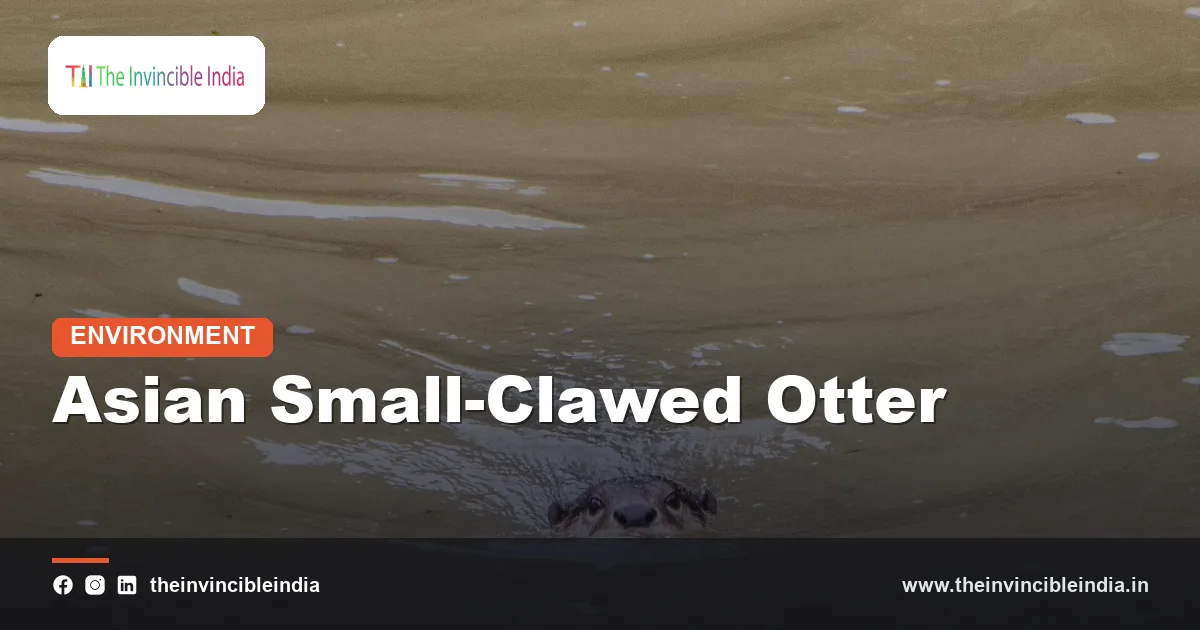
The Asian small-clawed otter (Aonyx cinereus) is the smallest otter species in the world, a social, shellfish-eating otter of wetlands, streams and mangroves in South and Southeast Asia, and in India it is found in the Himalayan foothills, the Northeast and the Western Ghats. Its conservation in India concerns the protection of freshwater habitats, control of the wildlife trade and better knowledge of a species that is rarely seen.
The Asian small-clawed otter is listed as Vulnerable by the IUCN, and its populations are declining across much of its range. It is easily confused with the larger smooth-coated otter, so accurate identification is a first step in understanding how many survive in India.
| Scientific name | Aonyx cinereus |
|---|---|
| Family | Mustelidae (weasels, otters and relatives) |
| Also called | Oriental small-clawed otter, small-clawed otter |
| Size | The smallest otter, with a body of roughly 45 to 55 cm plus a tail, and a weight of roughly 1 to 5 kg |
| Range in India | Himalayan foothills, the Northeast, the Eastern and Western Ghats, and the Nilgiri hills |
| Habitat | Hill streams, rivers, marshes, rice paddies, mangroves and estuaries |
| Diet | Mainly crabs, molluscs, crustaceans and small fish |
| IUCN status | Vulnerable |
| Legal protection in India | Protected under the Wildlife (Protection) Act, 1972; international trade is restricted under CITES |
Key Takeaways
- The Asian small-clawed otter (Aonyx cinereus) is the smallest of the world’s otter species and is native to South, Southeast and parts of East Asia.
- The Asian small-clawed otter has short, partly webbed paws with reduced claws, which it uses like hands to feel for and grab crabs, molluscs and other prey.
- The species lives in family groups that can include a breeding pair and several offspring, and members communicate with a range of calls.
- The IUCN classifies the Asian small-clawed otter as Vulnerable, with populations declining mainly because of wetland loss, pollution, hunting and the pet trade.
- In India, the species is protected under the Wildlife (Protection) Act, 1972, and its international trade is regulated under CITES.
- The Asian small-clawed otter is a different species from the smooth-coated otter (Lutrogale perspicillata) and the Eurasian otter (Lutra lutra), which also occur in India.
What is the Asian small-clawed otter?
The Asian small-clawed otter is the world’s smallest otter, a semi-aquatic carnivore of the weasel family that hunts mainly in shallow water. It has a rounded head, a short snout, a stocky body, a thick tail and dense brown fur, with a paler throat and cheeks.
Its name refers to its feet. The claws are short and do not extend beyond the tips of the toes, which makes the paws more flexible and sensitive than those of other otters. The webbing between the toes is also less developed.
Males and females look alike, though males are slightly larger. The animal is active mostly at dawn and dusk but can be seen at other times, particularly in areas with little disturbance.
Why is it called small-clawed?
The animal is called small-clawed because its claws are very short, vestigial and do not project past the pads of the digits. The reduced claws allow it to use its fingers with unusual dexterity, a feature that is rare among carnivores.
How does the Asian small-clawed otter use its paws?
The Asian small-clawed otter uses its clawless-looking, sensitive paws to probe under stones and in mud and to grasp prey such as crabs and molluscs, working much like a raccoon or a small primate. The otter often finds food by touch rather than sight, reaching into crevices and mud with its fingers.
After catching a crab, mollusc or snail, the otter can manipulate the prey in its paws and crack open the shell using its strong teeth. Its cheek teeth are broad and flat, suited to crushing hard-shelled prey.
This hand-like use of the paws is one reason the species is popular in zoos and, unfortunately, in the illegal pet trade. The same trait is also a clue that the animal’s ecology is tied to shallow, food-rich water where it can forage by touch.
Where is the Asian small-clawed otter found in India?
The Asian small-clawed otter is found in India in the foothills of the Himalaya, across the Northeast, in the hill streams of the Western Ghats including the Nilgiris, and in pockets of the Eastern Ghats and peninsular India. Its stronghold in India is generally considered to be the Northeast and the southern hills.
Outside India, the species occurs in Nepal, Bangladesh, Myanmar, Thailand, Malaysia, Indonesia, the Philippines, southern China and Indochina. In the Himalayan region, it ranges from the foothills to streams at moderate elevation.
In the Western Ghats, the otter is reported from protected areas and from rivers such as those in Kerala, Karnataka and Tamil Nadu. In the Northeast, records come from Assam, Meghalaya, Arunachal Pradesh and other states, where streams and marshes provide suitable habitat. Mangrove and estuarine populations are also known from the Sundarbans.
What habitats does it prefer?
The Asian small-clawed otter prefers shallow, slow-flowing freshwater with dense bank vegetation, such as hill streams, marshes, paddy fields, ponds and mangrove creeks. It needs food-rich shallows and secure places for dens, which are often burrows in banks or spaces under tree roots and rocks.
How does the Asian small-clawed otter live and breed?
The Asian small-clawed otter lives in family groups made up of a monogamous breeding pair and their offspring, and groups of up to a dozen animals have been reported. Pairs are thought to bond for life, and older offspring may help raise younger siblings.
Breeding can occur at different times of the year depending on the region. After a gestation of roughly two months, females give birth to a small litter, commonly of one to six pups, in a den lined with vegetation. The pups open their eyes after several weeks and learn to swim and forage under parental guidance.
Otters communicate with a varied vocal repertoire, including chirps, whistles and chatters, and they also use scent marks, called spraints, to signal territory. Researchers use spraints to survey otters, because the droppings contain fragments of shell and fish bone that reveal the animal’s diet.
| Feature | Asian small-clawed otter | Smooth-coated otter | Eurasian otter |
|---|---|---|---|
| Scientific name | Aonyx cinereus | Lutrogale perspicillata | Lutra lutra |
| Size | Smallest | Larger and heavier | Medium to large |
| Claws | Short, not projecting beyond toes | Well developed | Well developed |
| Fur | Dense, brown, with pale throat | Short, sleek and smooth | Dense, dark brown |
| Typical habitat in India | Hill streams, marshes, mangroves | Large rivers, lakes and coastal waters | Cold, clear Himalayan and Ghats streams |
| Main diet | Crabs and molluscs | Fish | Fish and amphibians |
| Social structure | Family groups | Larger family groups | Mostly solitary or small families |
What does the Asian small-clawed otter eat?
The Asian small-clawed otter eats mainly crabs, freshwater snails, mussels, crayfish and other crustaceans and molluscs, and takes fish, frogs and insects when they are available. This diet is unusual among otters, many of which rely heavily on fish.
The specialised diet affects where the species lives. It does best in streams, marshes and paddy fields with plenty of crabs and shellfish, and it may suffer if pesticides or pollution reduce these invertebrates.
By controlling populations of crabs and snails, the otter plays a role in the food web. Because otters sit near the top of aquatic food chains, they are also good indicators of freshwater health. Their absence from a stream often signals pollution, disturbance or loss of prey.
Why is the Asian small-clawed otter threatened?
The Asian small-clawed otter is threatened by loss and degradation of wetlands, water pollution, depletion of prey, hunting for fur and body parts, accidental capture in fishing gear and capture for the pet trade. Each of these pressures affects a species with a small body size, a specialised diet and dependence on shallow water.
- Wetland loss: Drainage and conversion of marshes and paddy fields reduce foraging habitat and denning sites.
- Pollution and pesticides: Agrochemicals and industrial waste harm the otter’s prey and can accumulate in the animal.
- Dams and river modification: Hydropower projects and channelisation alter stream flow and fragment habitat.
- Hunting and persecution: Otters are killed for skins, for traditional uses and sometimes because they are seen as competitors with fishers.
- Pet trade: Young otters are captured for the exotic pet market, which has grown in some Asian countries, partly driven by social media videos.
- Bycatch: Otters can drown in fish traps and nets.
The impact of these threats is hard to measure because there is little systematic data from India. Researchers often rely on spraint surveys and camera trapping, which provide information on presence but not always on numbers.
How is the Asian small-clawed otter protected in India?
The Asian small-clawed otter is protected in India under the Wildlife (Protection) Act, 1972, which prohibits hunting, capture and trade, and under international rules that restrict cross-border trade. The Act was amended in 2022 and its schedules were reorganised, so the current schedule placement should be verified against the latest notification.
At the international level, the species is listed under the Convention on International Trade in Endangered Species of Wild Fauna and Flora (CITES). The otters were moved to the strictest category of CITES in 2019, a decision intended to curb the international pet trade and trafficking of otters.
Many of the places where the otter occurs fall within protected areas, such as national parks and tiger reserves of the Western Ghats and the Northeast. Even so, a lot of its habitat lies in streams, wetlands and farmland outside these areas, where protection is weaker.
What does CITES listing mean for the otter?
A CITES listing means that international commercial trade in the species is heavily restricted and generally prohibited. For the Asian small-clawed otter, the stricter listing helps customs agencies treat the live otter trade as wildlife crime and supports enforcement against smuggling.
What can be done to conserve the Asian small-clawed otter?
Conserving the Asian small-clawed otter requires protecting freshwater and mangrove habitats, reducing pollution, tackling the pet trade and filling gaps in knowledge about where the species lives. Because the animal is shy and widespread but sparse, local involvement is essential.
- Habitat protection: Safeguard marshes, hill streams and mangroves, and maintain bank vegetation that provides cover and dens.
- Pollution control: Limit pesticide use and untreated discharge into streams and paddy ecosystems.
- Enforcement: Strengthen action against poaching and trafficking, including online sales of otters.
- Community engagement: Work with fishers and farmers to reduce conflict and accidental capture, for example through safer trap designs.
- Research and monitoring: Carry out systematic surveys using spraint counts, camera traps and genetic methods to establish distribution and trends.
- Rescue and rehabilitation: Support wildlife rescue centres in caring for confiscated or orphaned otters and, where possible, in returning them to the wild.
Is it legal to keep an otter as a pet in India?
It is not legal to keep an Asian small-clawed otter as a pet in India, because the species is protected under the Wildlife (Protection) Act, 1972, and possession, capture and trade without permission are offences. Anyone found keeping or selling a protected wild animal may face penalties.
Otters are poor pets. They need large amounts of clean water, a specialised diet and social companionship, and they can bite. Animals taken from the wild often die in transit or in captivity, and the trade encourages the capture of pups from family groups.
Conservation groups advise people to avoid sharing or promoting videos of pet otters, which can fuel demand, and to report suspected sales to forest authorities or wildlife crime agencies.
Why do small-clawed otters matter?
Small-clawed otters matter because they are top predators of shallow-water ecosystems and indicator species for the health of streams, wetlands and mangroves. Their presence indicates a food web with plenty of crabs, shellfish and other invertebrates, and clean water.
Protecting otters also protects the many other animals and plants that depend on the same wetlands, and the communities that rely on these waters for fishing and farming. The species is also a charismatic ambassador that can draw public interest to the less-known freshwater habitats of India.
Bottom Line
The Asian small-clawed otter is a small, hand-like foraging otter whose future in India depends on clean, connected wetlands and streams and on stopping the pet trade. Better surveys, firm enforcement and community involvement are the clearest ways to keep this species from declining further.
Frequently Asked Questions
What is the smallest otter in the world?
The smallest otter in the world is the Asian small-clawed otter, Aonyx cinereus. Adults weigh roughly 1 to 5 kilograms and measure around half a metre in body length, excluding the tail. It lives in streams, marshes and mangroves of South and Southeast Asia.
Where is the Asian small-clawed otter found in India?
The Asian small-clawed otter is found in India in the Himalayan foothills, the Northeast, the Western Ghats and parts of the Eastern Ghats. It also occurs in mangrove areas such as the Sundarbans. It prefers shallow streams, marshes and paddy fields with plenty of crabs and shellfish.
How is the Asian small-clawed otter different from the smooth-coated otter?
The Asian small-clawed otter is smaller than the smooth-coated otter and has short claws that do not extend beyond the toes. It eats mainly crabs and molluscs and lives in hill streams and marshes. The smooth-coated otter is larger, eats more fish and is common in big rivers and lakes.
Is the Asian small-clawed otter endangered?
The Asian small-clawed otter is classified as Vulnerable by the IUCN, which means it faces a high risk of extinction in the wild if threats continue. Populations are declining because of wetland loss, pollution, hunting and the pet trade. It is protected in India and under CITES.
Can you keep a small-clawed otter as a pet in India?
You cannot legally keep a small-clawed otter as a pet in India. The species is protected under the Wildlife (Protection) Act, 1972, and capture, possession and trade are offences. Otters also have complex needs that cannot be met in a home, and the pet trade harms wild populations.
What does the Asian small-clawed otter eat?
The Asian small-clawed otter eats mainly crabs, snails, mussels and other shellfish, and also catches small fish, frogs and insects. It uses its sensitive paws to find and hold prey, then crushes shells with its broad teeth. This diet makes it different from many fish-eating otters.
{“@context”:”https://schema.org”,”@graph”:[{“@type”:”FAQPage”,”mainEntity”:[{“@type”:”Question”,”name”:”What is the smallest otter in the world?”,”acceptedAnswer”:{“@type”:”Answer”,”text”:”The smallest otter in the world is the Asian small-clawed otter, Aonyx cinereus. Adults weigh roughly 1 to 5 kilograms and measure around half a metre in body length, excluding the tail. It lives in streams, marshes and mangroves of South and Southeast Asia.”}},{“@type”:”Question”,”name”:”Where is the Asian small-clawed otter found in India?”,”acceptedAnswer”:{“@type”:”Answer”,”text”:”The Asian small-clawed otter is found in India in the Himalayan foothills, the Northeast, the Western Ghats and parts of the Eastern Ghats. It also occurs in mangrove areas such as the Sundarbans. It prefers shallow streams, marshes and paddy fields with plenty of crabs and shellfish.”}},{“@type”:”Question”,”name”:”How is the Asian small-clawed otter different from the smooth-coated otter?”,”acceptedAnswer”:{“@type”:”Answer”,”text”:”The Asian small-clawed otter is smaller than the smooth-coated otter and has short claws that do not extend beyond the toes. It eats mainly crabs and molluscs and lives in hill streams and marshes. The smooth-coated otter is larger, eats more fish and is common in big rivers and lakes.”}},{“@type”:”Question”,”name”:”Is the Asian small-clawed otter endangered?”,”acceptedAnswer”:{“@type”:”Answer”,”text”:”The Asian small-clawed otter is classified as Vulnerable by the IUCN, which means it faces a high risk of extinction in the wild if threats continue. Populations are declining because of wetland loss, pollution, hunting and the pet trade. It is protected in India and under CITES.”}},{“@type”:”Question”,”name”:”Can you keep a small-clawed otter as a pet in India?”,”acceptedAnswer”:{“@type”:”Answer”,”text”:”You cannot legally keep a small-clawed otter as a pet in India. The species is protected under the Wildlife (Protection) Act, 1972, and capture, possession and trade are offences. Otters also have complex needs that cannot be met in a home, and the pet trade harms wild populations.”}},{“@type”:”Question”,”name”:”What does the Asian small-clawed otter eat?”,”acceptedAnswer”:{“@type”:”Answer”,”text”:”The Asian small-clawed otter eats mainly crabs, snails, mussels and other shellfish, and also catches small fish, frogs and insects. It uses its sensitive paws to find and hold prey, then crushes shells with its broad teeth. This diet makes it different from many fish-eating otters.”}}]}]}


