

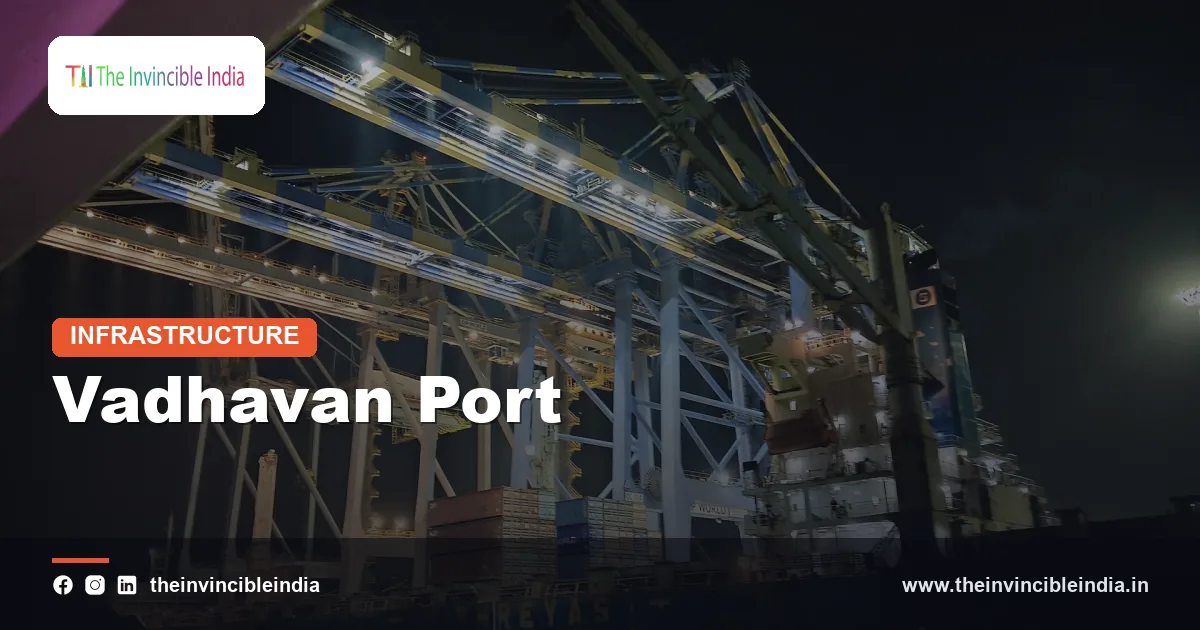
The Vadhavan Port is a mega all-weather, deepwater greenfield port being built at Vadhavan Point near Dahanu in Palghar district, Maharashtra, and it is intended to become one of India’s largest container ports. The project is being developed by a special-purpose vehicle in which the Jawaharlal Nehru Port Authority (JNPA) holds the majority stake and the Maharashtra Maritime Board (MMB) holds the minority share, under the Ministry of Ports, Shipping and Waterways.
The Vadhavan Port is designed around one central advantage: a naturally deep sea floor close to the shore, which allows the largest modern container ships to berth without extensive dredging. This explainer covers what the port is, why India wants it, how it is being constructed, how it will connect to the hinterland and what debates surround it. Details were last reviewed on 15 October 2026; because the project is in a multi-year build-out, readers should treat capacity and timeline figures as planning-stage values.
Quick Facts
| Attribute | Detail |
|---|---|
| Official focus | Vadhavan Port, a new major deepwater container and multipurpose port |
| Location | Vadhavan Point, near Dahanu, Palghar district, Maharashtra, on the Arabian Sea coast |
| Type | Greenfield, all-weather, deepwater port with substantial offshore land reclamation |
| Implementing entity | Vadhavan Port Project Limited, a special-purpose vehicle (SPV) of JNPA and the Maharashtra Maritime Board |
| Ownership pattern | JNPA holds the majority (about three-fourths) and the Maharashtra Maritime Board the balance |
| Administrative ministry | Ministry of Ports, Shipping and Waterways, Government of India |
| Natural draft | Around 20 metres, among the deepest natural drafts on India’s west coast |
| Project approval and launch | Union Cabinet approval in 2024, followed by the foundation stone ceremony the same year |
| Planned role | Gateway for the largest container ships and a hub linking to the Western Dedicated Freight Corridor |
Key Takeaways
- The Vadhavan Port is a greenfield deepwater port at Vadhavan Point in Palghar district, Maharashtra, planned to rank among India’s largest container ports.
- Vadhavan Port Project Limited, the SPV building the port, is promoted by the Jawaharlal Nehru Port Authority (majority) and the Maharashtra Maritime Board (minority).
- The site offers a natural draft of roughly 20 metres, enough for the biggest ultra-large container vessels that cannot fully enter many existing Indian ports.
- A large part of the port’s land will be created through offshore reclamation, protected by long breakwaters that shelter the berths from monsoon seas.
- The port is planned to connect with the Western Dedicated Freight Corridor, national highways and expressways serving Maharashtra, Gujarat and north India.
- The project sits within the Sagarmala programme and aims to reduce India’s dependence on foreign transhipment hubs such as Colombo, Singapore and Jebel Ali.
What is the Vadhavan Port?
The Vadhavan Port is a planned major port on the Arabian Sea coast of Maharashtra that will handle containers, bulk cargo, liquid cargo and other goods in several terminal complexes. It is classified as a greenfield project because it is being built on a site with no earlier port, rather than expanding an existing harbour.
The port is often described as a future top-tier global container gateway. At full build-out, project documents envisage multiple container terminals of roughly a kilometre of quay each, along with multipurpose berths, liquid cargo berths, a roll-on/roll-off (Ro-Ro) facility and a berth for the Indian Coast Guard. The final size is designed in phases, so capacity numbers depend on how far each phase advances.
The name is also spelled Wadhawan in some older records and news reports. Both spellings refer to the same location, a headland on the coast of the Dahanu region.
Where is the Vadhavan Port located?
The Vadhavan Port is located at Vadhavan Point, a coastal location close to Dahanu taluka in Palghar district, in the northern part of Maharashtra’s coastline. The site lies roughly 120 to 150 kilometres by road north of Mumbai and not far from the Gujarat border.
The location was chosen after studies of the western coast showed an unusually deep seabed near the shore. In most Indian ports, the seabed shelves gently, and ships need dredged channels. At Vadhavan Point, deeper water begins comparatively close to the coastline, so less dredging is needed to provide a deep channel.
Proximity to Gujarat, the Delhi-Mumbai industrial belt and the Western Dedicated Freight Corridor also makes the site attractive for long-distance cargo moving to and from northern India.
Who is building the Vadhavan Port?
The Vadhavan Port is being built by Vadhavan Port Project Limited (VPPL), a special-purpose vehicle created by the Jawaharlal Nehru Port Authority (JNPA) and the Maharashtra Maritime Board (MMB). JNPA, based at Nhava Sheva near Navi Mumbai, is a major port authority under the Government of India and operates one of the country’s busiest container gateways.
The Maharashtra Maritime Board is the state agency that administers non-major ports along Maharashtra’s coast. By bringing a state body and a central port authority together, the structure combines central funding and port expertise with state land and coastal management.
Within the SPV, JNPA holds the larger share, while the Maharashtra Maritime Board holds the balance. The SPV then works through a mix of engineering, procurement and construction contracts for common infrastructure and private-sector concessions for terminals, a model long used on Indian ports. Under this approach, public agencies typically build the breakwaters, reclamation, channel and connectivity, while private operators invest in terminal equipment and run the berths.
Why does India need the Vadhavan Port?
India needs the Vadhavan Port mainly because existing Indian ports cannot fully serve the largest container ships, so a significant share of India’s transhipment cargo is handled at foreign hubs. Transhipment means that containers travel to a hub port on a large mother vessel and are then shifted to smaller feeder ships for the final destination.
Ports such as Colombo in Sri Lanka, Singapore and Jebel Ali in the United Arab Emirates have long served as hubs for Indian cargo. The shipping cost and the time lost in transhipment, together with the strategic dependence on foreign terminals, are the reasons Indian policymakers want a domestic deepwater hub.
Other reasons cited for the port include:
- Congestion at JNPA, which handles a very large share of India’s western-coast containers.
- Rising container volumes tied to manufacturing growth and the shift to larger ships.
- The wish to lower logistics costs, which are a recurring theme in India’s national logistics policy.
- The need for a port directly linked to the Western Dedicated Freight Corridor for fast movement of containers inland.
How deep is the Vadhavan Port, and why does draft matter?
The Vadhavan Port has a natural draft of around 20 metres, which means ships drawing nearly that depth of water can approach the berths. Draft is the vertical distance between a ship’s waterline and the bottom of its hull, and it determines the depth of water a vessel needs to float safely.
Ultra-large container vessels, which can carry well over 20,000 twenty-foot equivalent units (TEU), sit deep in the water when fully loaded. Many existing Indian ports have channel depths of roughly 14 to 16 metres, so the biggest ships either arrive partly loaded or call at foreign hubs instead.
A 20-metre natural draft changes this in three ways:
- Large ships can call fully laden, improving per-container economics.
- Less capital dredging is needed, lowering initial cost and reducing the need for repeated maintenance dredging.
- The port can be positioned as a mainline hub on east-west trade routes between Asia, the Middle East and Europe.
Depth alone does not make a port competitive. Terminal productivity, customs efficiency, hinterland links and shipping-line confidence also decide whether carriers choose a port as a hub.
How is the Vadhavan Port being built?
The Vadhavan Port is being built mainly by reclaiming land from the sea, constructing protective breakwaters, creating berths and dredging approach channels. Because the site is a headland with little flat land, the terminal areas are planned largely on reclaimed ground in the sea.
The main construction components are:
- Breakwaters: long rubble-mound structures built to shelter the harbour from monsoon waves and keep the water inside calm for ships.
- Offshore reclamation: sand and rock fill placed behind bunds, creating more than a thousand hectares of land for terminals, yards and utilities according to planning documents.
- Dredging: deepening the channel and turning basin where required to meet design depth.
- Quay walls and berths: container berths designed for the largest vessels, along with multipurpose, liquid cargo and Ro-Ro berths.
- Terminal equipment: ship-to-shore cranes, yard cranes and automation systems, mostly supplied through private concessionaires.
The port is planned in phases, so each phase adds berths and yard space. Project planners usually base the sequence on traffic growth, so early phases focus on the container terminals and common infrastructure, and later phases add the remaining terminals.
How will the Vadhavan Port connect to the rest of India?
The Vadhavan Port will connect to the rest of India through rail, national highways and expressways, with the Western Dedicated Freight Corridor (DFC) as the central rail link. The Western DFC is a freight-only railway line built by the Dedicated Freight Corridor Corporation of India Limited, running between the Mumbai region and the Delhi region.
Linking the port to the Western DFC allows double-stacked container trains to carry cargo from the coast to northern India at higher speed and with greater load than on regular railway lines. Without this link, the benefits of a deepwater berth would be limited by slow inland movement.
The planned and available road connections include:
- National Highway 48, the long north-south route between Mumbai and Gujarat.
- The Delhi-Mumbai Expressway, a long access-controlled corridor under development in sections across several states.
- The Vadodara-Mumbai Expressway, which is meant to provide a faster alternative to older highways.
- A dedicated rail connection from the port to the existing Western Railway network.
Connectivity projects are often run by different agencies, such as the National Highways Authority of India (NHAI) and Indian Railways, so their timelines may not match that of the port itself.
What will the Vadhavan Port handle?
The Vadhavan Port is planned to handle mostly containerised cargo, along with bulk goods, liquid cargo and vehicles, in a series of dedicated terminals. The project’s planning documents describe a very large ultimate capacity, on the order of hundreds of millions of tonnes of total cargo and more than 20 million TEU of containers a year at full build-out.
These are design targets, not current throughput, and they depend on phased execution. The table below summarises the planned facility types.
| Facility type | Role at the port |
|---|---|
| Container terminals | Handle the largest container ships and act as the core of the port |
| Multipurpose berths | Handle general cargo, project cargo and some bulk goods |
| Liquid cargo berths | Handle petroleum, chemicals and other liquid products |
| Ro-Ro berth | Handle vehicles and wheeled cargo, supporting the automobile industry |
| Coast Guard berth | Support maritime security and patrol operations |
| Logistics and industrial zones | Warehouses, container freight stations and manufacturing clusters |
What are the environmental and community concerns around the Vadhavan Port?
The main concerns around the Vadhavan Port relate to the ecology of the Dahanu region and the livelihoods of local fishing and farming communities. Dahanu taluka was notified as an ecologically fragile area in 1991, and a statutory body, the Dahanu Taluka Environment Protection Authority, was later constituted to oversee activity there.
Local fishing communities have raised concerns about the effect of reclamation and dredging on fishing grounds, marine life and access to the sea. Farmers and horticulturists in the area, known for produce such as chikoo (sapota), have raised questions about land and environmental impact. Some residents have also raised concerns about land acquisition, compensation and the pace of consultation.
The project proponents have stated that environmental and coastal clearances were obtained through the regulatory process and that mitigation and rehabilitation measures are planned. Courts and statutory bodies have a role in reviewing such disputes, and the situation may evolve as work progresses. A balanced reading recognises both the national logistics rationale and the genuine local concerns.
How does the Vadhavan Port compare with JNPA and other ports?
The Vadhavan Port is intended to complement, not replace, the Jawaharlal Nehru Port at Nhava Sheva, by offering far deeper water and room to grow. JNPA is already a large, mature container port with established rail and road links, but its channel depth and land area limit how much larger ships and volumes it can take.
The table below compares them in general terms.
| Feature | Vadhavan Port | JNPA (Nhava Sheva) |
|---|---|---|
| Status | Greenfield, under development | Operating major port |
| Location | Palghar district, north of Mumbai | Raigad district, near Navi Mumbai |
| Water depth | Deep natural draft of around 20 metres | Shallower dredged channel, in the mid-teens of metres |
| Land | Substantial offshore reclamation | Land-constrained, with limited room to expand |
| Intended role | Mainline hub for the largest ships | Gateway for the Mumbai region and northern hinterland |
Among other Indian deepwater and transhipment projects, the Vizhinjam International Seaport in Kerala and the proposed Galathea Bay project in the Andaman and Nicobar Islands share a similar aim of reducing dependence on foreign hubs. Each focuses on a different part of India’s coastline and shipping routes.
What is the strategic significance of the Vadhavan Port?
The Vadhavan Port is strategically significant because it can anchor India’s western maritime gateway, strengthen supply-chain security and support trade corridors toward West Asia and Europe. Ports are critical infrastructure, and a high-capacity domestic hub reduces the risk of disruption at foreign transhipment terminals.
The port also fits into several larger national programmes:
- Sagarmala: India’s port-led development programme, which promotes modernisation of ports and coastal economic zones.
- National Logistics Policy: an effort to cut logistics costs and improve efficiency across modes of transport.
- PM Gati Shakti: a digital master plan to coordinate infrastructure planning across ministries.
- Trade corridors: proposed routes such as the India-Middle East-Europe Economic Corridor, which depend on strong west-coast ports.
Whether the port achieves its strategic aims depends on execution, customer demand and the quality of inland links. Its supporters see it as a long-term investment in trade capacity, while sceptics point to cost, timeline and environmental risks.
Bottom Line
The Vadhavan Port is a long-horizon national infrastructure project that aims to give India a deepwater container hub on its west coast, built by a JNPA-led SPV with the Maharashtra Maritime Board. Its success will depend on phased construction, strong rail and road connectivity, private terminal investment and careful handling of environmental and community concerns.
Frequently Asked Questions
What is the Vadhavan Port?
The Vadhavan Port is a greenfield deepwater port being built at Vadhavan Point near Dahanu in Palghar district, Maharashtra. It is planned to become one of India’s largest container ports, with additional terminals for bulk, liquid and vehicle cargo. It is being developed in phases by a special-purpose vehicle of JNPA and the Maharashtra Maritime Board.
Who owns the Vadhavan Port project?
The Vadhavan Port project is owned by Vadhavan Port Project Limited, a special-purpose vehicle in which the Jawaharlal Nehru Port Authority holds the majority stake and the Maharashtra Maritime Board holds the remainder. The Ministry of Ports, Shipping and Waterways oversees the project at the central level. Private companies are expected to operate terminals under concession agreements.
How deep is the Vadhavan Port?
The Vadhavan Port has a natural draft of about 20 metres, which is deeper than most existing Indian container ports. This depth allows the largest container ships to berth fully loaded. It also reduces the amount of dredging required to maintain a deep channel.
Why is the Vadhavan Port being built when JNPA already exists?
The Vadhavan Port is being built because JNPA has limited depth and land to handle the biggest container ships and rising volumes. Vadhavan offers deeper water and space for reclamation and expansion. The two ports are intended to complement each other rather than compete directly.
How will cargo move out of the Vadhavan Port?
Cargo from the Vadhavan Port is planned to move by rail and road, with the Western Dedicated Freight Corridor as the main rail link toward northern India. Road access is planned through national highways and expressways, including links to the Delhi-Mumbai and Vadodara-Mumbai corridors. The speed of these connections will determine how effective the port is as a hub.
What are the main concerns about the Vadhavan Port?
The main concerns about the Vadhavan Port are its impact on the ecologically fragile Dahanu region, local fishing grounds and farmland. Residents have also raised issues around land acquisition and consultation. The project authorities state that clearances were obtained and mitigation measures are planned, and the matter continues to be debated.
{“@context”:”https://schema.org”,”@graph”:[{“@type”:”FAQPage”,”mainEntity”:[{“@type”:”Question”,”name”:”What is the Vadhavan Port?”,”acceptedAnswer”:{“@type”:”Answer”,”text”:”The Vadhavan Port is a greenfield deepwater port being built at Vadhavan Point near Dahanu in Palghar district, Maharashtra. It is planned to become one of India’s largest container ports, with additional terminals for bulk, liquid and vehicle cargo. It is being developed in phases by a special-purpose vehicle of JNPA and the Maharashtra Maritime Board.”}},{“@type”:”Question”,”name”:”Who owns the Vadhavan Port project?”,”acceptedAnswer”:{“@type”:”Answer”,”text”:”The Vadhavan Port project is owned by Vadhavan Port Project Limited, a special-purpose vehicle in which the Jawaharlal Nehru Port Authority holds the majority stake and the Maharashtra Maritime Board holds the remainder. The Ministry of Ports, Shipping and Waterways oversees the project at the central level. Private companies are expected to operate terminals under concession agreements.”}},{“@type”:”Question”,”name”:”How deep is the Vadhavan Port?”,”acceptedAnswer”:{“@type”:”Answer”,”text”:”The Vadhavan Port has a natural draft of about 20 metres, which is deeper than most existing Indian container ports. This depth allows the largest container ships to berth fully loaded. It also reduces the amount of dredging required to maintain a deep channel.”}},{“@type”:”Question”,”name”:”Why is the Vadhavan Port being built when JNPA already exists?”,”acceptedAnswer”:{“@type”:”Answer”,”text”:”The Vadhavan Port is being built because JNPA has limited depth and land to handle the biggest container ships and rising volumes. Vadhavan offers deeper water and space for reclamation and expansion. The two ports are intended to complement each other rather than compete directly.”}},{“@type”:”Question”,”name”:”How will cargo move out of the Vadhavan Port?”,”acceptedAnswer”:{“@type”:”Answer”,”text”:”Cargo from the Vadhavan Port is planned to move by rail and road, with the Western Dedicated Freight Corridor as the main rail link toward northern India. Road access is planned through national highways and expressways, including links to the Delhi-Mumbai and Vadodara-Mumbai corridors. The speed of these connections will determine how effective the port is as a hub.”}},{“@type”:”Question”,”name”:”What are the main concerns about the Vadhavan Port?”,”acceptedAnswer”:{“@type”:”Answer”,”text”:”The main concerns about the Vadhavan Port are its impact on the ecologically fragile Dahanu region, local fishing grounds and farmland. Residents have also raised issues around land acquisition and consultation. The project authorities state that clearances were obtained and mitigation measures are planned, and the matter continues to be debated.”}}]}]}


