

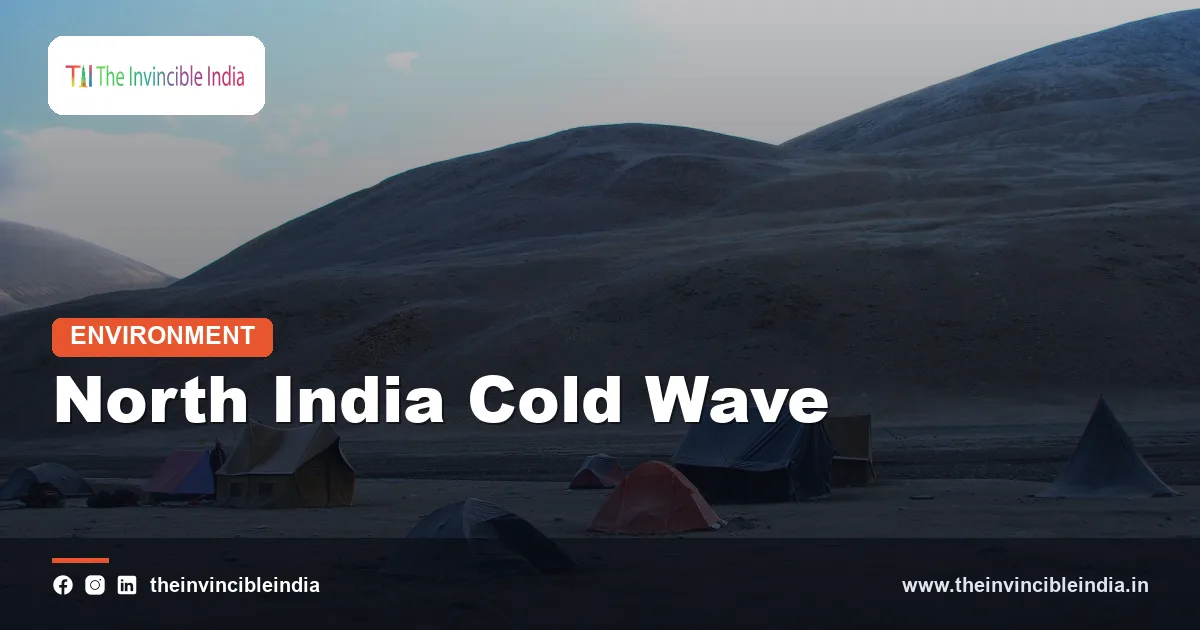
A cold wave is a spell of abnormally low temperatures, officially declared by the India Meteorological Department (IMD) when the minimum temperature in the plains falls to 4 degrees Celsius or below, or drops well under the normal for the time of year, on at least two consecutive days. Cold waves sweep across north and central India mostly between December and February, bringing frozen nights, dense fog, shivering days and a sharp rise in illness and deaths among the poor and homeless.
The cold wave of north India is driven by dry, cold northwesterly winds that blow down from the snow-covered western Himalaya and the cold regions beyond, usually after a western disturbance has passed and the skies have cleared. Because the Indo-Gangetic plain is flat, densely populated and poorly prepared for freezing weather, even a few days of severe cold can create a public-health emergency.
| Quick Facts | Details |
|---|---|
| Declaring agency | India Meteorological Department (IMD), under the Ministry of Earth Sciences |
| Typical season | December to February, with the peak usually from late December to mid-January |
| Plains criterion (actual minimum) | 4 degrees Celsius or below for a cold wave; 2 degrees Celsius or below for a severe cold wave |
| Plains criterion (departure from normal) | Minimum temperature 4.5 to 6.4 degrees Celsius below normal for a cold wave; 6.5 or more below normal for a severe cold wave |
| Hilly regions criterion | Minimum temperature of minus 2 degrees Celsius or below |
| Duration rule | Conditions must persist for at least two consecutive days in a meteorological subdivision |
| Most affected states | Punjab, Haryana, Delhi, Rajasthan, Uttar Pradesh, Bihar, Madhya Pradesh and nearby areas |
| Legal status | Cold wave and frost are listed as notified disasters eligible for relief from the State Disaster Response Fund |
Key Takeaways
- A cold wave in India is formally declared by the India Meteorological Department when minimum temperatures in the plains reach 4 degrees Celsius or below, or fall at least 4.5 degrees Celsius under normal.
- Cold waves in north India are caused mainly by cold, dry northwesterly winds from the snow-covered Himalaya and beyond, and by clear skies that let the ground lose heat at night.
- Western disturbances often set up the conditions for a cold wave, because the snowfall and rain they bring on the mountains is followed by cold air flowing onto the plains.
- Cold waves in the Indo-Gangetic plain frequently coincide with dense fog, which keeps daytime temperatures low and can create “cold day” conditions even when nights are not extreme.
- The elderly, children, the homeless, outdoor workers and people with heart or lung disease are the groups most likely to be harmed or killed during an Indian cold wave.
- Cold wave and frost are recognised as notified disasters in India, so state governments can use disaster-response funds for shelters, blankets and relief.
What Is a Cold Wave?
A cold wave is a period of unusually cold weather lasting at least a couple of days, during which temperatures fall far below the normal for the region and season. Meteorologists define it using numbers rather than feelings, so that warnings can be issued consistently across the country.
The word “wave” refers to a mass of cold air that moves into a region. The cold air arrives on the wind, settles over the surface and stays for days until the weather pattern changes. Unlike snowfall, a cold wave in the plains is not about precipitation. It is about air that is cold, dry and still, often under a clear or foggy sky.
In everyday Indian speech, the terms “cold wave” and “cold day” are often confused. The IMD treats them separately, as explained below.
What Are the IMD Criteria for a Cold Wave?
The IMD declares a cold wave using two tests, a departure-from-normal test and an actual-minimum test, and it applies both only when the minimum temperature is already low enough to matter. For the plains, a cold wave is considered when the minimum temperature is 10 degrees Celsius or lower, and for hilly regions when it is 0 degrees Celsius or lower.
The criteria in simplified form are shown below.
| Condition | Plains | Hilly regions |
|---|---|---|
| Cold wave (departure test) | Minimum 4.5 to 6.4 degrees Celsius below normal | Minimum 4.5 to 6.4 degrees Celsius below normal |
| Severe cold wave (departure test) | Minimum 6.5 degrees Celsius or more below normal | Minimum 6.5 degrees Celsius or more below normal |
| Cold wave (actual minimum test) | Minimum 4 degrees Celsius or below | Minimum minus 2 degrees Celsius or below |
| Severe cold wave (actual minimum test) | Minimum 2 degrees Celsius or below | Judged mainly by departure from normal |
The IMD also requires that the conditions occur in at least two stations in a meteorological subdivision and persist for at least two days before a cold wave is declared. These rules mean that a single very cold night at one station is not counted as a cold wave. Coastal stations follow a modified rule, since their winters are mild and a drop of several degrees can matter.
What Causes a Cold Wave in North India?
A cold wave in north India is caused by the arrival of cold, dry northwesterly winds over the plains together with clear skies that allow strong night-time cooling. Several ingredients typically combine.
- Cold air from the north-west: Air chilled over the snowbound western Himalaya, Afghanistan, Central Asia and the Tibetan region flows south-eastward onto the plains.
- Clear, dry skies: Without cloud, the ground radiates heat into space at night, and the surface air cools quickly. Dry air holds heat poorly, so the nights get colder.
- Calm winds near the ground: Light wind lets cold air pool close to the surface, forming a shallow layer in which the coldest air sits at ground level.
- Snow cover: Fresh snow on the mountains cools the air above it and reflects sunlight, so air moving down to the plains stays cold.
- Weather patterns in the upper air: A deep trough in the westerly jet stream pulls cold air towards India, and a ridge of high pressure then holds it in place.
Studies also point to a relationship with large-scale climate patterns such as La Nina, which tends to favour colder winters in north India, although the link is not strong enough to predict each cold spell.
How Are Western Disturbances Linked to Cold Waves?
Western disturbances are linked to cold waves because the cold air that follows these winter storms often produces the coldest weather on the plains. A western disturbance is a low-pressure system that travels eastward from the Mediterranean region along the jet stream, and it brings rain to the plains and snow to the Himalaya between December and March.
While the western disturbance is overhead, cloud cover and moisture usually keep nights relatively mild. When the system moves east, the clouds clear, the winds turn northwesterly and cold air flows down from the freshly snowed mountains. Nights then become colder, and the plains can experience a cold wave for several days. Light winter rain can also lower the temperature further by wetting the soil.
Not every western disturbance leads to a cold wave, and not every cold wave follows one. Winters with fewer or weaker disturbances can bring prolonged dry cold, while active winters bring more rain but alternating warm and cold phases.
Why Do Cold Waves and Dense Fog Occur Together?
Cold waves and dense fog occur together because the same conditions of clear skies, calm winds and moist ground favour both. During a cold wave, the ground cools quickly at night, and the air near it reaches its dew point, so water vapour condenses into fog. Fog is common across the Indo-Gangetic plain from December to January.
Fog also lengthens the cold. A thick fog layer blocks sunlight, so the day fails to warm up. This produces a “cold day”, which the IMD defines as a day on which the maximum temperature, not the minimum, is far below normal, usually by 4.5 degrees Celsius or more, while the minimum is already low. Cold day conditions can persist for several days under a shallow fog layer, with the high temperature stuck in the low teens in cities such as Delhi, Lucknow or Amritsar.
In a cold day, people may spend long periods in unheated homes, trains and offices at the same low temperature, with little relief from sunshine. This is one reason why days of persistent fog can be as harmful as the coldest nights.
Which Parts of India Face Cold Waves?
The parts of India that face cold waves most often are the north-western and central plains, with Punjab, Haryana, Delhi, Rajasthan, Uttar Pradesh and Bihar at the forefront. Cold waves also extend to Madhya Pradesh, Gujarat, Vidarbha, Jharkhand, West Bengal and Odisha in stronger episodes, and in some years cold air reaches as far south as Telangana and Maharashtra.
The Himalayan states, including Jammu and Kashmir, Ladakh, Himachal Pradesh and Uttarakhand, are cold throughout winter, but are used to it and have heating and clothing suited to the weather. The greater danger lies in the plains, where cold waves are less frequent but houses are poorly insulated and heating is rare.
Rajasthan’s desert regions add a special extreme. Dry air and open ground allow rapid night-time cooling, and places such as Churu and Sikar in the Shekhawati region sometimes record sub-zero minimum temperatures even though they lie in the plains.
How Do Cold Waves Affect Health?
Cold waves affect health mainly by causing hypothermia, frostbite and a rise in heart and lung complications, and they kill more people in India than is widely recognised. The cold constricts blood vessels, raises blood pressure and makes the heart work harder, so cardiac events and strokes increase.
The main health effects include the following.
- Hypothermia and frostbite: Prolonged exposure lowers the body temperature, particularly for people sleeping outdoors, without blankets or warm shelter.
- Heart attacks and strokes: Cold weather raises blood pressure and clotting risk, especially in older adults.
- Respiratory illness: Pneumonia, bronchitis, asthma and chronic lung disease worsen, and children are particularly vulnerable.
- Poisoning from indoor heating: Burning coal, wood or charcoal in closed rooms can cause carbon monoxide poisoning.
- Burns and fires: Open fires and heaters used by people trying to keep warm lead to accidents.
The highest risk falls on the homeless, rickshaw pullers, labourers sleeping on pavements, farm workers, and the poor in houses made of thin walls and plastic sheets. Newborns and the elderly also lose heat quickly. Animals suffer too, and cattle deaths are reported during severe spells.
How Do Cold Waves Affect Farming and the Economy?
Cold waves affect farming through frost, which damages sensitive crops, even though many winter crops need cool weather to grow. Wheat, India’s main rabi cereal, benefits from a cool winter, but a sudden freeze or frost at flowering can reduce yields. Mustard, potato, chickpea, pea, tomato and other vegetables are more sensitive, and frost can burn leaves and flowers.
Fog and low sunshine over many days slow plant growth and can encourage fungal diseases, such as late blight in potato. Farmers sometimes protect fields by irrigating before a frost, since moist soil releases heat at night, and by covering nurseries.
The wider economy is also affected, because fog and cold disrupt rail, road and air travel, reduce outdoor construction work and cut the incomes of daily-wage workers. Schools in several states close or change timings during severe cold waves.
What Does the Government Do During a Cold Wave?
The government responds to cold waves with early warnings from the IMD, advisories from the National Disaster Management Authority (NDMA), and relief measures by state governments. The IMD issues colour-coded warnings for cold wave and cold day conditions, and states then activate district disaster management authorities.
Typical measures include the following.
- Opening night shelters and temporary shelters for homeless people, such as those run by city authorities in Delhi and other cities.
- Distributing blankets and firewood, and lighting community bonfires at public places.
- Adjusting school hours and issuing health advisories on keeping warm.
- Arranging medical teams and keeping hospitals ready for cardiac and respiratory patients.
- Using State Disaster Response Fund money, since cold wave and frost are notified disasters.
Experts say that planning could be improved, with permanent shelters, better targeting of the homeless, and local cold-action plans similar to the heat-action plans now used in many cities.
Is Climate Change Making Indian Cold Waves Weaker?
Climate change is making cold waves in India less frequent over the long run, because average winter temperatures are rising, but severe cold spells can still occur. Records over recent decades show a general increase in winter minimum temperatures across India and a decline in the number of cold wave days in many regions.
The picture is not simple. Some scientists have proposed that changes in the Arctic and the jet stream can allow cold air to push further south in some winters, although the evidence for this is still debated. Recent winters have included both record-warm spells and intense cold snaps in north India. The practical lesson is that preparedness for cold waves remains necessary, even as the long-term trend leans towards warmer winters.
Bottom Line
A cold wave in India is a measured, officially declared spell of low temperatures that develops when cold northwesterly air, clear skies and often fog settle over the northern plains. The poorest, oldest and youngest suffer most, which makes shelters, warnings and relief the heart of the response.
Frequently Asked Questions
What is a cold wave according to the IMD?
A cold wave, according to the India Meteorological Department, is declared when the minimum temperature in the plains is 4 degrees Celsius or below, or is 4.5 to 6.4 degrees Celsius below normal, for at least two consecutive days. A severe cold wave means 2 degrees Celsius or below, or 6.5 degrees Celsius or more below normal. Hilly regions use a threshold of minus 2 degrees Celsius.
Which months does the cold wave occur in north India?
Cold waves in north India occur mainly from December to February, and the most intense spells usually come between late December and mid-January. Occasionally a cold spell appears in early March or late November. The timing depends on the passage of western disturbances and the strength of northwesterly winds.
What is the difference between a cold wave and a cold day?
A cold wave is judged by unusually low minimum (night-time) temperatures, whereas a cold day is judged by unusually low maximum (daytime) temperatures. A cold day usually happens under a thick fog or cloud layer that blocks sunshine. Both can occur together, and both carry health risks.
Why does north India get cold waves but south India does not?
North India gets cold waves because it lies open to cold northwesterly air from the Himalaya and Central Asia, while south India is warmed by the surrounding seas and sits far from the cold air source. The wide, flat plains of the north also allow strong night-time cooling under clear skies. Southern states rarely cross the cold wave thresholds, although a strong episode can reach central and peninsular India.
Who is most at risk during a cold wave?
The homeless, the elderly, young children, outdoor workers and people with heart or lung conditions are most at risk during a cold wave. They face hypothermia, frostbite, heart attacks and respiratory infections. Warm clothing, shelter, hot food and avoiding sleeping near closed coal or wood fires reduce the danger.
Is a cold wave a notified disaster in India?
Yes, cold wave and frost are listed among the notified disasters in India, which allows state governments to spend money from the State Disaster Response Fund on relief. Relief typically covers shelters, blankets and compensation for losses. Disaster authorities at the state and district level coordinate the response with the IMD and the National Disaster Management Authority.
{“@context”:”https://schema.org”,”@graph”:[{“@type”:”FAQPage”,”mainEntity”:[{“@type”:”Question”,”name”:”What is a cold wave according to the IMD?”,”acceptedAnswer”:{“@type”:”Answer”,”text”:”A cold wave, according to the India Meteorological Department, is declared when the minimum temperature in the plains is 4 degrees Celsius or below, or is 4.5 to 6.4 degrees Celsius below normal, for at least two consecutive days. A severe cold wave means 2 degrees Celsius or below, or 6.5 degrees Celsius or more below normal. Hilly regions use a threshold of minus 2 degrees Celsius.”}},{“@type”:”Question”,”name”:”Which months does the cold wave occur in north India?”,”acceptedAnswer”:{“@type”:”Answer”,”text”:”Cold waves in north India occur mainly from December to February, and the most intense spells usually come between late December and mid-January. Occasionally a cold spell appears in early March or late November. The timing depends on the passage of western disturbances and the strength of northwesterly winds.”}},{“@type”:”Question”,”name”:”What is the difference between a cold wave and a cold day?”,”acceptedAnswer”:{“@type”:”Answer”,”text”:”A cold wave is judged by unusually low minimum (night-time) temperatures, whereas a cold day is judged by unusually low maximum (daytime) temperatures. A cold day usually happens under a thick fog or cloud layer that blocks sunshine. Both can occur together, and both carry health risks.”}},{“@type”:”Question”,”name”:”Why does north India get cold waves but south India does not?”,”acceptedAnswer”:{“@type”:”Answer”,”text”:”North India gets cold waves because it lies open to cold northwesterly air from the Himalaya and Central Asia, while south India is warmed by the surrounding seas and sits far from the cold air source. The wide, flat plains of the north also allow strong night-time cooling under clear skies. Southern states rarely cross the cold wave thresholds, although a strong episode can reach central and peninsular India.”}},{“@type”:”Question”,”name”:”Who is most at risk during a cold wave?”,”acceptedAnswer”:{“@type”:”Answer”,”text”:”The homeless, the elderly, young children, outdoor workers and people with heart or lung conditions are most at risk during a cold wave. They face hypothermia, frostbite, heart attacks and respiratory infections. Warm clothing, shelter, hot food and avoiding sleeping near closed coal or wood fires reduce the danger.”}},{“@type”:”Question”,”name”:”Is a cold wave a notified disaster in India?”,”acceptedAnswer”:{“@type”:”Answer”,”text”:”Yes, cold wave and frost are listed among the notified disasters in India, which allows state governments to spend money from the State Disaster Response Fund on relief. Relief typically covers shelters, blankets and compensation for losses. Disaster authorities at the state and district level coordinate the response with the IMD and the National Disaster Management Authority.”}}]}]}


