

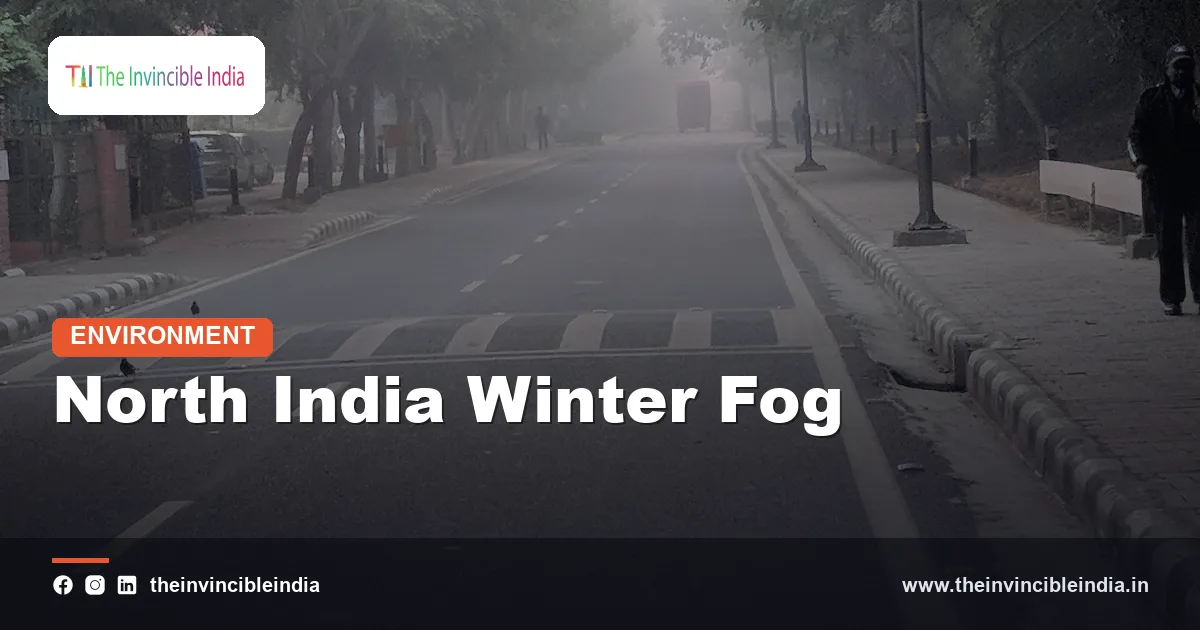
The winter fog of north India is a thick layer of tiny water droplets suspended near the ground, which forms on cold, still nights over the Indo-Gangetic plain and cuts visibility to under one kilometre, sometimes to a few metres. Known as kohra in Hindi and Urdu, this fog blankets Punjab, Haryana, Delhi, Uttar Pradesh and Bihar for days at a time between December and January, and is so extensive that it shows up clearly as a pale sheet in satellite images.
Winter fog is more than a seasonal inconvenience. It grounds flights, slows hundreds of trains, triggers road pile-ups and mixes with air pollution to form a dense, unhealthy murk. Understanding why the Indo-Gangetic plain is one of the foggiest regions on Earth helps explain what can be forecast, what can be managed and what cannot be fixed quickly.
| Quick Facts | Details |
|---|---|
| Fog definition | Visibility below 1,000 metres due to suspended water droplets near the ground |
| Local names | Kohra (Hindi, Urdu), kuhasa; “smog” when mixed with heavy pollution |
| Main type over the plains | Radiation fog, formed by night-time cooling of the ground and the air above it |
| Peak season | Mid-December to late January, sometimes from late November to February |
| Regions affected | Indo-Gangetic plain across Punjab, Haryana, Delhi, Uttar Pradesh, Bihar and West Bengal, extending into Pakistan and Bangladesh |
| IMD “very dense” fog | Visibility 0 to 50 metres |
| IMD “dense” fog | Visibility 51 to 200 metres |
| Agencies involved | India Meteorological Department (IMD), Indian Railways, Airports Authority of India, state transport departments |
Key Takeaways
- Winter fog in north India is mainly radiation fog, which forms when the ground cools by night under clear, calm skies and the air touching it becomes saturated with moisture.
- The India Meteorological Department classifies fog by visibility, calling it dense when visibility is between 51 and 200 metres and very dense when visibility is 50 metres or less.
- The Indo-Gangetic plain is a global hotspot for persistent winter fog because it is flat, moist from irrigation and rivers, hemmed in by the Himalaya, and rich in aerosol particles.
- Fog droplets form on tiny particles, so heavy air pollution can increase fog density and make fog last longer, although the precise size of this effect is still being studied.
- Dense fog disrupts rail, road and air transport across north India every winter, and the combined fog and pollution problem harms lungs, especially among children and the elderly.
- Fog is distinct from smog and haze, since fog is made of water droplets, while smog and haze contain pollutant particles and can persist even when the air is not saturated.
What Is Winter Fog?
Winter fog is a cloud that forms at ground level, made of millions of tiny liquid water droplets, which occurs when air near the surface cools to its dew point and the water vapour in it condenses. Meteorologists officially call it fog when visibility drops below 1,000 metres.
A thinner veil with visibility above one kilometre is called mist. Haze is a different phenomenon, made mainly of dry particles such as dust and smoke, which gives the air a dull, greyish look but does not usually reduce visibility as sharply. In north India, the three often blend together, and the thick grey winter air is a mixture of fog, mist, haze and pollution.
The IMD measures visibility at airports and observatories using instruments called transmissometers and runway visual range sensors, and it issues warnings in four categories, which are explained in the table below.
| Category | Visibility | Typical effect |
|---|---|---|
| Shallow fog | 501 to 1,000 metres | Slower driving, minor delays |
| Moderate fog | 201 to 500 metres | Speed restrictions on roads and trains |
| Dense fog | 51 to 200 metres | Significant flight and train delays |
| Very dense fog | 0 to 50 metres | Severe disruption, flight diversions and cancellations, high accident risk |
How Does Radiation Fog Form Over the Indo-Gangetic Plain?
Radiation fog forms over the Indo-Gangetic plain when the ground loses heat to space on a clear, calm winter night, cooling the air above it until the water vapour condenses into droplets. The process unfolds in a clear sequence.
- Clear skies: After sunset, the land radiates heat upward. With no cloud to trap it, the ground temperature falls quickly.
- Light winds: A gentle breeze mixes the lowest layer of air without disturbing it, whereas strong wind would stir the fog away.
- Moist ground and air: Irrigated fields, rivers, canals, ponds and recent winter rain give the air near the ground plenty of water vapour.
- Cooling to the dew point: Once the air reaches its dew point, the vapour condenses on tiny particles known as condensation nuclei.
- A temperature inversion: The air near the ground becomes colder than the air above it, which traps the fog under a warm lid and keeps it from rising.
Radiation fog usually thickens through the night, is deepest around dawn, and burns off when sunshine warms the ground in the late morning. In the heart of winter, the sun is weak and low, so the fog can remain through the entire day and the cycle repeats night after night.
Why Is the Indo-Gangetic Plain So Fog-Prone?
The Indo-Gangetic plain is so fog-prone because its geography, moisture supply and air quality all favour thick, long-lasting fog in winter. The plain is vast, flat and low, so cold air drains into it and stays there, and the Himalaya in the north block the flow of air that might clear it.
The main reasons are as follows.
- Flat terrain and the Himalayan barrier: Cold, heavy air collects over the plain and cannot easily escape, forming a stagnant layer near the surface.
- Western disturbances: These winter systems add moisture and rain, and the cold, clear weather that follows them is ideal for fog.
- Intensive irrigation and rivers: Rice and wheat fields, canals and the large Ganga and Yamuna river systems supply moisture to the lower air.
- Weak winds in winter: The winter circulation over north India is light, which allows fog to persist rather than be stirred away.
- Abundant aerosols: Smoke, dust, vehicle exhaust and industrial emissions supply the particles around which droplets form.
Studies using satellite and surface records have reported that the number of dense-fog days over the western and central parts of the plain increased over the decades from the 1980s onwards, although the scale of the increase and its causes remain debated. Rising aerosol loads, more irrigation, urban growth and shifts in winter weather have all been suggested as contributing factors.
What Is the Role of Pollution in Winter Fog?
Pollution plays a role in winter fog because tiny particles in polluted air act as condensation nuclei, the seeds on which water droplets grow, and because trapped pollutants stay near the ground in the same cold, still conditions that produce fog. The result is a thick mixture of water droplets and pollutants, often called smog.
Several points help to separate the two phenomena.
- Fog droplets form on aerosol particles, so polluted air can produce many small droplets, which reduce visibility more than fewer, larger droplets would.
- Fog and pollution both depend on a shallow layer of cold air under an inversion. This lid limits the mixing height, so pollutants emitted by traffic, industry, brick kilns, cooking fires and stubble burning accumulate in a small volume of air.
- Water-laden fog can also trigger chemical reactions in the droplets that form additional fine particles.
- Pollution is not the sole cause of fog. Clean air in a cold, moist region can still form dense fog, but polluted regions can see fog more often and for longer.
The autumn burning of crop residue in Punjab and Haryana and the arrival of cold weather in late October and November overlap, so smoke is already present when the first fogs form. This is why Delhi and nearby cities often experience severe pollution and fog together in winter.
How Is Fog Different From Smog and Haze?
Fog differs from smog and haze mainly in what it is made of: fog consists of water droplets, haze of dry particles, and smog of a mixture of fog or moisture with smoke and chemical pollutants. The distinction matters for health and for forecasting.
| Phenomenon | Main composition | Visibility | Health effect |
|---|---|---|---|
| Fog | Water droplets | Below 1,000 metres | Mainly accidents and cold exposure |
| Mist | Water droplets, thinner | 1,000 metres or more, but reduced | Minor |
| Haze | Dry dust, smoke and aerosols | Reduced, but often above 1,000 metres | Respiratory irritation |
| Smog | Fog or moisture mixed with smoke and pollutants | Often very low | Serious lung and heart effects |
The thick grey blanket over Delhi and the plains in winter is therefore often a mix of true fog and polluted haze. The popular word “fog” is used for the whole mixture, although a scientist might call parts of it smog.
Can Satellites See the Fog Belt?
Satellites can see the winter fog belt clearly, because fog forms a bright, low sheet that reflects sunlight and often stretches along the Indo-Gangetic plain from Pakistan’s Punjab through north India to Bangladesh. In satellite images from December and January, the plain appears as a long, whitish band lying south of the Himalaya, while the mountains and the peninsula to the south show up clearly.
Meteorologists use geostationary satellites such as India’s INSAT series, polar-orbiting satellites and specialised night-time fog products to track the fog’s growth and burn-off through the day. At night, the contrast between cold fog tops and surrounding land is detected using infrared channels in a way that is different from daytime imagery. Satellites show the extent of the fog, while ground sensors at airports and weather stations measure how low the visibility is.
How Does Winter Fog Disrupt Transport?
Winter fog disrupts transport in north India by cutting the visibility that pilots, train drivers and road users need, which leads to delays, cancellations and accidents. The effects are largest in the weeks when dense fog is most persistent.
Railways
Indian Railways runs reduced speeds and cancels or reschedules trains in the fog belt, because drivers find it hard to see signals. Delays accumulate across the network, since north India is the junction of many long-distance routes. Fog-pass safety devices, which use satellite positioning to warn drivers of upcoming signals and landmarks, have been introduced to help trains run safely and keep schedules.
Aviation
Airports such as Delhi, Lucknow and Amritsar face low visibility that can halt takeoffs and landings. Runways equipped with Category III instrument landing systems allow trained pilots and certified aircraft to land in very low visibility, but flights without such capability must divert or wait, and departures also need minimum visibility.
Roads
Roads and expressways record some of the worst effects, with multi-vehicle pile-ups on highways when drivers travel too fast for the conditions. Authorities impose speed limits, advise the use of fog lights, and sometimes close expressways in the worst conditions.
How Does Winter Fog Affect Health and Farming?
Winter fog affects health through accidents, cold stress and, where it mixes with pollution, breathing problems. Fog itself is not poisonous, but the cold, damp air worsens asthma and bronchitis, and the pollutants trapped under it irritate the lungs.
- Respiratory illness: Children, older adults and people with asthma, chronic obstructive pulmonary disease or heart disease are most affected by smog episodes.
- Cold stress: Fog keeps daytime temperatures low, so the outdoor poor and homeless endure longer periods of cold.
- Injury and death on roads: Low visibility raises road accident rates in winter.
- Mental and economic strain: Long periods of grey, cold weather and lost workdays affect daily life.
For farmers, fog reduces sunlight and can slow the growth of wheat, mustard, potato and vegetables, and it favours fungal diseases such as late blight in potato. At the same time, moderate winter fog and cool, moist conditions are not harmful to wheat in themselves, and the crop depends on a cool winter. The effect depends on how long the fog lasts and when it occurs.
How Is Fog Forecast and Managed?
Fog is forecast by the India Meteorological Department using weather models, satellite data and observations of humidity, wind and temperature, and it is managed through warnings, transport rules and measures against pollution. The IMD issues colour-coded alerts for dense fog, and airports use runway visual range sensors to decide whether flights can operate.
- Nowcasts and warnings: Forecasts one to several days ahead identify regions where dense fog is likely, with yellow, orange or red alerts.
- Transport measures: Railways use speed restrictions and safety devices, airports use instrument landing systems, and highway authorities use speed limits and signage.
- Pollution control: Reducing emissions from vehicles, industry, construction dust, biomass burning and crop-residue fires would lower the number of particles available for fog droplets and reduce smog.
- Public advice: People are advised to avoid early morning travel, use low-beam lights and reflectors, wear warm clothing and avoid outdoor exercise on polluted fog days.
Cloud seeding or clearing fog on a large scale is not a practical tool over the open plains, so the focus is on forecasting, safe operations and cleaner air.
Bottom Line
Winter fog over the Indo-Gangetic plain is a product of cold, calm nights, moist ground, a Himalayan barrier and a heavy load of aerosols. It cannot be eliminated, but better forecasts, safer transport systems and cleaner air can reduce its toll on travel and health.
Frequently Asked Questions
What is winter fog in north India?
Winter fog in north India is a ground-level cloud of water droplets that forms on cold, calm nights over the Indo-Gangetic plain and reduces visibility to under 1,000 metres. It is most common from mid-December to late January and often lasts well into the day. People call it kohra in Hindi and Urdu.
What is the difference between fog and smog?
Fog is made of water droplets, while smog is a mixture of fog or moisture with smoke, dust and chemical pollutants. Fog mainly causes accidents and delays, whereas smog also harms the lungs and heart. In north India, the thick winter murk is often a blend of both.
Why does the Indo-Gangetic plain get so much fog?
The Indo-Gangetic plain gets so much fog because it is flat, moist from irrigation and rivers, bounded by the Himalaya, and full of aerosol particles on which droplets form. Winter nights are long, clear and calm, which allows the ground to cool quickly. Cold air collects in the plain and stays trapped under a temperature inversion.
What visibility counts as dense fog in India?
The India Meteorological Department calls fog dense when visibility is between 51 and 200 metres and very dense when it is 50 metres or less. Moderate fog is 201 to 500 metres and shallow fog is 501 to 1,000 metres. Visibility of 1,000 metres or more is not classed as fog.
Does pollution make winter fog worse?
Pollution can make winter fog denser and longer-lasting, because fine particles act as seeds for droplets and the same cold, still air traps pollutants near the ground. Fog can form in clean air as well, so pollution is a contributing factor rather than the only cause. Cutting emissions would improve air quality and reduce smog, though its effect on fog frequency is still being studied.
How does fog affect trains and flights in India?
Fog forces trains to slow down and flights to be delayed, diverted or cancelled, because low visibility makes it hard to see signals and runways. Indian Railways uses speed restrictions and fog safety devices, while airports use instrument landing systems that allow certified aircraft and trained crews to land in low visibility. Delays in north India often spread to other parts of the network.
{“@context”:”https://schema.org”,”@graph”:[{“@type”:”FAQPage”,”mainEntity”:[{“@type”:”Question”,”name”:”What is winter fog in north India?”,”acceptedAnswer”:{“@type”:”Answer”,”text”:”Winter fog in north India is a ground-level cloud of water droplets that forms on cold, calm nights over the Indo-Gangetic plain and reduces visibility to under 1,000 metres. It is most common from mid-December to late January and often lasts well into the day. People call it kohra in Hindi and Urdu.”}},{“@type”:”Question”,”name”:”What is the difference between fog and smog?”,”acceptedAnswer”:{“@type”:”Answer”,”text”:”Fog is made of water droplets, while smog is a mixture of fog or moisture with smoke, dust and chemical pollutants. Fog mainly causes accidents and delays, whereas smog also harms the lungs and heart. In north India, the thick winter murk is often a blend of both.”}},{“@type”:”Question”,”name”:”Why does the Indo-Gangetic plain get so much fog?”,”acceptedAnswer”:{“@type”:”Answer”,”text”:”The Indo-Gangetic plain gets so much fog because it is flat, moist from irrigation and rivers, bounded by the Himalaya, and full of aerosol particles on which droplets form. Winter nights are long, clear and calm, which allows the ground to cool quickly. Cold air collects in the plain and stays trapped under a temperature inversion.”}},{“@type”:”Question”,”name”:”What visibility counts as dense fog in India?”,”acceptedAnswer”:{“@type”:”Answer”,”text”:”The India Meteorological Department calls fog dense when visibility is between 51 and 200 metres and very dense when it is 50 metres or less. Moderate fog is 201 to 500 metres and shallow fog is 501 to 1,000 metres. Visibility of 1,000 metres or more is not classed as fog.”}},{“@type”:”Question”,”name”:”Does pollution make winter fog worse?”,”acceptedAnswer”:{“@type”:”Answer”,”text”:”Pollution can make winter fog denser and longer-lasting, because fine particles act as seeds for droplets and the same cold, still air traps pollutants near the ground. Fog can form in clean air as well, so pollution is a contributing factor rather than the only cause. Cutting emissions would improve air quality and reduce smog, though its effect on fog frequency is still being studied.”}},{“@type”:”Question”,”name”:”How does fog affect trains and flights in India?”,”acceptedAnswer”:{“@type”:”Answer”,”text”:”Fog forces trains to slow down and flights to be delayed, diverted or cancelled, because low visibility makes it hard to see signals and runways. Indian Railways uses speed restrictions and fog safety devices, while airports use instrument landing systems that allow certified aircraft and trained crews to land in low visibility. Delays in north India often spread to other parts of the network.”}}]}]}


