

The northern pintail (Anas acuta) is a slender, long-necked dabbling duck that breeds across the northern latitudes of Eurasia and North America and spends the winter in large numbers on freshwater wetlands across India. The drake is easy to recognise by its chocolate-brown head, a white stripe running up the side of the neck and a long, needle-like central tail feather that gives the species its name.
For many Indian birdwatchers, the arrival of the northern pintail in autumn is one of the first signs that the winter migration season has begun. This guide explains how to identify the northern pintail, where and when it is found in India, what it eats, how it breeds and what threatens it.
| Common name | Northern pintail (also called the pintail or common pintail) |
|---|---|
| Scientific name | Anas acuta |
| Family | Anatidae (ducks, geese and swans) |
| Size | About 50 to 75 cm in length, including the drake’s long tail; wingspan roughly 80 to 95 cm |
| Range in India | Winter visitor to lakes, jheels, reservoirs, marshes and flooded fields across most of the country |
| Diet | Seeds, grain, aquatic plants, snails, insects and other small invertebrates |
| Breeding and migration | Breeds in northern Eurasia and North America; Indian birds arrive from about September and leave by March or April |
| Conservation status | Least Concern globally (IUCN); protected under India’s Wild Life (Protection) Act, 1972 |
Key Takeaways
- The northern pintail is a long-necked dabbling duck whose drake has a brown head, a white neck stripe and a long pointed tail.
- Northern pintails visit India only in winter, usually arriving from September or October and leaving by March or April.
- The northern pintail breeds in the far north of Europe, Asia and North America, and Indian winter flocks are linked by bird ringing to Siberian and Central Asian breeding areas.
- Northern pintails feed by dabbling and upending in shallow water and often forage in harvested rice fields at night.
- The northern pintail is classed as Least Concern by the IUCN, yet it depends on healthy wetlands that continue to shrink in many parts of India.
- Northern pintails are protected in India under the Wild Life (Protection) Act, 1972, and are counted every January in the Asian Waterbird Census.
What is the northern pintail?
The northern pintail is a medium-large dabbling duck in the family Anatidae, known for its elegant build, long neck and pointed tail. It is one of the most widespread ducks in the world, found on every continent except Antarctica and Australia at some time of year, and it is among the most numerous wintering ducks in South Asia.
The scientific name Anas acuta means “sharp duck” and refers to the tapering tail and wing tips. Dabbling ducks, also called surface-feeding ducks, are those that feed at the water surface or by tipping forward with the tail raised, rather than diving. The northern pintail belongs to this group alongside the mallard, gadwall, wigeon, shoveler and teal.
Unlike many Indian ducks, the northern pintail does not breed in India in any significant way. It is a true migrant, travelling thousands of kilometres between its northern nesting grounds and warm southern wetlands. Within India it is generally regarded as a common to abundant winter visitor, and flocks of several hundred birds are not unusual on a good wetland.
How do you identify a northern pintail?
A northern pintail is identified by its long slim neck, small rounded head, grey bill and a pointed tail, which is especially long in the drake. The bird sits high and graceful on the water, and the neck is noticeably longer than that of a mallard or a gadwall.
The drake in breeding plumage
The adult male in winter has a warm chocolate-brown head and a white breast. A narrow white stripe rises from the breast along each side of the neck and ends near the back of the head. The back and flanks are finely vermiculated grey, the rear is black with a cream patch on the flank, and the two long central tail feathers can extend several centimetres beyond the rest of the tail. The bill is blue-grey with a black stripe along the upper surface.
The female and the eclipse drake
The female northern pintail is mottled buff and brown, with a plain, finely marked face and a greyish bill. Her tail is pointed but not elongated. After breeding, the male moults into an “eclipse” plumage that resembles the female, which is why identification in early autumn can be confusing. Drakes regain their full colours by about October or November, often while still in India.
In flight
In flight, the northern pintail looks slim and long-winged, with a distinctive tapering rear end. The male shows a bronze-green speculum, which is the coloured patch on the secondary feathers, edged with cinnamon in front and a broad white band behind. The female has a brown speculum with a white trailing edge. Flocks fly in loose lines and V-shapes, and the whistling wingbeats of fast-flying groups are a familiar sound at dawn and dusk.
Species that look similar
- Gadwall: a greyer duck with a white wing patch and a shorter, thicker neck.
- Mallard: heavier, with a bright orange bill in the female and a blue speculum bordered in white.
- Eurasian wigeon: a rounder head, short neck and a small pale bill.
- Female garganey and common teal: much smaller than the northern pintail, with a compact outline.
Where is the northern pintail found in India?
The northern pintail is found in winter in almost every part of India that has shallow freshwater wetlands, from Kashmir and Punjab to Kerala and from Gujarat to Assam. It prefers open, shallow water with muddy margins, such as natural lakes, village tanks, reservoirs, saltpans, estuaries, flooded paddy fields and marshes.
Numbers are highest in northern and central India, and in coastal wetlands in Gujarat and Odisha. Well-known sites where northern pintails are regularly recorded include the following.
| Wetland | State or region | Why it suits the northern pintail |
|---|---|---|
| Keoladeo National Park, Bharatpur | Rajasthan | Shallow, managed marshes; a Ramsar site and World Heritage Site |
| Chilika Lake | Odisha | Vast brackish lagoon with shallows and islands; among India’s first Ramsar sites |
| Nal Sarovar | Gujarat | Large shallow lake with reedbeds and mudflats |
| Sultanpur National Park | Haryana | Seasonal jheel close to Delhi |
| Harike Wetland | Punjab | Reservoir at the meeting of the Beas and Sutlej rivers |
| Pong Dam Lake | Himachal Pradesh | Large reservoir with shoreline marshes |
| Kolleru Lake | Andhra Pradesh | Freshwater lake between the Godavari and Krishna deltas |
| Hokersar and Wular Lake | Jammu and Kashmir | High-altitude wetlands used by many wintering ducks |
Smaller sites matter as much as the famous ones. Irrigation tanks, village ponds and sewage-fed lagoons near towns often hold dozens of northern pintails, and they are often the best places for a beginner to see the bird at close range.
When does the northern pintail visit India?
The northern pintail visits India from roughly September or October until March or April, with the main wintering period lasting from November to February. It is among the earlier ducks to appear, and the first small parties are often noticed in the last weeks of September.
Numbers build through October and November as more birds arrive from the north. By December and January, flocks reach their peak, and this is when the Asian Waterbird Census, coordinated by Wetlands International, counts waterbirds at sites across India. Departure begins in late February. Most northern pintails have left by the end of March, although stragglers can linger into April, particularly in the north.
The timing depends on weather at the breeding grounds and along the route. A cold early autumn in Siberia pushes birds south sooner, while a late spring thaw delays their return north. For this reason, the exact arrival date varies a little from year to year.
Where do northern pintails come from, and why do they migrate?
The northern pintails that winter in India breed mainly in the northern parts of Russia, Siberia and Central Asia, and they migrate because their breeding wetlands freeze in winter and cannot supply food. The journey takes them along the Central Asian Flyway, one of the major bird migration routes that links Arctic breeding grounds with the Indian subcontinent.
Ringing studies, including those carried out by the Bombay Natural History Society (BNHS), have recovered rings from ducks in India that were originally marked in Siberia and Central Asia. This type of evidence is how scientists know that the same species that spends the winter in Rajasthan or Odisha was raising ducklings on northern lakes a few months earlier.
The route crosses mountain barriers, including the Himalaya and the Hindu Kush. Ducks often travel at night and rest during the day on stopover wetlands in Central Asia and Pakistan. They arrive in India in good condition, but those that reach the country late may have to feed intensively to rebuild fat stores. Northern pintails are strong fliers, and they have a reputation among ornithologists as one of the fastest and most long-ranging dabbling ducks.
What does the northern pintail eat?
The northern pintail eats a mix of plant and animal food, mainly seeds, grain, the shoots and tubers of aquatic plants, snails, insects and small crustaceans. In winter the diet is mostly vegetable, while in the breeding season, animal food such as insects becomes much more important for egg-laying females and for ducklings.
The long neck of the northern pintail allows it to upend, which means tipping forward with its tail pointing to the sky, and reach food on the bottom of water up to about 30 cm deep or more. It also feeds by dabbling at the surface, sieving mud, and walking on soft ground at the water’s edge.
- By day, many northern pintails rest in tight groups on open water.
- At dusk, flocks often fly out to feed in harvested paddy fields, where they eat spilt rice and weed seeds.
- In shallow marshes, they take seeds of sedges, grasses and pondweeds.
- In coastal lagoons they also eat small molluscs and crustaceans.
Because the northern pintail relies on both natural wetlands and farmland, it is affected by changes in cropping patterns and by pesticide use in the fields around lakes.
How does the northern pintail behave?
The northern pintail is a highly sociable duck that lives in flocks, often mixed with other ducks, and it is wary, quick to take off and very agile in the air. Flocks may number from a few birds to several thousand on the best wetlands, and they commonly raft together in open water during the day.
Voice
The drake gives a soft, mellow double whistle, while the female produces a low, rough quack. In winter flocks, the whistling of the males carries across the water and can be heard even when the birds are hard to see.
Courtship in winter
Much of the courtship of northern pintails happens in winter, before the northward migration. Several drakes may chase a single female in flight, and on the water the males perform displays that include stretching the neck, raising the tail and giving a whistle. Pairs often form on the wintering grounds, and the male then accompanies the female back to her breeding area.
Mixed flocks and safety
The northern pintail often associates with gadwall, wigeon, shoveler, teal and coots. Birds in mixed groups gain safety, because many eyes detect an approaching eagle or harrier sooner. When disturbed, the flock rises quickly, circles and often returns to the same area after the danger has passed.
How does the northern pintail breed?
The northern pintail breeds on the ground near shallow water in open country, such as tundra, steppe, wet meadows and prairie, and it does not nest in India in regular numbers. The nest is a shallow scrape in short vegetation, lined with grass and down, and it may be some distance from the nearest water.
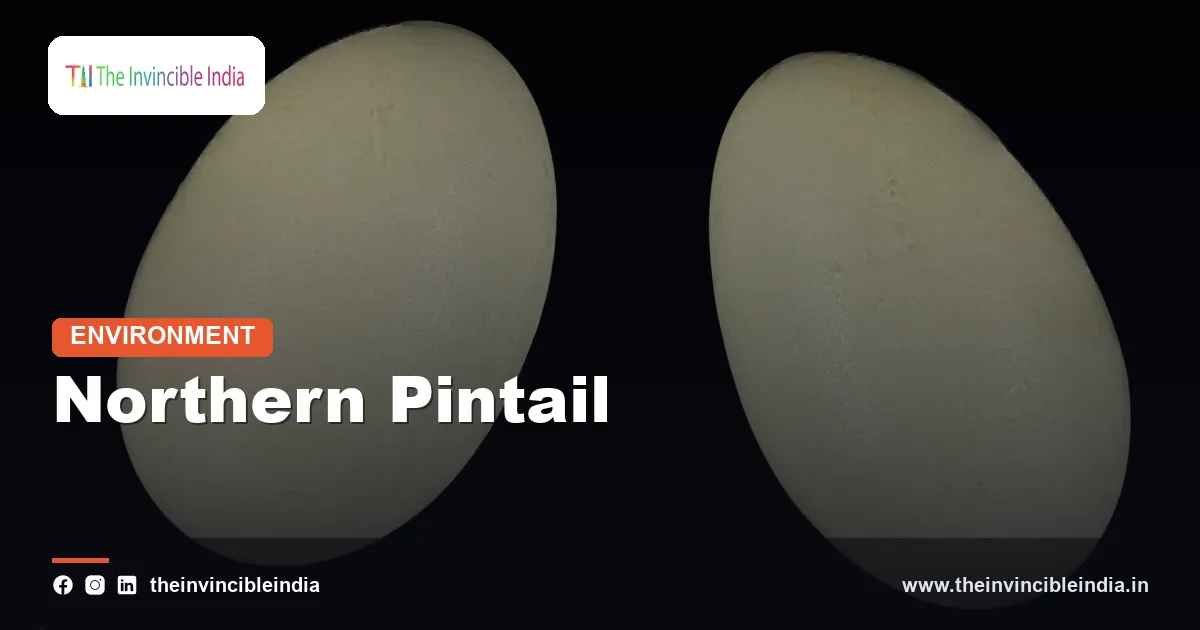
The female lays about seven to nine eggs and incubates them alone for roughly three weeks. The ducklings are precocial, which means they hatch with open eyes and downy feathers and leave the nest within a day or so. The mother leads them to water, where they feed on insects, and they can fly after about six to seven weeks.
Breeding success depends strongly on rainfall and the water level in the northern wetlands. In dry years, fewer young are raised, and this affects how many birds return to India the following winter.
Is the northern pintail threatened?
The northern pintail is classified as Least Concern by the International Union for Conservation of Nature (IUCN) because it is so widespread, but local populations face real pressures, and some regional declines have been recorded. The Indian winter population is affected mainly by what happens to wetlands, both in India and along the migration route.
- Wetland loss: drainage, encroachment, silting and conversion of lakes to farmland or construction reduce habitat.
- Pollution: sewage, industrial effluents and agricultural runoff degrade water quality and food supply.
- Hunting and trapping: illegal netting, shooting and poisoning of wintering ducks still occur in some areas.
- Disease: outbreaks of avian influenza have affected wild waterbirds in several countries, including India.
- Climate change: droughts in the breeding areas and changing water regimes alter nesting success and migration timing.
- Lead shot: spent shotgun pellets swallowed with grit can poison ducks in heavily hunted wetlands elsewhere in the world.
The northern pintail is protected in India under the Wild Life (Protection) Act, 1972, and many of its key wintering sites are national parks, sanctuaries or Ramsar wetlands. India is a party to the Ramsar Convention on wetlands, and the protection of such sites helps migratory ducks directly.
How can you watch northern pintails responsibly?
The best way to watch northern pintails is to visit a protected wetland between November and February, arrive at dawn, use binoculars from a distance and keep quiet. Dawn and late afternoon are the best times, because the ducks are active and the light is soft.
- Use binoculars or a spotting scope rather than approaching the flock; pintails are wary and flush easily.
- Stay on marked paths and observation towers, and never wade into wetlands.
- Do not throw food into the water, since it can harm both birds and water quality.
- Keep dogs on a lead and avoid loud noise, drones and flash photography.
- Note the date, place and number of birds, and share records with community science platforms or local bird groups.
Learning to tell the northern pintail apart from other ducks is a good first step in waterbird identification. Its long neck and tail make it one of the easier species to recognise once you know what to look for.
Bottom Line
The northern pintail is an elegant migrant duck that reaches India each autumn from northern breeding grounds and relies on the country’s lakes, marshes and paddy fields through winter. Protecting wetlands, keeping water clean and stopping illegal hunting are the practical steps that keep this species, and many others that share its habitat, returning year after year.
Frequently Asked Questions
What is a northern pintail?
A northern pintail is a slender, long-necked dabbling duck (Anas acuta) that breeds in the far north of Eurasia and North America. In India it is a common winter visitor to lakes, marshes and flooded fields. The drake is recognised by its brown head, white neck stripe and long pointed tail.
When do northern pintails come to India?
Northern pintails arrive in India from about September or October and stay until March or April. Numbers peak between November and February. Departure for the northern breeding grounds begins in late February.
Where can I see northern pintails in India?
Northern pintails can be seen at shallow wetlands across India, including Keoladeo National Park in Rajasthan, Chilika Lake in Odisha, Nal Sarovar in Gujarat, Sultanpur in Haryana and Harike in Punjab. Village tanks and reservoirs also hold them. The best time to look is between November and February, early in the morning.
What does a northern pintail eat?
A northern pintail eats seeds, grain, aquatic plants, snails, insects and small crustaceans. It feeds by dabbling at the surface and upending in shallow water, and it often forages in harvested rice fields at dusk. Animal food becomes more important during the breeding season.
How do you tell a male northern pintail from a female?
The male northern pintail has a chocolate-brown head, a white stripe up the neck, a white breast and a long, pointed tail. The female is mottled buff and brown with a plain face and a shorter pointed tail. Males in eclipse plumage after breeding look much like females.
Is the northern pintail an endangered bird?
No, the northern pintail is classified as Least Concern by the IUCN because it is widespread and numerous. However, it faces threats such as wetland loss, pollution, illegal hunting and disease. In India it is protected under the Wild Life (Protection) Act, 1972.
{“@context”:”https://schema.org”,”@graph”:[{“@type”:”FAQPage”,”mainEntity”:[{“@type”:”Question”,”name”:”What is a northern pintail?”,”acceptedAnswer”:{“@type”:”Answer”,”text”:”A northern pintail is a slender, long-necked dabbling duck (Anas acuta) that breeds in the far north of Eurasia and North America. In India it is a common winter visitor to lakes, marshes and flooded fields. The drake is recognised by its brown head, white neck stripe and long pointed tail.”}},{“@type”:”Question”,”name”:”When do northern pintails come to India?”,”acceptedAnswer”:{“@type”:”Answer”,”text”:”Northern pintails arrive in India from about September or October and stay until March or April. Numbers peak between November and February. Departure for the northern breeding grounds begins in late February.”}},{“@type”:”Question”,”name”:”Where can I see northern pintails in India?”,”acceptedAnswer”:{“@type”:”Answer”,”text”:”Northern pintails can be seen at shallow wetlands across India, including Keoladeo National Park in Rajasthan, Chilika Lake in Odisha, Nal Sarovar in Gujarat, Sultanpur in Haryana and Harike in Punjab. Village tanks and reservoirs also hold them. The best time to look is between November and February, early in the morning.”}},{“@type”:”Question”,”name”:”What does a northern pintail eat?”,”acceptedAnswer”:{“@type”:”Answer”,”text”:”A northern pintail eats seeds, grain, aquatic plants, snails, insects and small crustaceans. It feeds by dabbling at the surface and upending in shallow water, and it often forages in harvested rice fields at dusk. Animal food becomes more important during the breeding season.”}},{“@type”:”Question”,”name”:”How do you tell a male northern pintail from a female?”,”acceptedAnswer”:{“@type”:”Answer”,”text”:”The male northern pintail has a chocolate-brown head, a white stripe up the neck, a white breast and a long, pointed tail. The female is mottled buff and brown with a plain face and a shorter pointed tail. Males in eclipse plumage after breeding look much like females.”}},{“@type”:”Question”,”name”:”Is the northern pintail an endangered bird?”,”acceptedAnswer”:{“@type”:”Answer”,”text”:”No, the northern pintail is classified as Least Concern by the IUCN because it is widespread and numerous. However, it faces threats such as wetland loss, pollution, illegal hunting and disease. In India it is protected under the Wild Life (Protection) Act, 1972.”}}]}]}


