

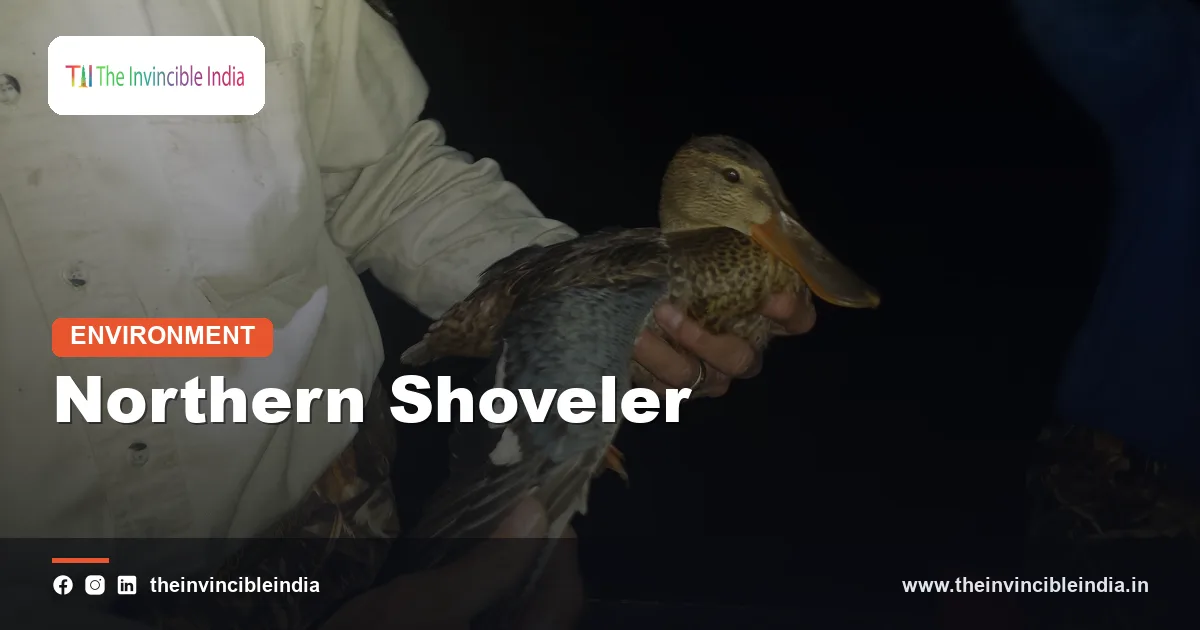
The northern shoveler (Spatula clypeata) is a medium-sized dabbling duck with an enormous, spoon-shaped bill that it uses to strain tiny food particles from shallow water, and it is a common winter visitor to wetlands across India. The drake is a striking bird, with a glossy green head, white breast, chestnut flanks and a bright yellow eye, while the female is a mottled brown duck that is recognised mainly by her oversized bill.
The northern shoveler arrives from its northern breeding grounds in autumn and remains until spring. This guide explains how to identify the northern shoveler, why its bill is so unusual, where and when to see it in India, and what helps or harms it.
| Common name | Northern shoveler (also spelt shoveller; called the shoveler in North America) |
|---|---|
| Scientific name | Spatula clypeata (formerly Anas clypeata) |
| Family | Anatidae (ducks, geese and swans) |
| Size | About 44 to 52 cm in length; wingspan roughly 70 to 85 cm |
| Range in India | Widespread winter visitor to shallow lakes, jheels, marshes, tanks and reservoirs, from Kashmir to the southern peninsula |
| Diet | Zooplankton, small crustaceans, insect larvae, snails, seeds and algae, filtered from the water surface |
| Breeding and migration | Breeds across northern Eurasia and North America; Indian birds arrive from about September or October and leave by March or April |
| Conservation status | Least Concern globally (IUCN); protected under India’s Wild Life (Protection) Act, 1972 |
Key Takeaways
- The northern shoveler is a dabbling duck named for its large, flat, spatula-shaped bill, which is wider at the tip than at the base.
- The drake northern shoveler has a green head, white breast, rufous flanks and a yellow eye, while the female is mottled brown with an orange-edged bill.
- Northern shovelers visit India from roughly September to April and are most numerous between November and February.
- The northern shoveler filters plankton and small invertebrates through comb-like plates called lamellae along the edges of its bill.
- Northern shovelers often feed in tight circles, with several birds swimming in a ring so that each one benefits from the food stirred up by the others.
- The northern shoveler is rated Least Concern by the IUCN, but its shallow-water feeding grounds in India are threatened by drainage, pollution and encroachment.
What is the northern shoveler?
The northern shoveler is a dabbling duck of the family Anatidae, distinguished from all other common ducks by its long, wide, spoon-like bill. It breeds in the temperate and northern zones of Europe, Asia and North America and migrates south in winter, reaching as far as Africa, South Asia, Southeast Asia and Central America.
The older scientific name Anas clypeata is still seen in many books and field guides. Taxonomists later moved the shovelers and some related ducks into the genus Spatula, so recent checklists list the species as Spatula clypeata. The word “clypeata” means “armed with a shield” and refers to the shield-like shape of the bill.
In India the northern shoveler is among the most familiar wintering ducks, sharing wetlands with the northern pintail, gadwall, common teal, garganey and Eurasian wigeon. It is not a resident bird in India, and the large flocks seen in January are all migrants.
How do you identify a northern shoveler?
A northern shoveler can be identified by its huge spatulate bill, which is visible even at a distance and gives the bird a front-heavy look on the water. The bill is held pointing slightly downward, and the bird often sits low in the water with its head angled toward the surface.
The drake
The adult male in winter has a dark glossy green head, a black bill, a white breast and bright rufous (chestnut) flanks and belly. The back is dark, with white on the sides of the rump, and the eye is a vivid yellow. From a distance, the white chest and chestnut belly make the drake look like a brightly divided bird.
The female and young birds
The female northern shoveler is a streaky brown duck similar to a female mallard. The best features are the long, broad bill, which is orange along the cutting edges and dusky on top, and the generally smaller size. Juveniles resemble the female. The male in eclipse plumage after breeding resembles the female, but retains a trace of rufous on the flanks.
In flight
In flight, both sexes show a pale blue forewing patch, a green speculum and a white bar between them. The head and bill appear long and heavy compared with the rest of the body, and the wings are set far back. The wingbeats make a distinct rattling or whirring sound.
Common confusions
- Mallard: larger, with a smaller, conventionally shaped bill and a blue speculum.
- Gadwall: greyer and plainer, with a small bill.
- Garganey: a smaller duck with a fine bill and a white stripe above the eye in the male.
Why does the northern shoveler have such a large bill?
The northern shoveler has a large bill because the bill works as a filter, letting the bird strain tiny animals and plant matter from water or soft mud. The edges of the upper and lower bill carry fine comb-like plates called lamellae, which are longer and more numerous than in any other European or Asian duck.
The shoveler swims forward with its bill just below the surface, sweeping it from side to side. Water enters the bill, and the tongue pushes it out through the lamellae, leaving food particles behind. The process resembles the way baleen whales strain plankton, though on a much smaller scale.
This specialised feeding method means that the northern shoveler depends on water rich in plankton and invertebrates. It is rarely found in fast or deep water. Instead, it seeks out warm, nutrient-rich shallows, which is the reason many shoveler flocks gather in sewage-fed ponds, fish tanks and eutrophic lakes where plankton is abundant.
Where is the northern shoveler found in India?
The northern shoveler is found in winter across most of India, in any shallow freshwater or brackish wetland with plenty of floating food, from Jammu and Kashmir to Tamil Nadu and from Gujarat to the northeast. Large numbers gather in the Indo-Gangetic plain, Gujarat, Rajasthan, Odisha and the Deccan.
| Region | Example wetlands | Habitat type |
|---|---|---|
| Rajasthan | Keoladeo National Park, Sambhar Lake | Managed freshwater marshes and saline lake |
| Gujarat | Nal Sarovar, Thol Lake, Little Rann of Kutch fringes | Shallow lakes and seasonal wetlands |
| Odisha | Chilika Lake | Brackish lagoon with shallow margins |
| Haryana and Delhi | Sultanpur National Park, Okhla Bird Sanctuary | Seasonal jheel and river barrage |
| Punjab | Harike Wetland | River-fed reservoir |
| Karnataka and Tamil Nadu | Irrigation tanks and coastal lagoons | Shallow tanks and lagoons |
| Assam | Deepor Beel | Floodplain wetland |
Small wetlands close to towns are often rewarding. Sewage-fed pools, aquaculture ponds and irrigation reservoirs can hold hundreds of northern shovelers, because the water is rich in plankton, although such sites are not always clean or safe for the birds.
When does the northern shoveler visit India?
The northern shoveler visits India from about September or October until March or April, and it is most abundant between November and February. First arrivals are usually seen in the last weeks of September, and the final birds depart in April.
The shoveler migrates later than some other ducks, and numbers climb steadily through October and November. The bird travels along the Central Asian Flyway, using inland lakes and rivers in Central Asia as stopover sites before crossing the Himalaya and the Hindu Kush. Some birds winter in Pakistan, Nepal and Bangladesh, and a number continue farther south.
The timing of arrival varies from year to year with weather conditions in the breeding area. During the winter, the birds move between wetlands depending on water levels, so a lake that is full of shovelers in December may hold only a few in February.
What does the northern shoveler eat?
The northern shoveler eats mostly tiny animals, such as zooplankton, small crustaceans, water fleas, insect larvae and snails, together with algae and seeds. It obtains this food by filtering water through the lamellae of its bill, and it spends a large part of the day feeding.
The shoveler uses several feeding methods:
- Surface filtering: swimming forward with the bill skimming the top few centimetres of water.
- Mud dabbling: sweeping the bill through soft mud at the edge of a pond.
- Circle feeding: several birds swim in a tight circle or follow each other in a line, stirring up food that the next bird can filter.
- Upending: occasionally tipping forward to reach food just beneath the surface.
Unlike the northern pintail or the Eurasian wigeon, the northern shoveler seldom grazes on land or in fields. It stays on or near the water, and it is therefore especially sensitive to the condition of the wetlands it uses.
How does the northern shoveler behave?
The northern shoveler is a fairly quiet, often slow-moving duck that feeds in compact groups and prefers shallow, sheltered water. It is less wary than some other ducks, and flocks may allow patient observers to approach quite closely, provided they move slowly and keep a respectful distance.
Males make a dull, hollow “took-took” call, while females give a quiet quack, so shoveler flocks are less noisy than pintail or teal flocks. The birds frequently associate with other species, especially in the afternoon, when they rest on islands, banks or floating vegetation.
Pair formation begins during winter in India. Drakes display to females by pumping their heads, whistling softly and swimming around her in the water. In spring, pairs fly north together, and the female returns to the area where she hatched or bred in a previous year.
How does the northern shoveler breed?
The northern shoveler breeds on the ground near shallow freshwater marshes and wet meadows in the northern parts of Europe, Asia and North America, and it does not breed regularly in India. The nest is a hollow lined with grass and down, hidden in short vegetation not far from water.
The female lays about nine to eleven eggs and incubates them for roughly three weeks. The male usually guards the territory during incubation and then leaves. Ducklings hatch covered in down, leave the nest soon afterwards and learn to filter feed while still very small. They are able to fly within about six weeks.
The breeding success of shovelers depends on the abundance of invertebrates in the breeding ponds, since a female needs plenty of animal protein to produce eggs. Dry summers on the northern breeding grounds can reduce the number of ducklings that survive.
Is the northern shoveler threatened in India?
The northern shoveler is not threatened globally and is rated Least Concern by the IUCN, but its Indian wintering habitat faces constant pressure from drainage, pollution and development. Because the shoveler relies on shallow, plankton-rich water, any change to water depth or quality quickly affects where it can feed.
- Wetland drainage and filling for roads, housing and industry.
- Pollution from untreated sewage, industrial effluent and agricultural chemicals, which can cause toxic algal blooms or oxygen loss.
- Invasive aquatic plants such as water hyacinth that cover open water.
- Illegal hunting, netting and poisoning in some regions.
- Disturbance from boats, drones, fireworks and large crowds.
- Disease outbreaks, including avian influenza.
The northern shoveler is protected in India under the Wild Life (Protection) Act, 1972. Many of its winter strongholds are Ramsar sites, national parks or sanctuaries, and the annual Asian Waterbird Census, coordinated by Wetlands International, helps track changes in numbers year by year.
How can you watch northern shovelers?
The best way to watch northern shovelers is to visit a shallow wetland between November and February, go early in the morning and look for ducks with large bills feeding at the surface. Binoculars are essential, and a spotting scope is useful on big lakes.
- Scan the water edges first, where shovelers feed in the shallows.
- Look for groups swimming in circles, which is a clear sign of shoveler feeding.
- Check mixed flocks of ducks carefully; the large bill is easy to spot.
- Stay behind barriers or in hides and avoid disturbing the birds.
- Record the date, location and approximate count, and share your observations with local bird groups or community science platforms.
Bottom Line
The northern shoveler is a specialist filter-feeding duck whose spoon-shaped bill is one of the most distinctive features among Indian wintering waterbirds. Clean, shallow, plankton-rich wetlands are what it needs, and protecting them benefits not only this species but the whole community of ducks, waders and other wildlife that winters in India.
Frequently Asked Questions
What is a northern shoveler?
A northern shoveler is a medium-sized dabbling duck (Spatula clypeata) with a large, spoon-shaped bill used to filter food from shallow water. It breeds in northern Eurasia and North America and winters widely in India. The drake has a green head, white breast and chestnut flanks.
Why does the northern shoveler have a big beak?
The northern shoveler has a big beak because it works as a filter for straining plankton and small invertebrates from the water. Comb-like plates called lamellae line the edges of the bill and trap food as water is pushed out. This makes the shoveler a specialist of shallow, plankton-rich wetlands.
When do northern shovelers arrive in India?
Northern shovelers arrive in India from about September or October and remain until March or April. They are most numerous between November and February. Departure for the northern breeding grounds begins in late winter.
Where can I see northern shovelers in India?
Northern shovelers can be seen at shallow wetlands across India, including Keoladeo National Park, Nal Sarovar, Chilika Lake, Sultanpur and Harike. Irrigation tanks, village ponds and sewage-fed lagoons also attract them. Early morning visits between November and February work best.
What does a northern shoveler eat?
A northern shoveler eats mainly zooplankton, small crustaceans, insect larvae, snails, algae and seeds. It filters these from the surface water or soft mud with its bill. Groups often swim in circles to stir up more food.
Is the northern shoveler a migratory bird?
Yes, the northern shoveler is a long-distance migratory bird. Birds that winter in India breed in northern Eurasia and travel along the Central Asian Flyway each autumn. They return north in spring and do not normally breed in India.
{“@context”:”https://schema.org”,”@graph”:[{“@type”:”FAQPage”,”mainEntity”:[{“@type”:”Question”,”name”:”What is a northern shoveler?”,”acceptedAnswer”:{“@type”:”Answer”,”text”:”A northern shoveler is a medium-sized dabbling duck (Spatula clypeata) with a large, spoon-shaped bill used to filter food from shallow water. It breeds in northern Eurasia and North America and winters widely in India. The drake has a green head, white breast and chestnut flanks.”}},{“@type”:”Question”,”name”:”Why does the northern shoveler have a big beak?”,”acceptedAnswer”:{“@type”:”Answer”,”text”:”The northern shoveler has a big beak because it works as a filter for straining plankton and small invertebrates from the water. Comb-like plates called lamellae line the edges of the bill and trap food as water is pushed out. This makes the shoveler a specialist of shallow, plankton-rich wetlands.”}},{“@type”:”Question”,”name”:”When do northern shovelers arrive in India?”,”acceptedAnswer”:{“@type”:”Answer”,”text”:”Northern shovelers arrive in India from about September or October and remain until March or April. They are most numerous between November and February. Departure for the northern breeding grounds begins in late winter.”}},{“@type”:”Question”,”name”:”Where can I see northern shovelers in India?”,”acceptedAnswer”:{“@type”:”Answer”,”text”:”Northern shovelers can be seen at shallow wetlands across India, including Keoladeo National Park, Nal Sarovar, Chilika Lake, Sultanpur and Harike. Irrigation tanks, village ponds and sewage-fed lagoons also attract them. Early morning visits between November and February work best.”}},{“@type”:”Question”,”name”:”What does a northern shoveler eat?”,”acceptedAnswer”:{“@type”:”Answer”,”text”:”A northern shoveler eats mainly zooplankton, small crustaceans, insect larvae, snails, algae and seeds. It filters these from the surface water or soft mud with its bill. Groups often swim in circles to stir up more food.”}},{“@type”:”Question”,”name”:”Is the northern shoveler a migratory bird?”,”acceptedAnswer”:{“@type”:”Answer”,”text”:”Yes, the northern shoveler is a long-distance migratory bird. Birds that winter in India breed in northern Eurasia and travel along the Central Asian Flyway each autumn. They return north in spring and do not normally breed in India.”}}]}]}


