

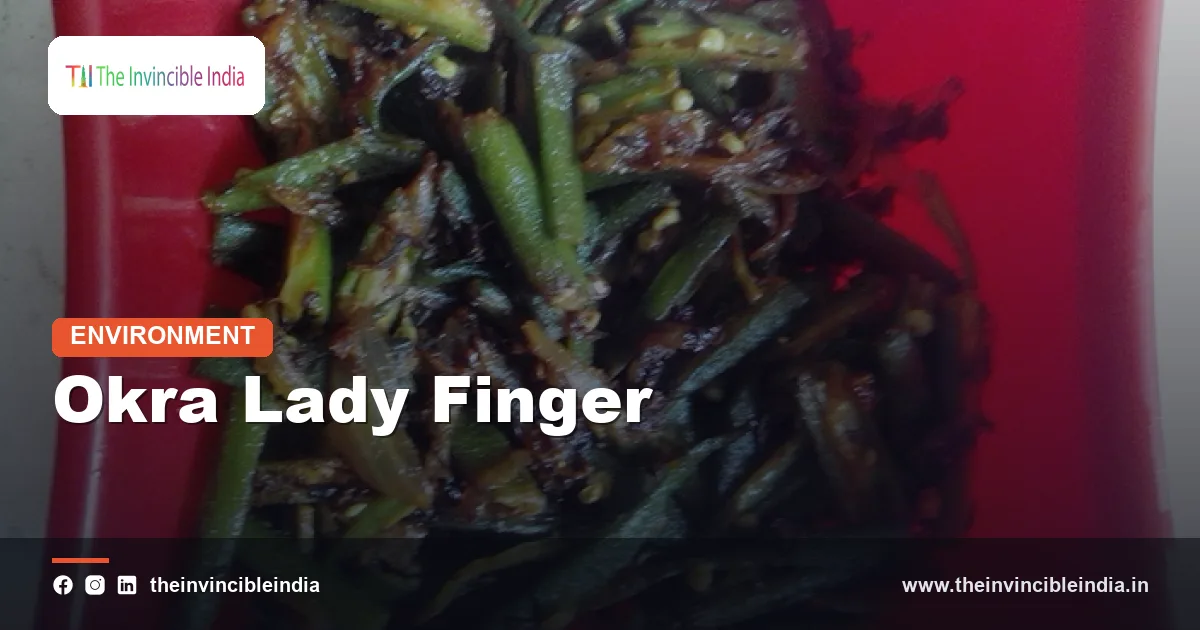
The okra (Abelmoschus esculentus), known in India as lady finger or bhindi, is a warm-season flowering plant of the mallow family grown for its slender, ridged, green seed pods, which are cooked as a vegetable. The crop thrives in the heat and humidity of the Indian plains and is sown twice a year in most regions, so fresh pods reach the market almost throughout the year.
Okra is among the most widely eaten everyday vegetables in India, appearing in home kitchens, school meals, restaurant menus and weekly haat baskets alike. This explainer covers what the plant is, how it grows, why the pods turn slimy, where and when it is cultivated, and how it is cooked.
Quick Facts
| Attribute | Detail |
|---|---|
| Common names | Okra, lady finger, ladies’ finger, bhindi (Hindi), vendakkai (Tamil), bendakaya (Telugu), bhenda (Marathi), dherosh (Bengali) |
| Scientific name | Abelmoschus esculentus |
| Family | Malvaceae (the mallow family, which also includes cotton and hibiscus) |
| Where grown in India | Across the plains of Uttar Pradesh, Bihar, West Bengal, Gujarat, Odisha, Andhra Pradesh, Karnataka, Madhya Pradesh and many other states |
| Main seasons | Summer crop (sown February to March) and rainy-season or kharif crop (sown June to July) |
| Part used | Immature green fruit (the seed pod) |
| Growth habit | Erect annual herb, usually 1 to 2 metres tall |
| Main uses | Dry and gravy curries, stir-fries, sambar, stuffed and fried preparations |
Key Takeaways
- Okra, called bhindi in Hindi and lady finger in Indian English, is the edible immature seed pod of Abelmoschus esculentus, a plant in the mallow family Malvaceae.
- Okra is a warm-season crop that needs sustained heat, and Indian farmers sow it twice a year, in February to March and again in June to July.
- The slippery texture of cooked okra comes from mucilage, a gel-forming mix of sugars and proteins found in the pods and seeds.
- Yellow vein mosaic virus, spread by whiteflies, is the most serious disease of okra in India, and resistant or tolerant varieties are widely grown to manage it.
- Okra pods are harvested young, usually four to six days after the flower opens, because older pods turn tough and fibrous.
- Okra flowers resemble those of the hibiscus because both plants belong to the same family, Malvaceae.
What Is Okra?
Okra is an annual, tropical to subtropical herbaceous plant whose edible part is the green, tapering seed pod, botanically a capsule. The plant has an upright, sturdy stem, large lobed leaves covered in fine hairs, and pale yellow flowers with a deep maroon or crimson patch at the base.
The English word “okra” is of West African origin, while “lady finger” or “ladies’ finger” is the name that Indian English, and British English before it, uses for the narrow, tapering pod. In Hindi and several north Indian languages the vegetable is bhindi, and each regional language has its own word, such as vendakkai in Tamil, bendakaya in Telugu and bhenda in Marathi.
Okra belongs to the genus Abelmoschus, which is placed in Malvaceae. This family gives the plant its close relationship to cotton, hibiscus (gudhal), hollyhock and the musk mallow. The family connection is easy to see in the large, showy, five-petalled flowers, which open for a single day.
The pods are typically five-ridged, although some varieties have rounder pods with a smoother outline. Colour is usually green, but red-podded varieties also exist and are grown on a small scale. Red pods turn green when cooked in most preparations, so the difference is mainly visual.
Where Does Okra Come From and How Did It Reach India?
Okra is believed to have originated in the tropical regions of Africa or South Asia, and botanists still debate the exact place. Wild and weedy relatives of the genus Abelmoschus are found across tropical Asia and Africa, which is why the evidence points to more than one possible centre of origin.
The crop has been cultivated for a very long time in the Indian subcontinent, and it is now so thoroughly embedded in Indian cuisine that many people consider it a native vegetable. Whatever its precise origin, okra spread through warm regions of the world along trade and migration routes and is now grown in tropical, subtropical and warm temperate countries.
India is consistently ranked among the largest okra-producing countries in the world, and the crop is grown mostly for the domestic fresh market. Because the pods are fragile and perishable, most okra is sold and eaten within a short distance of where it is grown.
How Does the Okra Plant Grow?
The okra plant grows from seed to first harvest in roughly six to seven weeks under good conditions, which makes it a quick-yielding vegetable. Seeds are round, dark and hard-coated, and farmers often soak them overnight to speed germination.
Climate and soil
Okra prefers warm weather, with temperatures in the range of roughly 25 to 35 degrees Celsius considered ideal. Germination is slow and patchy when the soil is cold, and growth stalls in cool conditions, which is why the crop is not sown in the north Indian winter. Okra grows best in well-drained, loamy soils that are rich in organic matter, and waterlogging damages the roots.
Sowing and spacing
Seeds are sown directly in the field, in rows, rather than being raised in nurseries and transplanted. A common practice is to keep about 45 to 60 centimetres between rows and 20 to 30 centimetres between plants, though spacing varies with variety and season. Plants in the rainy season are often spaced a little wider to improve air circulation.
Flowering and fruiting
Each flower opens in the morning and fades by evening, and the pod begins to swell almost immediately after pollination. Okra is largely self-pollinating, though bees and other insects do cross-pollinate some flowers. Pods grow very fast, and a tender pod can become fibrous within a few days if it is left on the plant.
Because new flowers keep appearing along the stem as it grows, the plant produces pods continuously over several weeks. Regular picking encourages more flowering, whereas leaving mature pods on the plant slows further production.
Why Is Okra Slimy?
Okra is slimy because its pods and seeds contain mucilage, a thick, gel-like substance made mostly of complex carbohydrates and proteins that swells and turns slippery when it meets water. The mucilage helps the plant store water and protect its seeds, and it is the reason okra is used to thicken soups and stews in several cuisines.
The sliminess increases when the pods are cut and then cooked slowly in a wet environment, because cutting exposes more mucilage to moisture. Indian cooks have developed several ways to manage it, and the main methods are listed below.
- Wash the pods and dry them completely before cutting, since surface water activates the mucilage.
- Cook the pieces over high heat in a wide pan, without covering it, so that steam escapes.
- Add something sour, such as dried mango powder (amchur), tomato, tamarind or curd, which helps reduce the stickiness.
- Keep the pods whole or cut them into large pieces for dishes like stuffed bhindi.
- Avoid stirring too often at the start, so that the pieces can sear before they release their gel.
In some preparations, the slippery quality is welcome rather than avoided. Gravy dishes, soups and certain regional stews use the mucilage as a natural thickener, and many cooks consider it a feature of the vegetable rather than a flaw.
Where and When Is Okra Grown in India?
Okra is grown in almost every Indian state, because it tolerates a wide range of tropical and subtropical conditions and has a short crop duration. The leading production belts lie in the Indo-Gangetic plain and in peninsular and eastern India, with large volumes also coming from Gujarat, West Bengal, Odisha, Andhra Pradesh, Karnataka and Madhya Pradesh.
The two main sowing seasons give the crop its familiar rhythm in the market, and the table below summarises them.
| Season | Typical sowing time | Typical harvest period | Main considerations |
|---|---|---|---|
| Summer crop | February to March | April to June or July | Needs regular irrigation; hot, dry weather favours mites and some pests |
| Rainy-season (kharif) crop | June to July | August to October or later | Heavy rain and humidity favour fungal diseases and whitefly-borne viruses |
| Warm-region winter crop | Sown in late summer or early autumn in the far south | Winter months | Possible only where winter stays mild; yields are generally lower |
In the hills, okra is a summer vegetable that grows only during the warmer months, since frost kills the plants. In the far south and in coastal regions with mild winters, okra can be grown across more of the year.
Kitchen gardens, terraces and large grow bags in cities also support okra, because the plant is compact enough for a sunny balcony. Home gardeners usually sow it in spring or at the start of the monsoon.
Which Okra Varieties Are Grown in India?
Indian okra varieties are bred mainly for pod quality, high yield and resistance to yellow vein mosaic virus, and both open-pollinated varieties and hybrids are in use. Public research institutions such as the Indian Agricultural Research Institute (IARI), the Indian Institute of Horticultural Research (IIHR) and the Indian Institute of Vegetable Research (IIVR) have released many of the best-known types.
- Pusa Sawani: An older, well-known variety from IARI, long popular for its dark green, tender pods.
- Arka Anamika: A variety from IIHR, Bengaluru, valued for its tolerance of yellow vein mosaic virus and its tender pods.
- Parbhani Kranti: A variety developed in Maharashtra, widely grown for its resistance to yellow vein mosaic virus.
- Kashi Lalima: A red-podded variety from IIVR, Varanasi, grown as a specialty vegetable.
Private seed companies sell many hybrids, which are favoured by commercial farmers for their uniform pods, high yield and disease tolerance. Buyers in city markets generally prefer pods that are straight, tender, dark green and about 8 to 12 centimetres long.
What Pests and Diseases Affect Okra?
The most serious disease of okra in India is yellow vein mosaic virus (YVMV), a viral infection spread by the whitefly that turns the leaf veins yellow and makes pods pale and small. A plant infected early may produce very little, so farmers rely on tolerant varieties and on controlling whitefly populations.
Common problems
- Whitefly: A small sap-sucking insect that carries the virus and also weakens plants by feeding.
- Shoot and fruit borer: A caterpillar that tunnels into shoot tips and pods, which damages pods and lowers their market value.
- Jassids and aphids: Sap-sucking insects that curl and yellow the leaves.
- Red spider mites: Tiny mites that thrive in hot, dry weather and give leaves a bronzed look.
- Powdery mildew: A fungal disease that dusts leaves with white powder, common in cool, humid spells.
- Root-knot nematodes: Microscopic worms that create galls on roots and stunt the plant.
Integrated pest management, which combines resistant varieties, crop rotation, clean field borders, sticky traps and the careful use of pesticides, is the approach recommended by agricultural extension services. Rotating okra with unrelated crops helps break pest and nematode cycles in the soil.
How Is Okra Harvested and Handled?
Okra is harvested while the pods are still immature, usually four to six days after the flower opens, when they are tender and snap cleanly. Farmers generally pick every second or third day during the peak of the crop, because pods that are even a little overgrown become stringy and lose value.
The pods are covered with tiny hairs that can irritate the skin, so pickers wear gloves or long sleeves. After harvest, pods are sorted by size and quality, packed in baskets or crates, and moved quickly to market, since they bruise easily and darken at the cut stalk end.
Fresh okra keeps best in cool, dry conditions for a few days. Moisture speeds spoilage, so cooks usually store the pods dry and wash them just before use.
How Is Okra Used in Indian Cooking?
Okra is cooked across India as a dry stir-fry, a gravy dish, a stuffed vegetable, a crisp snack and a component of lentil and vegetable stews. The vegetable absorbs spices well and holds its shape when the pods are properly dried and cooked at high heat.
| Preparation | Region or style | Notes |
|---|---|---|
| Bhindi masala or bhindi sabzi | North India | Pods sauteed with onion, tomato and dry spices |
| Kurkuri bhindi | North and western India | Thin strips coated in spiced gram flour and fried until crisp |
| Bharwan bhindi | Pan-Indian | Whole pods slit and stuffed with a spice mix |
| Vendakkai sambar and poriyal | Tamil Nadu and the south | Pods added to lentil stew or stir-fried with coconut |
| Bhenda fry | Maharashtra and Gujarat | Dry preparations, sometimes with peanuts or sesame |
| Bhindi in curd gravy | Various regions | Sour curd or buttermilk gravies that balance the sliminess |
Okra is also pickled in some households, dried into crisp chips, and added to mixed vegetable preparations. Other parts of the plant also have uses: roasted okra seeds have been used as a coffee substitute in some places, and the young leaves and flower buds are eaten in parts of the world.
Is Okra Nutritious?
Okra is a low-calorie vegetable that provides dietary fibre along with vitamin C, vitamin K, folate and minerals such as magnesium. The fibre content is partly due to the mucilage, which is a soluble fibre that moves through the digestive system slowly.
As with any vegetable, the benefits depend on preparation. Deep-fried bhindi carries far more fat and calories than pods that are steamed, boiled or lightly sauteed. A balanced diet that includes a variety of vegetables is more useful than relying on any single one, and people with medical conditions should follow the advice of their doctors and dietitians.
Okra contains oxalates, as many leafy and pod vegetables do, so people who have been advised to limit oxalate intake because of kidney stones may be told to eat it in moderation.
How Can You Grow Okra at Home?
Okra is easy to grow at home in a sunny spot with well-drained soil, and the seeds can be sown directly in the ground or in a deep container from spring to the start of the monsoon. A pot or grow bag at least 30 centimetres deep suits one or two plants.
- Soak the seeds overnight to soften the hard coat and speed germination.
- Sow about 1 to 2 centimetres deep once the weather is consistently warm.
- Provide at least six hours of direct sunlight each day.
- Water regularly but allow the surface to dry between waterings.
- Feed with compost or well-rotted manure during growth.
- Pick pods when they are small and tender, and harvest often to keep the plant producing.
Watch for whiteflies on the underside of leaves. Removing badly infected plants early prevents the virus from spreading to healthy neighbours.
Bottom Line
Okra is a fast-growing, heat-loving mallow whose tender pods have become one of the most familiar vegetables in India. Knowing its seasons, its mucilage and its main pest, the whitefly-borne yellow vein mosaic virus, explains most of what matters about growing, buying and cooking it well.
Frequently Asked Questions
What is the difference between okra and lady finger?
There is no difference, because okra and lady finger are two names for the same vegetable, the pod of Abelmoschus esculentus. “Okra” is the more common name in American English and in global trade, while “lady finger” or “ladies’ finger” is widely used in India and Britain. In Hindi the vegetable is called bhindi.
Why is okra called lady finger?
Okra is called lady finger because the long, slender, tapering pod resembles a delicate finger. The name has been in use in English for a long time and is the standard term in Indian English for the vegetable sold in markets as bhindi.
Which season is best for growing okra in India?
Okra grows best in the warm months, and the two main sowing seasons are February to March for a summer crop and June to July for a rainy-season crop. The plant does not tolerate frost or prolonged cold, so it is not grown in the north Indian winter. In the mild-winter far south, planting can be spread over more of the year.
How do you stop okra from becoming slimy when cooked?
The best way to reduce sliminess is to dry the pods completely before cutting them and then cook them over high heat without covering the pan. Adding a sour ingredient such as amchur, tomato, tamarind or curd also helps. Keeping the pieces large and stirring only occasionally at the start further limits the release of mucilage.
What is yellow vein mosaic virus in okra?
Yellow vein mosaic virus is a plant disease spread by the whitefly that makes the veins of okra leaves turn yellow and leads to small, pale, poorly formed pods. It is the most serious disease of okra in India. Farmers manage it by growing resistant or tolerant varieties and by controlling whitefly populations.
Which part of the okra plant is eaten?
The part of the okra plant eaten as a vegetable is the immature green seed pod. Pods are picked while tender, usually four to six days after the flower opens. In some places, the young leaves and flower buds are also eaten, and roasted ripe seeds have been used as a coffee substitute.
{“@context”:”https://schema.org”,”@graph”:[{“@type”:”FAQPage”,”mainEntity”:[{“@type”:”Question”,”name”:”What is the difference between okra and lady finger?”,”acceptedAnswer”:{“@type”:”Answer”,”text”:”There is no difference, because okra and lady finger are two names for the same vegetable, the pod of Abelmoschus esculentus. “Okra” is the more common name in American English and in global trade, while “lady finger” or “ladies’ finger” is widely used in India and Britain. In Hindi the vegetable is called bhindi.”}},{“@type”:”Question”,”name”:”Why is okra called lady finger?”,”acceptedAnswer”:{“@type”:”Answer”,”text”:”Okra is called lady finger because the long, slender, tapering pod resembles a delicate finger. The name has been in use in English for a long time and is the standard term in Indian English for the vegetable sold in markets as bhindi.”}},{“@type”:”Question”,”name”:”Which season is best for growing okra in India?”,”acceptedAnswer”:{“@type”:”Answer”,”text”:”Okra grows best in the warm months, and the two main sowing seasons are February to March for a summer crop and June to July for a rainy-season crop. The plant does not tolerate frost or prolonged cold, so it is not grown in the north Indian winter. In the mild-winter far south, planting can be spread over more of the year.”}},{“@type”:”Question”,”name”:”How do you stop okra from becoming slimy when cooked?”,”acceptedAnswer”:{“@type”:”Answer”,”text”:”The best way to reduce sliminess is to dry the pods completely before cutting them and then cook them over high heat without covering the pan. Adding a sour ingredient such as amchur, tomato, tamarind or curd also helps. Keeping the pieces large and stirring only occasionally at the start further limits the release of mucilage.”}},{“@type”:”Question”,”name”:”What is yellow vein mosaic virus in okra?”,”acceptedAnswer”:{“@type”:”Answer”,”text”:”Yellow vein mosaic virus is a plant disease spread by the whitefly that makes the veins of okra leaves turn yellow and leads to small, pale, poorly formed pods. It is the most serious disease of okra in India. Farmers manage it by growing resistant or tolerant varieties and by controlling whitefly populations.”}},{“@type”:”Question”,”name”:”Which part of the okra plant is eaten?”,”acceptedAnswer”:{“@type”:”Answer”,”text”:”The part of the okra plant eaten as a vegetable is the immature green seed pod. Pods are picked while tender, usually four to six days after the flower opens. In some places, the young leaves and flower buds are also eaten, and roasted ripe seeds have been used as a coffee substitute.”}}]}]}


