

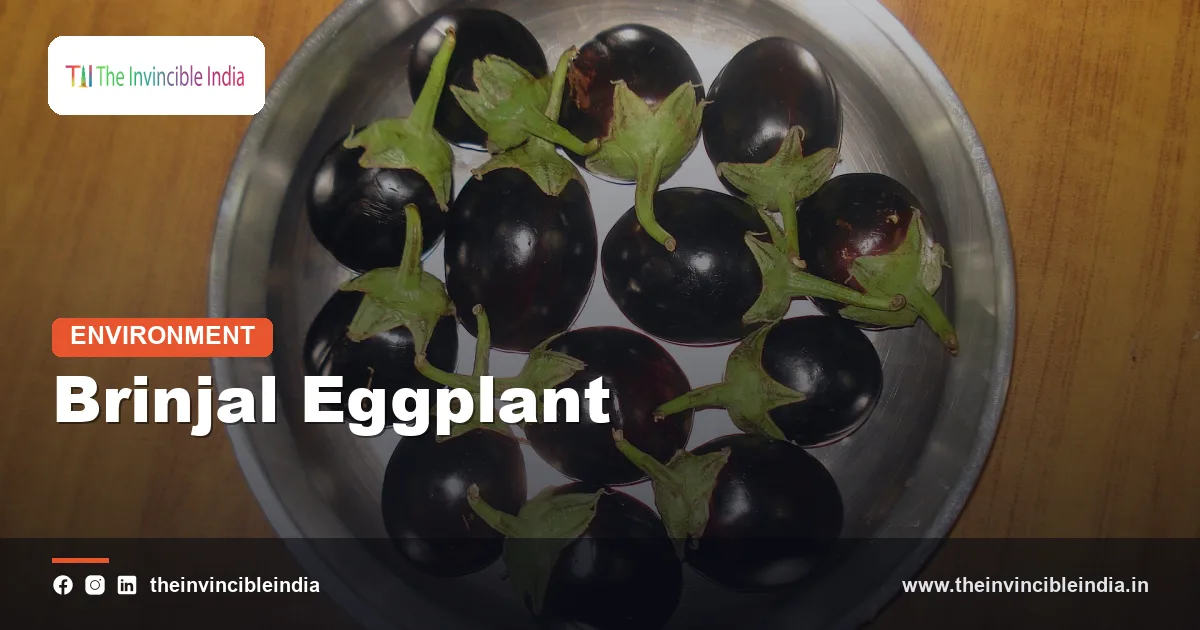
The brinjal (Solanum melongena), known elsewhere as eggplant or aubergine and in Hindi as baingan, is a warm-season fruiting vegetable of the nightshade family that was domesticated in the Indian subcontinent and is now grown across almost every Indian state. The fruit comes in shapes and colours from long purple and round green to small white and striped, and it features in dishes from baingan bharta and sambar to begun bhaja and gutti vankaya.
India is among the world’s largest producers of brinjal, behind China, and the plant is also at the centre of one of the country’s best-known debates on genetically modified food crops, the Bt brinjal controversy. This explainer covers what brinjal is, where it comes from, how it is grown, its regional varieties, its cooking roles and the main arguments in the Bt brinjal debate. Facts were last reviewed on 23 October 2026.
| Quick Fact | Detail |
|---|---|
| Scientific name | Solanum melongena |
| Family | Solanaceae (the nightshade family, which includes tomato, potato and chilli) |
| Other names | Eggplant, aubergine, baingan (Hindi), begun (Bengali, Odia), vankaya (Telugu), kathirikai (Tamil), badane (Kannada), vazhuthananga (Malayalam), ringna (Gujarati) |
| Native range | Domesticated in South and Southeast Asia, with India recognised as a centre of diversity; related wild species still occur in the region |
| Where grown in India | West Bengal, Odisha, Gujarat, Bihar, Madhya Pradesh, Andhra Pradesh, Karnataka and many other states |
| Season | Mainly kharif (monsoon), autumn-winter and spring-summer plantings; grown nearly year-round in many regions |
| Uses | Cooked vegetable in curries, roasted mash, fried snacks, pickles, sambar and stuffed dishes |
| Notable facts | The first genetically modified food crop to reach advanced regulatory approval in India (Bt brinjal), placed under a moratorium in February 2010 |
Key Takeaways
- Brinjal (Solanum melongena) is a nightshade-family vegetable domesticated in the Indian subcontinent, and it is called eggplant in North America and aubergine in Britain.
- India is a centre of brinjal diversity, with hundreds of local varieties differing in shape, colour, size and taste across regions.
- The main pest of brinjal in India is the brinjal fruit and shoot borer (Leucinodes orbonalis), which causes farmers to spray insecticides frequently.
- Bt brinjal, a genetically modified brinjal carrying the Cry1Ac gene to resist the fruit and shoot borer, was recommended for release by the Genetic Engineering Appraisal Committee in 2009 but was placed under a moratorium by the Union Environment Minister in February 2010.
- Bangladesh approved Bt brinjal for cultivation in 2013, while India has not allowed commercial cultivation as of the latest widely reported position.
- Brinjal is low in calories and provides fibre and plant pigments, and it is cooked in nearly every regional cuisine of India.
What is brinjal?
Brinjal is the fleshy, usually purple fruit of Solanum melongena, a tender perennial shrub grown as an annual vegetable, and it belongs to the same family as the tomato, potato and chilli. The plant grows 60 centimetres to over a metre tall, with large, hairy, lobed leaves and star-shaped violet flowers that develop into glossy fruits.
The English word brinjal reached Indian English through Portuguese (berinjela), which in turn derives from Arabic and Persian words for the vegetable. The same word family produced aubergine in French and British usage. The fruit is botanically a berry and is almost always eaten cooked, since raw brinjal has a bitter taste and a spongy texture.
Brinjal is one of India’s most widely eaten vegetables. It has a role in the meals of nearly every region, and in many states it is available through most of the year, which makes it an economic staple for small and marginal farmers.
Where did brinjal originate?
Brinjal originated in the tropical Old World, with the Indian subcontinent and Southeast Asia widely regarded as the principal centre of domestication, and a separate domestication in China is also discussed by researchers. The wild ancestor is generally linked to a spiny plant called Solanum insanum, and a number of closely related wild species still grow in South Asia.
Ancient Sanskrit texts mention the plant by names such as vartaka and vatingana, indicating long use in the subcontinent. From India the crop spread westward through Persian and Arab trade to the Mediterranean and later to Europe and Africa, and eastward to China and Japan. European botanists noted the plant by the sixteenth century, and the crop reached the Americas through colonial exchange.
India’s role as a primary centre of diversity matters for conservation. The country has a very large number of local varieties and wild relatives. Researchers regard these landraces as a valuable gene pool for breeding disease and pest resistance, which is one reason that plant genetic resource institutions maintain brinjal collections.
Where is brinjal grown in India?
Brinjal is grown in nearly every Indian state, with West Bengal, Odisha, Gujarat, Bihar, Madhya Pradesh, Andhra Pradesh, Karnataka and Chhattisgarh among the leading producers. The crop thrives in warm conditions with temperatures between roughly 21 and 30 degrees Celsius and is sensitive to frost.
The vegetable is a smallholder crop because it fruits continuously over several months, giving repeated harvests and a regular cash flow. Peri-urban belts around large cities often specialise in brinjal for the local market. India ranks second only to China in global production, a standing that has persisted for years even as exact tonnages change from season to season.
Typical planting windows include:
- Kharif crop: seedlings raised in May to June and transplanted in June to July.
- Autumn-winter crop: nursery in August to September and transplanting in September to October.
- Spring-summer crop: nursery in November to December and transplanting in January to February.
- Hill and cooler regions: summer planting after the frost risk has passed.
What are the main types and regional varieties of brinjal?
The main types of brinjal in India are classified by fruit shape and colour into long, oval or round, and small round forms, in purple, green, white and striped shades, with many local varieties tied to particular regions and dishes. Indian consumers often have strong regional preferences: Eastern India favours long and oblong fruits, while Western and Southern India often prefer round or small round types.
| Type | Typical shape and colour | Where preferred | Typical dish |
|---|---|---|---|
| Long purple | Slender, glossy purple or violet | Eastern India, Bihar, Odisha | Begun bhaja, fried and curried preparations |
| Large round purple | Big, globe-shaped, deep purple | North India, Punjab, Delhi | Baingan bharta (roasted mash) |
| Green round or oval | Pale to dark green, sometimes striped | Gujarat, Maharashtra | Ringna oro, bharli vangi (stuffed) |
| Small round | Egg-sized, purple or green | Andhra Pradesh, Telangana, Karnataka, Maharashtra | Gutti vankaya, stuffed masala curries |
| White or cream | Egg-shaped, creamy white | Ornamental and some local markets | Lightly cooked preparations |
| Striped and local landraces | Green and white or purple streaks | Coastal Karnataka, Odisha and other regions | Regional curries and chutneys |
One well-known regional brinjal is the Udupi Matti Gulla of coastal Karnataka, a small, spiny, glossy green variety that holds a Geographical Indication (GI) tag. It is traditionally cooked in the sambar eaten at the Krishna temple at Udupi. Plant breeders have also released many improved varieties and hybrids through ICAR institutes, state agricultural universities and private seed companies.
How is brinjal cultivated?
Brinjal is cultivated by raising seedlings in a nursery for four to six weeks, transplanting them into fertile, well-drained soil and providing regular irrigation, support and pest protection through a long fruiting period. Plants are spaced 60 to 90 centimetres apart, and fruiting starts about two to three months after transplanting.
Soil and climate
The crop grows best in loamy soils rich in organic matter, with a pH from about 5.5 to 6.8. Waterlogging encourages wilt diseases, so good drainage is important. Brinjal prefers a long warm season and does poorly in cold weather.
Irrigation and nutrition
Brinjal is a heavy feeder and requires regular nutrients, usually a mix of compost or farmyard manure and balanced fertilisers. Drip irrigation and mulching save water and reduce disease spread through splashing soil. Fruits are harvested while still glossy and tender, since overripe brinjal turns seedy, dull and bitter.
Pests and diseases
The brinjal fruit and shoot borer is the most serious pest, since the caterpillar tunnels into shoots and fruits and makes them unmarketable. Other problems include whiteflies, jassids, red spider mites, bacterial wilt and little leaf disease. Farmers often spray insecticides frequently to control the borer, which raises costs and has health and environmental implications. Integrated pest management, using pheromone traps, clean cultivation, removal of infested shoots and resistant varieties, is promoted as a safer approach.
What is Bt brinjal?
Bt brinjal is a genetically modified brinjal that contains the Cry1Ac gene from the soil bacterium Bacillus thuringiensis, designed to make the plant produce a protein that kills the brinjal fruit and shoot borer. The technology was developed by the Maharashtra Hybrid Seeds Company (Mahyco), with public-sector partners including agricultural universities that worked on versions suited to local varieties.
The plant is called Bt because the inserted gene is from Bacillus thuringiensis, a bacterium whose proteins are also used in sprays approved for organic farming. In Bt cotton, a similar approach has been used in India since 2002, but cotton is not a food crop, which is a key reason why Bt brinjal drew stronger scrutiny.
The regulatory path went through several stages:
- Safety and field trials were conducted under the Genetic Engineering Appraisal Committee (GEAC) of the Ministry of Environment, Forest and Climate Change.
- In October 2009, the GEAC recommended commercial release of Bt brinjal.
- The government then held public consultations in several cities and sought views from scientists, farmers and state governments.
- On 9 February 2010, the Union Environment Minister announced a moratorium on the commercial release until independent studies could establish safety to the satisfaction of both the public and the scientific community.
Since then, no Bt brinjal has been approved for commercial cultivation in India, and the question continues to arise in court cases and policy discussions about genetically modified crops.
What are the arguments for and against Bt brinjal?
The arguments for Bt brinjal centre on reducing insecticide use and crop loss, while the arguments against centre on biosafety, biodiversity, transparency and corporate control of seed, and both sides rely on contested interpretations of the evidence. A fair reading of the debate recognises that each side raises real concerns.
| Arguments in favour | Arguments against or for caution |
|---|---|
| Could cut the number of insecticide sprays needed against the fruit and shoot borer | Long-term effects on human health and animal feeding have not been tested to every critic’s satisfaction |
| May reduce farmers’ costs and pesticide exposure | India is a centre of brinjal diversity, and gene flow to local varieties and wild relatives is a concern |
| Cry1Ac has been used in Bt cotton and other crops for years | Independent, long-term testing and public data sharing were seen as insufficient |
| Bangladesh has grown Bt brinjal commercially since 2014 | Concerns about farmer dependence on seed companies and intellectual property |
| Scientific committees reviewed the biosafety data before recommending release | Many state governments and farmer groups opposed release, and consumers want labelling and choice |
| Borer damage can be severe and hard to control by spraying alone | Resistance in pests may eventually develop, as seen with other Bt crops |
The Bt brinjal controversy is often cited in discussions about how India regulates agricultural biotechnology, how scientific committees should be structured and how much public consultation should precede approval. Supporters note that regulators and scientists studied the data, while critics respond that a food crop eaten daily should meet the highest standard of independent evidence. Several state governments, including those of Kerala, Karnataka and Odisha, publicly declined to allow Bt brinjal trials or cultivation within their territories, as agriculture is a state subject.
How is brinjal used in Indian cooking?
Brinjal is used in Indian cooking as a roasted mash, a fried or stuffed vegetable, a curry base and a component of lentil stews, and it absorbs oil and spices well because of its spongy flesh. Each region has its signature preparations.
- North India: baingan bharta, made by roasting a large round brinjal over a flame and cooking the pulp with onion, tomato and spices.
- Bengal and Odisha: begun bhaja (slices fried in mustard oil), begun pora (roasted) and brinjal in fish and vegetable curries.
- Gujarat and Maharashtra: ringna no oro, bharli vangi and undhiyu, which includes small brinjals stuffed with spice mixes.
- Andhra and Telangana: gutti vankaya (stuffed brinjal curry) and vankaya pachadi.
- Karnataka: vangi bath, a spiced rice dish, and Udupi sambar with Matti Gulla.
- Tamil Nadu and Kerala: kathirikai kootu, ennai kathirikai and brinjal in sambar and theeyal.
Choosing a good brinjal means looking for firm, glossy skin and a fresh green calyx, with no soft spots. Salting slices briefly before cooking draws out moisture and some bitterness, though modern varieties are less bitter than older types.
Is brinjal healthy?
Brinjal is a low-calorie, fibre-rich vegetable that supplies small amounts of vitamins, minerals and plant pigments, and it is generally considered a healthy part of a balanced diet when cooked without excessive oil. The purple skin contains anthocyanins, including the pigment nasunin, which give the colour and act as antioxidants.
Brinjal is mostly water, and a typical serving adds few calories, although frying in oil raises the energy content considerably. As a nightshade, the plant contains small amounts of compounds such as solanine, which are present at levels that are not harmful in normal eating. A few people report sensitivity to nightshades, and anyone with a specific allergy or medical advice to avoid them should follow it.
Traditional Indian systems regard brinjal differently in different contexts. Ayurvedic texts mention it for various uses, though advice on whether it is suitable varies by condition, and popular beliefs about avoiding brinjal during some illnesses are not well supported by modern evidence. Where health claims are made, they should be checked against reliable nutritional sources.
Bottom Line
Brinjal is a home-grown staple of Indian farms and kitchens, valued for its diversity, adaptability and flavour. The long-running Bt brinjal debate shows how a single vegetable can raise large questions about science, regulation, farmers’ livelihoods and public trust, and it remains a reference point whenever new crop technologies are proposed.
Frequently Asked Questions
What is the difference between brinjal, eggplant and aubergine?
Brinjal, eggplant and aubergine are three English names for the same vegetable, Solanum melongena. Brinjal is used in India, eggplant in North America and Australia, and aubergine in Britain and France. The name eggplant comes from early white, egg-shaped varieties.
Is brinjal native to India?
Yes, brinjal is believed to have been domesticated in the Indian subcontinent, and India is a major centre of its diversity. Wild relatives still grow in South Asia, and the vegetable appears in ancient Sanskrit texts. A separate domestication in China has also been proposed by researchers.
What is Bt brinjal?
Bt brinjal is a genetically modified brinjal that carries a gene from the bacterium Bacillus thuringiensis to resist the fruit and shoot borer. India’s regulator recommended its release in 2009, but the Environment Minister imposed a moratorium in February 2010. It has not been approved for commercial cultivation in India.
Is Bt brinjal grown anywhere?
Yes, Bt brinjal is grown by farmers in Bangladesh, which approved it in 2013 with cultivation starting in 2014. India has not permitted commercial cultivation. Its approval elsewhere does not settle the Indian debate, which also covers biodiversity and regulatory questions.
Which Indian states grow the most brinjal?
West Bengal, Odisha, Gujarat, Bihar, Madhya Pradesh, Andhra Pradesh and Karnataka are among the leading brinjal-growing states. The exact ranking changes with each season. India as a whole is the second largest brinjal producer in the world after China.
Why does brinjal sometimes taste bitter?
Brinjal tastes bitter when the fruit is overripe or contains natural bitter compounds in the seeds and flesh. Choosing young, glossy, firm fruits helps avoid bitterness. Slicing and salting the brinjal for a few minutes before cooking can also reduce it.
{“@context”:”https://schema.org”,”@graph”:[{“@type”:”FAQPage”,”mainEntity”:[{“@type”:”Question”,”name”:”What is the difference between brinjal, eggplant and aubergine?”,”acceptedAnswer”:{“@type”:”Answer”,”text”:”Brinjal, eggplant and aubergine are three English names for the same vegetable, Solanum melongena. Brinjal is used in India, eggplant in North America and Australia, and aubergine in Britain and France. The name eggplant comes from early white, egg-shaped varieties.”}},{“@type”:”Question”,”name”:”Is brinjal native to India?”,”acceptedAnswer”:{“@type”:”Answer”,”text”:”Yes, brinjal is believed to have been domesticated in the Indian subcontinent, and India is a major centre of its diversity. Wild relatives still grow in South Asia, and the vegetable appears in ancient Sanskrit texts. A separate domestication in China has also been proposed by researchers.”}},{“@type”:”Question”,”name”:”What is Bt brinjal?”,”acceptedAnswer”:{“@type”:”Answer”,”text”:”Bt brinjal is a genetically modified brinjal that carries a gene from the bacterium Bacillus thuringiensis to resist the fruit and shoot borer. India’s regulator recommended its release in 2009, but the Environment Minister imposed a moratorium in February 2010. It has not been approved for commercial cultivation in India.”}},{“@type”:”Question”,”name”:”Is Bt brinjal grown anywhere?”,”acceptedAnswer”:{“@type”:”Answer”,”text”:”Yes, Bt brinjal is grown by farmers in Bangladesh, which approved it in 2013 with cultivation starting in 2014. India has not permitted commercial cultivation. Its approval elsewhere does not settle the Indian debate, which also covers biodiversity and regulatory questions.”}},{“@type”:”Question”,”name”:”Which Indian states grow the most brinjal?”,”acceptedAnswer”:{“@type”:”Answer”,”text”:”West Bengal, Odisha, Gujarat, Bihar, Madhya Pradesh, Andhra Pradesh and Karnataka are among the leading brinjal-growing states. The exact ranking changes with each season. India as a whole is the second largest brinjal producer in the world after China.”}},{“@type”:”Question”,”name”:”Why does brinjal sometimes taste bitter?”,”acceptedAnswer”:{“@type”:”Answer”,”text”:”Brinjal tastes bitter when the fruit is overripe or contains natural bitter compounds in the seeds and flesh. Choosing young, glossy, firm fruits helps avoid bitterness. Slicing and salting the brinjal for a few minutes before cooking can also reduce it.”}}]}]}


