

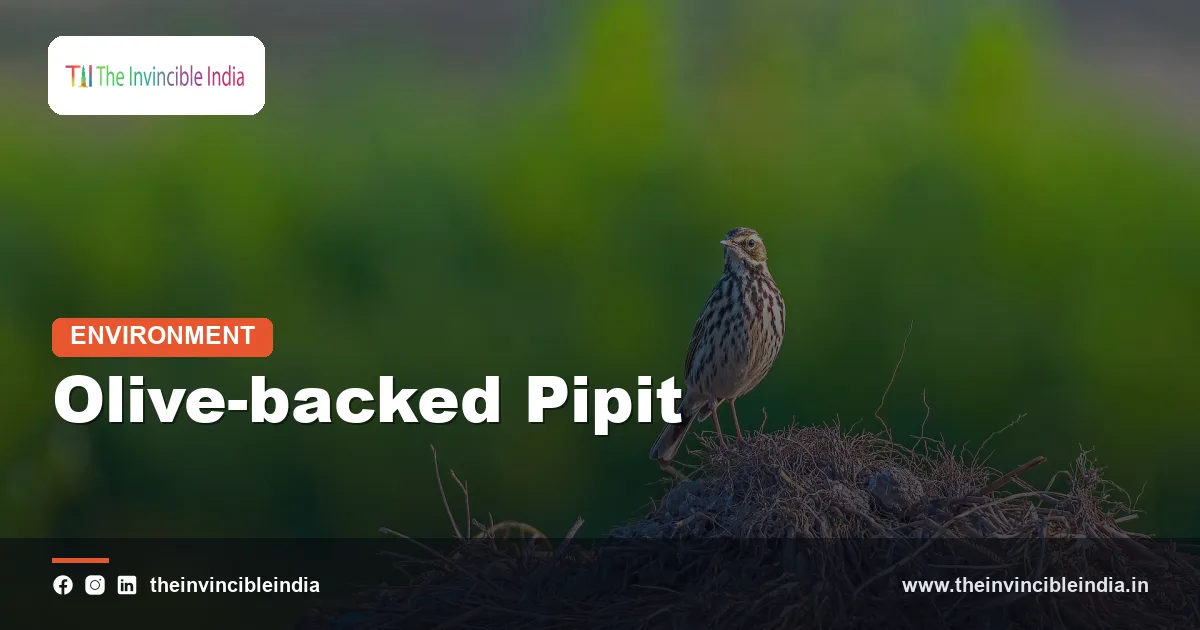
The olive-backed pipit (Anthus hodgsoni) is a small, greenish-brown, heavily streaked songbird of woodland floors that breeds in northern Eurasia and the Himalaya and spends the winter in the shaded forests, hill slopes and gardens of India and South-East Asia. It is recognised by its olive-green back, bold pale eyebrow, a black-and-white spot behind the ear, and its habit of walking on the ground, bobbing its tail and flying up into a tree when startled.
The olive-backed pipit is also known as Hodgson’s pipit, after the naturalist Brian Houghton Hodgson, who studied the birds of Nepal in the nineteenth century. This explainer describes how to identify the species, where it lives in India, what it eats, how it breeds and migrates, and how it differs from the closely similar tree pipit.
| Quick Fact | Detail |
|---|---|
| Common name | Olive-backed pipit (also Hodgson’s pipit) |
| Scientific name | Anthus hodgsoni |
| Family | Motacillidae (pipits, wagtails and longclaws) |
| Size | About 15 cm long, a slim sparrow-sized bird |
| India status and habitat | Winter visitor to shaded forest floors, hill slopes, gardens, plantations and clearings; also breeds in the Himalaya |
| Diet | Mainly small insects and other invertebrates; some seeds |
| Breeding and migration | Breeds in northern Asia and mountain forests; moves south and to lower elevations in winter |
| Nest | Ground nest hidden by grass or a mossy bank, usually with four to five eggs |
| Conservation status | Least Concern on the IUCN Red List |
Key Takeaways
- The olive-backed pipit is a small, olive-green and heavily streaked songbird in the pipit family, scientifically named Anthus hodgsoni.
- The olive-backed pipit is identified by its greenish back, strong dark breast streaks, a pale eyebrow and a distinctive black-and-white spot at the rear of the ear coverts.
- The olive-backed pipit visits India in large numbers in winter and favours shaded ground in forests, hill slopes, tea gardens, parks and orchards.
- The olive-backed pipit feeds on small insects and other invertebrates collected on the ground, and takes seeds when insects are scarce.
- The olive-backed pipit pumps its tail while walking and flies into a tree when disturbed, then often sits still on a branch.
- The olive-backed pipit is listed as Least Concern by the IUCN because it has a very large range and a large population.
What is the olive-backed pipit?
The olive-backed pipit is a small songbird in the family Motacillidae, which includes pipits and wagtails, and it is classified in the genus Anthus. It breeds from northern Europe and Siberia across Asia to Japan, and in mountain forests of the Himalaya, and it winters in southern and eastern Asia, including much of India.
The species is named for the olive-green tinge of its upperparts, which is more obvious than the plain brown of most other pipits. Its alternative name, Hodgson’s pipit, honours Brian Houghton Hodgson, a British naturalist and diplomat who collected and described many Himalayan birds while he lived in Nepal.
Unlike the pipits of open grassland, the olive-backed pipit prefers shaded ground in woodland, forest edges and well-planted gardens. This habitat choice, together with its tendency to flick into a tree, makes it a common sight in Indian hill stations and wooded parks during the cooler months.
How can you identify the olive-backed pipit?
The olive-backed pipit is identified by its olive-green upperparts, a buffy eyebrow that turns whiter behind the eye, a black-and-white spot at the back of the ear, and a buff-white breast with bold black streaks. These features give the bird a more strongly marked head than its close relatives.
Plumage features
- Back: olive-green to olive-brown with faint dark streaks, noticeably greener than most pipits.
- Face: a clear pale eyebrow, a dark line through the eye and a distinct pale-and-dark spot behind the ear coverts.
- Breast and flanks: buffy-white with bold black streaks that continue onto the flanks, and a whitish belly.
- Wings: two pale wing bars formed by buffy tips on the coverts.
- Legs: pinkish, with a short, curved hind claw.
- Bill: slender and dark above, paler at the base below.
Behaviour and voice
The olive-backed pipit walks on the ground with a bobbing, slightly horizontal posture and pumps its tail rhythmically. When alarmed it flies up into a tree and may stand perfectly still, making it easy to overlook. Its flight call is a thin, high “tseep” or “seep”, given as the bird takes off, and this is one of the most useful clues in the field.
Where does the olive-backed pipit live in India?
The olive-backed pipit lives in India chiefly during the winter months, when it is found across the Himalayan foothills, the north-east, the plains and the hills of the peninsula, wherever shaded ground with leaf litter and scattered trees is available. It is also present in summer in the higher Himalayan forests where it breeds.
It appears in a variety of habitats during winter:
- Moist deciduous and evergreen forest floors and forest tracks.
- Tea, coffee and cardamom plantations with shade trees.
- Hill-station gardens, wooded parks and campuses.
- Orchards and wooded edges of cultivation.
- Streamsides and clearings in hill forests.
The bird often feeds in small groups in winter, and several individuals may be seen along a forest track at once. It tends to be more common in hill and foothill regions than in dry, open plains, which suit other pipits better. Numbers vary from year to year depending on food supply and weather.
What does the olive-backed pipit eat?
The olive-backed pipit eats mainly small insects and other invertebrates, including ants, beetles, flies, caterpillars, spiders and small snails, which it picks from leaf litter and bare soil. It also eats small seeds, particularly in the colder months when insects become fewer.
It forages on foot, walking steadily over shaded ground, turning over leaves and probing the soil surface. Its slender bill is well suited to picking out small prey from crevices. Unlike some pipits, it does not often chase flying insects but sticks mainly to ground-dwelling prey.
By feeding on insects in forests, gardens and plantations, the olive-backed pipit contributes to the natural control of pests. In plantation landscapes such as tea gardens, flocks may feed along pathways and drains, where they are easy to observe.
How does the olive-backed pipit breed?
The olive-backed pipit breeds on the ground in mountain and northern forests, building a cup nest of grass and moss tucked into a bank, a grass tussock or beneath a low shrub. The female usually lays four to five eggs, which are pale and marked with brown, and both parents feed the chicks.
In the Himalaya, breeding takes place at higher elevations in mixed forest and open glades, usually during the spring and summer months. The male sings from the tip of a tree and performs a song-flight, rising a short distance before gliding down while still singing. The song is a series of loud, repeated, canary-like trills.
| Breeding feature | Detail |
|---|---|
| Nest site | On the ground, concealed by grass, moss or a bank |
| Clutch size | Usually four to five eggs |
| Habitat | Open mixed or coniferous forest with grassy clearings |
| Parental care | Both parents feed the nestlings with insects |
| Display | Song-flight from a tree, ending in a gliding descent |
| Winter behaviour | Silent for most of the winter, apart from the thin flight call |
Most olive-backed pipits recorded in the Indian plains are non-breeding winter visitors. Breeding birds are mainly restricted to the Himalaya and the cold forests of the north.
Is the olive-backed pipit a migratory bird?
The olive-backed pipit is a migratory bird: northern populations travel south in autumn to spend the winter in warmer parts of Asia, while Himalayan birds typically move down the mountain slopes to lower elevations. Many of those that reach India arrive between September and November and leave in March or April.
The species makes both long-distance and altitudinal movements. Birds that breed in Siberia and northern China cross mountain ranges and travel to India, South-East Asia and southern China. Birds that breed in the Himalaya may move only a short distance, from high-elevation forests down to foothills, valleys and plains once snow arrives.
Migration is mostly at night, with birds resting and feeding by day in woodland patches. A few individuals occasionally turn up in unexpected places, including coastal areas and islands, during migration.
How is the olive-backed pipit different from the tree pipit?
The olive-backed pipit differs from the tree pipit mainly by its greener back, bolder streaking on the breast and flanks, and the distinctive black-and-white spot behind the ear, while the tree pipit is browner and has a plainer face. Calls also differ, since the olive-backed pipit gives a thin tseep and the tree pipit a buzzy note.
| Feature | Olive-backed pipit | Tree pipit |
|---|---|---|
| Upperparts | Olive-green, faintly streaked | Olive-brown, faintly streaked |
| Face | Strong eyebrow and black-and-white ear spot | Plainer face, weaker marks |
| Breast and flank streaks | Bold, dark and extensive | Bold on breast, finer on flanks |
| Flight call | Thin “tseep” | Buzzy, rasping “teez” |
| Preferred habitat | Shaded forest floors and gardens | Brighter open woodland and edges |
| Behaviour | Bobs tail, often freezes in trees | Pumps tail slowly, perches readily |
The two species overlap in winter in some parts of India and can occur in the same area, so it is worth checking each bird individually. Photographs showing the head, breast and call recording help in confirming identification, as plumage differences can look subtle in dim forest light.
What threats does the olive-backed pipit face?
The olive-backed pipit faces relatively few direct threats, and the IUCN classifies it as Least Concern, but it can be affected by loss of forest cover, degradation of shaded ground habitat and heavy pesticide use in plantations. The main risk is the clearing of woodland floors that supply its insect food.
Specific pressures include:
- Forest loss and fragmentation: felling and conversion of forest to farmland reduce suitable winter habitat.
- Intensive plantation management: removal of leaf litter and heavy chemical sprays reduce insect prey.
- Climate change: altered temperatures and rainfall can change migration timing and snow lines.
- Night-time collisions: migrating birds can strike lit towers and tall glass buildings.
- Trapping: small ground birds are occasionally caught in traps and nets in some regions.
Because the species uses many habitats and has a huge range, it is currently secure. Its dependence on healthy woodland floors, however, makes it a useful indicator of the quality of shade forests and gardens.
How can you watch the olive-backed pipit in India?
The best way to watch the olive-backed pipit in India is to walk quietly along shaded forest tracks, garden paths or plantation lanes between October and March and look for a streaky bird walking on the ground with a pumping tail. When it flies up into a tree, it often perches in plain view.
The following approach works well:
- Visit hill stations, forest edges and wooded gardens in the early morning.
- Scan leaf litter and track edges ahead of you rather than looking only at trees.
- Listen for the thin, high tseep as a bird takes flight.
- Watch where it lands and look for the head pattern with binoculars.
- Record sightings in eBird to help track the species’ winter range.
Why does the olive-backed pipit matter?
The olive-backed pipit matters because it links the forests of the north with those of the Indian subcontinent through migration and acts as an indicator of healthy, insect-rich forest floors. Its presence in gardens and plantations also shows that managed green spaces can support wild birds.
Watching such common migrants is a good introduction to birding, since they teach observers to pay attention to subtle details like face patterns, calls and behaviour. Records collected by citizen scientists add to the understanding of how migratory birds respond to changes in land use and climate.
Bottom Line
The olive-backed pipit is a greenish, boldly streaked ground bird that visits shaded woodland and gardens across India in winter and breeds in the Himalaya. It is secure at present, and the black-and-white ear spot, green back and thin tseep call make it identifiable once an observer knows what to look for.
Frequently Asked Questions
What is the olive-backed pipit?
The olive-backed pipit is a small, olive-green, heavily streaked songbird, Anthus hodgsoni, in the pipit and wagtail family. It breeds in northern Asia and the Himalaya and winters across southern and eastern Asia, including India. It is also known as Hodgson’s pipit.
How do you identify an olive-backed pipit?
An olive-backed pipit is identified by its olive-green back, a pale eyebrow, a black-and-white spot behind the ear and bold black streaks on a buff-white breast. It walks on the ground with a bobbing tail. When flushed, it gives a thin tseep and flies up into a tree.
Is the olive-backed pipit found in India all year?
The olive-backed pipit is mainly a winter visitor to India, arriving from about September to November and leaving by March or April. Some birds breed in the Himalaya and are present in the higher forests in summer. In winter, Himalayan birds move to lower elevations.
What does the olive-backed pipit eat?
The olive-backed pipit eats mainly small insects and other invertebrates such as ants, beetles, flies and spiders, which it picks from the ground and leaf litter. It also takes small seeds when insects are scarce. It forages on foot in shaded areas.
How is the olive-backed pipit different from the tree pipit?
The olive-backed pipit is greener above and has a bold black-and-white ear spot with heavier streaking, while the tree pipit is browner with a plainer face and finer flank streaks. Their calls also differ, with a thin tseep for the olive-backed pipit and a buzzy note for the tree pipit. Both fly into trees when disturbed.
Is the olive-backed pipit endangered?
The olive-backed pipit is not endangered; the IUCN lists it as Least Concern because of its very large range and population. It depends on shaded woodland and garden floors that supply insect food. Forest loss and heavy pesticide use are the main local risks.
{“@context”:”https://schema.org”,”@graph”:[{“@type”:”FAQPage”,”mainEntity”:[{“@type”:”Question”,”name”:”What is the olive-backed pipit?”,”acceptedAnswer”:{“@type”:”Answer”,”text”:”The olive-backed pipit is a small, olive-green, heavily streaked songbird, Anthus hodgsoni, in the pipit and wagtail family. It breeds in northern Asia and the Himalaya and winters across southern and eastern Asia, including India. It is also known as Hodgson’s pipit.”}},{“@type”:”Question”,”name”:”How do you identify an olive-backed pipit?”,”acceptedAnswer”:{“@type”:”Answer”,”text”:”An olive-backed pipit is identified by its olive-green back, a pale eyebrow, a black-and-white spot behind the ear and bold black streaks on a buff-white breast. It walks on the ground with a bobbing tail. When flushed, it gives a thin tseep and flies up into a tree.”}},{“@type”:”Question”,”name”:”Is the olive-backed pipit found in India all year?”,”acceptedAnswer”:{“@type”:”Answer”,”text”:”The olive-backed pipit is mainly a winter visitor to India, arriving from about September to November and leaving by March or April. Some birds breed in the Himalaya and are present in the higher forests in summer. In winter, Himalayan birds move to lower elevations.”}},{“@type”:”Question”,”name”:”What does the olive-backed pipit eat?”,”acceptedAnswer”:{“@type”:”Answer”,”text”:”The olive-backed pipit eats mainly small insects and other invertebrates such as ants, beetles, flies and spiders, which it picks from the ground and leaf litter. It also takes small seeds when insects are scarce. It forages on foot in shaded areas.”}},{“@type”:”Question”,”name”:”How is the olive-backed pipit different from the tree pipit?”,”acceptedAnswer”:{“@type”:”Answer”,”text”:”The olive-backed pipit is greener above and has a bold black-and-white ear spot with heavier streaking, while the tree pipit is browner with a plainer face and finer flank streaks. Their calls also differ, with a thin tseep for the olive-backed pipit and a buzzy note for the tree pipit. Both fly into trees when disturbed.”}},{“@type”:”Question”,”name”:”Is the olive-backed pipit endangered?”,”acceptedAnswer”:{“@type”:”Answer”,”text”:”The olive-backed pipit is not endangered; the IUCN lists it as Least Concern because of its very large range and population. It depends on shaded woodland and garden floors that supply insect food. Forest loss and heavy pesticide use are the main local risks.”}}]}]}


