

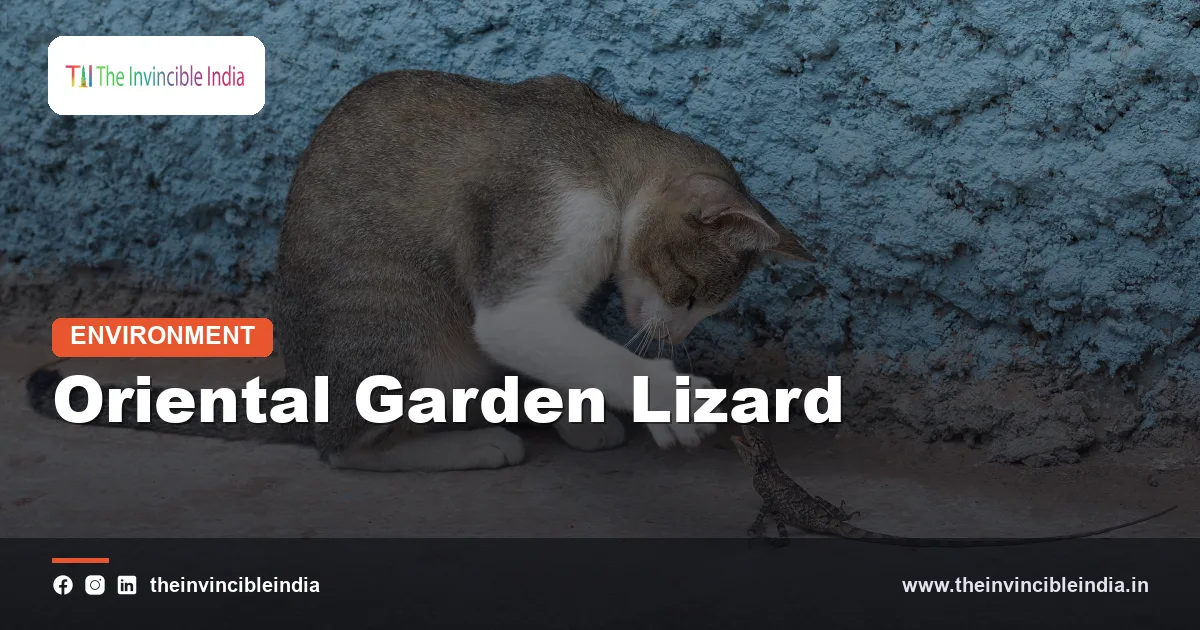
The oriental garden lizard (Calotes versicolor) is a common, long-tailed agamid lizard of Indian gardens, hedges and scrub, famous for the bright red head that the breeding male displays and for a harmless reputation that its old nickname “bloodsucker” wrongly contradicts. It is a daytime insect-eater that perches on fences, trunks and shrubs, and it is one of the most familiar reptiles that people in India see near their homes.
The oriental garden lizard is also called the changeable lizard, the common garden lizard or the eastern garden lizard, and in Hindi it is often called girgit. This article explains what the oriental garden lizard is, why it changes colour, how it feeds and breeds, why people call it a bloodsucker, whether it is dangerous, and how it differs from chameleons and geckos.
| Quick Facts | Details |
|---|---|
| Scientific name | Calotes versicolor |
| Other names | Changeable lizard, common garden lizard, eastern garden lizard, girgit, “bloodsucker” |
| Class, order and family | Reptilia, Squamata, Agamidae |
| Size | Total length around 35 to 40 cm in large males, with the tail making up about two-thirds |
| Range and habitat | Widespread across India and South and Southeast Asia in gardens, hedges, scrub, farmland and forest edges |
| Diet | Mainly insects, spiders and other small invertebrates; occasionally small lizards |
| Life cycle | Egg-laying; female buries a clutch of eggs in damp soil, usually around the monsoon |
| Danger to humans | Not venomous; may give a mild bite if handled roughly |
| Conservation status | Least Concern on the IUCN Red List; common and adaptable |
Key Takeaways
- The oriental garden lizard (Calotes versicolor) is a common Indian agamid lizard that lives in gardens, hedges and scrub and eats insects.
- The breeding male oriental garden lizard develops a bright red or crimson head and throat, which gave rise to the misleading nickname “bloodsucker”.
- The oriental garden lizard is harmless and does not suck blood; it is not venomous and is not dangerous to people or pets.
- The oriental garden lizard changes colour between brown, grey, olive and yellowish shades depending on temperature, mood and social signals, but it does not match its background as a chameleon can.
- The female oriental garden lizard digs a hole in damp soil and buries her eggs, which hatch after roughly two months into independent young.
- By eating large numbers of insects, the oriental garden lizard acts as a natural pest controller in Indian gardens and farms.
What is the oriental garden lizard?
The oriental garden lizard is a medium-sized lizard of the family Agamidae, the group that includes the fan-throated lizards, rock agamas and dragon lizards. Its scientific name is Calotes versicolor, and the species name “versicolor” means “changing colour”, pointing to its ability to shift its shades.
Like other agamids, the oriental garden lizard has a slim, laterally flattened body, strong limbs with sharp claws, a row of small spines along the neck and back, and a long whip-like tail. It is cold-blooded, which means it depends on external heat and warms itself by basking in the sun.
The oriental garden lizard is a diurnal animal, meaning it is active in the daytime. It is one of the commonest reptiles in the Indian subcontinent and has adapted well to human-made habitats, which is why it is often the first lizard people notice in a garden, on a boundary wall or in a park.
Where does the oriental garden lizard live?
The oriental garden lizard lives across most of India, where it is found in gardens, hedgerows, farmland, scrub, roadside trees and forest edges, from the plains to low hills. Its natural range stretches across South Asia, including Sri Lanka, Nepal, Bangladesh and Pakistan, and into Southeast Asia.
The species has also been introduced to a number of other regions of the world, where it has settled in warm climates. Within India, it is rarely absent from a suitable habitat. Its favourite places include:
- Garden shrubs, hedges and tree trunks with good perches
- Fences, boundary walls and fallen logs in sunny spots
- Farm bunds, orchards and plantations
- Scrub, open woodland and forest edges
The oriental garden lizard lives mostly on vegetation but comes to the ground to hunt, to bask and, in the case of the female, to lay eggs. It does not need water pools nearby, but it needs a reliable supply of insects and some cover where it can hide from predators.
At night it sleeps on a thin twig or leaf, usually well off the ground, with a paler, duller body colour. In cool weather it becomes sluggish and stays hidden until the sun warms the air.
What does the oriental garden lizard look like?
The oriental garden lizard looks like a slim, brownish or olive lizard with a long tail, a pointed head, a crest of small spines along the neck and back, and a body that can shift in colour. A typical adult is sandy-brown to grey with darker bands across the back, and the underside is paler.
Features that help identify the oriental garden lizard include:
- Long, thin tail: usually about twice the length of the head and body together, used for balance when climbing.
- Spiny crest: small, upright scales run along the nape and back, more prominent in males.
- Prominent head: the head is triangular, with bulging cheek muscles in mature males.
- Strong limbs: long toes with claws, suited to gripping bark and branches.
- Dark line behind the eye: many individuals show a dark streak from the eye toward the ear.
Males are larger and more brightly coloured than females, particularly in the breeding season. Females and young are generally duller and greener or browner. Juveniles look like small, slender copies of the adults and are often more greenish.
Why does the oriental garden lizard turn red?
The oriental garden lizard turns red because the breeding male develops a bright crimson, orange or reddish head and throat, mainly to signal to females and to rival males. This breeding colour is temporary and is strongest during the mating season, which is often tied to the monsoon months.
The colour comes from pigment cells in the skin, called chromatophores, which contain different pigments and light-reflecting crystals. Nerve signals and hormones can make these cells expand or contract, changing the visible colour. Several factors influence the change in the oriental garden lizard:
- Breeding hormones: rising levels in the male trigger the red head and throat.
- Temperature: cooler lizards tend to look darker to absorb more heat, and warm lizards look paler.
- Mood and stress: excitement, aggression or fear can brighten or darken the skin.
- Social signalling: a dominant male shows brighter colours than a subordinate one.
It is a common misunderstanding that the oriental garden lizard changes colour to match any background like a chameleon. In reality its colour change is more limited and is chiefly a tool for body temperature control and communication.
The red colouring of the male may fade within hours or days when the animal is stressed or when the breeding season ends, so a lizard with a red head is not a different species. A male may also show only a hint of red outside the breeding season.
Is the oriental garden lizard really a bloodsucker?
The oriental garden lizard is not a bloodsucker; the nickname is a myth based on the blood-red head of the breeding male, and the lizard does not feed on blood. Calotes lizards eat insects and other small animals and have no mouthparts or behaviour for drinking blood.
The name “bloodsucker” is widely used in India and elsewhere and gives rise to stories that the lizard sucks the blood of people or livestock, or that its bite is dangerous. None of these beliefs is supported by evidence. Some of the confusion comes from the red throat colouring, which looks as if the animal has just fed on blood.
Several other false beliefs surround garden lizards in India:
- That the oriental garden lizard is venomous. It is not venomous.
- That a bite from the lizard leads to illness. A bite is rare, small and usually only needs cleaning like any minor wound.
- That a lizard falling on a person brings bad luck. This is a folk belief with no biological basis.
- That the red-headed lizard is a different, more dangerous species. It is the same species in breeding colours.
Understanding the myth matters because garden lizards are sometimes killed out of fear. Killing them removes a natural insect controller from the garden.
What does the oriental garden lizard eat?
The oriental garden lizard eats mainly insects, such as ants, grasshoppers, beetles, flies, termites and caterpillars, along with spiders and other small invertebrates. It is an ambush predator that waits on a perch and watches for movement.
Its hunting method is simple and effective. The lizard sits motionless on a trunk or fence, scans the ground and air with its sharp eyesight, then dashes forward or leaps to grab the prey with a quick lunge. The sticky, muscular tongue flicks out to catch small insects.
The diet of the oriental garden lizard may include:
- Ants and termites, especially when they swarm
- Grasshoppers, crickets, beetles and moths
- Caterpillars, flies and other garden insects
- Spiders and small snails
- Occasionally smaller lizards, such as geckos or young garden lizards, and soft fruit, flowers or nectar in small amounts
Because it feeds on so many insects, the oriental garden lizard has real value in gardens and orchards, where it reduces numbers of pests without any chemical use. It also drinks water droplets from leaves and wet surfaces, particularly after rain.
How does the oriental garden lizard breed?
The oriental garden lizard breeds by laying eggs: the female digs a small burrow in damp soil, deposits a clutch of eggs and covers them over. Breeding is usually linked to the warm, wet months of the monsoon, though timing varies across India with local climate.
During the breeding season, males defend territories from perches, performing displays that include head-bobbing, push-ups on their front legs, puffing out the throat and showing the red head. Rival males may chase and fight, and a successful male mates with one or more females within his territory.
After mating, the female finds a patch of damp, loose soil, digs a hole with her front limbs, and lays a clutch that is commonly around a dozen eggs, though the number varies with the size of the female and the season. She then covers the eggs with soil and leaves. The eggs are soft-shelled and take roughly two months to hatch, depending on temperature.
The hatchlings are fully independent from birth. They are small, greenish-brown and fast-moving, and they begin to catch tiny insects at once. Many are eaten by birds, snakes, cats and other lizards, but a few survive to reach maturity in their first year or two. The oriental garden lizard commonly lives for a few years in the wild.
How is the oriental garden lizard different from a chameleon or a gecko?
The oriental garden lizard differs from a chameleon and a gecko in body shape, behaviour, eyes and feet: it is a sun-loving, daytime agamid with a thin tail and no prehensile grip. People often confuse these lizards, especially because “girgit” is used loosely in Hindi for both garden lizards and chameleons.
| Lizard | Family | Key features | Activity |
|---|---|---|---|
| Oriental garden lizard | Agamidae | Slim body, long thin tail, spiny crest, breeding male has red head | Day, sunny perches |
| Indian chameleon | Chamaeleonidae | Turret-like swivelling eyes, grasping toes, curled prehensile tail, slow movement | Day, in bushes |
| Common house gecko | Gekkonidae | Pale body, adhesive toe pads, large eyes, makes chirping calls | Night, walls and ceilings |
| Fan-throated lizard | Agamidae | Small, ground-dwelling, males show a colourful throat fan | Day, open ground |
| Bengal monitor | Varanidae | Large, heavy body, forked tongue, powerful claws | Day, forest and scrub |
The oriental garden lizard cannot cling to smooth ceilings as geckos do, because it has claws rather than sticky toe pads. It also lacks the independent, swivelling eyes and the long projectile tongue that define a chameleon. These differences make identification simple once you know what to look for.
What are the natural predators and threats of the oriental garden lizard?
The oriental garden lizard is hunted by birds of prey, snakes, mongooses, cats and monitor lizards, and its main threats are accidental killing by people and loss of garden cover. Kites, shikras, crows and kingfishers take lizards from perches, while rat snakes and cat snakes search hedges and trees for them.
To escape, the oriental garden lizard relies on several defences:
- Freezing on a trunk or branch so that its colour blends with the bark
- Running along a branch or fence and dropping to the ground
- Darting into thick vegetation, burrows or crevices
- Flattening the body and turning to keep the trunk between itself and a threat
- Biting and flailing when cornered
Despite predators, the species is abundant and listed as Least Concern by the IUCN. Its adaptability to gardens and farmland means it has not declined in the way that forest specialists have. The most useful steps for people who like having these lizards nearby are to avoid pesticides, keep some shrubs and hedges, and leave patches of bare, sunny soil.
Should you worry about having oriental garden lizards at home?
There is no need to worry about having oriental garden lizards in or around a home, because they are harmless, shy and helpful. They stay on shrubs, trees, fences and walls and rarely enter rooms.
If an oriental garden lizard does come indoors, it can be guided out with a broom or a cloth, or allowed to leave on its own. Handling is best avoided, because a frightened lizard may bite or lose its footing and be injured. A bite from a garden lizard can produce a small scratch or puncture, which should be washed with soap and water.
It is also good practice to wash hands after touching any reptile, because reptiles can carry bacteria such as Salmonella. Wild lizards should not be kept as pets, since they stress easily and need live insects and sunlight to survive.
Bottom Line
The oriental garden lizard is a harmless, sun-loving insect-eater whose red-headed breeding male has been unfairly nicknamed a bloodsucker. Recognising it as a useful garden resident rather than a menace helps protect both the animal and the natural pest control it provides.
Frequently Asked Questions
Is the oriental garden lizard poisonous or dangerous?
The oriental garden lizard is not poisonous or venomous and is not dangerous to people. It may bite if it is grabbed or cornered, but the bite is small and usually needs only washing with soap and water. It prefers to run away.
Why is the oriental garden lizard called a bloodsucker?
The oriental garden lizard is called a bloodsucker because the breeding male develops a blood-red head and throat, which people mistook for blood. The lizard does not drink blood and feeds on insects. The name is a myth with no biological basis.
Can the oriental garden lizard really change colour?
The oriental garden lizard can change colour, shifting between brown, grey, olive and yellowish shades, and the breeding male turns red on the head and throat. The change is caused by pigment cells in the skin and is linked to temperature, mood and social signals. It is less complete than a chameleon’s colour change.
What does the oriental garden lizard eat?
The oriental garden lizard eats mainly insects such as ants, grasshoppers, beetles and termites, along with spiders and other small invertebrates. It sits on a perch and ambushes prey that passes by. Occasionally it eats a small lizard or a little soft fruit.
Is the oriental garden lizard a chameleon?
The oriental garden lizard is not a chameleon; it belongs to the family Agamidae, while true chameleons belong to the family Chamaeleonidae. The Indian chameleon is slower, has swivelling eyes, grasping feet and a curled tail, which the garden lizard lacks. Both are sometimes called girgit in Hindi, which causes confusion.
How long does the oriental garden lizard live?
The oriental garden lizard lives for a few years in the wild, though many individuals die earlier from predators. The females bury a clutch of eggs in damp soil, and the young are independent from hatching. Survival is better in gardens with hedges and few pesticides.
{“@context”:”https://schema.org”,”@graph”:[{“@type”:”FAQPage”,”mainEntity”:[{“@type”:”Question”,”name”:”Is the oriental garden lizard poisonous or dangerous?”,”acceptedAnswer”:{“@type”:”Answer”,”text”:”The oriental garden lizard is not poisonous or venomous and is not dangerous to people. It may bite if it is grabbed or cornered, but the bite is small and usually needs only washing with soap and water. It prefers to run away.”}},{“@type”:”Question”,”name”:”Why is the oriental garden lizard called a bloodsucker?”,”acceptedAnswer”:{“@type”:”Answer”,”text”:”The oriental garden lizard is called a bloodsucker because the breeding male develops a blood-red head and throat, which people mistook for blood. The lizard does not drink blood and feeds on insects. The name is a myth with no biological basis.”}},{“@type”:”Question”,”name”:”Can the oriental garden lizard really change colour?”,”acceptedAnswer”:{“@type”:”Answer”,”text”:”The oriental garden lizard can change colour, shifting between brown, grey, olive and yellowish shades, and the breeding male turns red on the head and throat. The change is caused by pigment cells in the skin and is linked to temperature, mood and social signals. It is less complete than a chameleon’s colour change.”}},{“@type”:”Question”,”name”:”What does the oriental garden lizard eat?”,”acceptedAnswer”:{“@type”:”Answer”,”text”:”The oriental garden lizard eats mainly insects such as ants, grasshoppers, beetles and termites, along with spiders and other small invertebrates. It sits on a perch and ambushes prey that passes by. Occasionally it eats a small lizard or a little soft fruit.”}},{“@type”:”Question”,”name”:”Is the oriental garden lizard a chameleon?”,”acceptedAnswer”:{“@type”:”Answer”,”text”:”The oriental garden lizard is not a chameleon; it belongs to the family Agamidae, while true chameleons belong to the family Chamaeleonidae. The Indian chameleon is slower, has swivelling eyes, grasping feet and a curled tail, which the garden lizard lacks. Both are sometimes called girgit in Hindi, which causes confusion.”}},{“@type”:”Question”,”name”:”How long does the oriental garden lizard live?”,”acceptedAnswer”:{“@type”:”Answer”,”text”:”The oriental garden lizard lives for a few years in the wild, though many individuals die earlier from predators. The females bury a clutch of eggs in damp soil, and the young are independent from hatching. Survival is better in gardens with hedges and few pesticides.”}}]}]}


