

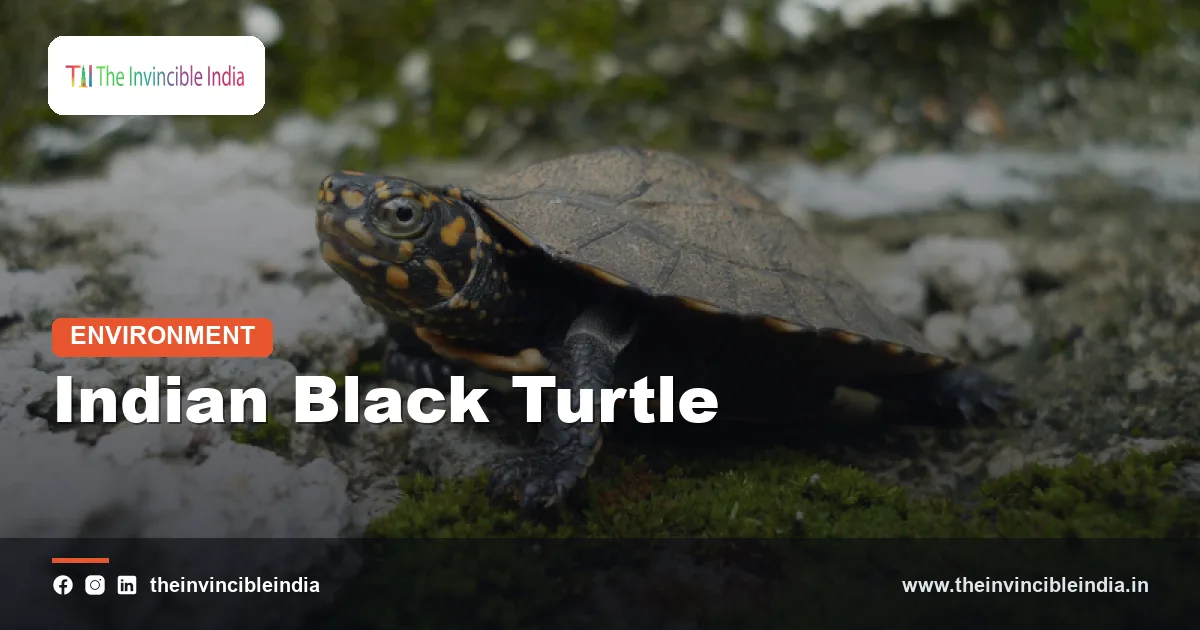
The Indian black turtle (Melanochelys trijuga), also called the pond terrapin, is a dark-shelled freshwater turtle that lives in the ponds, lakes, marshes, slow streams and temple tanks of India and neighbouring parts of South Asia. It is an omnivore that feeds on water plants, snails, insects and carrion, and it is often seen basking on logs and rocks in the sun.
The Indian black turtle is one of the most familiar turtles in India because it thrives in village ponds and temple pools, where people see it daily. This article explains what the Indian black turtle is, how to recognise it, where it lives, what it eats, how it breeds, how it differs from tortoises, why it is protected, and what people can do to keep it safe.
| Quick Facts | Details |
|---|---|
| Scientific name | Melanochelys trijuga |
| Other names | Pond terrapin, Indian pond terrapin, Indian black turtle |
| Class, order and family | Reptilia, Testudines, Geoemydidae (Asian pond and river turtles) |
| Size | Shell length commonly about 20 to 30 cm, occasionally approaching 38 cm; females larger than males |
| Range and habitat | Widespread in India and South Asia; ponds, lakes, marshes, canals, slow rivers and temple tanks |
| Diet | Omnivore: aquatic plants, fruit, snails, insects, worms, small fish and carrion |
| Life cycle | Egg-laying; female digs a nest on land near water and buries a small clutch of hard-shelled eggs |
| Lifespan | Can live for decades in suitable conditions |
| Conservation status | Assessed as Near Threatened by the IUCN; protected in India under the Wildlife (Protection) Act, 1972 |
Key Takeaways
- The Indian black turtle (Melanochelys trijuga) is a medium-sized freshwater turtle with a dark brown or black shell, found across India in ponds, lakes and temple tanks.
- The Indian black turtle is an omnivore that eats both plants and animals, including aquatic vegetation, snails, insects, small fish and carrion.
- The female Indian black turtle buries her eggs in a nest dug on land near water, and the hatchlings must find their own way to the pond.
- The Indian black turtle is a turtle rather than a tortoise, because it spends most of its life in water and has partially webbed feet.
- The Indian black turtle is threatened by illegal collection for meat and the pet trade, loss of wetlands and pollution, and wild turtles are legally protected in India.
- Feeding turtles in temple tanks with bread, sweets or puffed rice can harm the Indian black turtle, which needs a natural, varied diet.
What is the Indian black turtle?
The Indian black turtle is a freshwater turtle of the family Geoemydidae, a large family of Asian pond and river turtles, and it is known to science as Melanochelys trijuga. The genus name Melanochelys means “black turtle” and the species name trijuga refers to three ridges, or keels, that run along the shell of young animals.
The Indian black turtle is often called the pond terrapin, and the word terrapin is sometimes used for small to medium freshwater turtles that live in ponds and slow water. Its habit of living near people has made it a regular sight in tanks, village ponds and water bodies around temples.
Zoologists recognise several subspecies of the Indian black turtle across its range, and these differ in details of head markings, shell shape and colour. This variation is one reason why different regions of India describe the animal with slightly different features.
What does the Indian black turtle look like?
The Indian black turtle has a smooth, domed, dark brown to black shell, a dark underside and a dark head and limbs, usually marked with pale yellow, orange or whitish spots or stripes. The shell is made of two parts, the upper carapace and the lower plastron, joined at the sides by a bony bridge.
Key identifying features of the Indian black turtle include:
- Dark, domed carapace: young turtles have three distinct ridges along the shell, while adults are smoother with a low central keel.
- Pale head markings: in many individuals there are cream, yellow or orange patches or streaks on the sides of the head and neck.
- Partially webbed feet: the toes are webbed, helping the animal swim, while the claws help it climb out onto banks.
- Hooked beak: a horny, toothless beak is used to bite vegetation and prey.
- Size difference: females grow larger and have shorter tails than males.
The Indian black turtle has a mostly dark colour that blends with muddy pond water and dim light, giving it a measure of camouflage. When frightened it pulls its head and limbs into the shell and often slides into the water with a splash.
Where does the Indian black turtle live?
The Indian black turtle lives across much of India and South Asia in still or slow-moving freshwater such as ponds, lakes, marshes, canals, paddy fields and temple tanks. It is one of the most widespread freshwater turtles of the subcontinent and is also found in Nepal, Bangladesh, Sri Lanka and nearby regions.
The species is very adaptable. Typical habitats include:
- Village ponds and irrigation tanks with muddy bottoms and aquatic plants
- Lakes, reservoirs and marshes with shallow edges
- Slow-flowing rivers and canals
- Temple ponds and sacred tanks, where the animals are protected and fed by devotees
The Indian black turtle needs three things from its habitat: water to swim and feed in, a safe sunny place to bask, and soft, undisturbed ground nearby where females can dig nests. A pond with only concrete walls may hold a few turtles, but it cannot support breeding unless there is a natural bank.
During the dry season, when ponds shrink or dry up, the Indian black turtle may move overland to find water or bury itself in mud and wait for the rains. This ability to survive drought is part of why it persists in so many seasonal waterbodies.
Why are Indian black turtles found in temple tanks?
Indian black turtles are found in temple tanks because tanks provide permanent water and shelter, and because many communities protect and feed turtles as an act of religious belief. In Hindu tradition the tortoise is revered as Kurma, the second avatar of Vishnu, which has encouraged people to look after turtles and tortoises at sacred sites.
Sacred ponds are important refuges for turtles in places where natural wetlands have been drained or polluted. Some temple tanks hold large and healthy turtle populations that survive for generations because they are rarely hunted.
The benefits and risks of temple tank life for the Indian black turtle can be summarised as follows:
- Benefit: protection from poaching and a steady water supply.
- Benefit: community care that has kept turtles alive in urban areas.
- Risk: unsuitable food such as bread, sweets, biscuits and fried snacks, which can cause poor nutrition and shell problems.
- Risk: polluted water from offerings, soaps, flowers and plastic.
- Risk: lack of natural banks for nesting, and overcrowding of released animals.
Visitors can help turtles in temple tanks by keeping the water clean, avoiding throwing rubbish or plastic, and offering only natural foods if feeding is permitted, such as small amounts of leafy greens. Dumping unwanted pet turtles into temple ponds is harmful and should never be done.
What does the Indian black turtle eat?
The Indian black turtle is an omnivore that eats a mixed diet of aquatic plants and small animals, and it will also scavenge dead fish and other carrion. This flexible diet is another reason it survives in so many different waterbodies.
The diet of the Indian black turtle includes:
- Water plants, algae, duckweed and soft leaves
- Fallen fruit and flowers that drop into the water
- Snails, insects and their larvae, worms and crustaceans
- Small fish, tadpoles and frogs when they can be caught
- Dead fish and other animal remains
The turtle feeds mostly in water, because it needs water to help swallow its food. It uses its sharp beak to tear plants and crush shells of snails, and it hunts by slowly approaching prey or by scavenging along the bottom. Young turtles tend to eat more animal food, which supplies protein for growth, and older turtles eat more plant matter.
By feeding on dead animals, the Indian black turtle helps keep ponds cleaner. By eating snails and insect larvae, it also helps control animals that might otherwise multiply in waterbodies.
How does the Indian black turtle breed and grow?
The Indian black turtle breeds by laying hard-shelled eggs in a nest dug on land, and the hatchlings emerge on their own and make their way to the water. Like all turtles, the mother provides no care after laying.
The breeding process runs through several stages:
- Courtship and mating: the male follows the female in the water and the two mate underwater.
- Nesting: the female leaves the water, usually at dusk or night, and digs a hole in soft soil or sand with her hind legs.
- Egg laying: she lays a small clutch of white, elongated eggs, covers them with soil and returns to the water.
- Incubation: the eggs develop for roughly two to three months, with warmth from the soil controlling the timing.
- Hatching: the small turtles dig out of the nest and head for the nearest water.
Hatchling Indian black turtles are tiny, with a rounder shell and prominent keels, and they are extremely vulnerable. Crows, herons, snakes, monitor lizards, mongooses, dogs, large fish and even other turtles prey on them. Only a small fraction survive to adulthood.
The turtle grows slowly and may take several years to reach breeding age. Once adult, it has few natural enemies and can live for decades, which means that the loss of adult females from a population is especially damaging.
What is the difference between a turtle, a tortoise and a terrapin?
A turtle is a shelled reptile that spends most of its life in water, a tortoise is a land-living shelled reptile with stumpy legs and a high dome, and a terrapin is a small freshwater turtle. The Indian black turtle is a freshwater turtle, often called a terrapin, and is not a tortoise.
| Feature | Turtle or terrapin | Tortoise |
|---|---|---|
| Habitat | Mainly in or near water | On land, often dry areas |
| Feet | Webbed or flipper-like | Stumpy, elephant-like |
| Shell shape | Flatter and streamlined | High and dome-shaped |
| Diet | Often omnivorous or carnivorous | Mostly plants |
| Indian example | Indian black turtle, Indian flapshell turtle | Indian star tortoise |
The word “tortoise” is therefore not correct for the Indian black turtle, even though the Kurma avatar is usually rendered as a tortoise in religious art. Biologists use turtle as the broad term for the whole order of shelled reptiles in many countries, but in Indian usage the distinction between tortoise and turtle is commonly used.
Why does the Indian black turtle bask?
The Indian black turtle basks to warm its body, because as a cold-blooded reptile it relies on sunlight to raise its temperature and help digestion. Basking also helps dry the shell, which discourages algae and fungus, and exposes the skin to ultraviolet light that supports vitamin D production.
Turtles typically climb onto logs, rocks, mud banks or floating vegetation on sunny mornings and spend an hour or more with their legs and necks stretched out. They slip into the water at the slightest disturbance. For this reason it is important that ponds have safe basking places with easy access to deep water.
Basking is easy to observe and offers a calm way to learn about the species. Quiet watching from a distance, without throwing stones or chasing the animals, lets people enjoy turtles without disturbing them.
Is the Indian black turtle protected and threatened?
The Indian black turtle is legally protected in India and has been assessed as Near Threatened by the IUCN, because wild populations are declining due to hunting, collection and habitat loss. In India, capturing, keeping, selling or killing wild turtles is an offence under the Wildlife (Protection) Act, 1972.
The main threats to the Indian black turtle include:
- Illegal collection: turtles are caught for meat, traditional use and the pet trade, both within India and across borders.
- Wetland loss: draining and filling of ponds, lakes and marshes for building and agriculture.
- Pollution: plastic, chemicals, sewage and fishing gear that entangle or poison turtles.
- Nest destruction: dogs, rats and people digging up nests, and loss of soft nesting banks.
- Road deaths: females crossing roads to nest or to find new water.
Protecting the Indian black turtle requires safeguarding its ponds and the soft banks around them as well as stopping illegal trade. Community-managed temple tanks and village ponds play a larger role in the survival of this species than many people realise.
How can people help and handle turtles safely?
People can help the Indian black turtle by protecting wetlands, keeping ponds clean, not collecting wild turtles, and reporting illegal trade to the local forest department. If a turtle is found on a road or in a field, it can be moved a short distance in the direction it was heading, to a safe patch of water.
Good practices around turtles include:
- Do not buy or keep wild turtles as pets; the trade fuels poaching.
- Never release pet turtles, especially foreign species such as the red-eared slider, into ponds, since they can spread disease and compete with native turtles.
- Avoid feeding bread, sweets or processed food to turtles in tanks.
- Keep dogs away from nesting banks and leave nests undisturbed.
- Wash hands after contact with turtles or pond water, because reptiles can carry Salmonella bacteria.
An injured or sick turtle should be taken to a wildlife rescue centre or the forest department. Educational programmes in schools and temples can also help local communities appreciate the role of turtles in keeping waterbodies clean.
Bottom Line
The Indian black turtle is a hardy, adaptable pond dweller that has shared Indian water bodies with people for centuries. Keeping its ponds clean, its nesting banks intact and its trade illegal ensures that this familiar turtle continues to bask in India’s tanks and wetlands.
Frequently Asked Questions
Is the Indian black turtle a turtle or a tortoise?
The Indian black turtle is a freshwater turtle, not a tortoise. It lives mostly in water, has partially webbed feet and a flatter shell than a land tortoise. It is often called a pond terrapin.
What does the Indian black turtle eat?
The Indian black turtle eats both plants and animals, including aquatic vegetation, fruit, snails, insects, small fish and carrion. Young turtles eat more animal food, while adults eat more plants. It feeds in water and uses its sharp beak to tear food.
How big does the Indian black turtle grow?
The Indian black turtle usually grows to a shell length of about 20 to 30 cm, with some large individuals approaching 38 cm. Females grow larger than males. Size varies between subspecies and regions.
Why are turtles kept in Indian temple tanks?
Turtles are kept in Indian temple tanks because many communities treat them as sacred, linking them to Kurma, the tortoise avatar of Vishnu. The tanks give them permanent water and protection from hunting. Visitors should avoid feeding processed food or dumping waste in the water.
Is it legal to keep an Indian black turtle as a pet?
It is not legal to capture or keep a wild Indian black turtle in India, because wild turtles are protected under the Wildlife (Protection) Act, 1972. Collecting turtles for the pet trade contributes to their decline. Anyone who finds a turtle in need of help should contact the forest department or a wildlife rescue group.
Can the Indian black turtle harm humans?
The Indian black turtle is not venomous and rarely harms humans, though a large one can bite or scratch if it is handled roughly. Like other reptiles it can carry Salmonella bacteria, so hands should be washed after touching it or its water. It is best watched rather than handled.
{“@context”:”https://schema.org”,”@graph”:[{“@type”:”FAQPage”,”mainEntity”:[{“@type”:”Question”,”name”:”Is the Indian black turtle a turtle or a tortoise?”,”acceptedAnswer”:{“@type”:”Answer”,”text”:”The Indian black turtle is a freshwater turtle, not a tortoise. It lives mostly in water, has partially webbed feet and a flatter shell than a land tortoise. It is often called a pond terrapin.”}},{“@type”:”Question”,”name”:”What does the Indian black turtle eat?”,”acceptedAnswer”:{“@type”:”Answer”,”text”:”The Indian black turtle eats both plants and animals, including aquatic vegetation, fruit, snails, insects, small fish and carrion. Young turtles eat more animal food, while adults eat more plants. It feeds in water and uses its sharp beak to tear food.”}},{“@type”:”Question”,”name”:”How big does the Indian black turtle grow?”,”acceptedAnswer”:{“@type”:”Answer”,”text”:”The Indian black turtle usually grows to a shell length of about 20 to 30 cm, with some large individuals approaching 38 cm. Females grow larger than males. Size varies between subspecies and regions.”}},{“@type”:”Question”,”name”:”Why are turtles kept in Indian temple tanks?”,”acceptedAnswer”:{“@type”:”Answer”,”text”:”Turtles are kept in Indian temple tanks because many communities treat them as sacred, linking them to Kurma, the tortoise avatar of Vishnu. The tanks give them permanent water and protection from hunting. Visitors should avoid feeding processed food or dumping waste in the water.”}},{“@type”:”Question”,”name”:”Is it legal to keep an Indian black turtle as a pet?”,”acceptedAnswer”:{“@type”:”Answer”,”text”:”It is not legal to capture or keep a wild Indian black turtle in India, because wild turtles are protected under the Wildlife (Protection) Act, 1972. Collecting turtles for the pet trade contributes to their decline. Anyone who finds a turtle in need of help should contact the forest department or a wildlife rescue group.”}},{“@type”:”Question”,”name”:”Can the Indian black turtle harm humans?”,”acceptedAnswer”:{“@type”:”Answer”,”text”:”The Indian black turtle is not venomous and rarely harms humans, though a large one can bite or scratch if it is handled roughly. Like other reptiles it can carry Salmonella bacteria, so hands should be washed after touching it or its water. It is best watched rather than handled.”}}]}]}


