

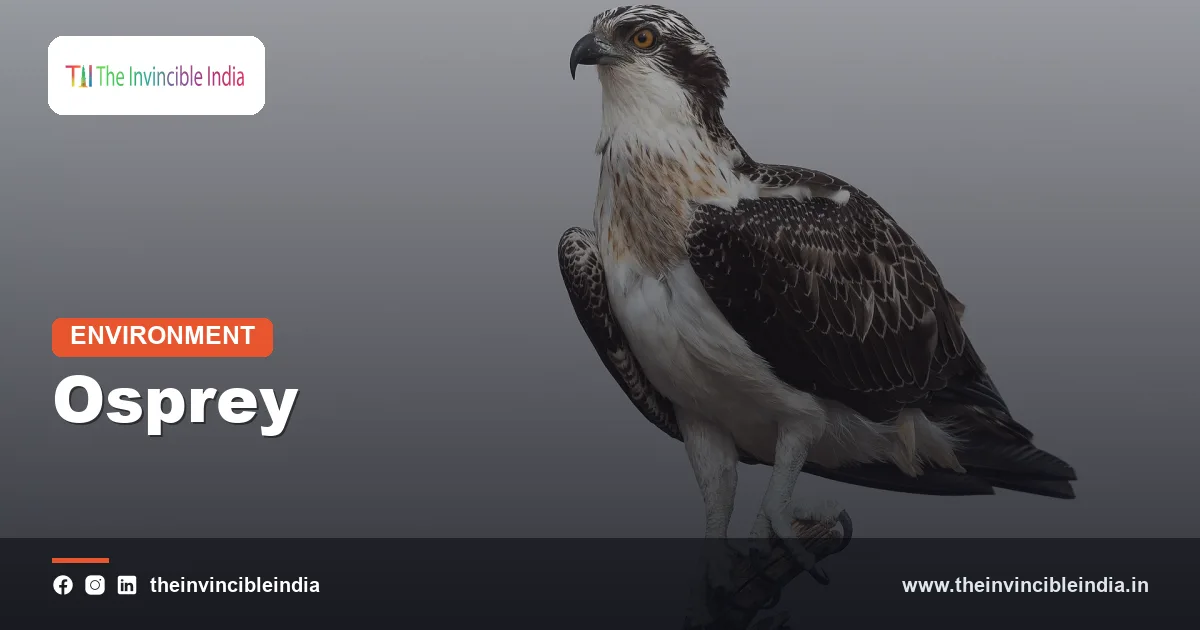
The osprey (Pandion haliaetus) is a large fish-eating bird of prey, also known as the fish hawk, that hunts by plunging feet-first into water to seize live fish, and it is a regular winter visitor to the rivers, lakes, reservoirs and coasts of India. It is the only living member of its own family, the Pandionidae, and is found on every continent except Antarctica.
The osprey is easily recognised by its white underparts, dark brown back and a dark stripe running through the eye. Its body is specially adapted for fishing, from the reversible outer toe to the spiny soles of its feet. This article explains how the osprey looks and hunts, why it is unique among raptors, where it can be seen in India and how its long migrations work.
| Quick Facts: Osprey | |
|---|---|
| Common name | Osprey (also called fish hawk or sea hawk) |
| Scientific name | Pandion haliaetus |
| Family | Pandionidae (the only living species in the family) |
| Size | About 54 to 58 cm in length, with a wingspan of roughly 150 to 180 cm |
| Range and habitat in India | Coasts, estuaries, large rivers, lakes and reservoirs across the country, mainly as a winter visitor |
| Diet | Almost entirely live fish |
| Breeding and movement | Breeds mainly in the temperate north; bulky stick nests on trees, cliffs or platforms; migratory birds reach India from about autumn to spring |
| Conservation status | Least Concern on the IUCN Red List; protected under the Wildlife (Protection) Act, 1972 |
Key Takeaways
- The osprey is a fish-eating raptor of the family Pandionidae and is seen across India near rivers, lakes, reservoirs and coasts, mainly in the cooler months.
- An osprey hunts by hovering and then diving feet-first into the water, often submerging almost completely before rising with a fish in its talons.
- The osprey has a reversible outer toe and spiny pads on its feet, features that help it grip slippery fish firmly.
- The osprey is the only living species in the family Pandionidae and is found on every continent except Antarctica.
- Most ospreys seen in India are non-breeding winter visitors that have migrated from northern Asia and Europe, travelling thousands of kilometres.
- The osprey is classed as Least Concern globally, having recovered in many regions after pesticide damage in the twentieth century, but it still depends on clean water and healthy fish stocks.
What is the osprey?
The osprey is a large raptor that feeds almost entirely on live fish, and it is placed in its own family, Pandionidae, with a single living species. Although it looks like a hawk or an eagle, it is biologically distinct, and scientists treat it as a separate lineage of birds of prey.
The scientific name Pandion haliaetus combines Pandion, a king in Greek myth, with haliaetus, which means “sea eagle”. The bird is also known as the fish hawk or fish eagle in some places, although the term fish eagle is more commonly used for other species such as the grey-headed fish eagle. The osprey is a medium-large bird that weighs about 1 to 2 kg, and females are generally a little larger than males.
The species has an almost worldwide distribution. Different populations breed in North America, Europe, Asia and Australia, and the bird is seen wherever there is enough fish in clear, open water. This wide range is the result of its specialised diet, which makes it independent of any particular climate as long as water and fish are available.
How can you identify an osprey?
An osprey is identified by its dark brown upperparts, white underparts, white head with a broad dark eye-stripe and long, narrow wings that are bent at the wrist in flight. The combination of a white head and dark mask makes it look quite different from most other large Indian raptors.
On the ground and perch
A perched osprey shows a brown back, a white crown that is often streaked, a dark band through the eye and a hooked black bill. The eyes are yellow. The legs are pale and unfeathered, and the toes are strong and long.
In flight
The bird flies with its wings angled in a gentle “M” or crooked shape when seen from the front. From below, it looks mostly white, with a dark patch at the wrist and dark bars on the flight feathers. The tail is short to medium in length and shows narrow bars.
Males and females
The sexes look similar. Females often carry a darker, speckled band across the chest, a feature that is helpful but not always reliable. Young birds have pale-tipped feathers on the back, which gives them a scaly appearance.
How does the osprey catch fish?
The osprey catches fish by flying or hovering over water, spotting a fish close to the surface and diving feet-first to seize it with its talons. The bird often enters the water up to its body and head, then pushes up with strong wingbeats to take off.
Search and dive
The bird usually searches from a height of about 10 to 40 metres, circling or hovering briefly above promising water. When it has chosen a target, it folds its wings partly, tucks its head and then swings its feet forward just before impact. The dive is not a long stoop like that of a falcon but a fast, steep plunge.
Success rate
Studies in several parts of the world have found that ospreys succeed in a large proportion of their dives, and their success is high compared with many other fish-eating birds. Clear, shallow water makes fishing easier, which is why the bird does well at coasts, lagoons, lakes and reservoirs.
Carrying the fish
After a catch, the osprey shakes off water in mid-air, like a dog, and carries the fish with the head pointing forward to reduce drag. It usually takes the fish to a favourite perch, such as a dead tree, a pole or a rock, and eats it from the head end.
What makes the osprey different from other raptors?
The osprey differs from other raptors in having a reversible outer toe, spiny scales on the soles of its feet, nostrils that can close and dense, oily plumage, all of which help it to catch and hold fish. These are some of the clearest examples of body structure matching a particular way of life among Indian birds of prey.
| Adaptation | What it does |
|---|---|
| Reversible outer toe | Lets the bird grip with two toes forward and two backward, giving a firm hold on a wriggling fish |
| Spicules on the toe pads | Small spiny scales act like grip tape on slippery skin |
| Long, curved talons | Pierce and hold the fish securely |
| Closable nostrils | Help keep water out when the bird plunges |
| Oily, dense plumage | Sheds water quickly and reduces the weight of the wet bird |
| Long, narrow wings | Allow hovering, gliding and a strong take-off from water |
Most other raptors have a fixed arrangement of three toes in front and one behind. The osprey’s flexible foot is a rare exception and one of the traits that justify its own family.
Where can you see the osprey in India?
The osprey can be seen in India along the coasts, estuaries, backwaters, large rivers, lakes and reservoirs, most often between autumn and spring. Typical places include coastal lagoons, tidal creeks, reservoirs, fish ponds and wide stretches of rivers.
The bird is recorded across much of the country, from the Himalayan foothills and the Gangetic plains to the peninsula and the island groups. Wetlands and protected waters, such as national parks and bird sanctuaries with large lakes, are especially good places to look. Coastal states and islands also attract ospreys, since the sea and estuaries provide a reliable supply of fish.
A few points help in finding the bird:
- Scan exposed perches such as dead trees, poles and rocks near open water
- Look for a large white-and-brown bird hovering over the surface
- Visit in the cooler months, when migrants have arrived
- Check early morning, when fish are active near the surface
Does the osprey breed in India, and where does it migrate from?
The osprey is mainly a non-breeding visitor to India, because most ospreys that reach the country breed in the cooler north of Asia and Europe and spend the winter in warmer regions. Breeding in India itself is rare, and the large majority of birds seen here are migrants or wandering individuals.
Ospreys that breed in temperate regions head south each autumn. Satellite-tracking studies of ospreys elsewhere have shown that individual birds travel thousands of kilometres, flying mostly by day and using thermals and coastlines where possible. Some individuals return to the same winter site year after year. Birds that reach India usually arrive in autumn and leave by spring, although a few non-breeding birds may stay through the summer.
The osprey’s migration is a valuable reminder that Indian wetlands are part of a global network. A reservoir in India can be an essential winter stop for a bird that nests in a faraway forest.
How does the osprey nest and raise its young?
The osprey nests by building a very large, bulky platform of sticks on a tree, rock, pole or artificial platform near water, and it usually lays two to three eggs. Pairs often reuse and enlarge the same nest in successive years, so nests may become huge over time.
The female does most of the incubation, which lasts about five weeks, while the male brings fish. After hatching, the chicks are fed fish torn into small pieces. They fledge at about seven to eight weeks and continue to depend on their parents for some time. Young ospreys then make their first long migration without parental guidance, and many do not survive their first year.
Although most of the species’ breeding takes place outside India, the nesting behaviour is useful to understand because it shows why artificial nest platforms and protected waterside trees have helped the species in other countries.
What does the osprey eat besides fish?
The osprey eats almost nothing besides live fish, and other prey, such as small birds, reptiles or crustaceans, forms a tiny fraction of its diet. This extreme specialisation sets the bird apart from many other raptors that take a variety of prey.
Fish of moderate size are preferred, typically up to a few hundred grams and sometimes heavier. The exact species depends on what is available: coastal birds take mullet and other marine fish, while birds at reservoirs and rivers take carp-type fish, catfish and tilapia. Ospreys rarely take dead fish. They need fish that swim near the surface, so murky, deep or heavily vegetated water is poor hunting ground.
Fish farmers in some regions complain about ospreys taking fish from stocked ponds. Simple measures such as netting over ponds can reduce such conflict without harming the bird.
Is the osprey threatened?
The osprey is not threatened globally and is classed as Least Concern by the IUCN, and it is protected in India under the Wildlife (Protection) Act, 1972. Its populations suffered in the mid-twentieth century because of the pesticide DDT, which thinned eggshells, but numbers recovered in many regions after the chemical was restricted.
Present-day concerns for the osprey in India and elsewhere include:
- Water pollution and the decline of fish stocks
- Loss and disturbance of coastal and wetland habitats
- Entanglement in fishing nets and lines
- Collision and electrocution on power lines
- Persecution in places where fish farming is intensive
Protecting wetlands, keeping water clean and avoiding harmful chemicals benefit ospreys and many other species. The bird is also considered a useful indicator of the health of aquatic ecosystems because it sits near the top of the food chain.
Bottom Line
The osprey is a specialised fish-hunting raptor with a reversible toe, spiny foot pads and a spectacular feet-first dive. In India it is mainly a winter visitor to rivers, lakes, reservoirs and coasts. Its recovery from pesticide-era declines shows how clean water and sensible regulation can help wildlife return.
Frequently Asked Questions
What is an osprey?
An osprey is a large fish-eating bird of prey with the scientific name Pandion haliaetus. It is the only living member of the family Pandionidae. The bird is found on almost every continent and is often called the fish hawk.
How does an osprey catch fish?
An osprey catches fish by hovering over water and diving feet-first to grab a fish with its talons. Its reversible outer toe and spiny foot pads help it hold the fish. After the catch, it carries the fish head-first through the air to a perch.
Is the osprey found in India?
Yes, the osprey is found in India, mostly as a winter visitor from northern Asia and Europe. It can be seen along coasts, estuaries, rivers, lakes and reservoirs from about autumn to spring. Breeding in India is rare.
How can I tell an osprey from an eagle?
You can tell an osprey from an eagle by its white underparts, white head with a dark eye-stripe and crooked wings. It is also usually seen close to water and often hovers before diving. Most eagles have darker underparts and do not plunge feet-first into water.
What does an osprey eat?
An osprey eats almost entirely live fish, caught near the water surface. Mullet, carp, catfish and similar fish are common prey, depending on the habitat. Other animals form only a very small part of its diet.
Is the osprey protected in India?
Yes, the osprey is protected in India under the Wildlife (Protection) Act, 1972, and it is classed as Least Concern globally by the IUCN. Hunting and capture are illegal. Clean water and healthy fish populations are important for its continued presence.
{“@context”:”https://schema.org”,”@graph”:[{“@type”:”FAQPage”,”mainEntity”:[{“@type”:”Question”,”name”:”What is an osprey?”,”acceptedAnswer”:{“@type”:”Answer”,”text”:”An osprey is a large fish-eating bird of prey with the scientific name Pandion haliaetus. It is the only living member of the family Pandionidae. The bird is found on almost every continent and is often called the fish hawk.”}},{“@type”:”Question”,”name”:”How does an osprey catch fish?”,”acceptedAnswer”:{“@type”:”Answer”,”text”:”An osprey catches fish by hovering over water and diving feet-first to grab a fish with its talons. Its reversible outer toe and spiny foot pads help it hold the fish. After the catch, it carries the fish head-first through the air to a perch.”}},{“@type”:”Question”,”name”:”Is the osprey found in India?”,”acceptedAnswer”:{“@type”:”Answer”,”text”:”Yes, the osprey is found in India, mostly as a winter visitor from northern Asia and Europe. It can be seen along coasts, estuaries, rivers, lakes and reservoirs from about autumn to spring. Breeding in India is rare.”}},{“@type”:”Question”,”name”:”How can I tell an osprey from an eagle?”,”acceptedAnswer”:{“@type”:”Answer”,”text”:”You can tell an osprey from an eagle by its white underparts, white head with a dark eye-stripe and crooked wings. It is also usually seen close to water and often hovers before diving. Most eagles have darker underparts and do not plunge feet-first into water.”}},{“@type”:”Question”,”name”:”What does an osprey eat?”,”acceptedAnswer”:{“@type”:”Answer”,”text”:”An osprey eats almost entirely live fish, caught near the water surface. Mullet, carp, catfish and similar fish are common prey, depending on the habitat. Other animals form only a very small part of its diet.”}},{“@type”:”Question”,”name”:”Is the osprey protected in India?”,”acceptedAnswer”:{“@type”:”Answer”,”text”:”Yes, the osprey is protected in India under the Wildlife (Protection) Act, 1972, and it is classed as Least Concern globally by the IUCN. Hunting and capture are illegal. Clean water and healthy fish populations are important for its continued presence.”}}]}]}


