

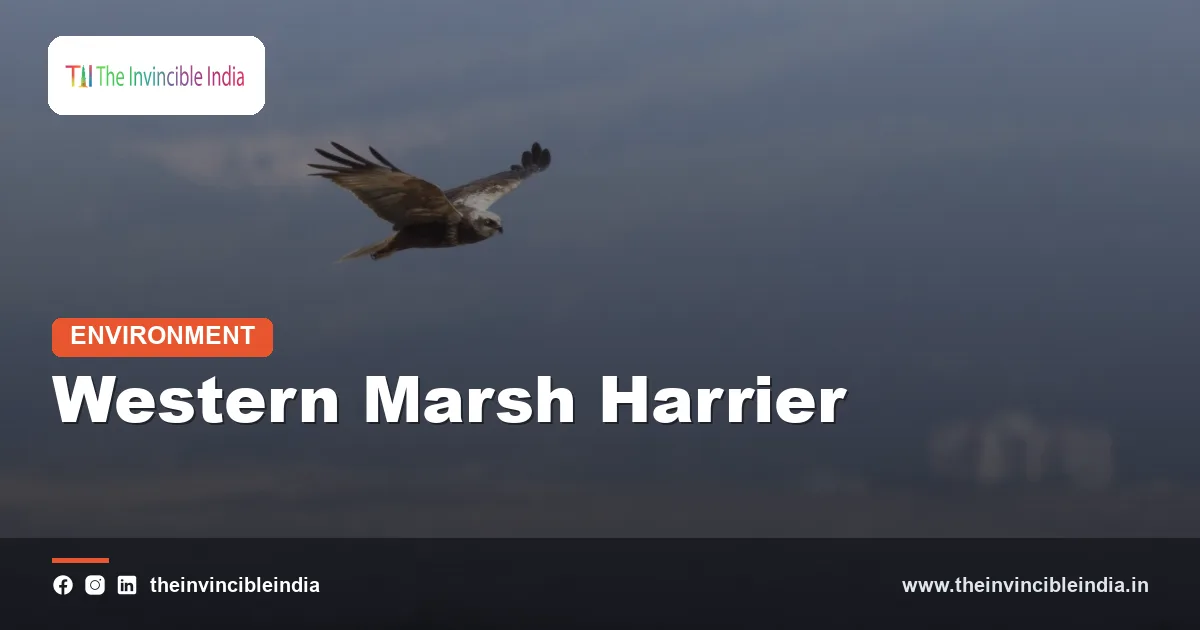
The western marsh harrier (Circus aeruginosus) is a medium-large bird of prey of the hawk family that glides low over reed-beds, marshes and wet fields and, in India, is mainly a winter visitor from Europe and Central Asia. Easily recognised by its long wings held in a shallow V and its slow, tilting, quartering flight, the western marsh harrier is among the most familiar raptors of Indian wetlands between autumn and early spring.
This explainer covers how to identify the western marsh harrier, where it winters in India, how it hunts, what it eats, why it does not normally breed in the country, and how it differs from its harrier relatives. It also looks at why wetlands matter to this bird and where birdwatchers can see it.
Quick Facts
| Common name | Western marsh harrier |
|---|---|
| Scientific name | Circus aeruginosus |
| Family | Accipitridae (hawks, eagles, kites and harriers) |
| Size | About 43 to 54 cm long, with a wingspan of roughly 115 to 140 cm; females are larger than males |
| India range and habitat | Winter visitor across much of the country; reed-beds, lakes, marshes, paddy fields and other open wetlands |
| Diet | Small mammals, birds and their chicks and eggs, frogs, reptiles, large insects and occasional carrion |
| Breeding | Breeds on the ground or in dense reeds in Europe and temperate Asia, not normally in India; usually 3 to 6 eggs |
| Conservation status | Least Concern on the IUCN Red List; protected under the Wildlife (Protection) Act, 1972 in India |
Key Takeaways
- The western marsh harrier is a raptor in the family Accipitridae whose scientific name is Circus aeruginosus.
- In India, the western marsh harrier is a winter visitor that arrives from its breeding grounds in Europe and temperate Asia, usually from about September or October and leaving by March or April.
- A western marsh harrier flies low over reeds and wet fields with its wings raised in a shallow V, a posture that separates it from most other large raptors.
- The western marsh harrier is sexually dimorphic: the adult male shows grey on the wings and tail, while the larger female is mostly chocolate brown with a pale cap and throat.
- The western marsh harrier feeds mainly on small birds, rodents, frogs and the young of waterbirds, which it surprises from low altitude.
- Globally the western marsh harrier is listed as Least Concern, but its Indian wintering success depends on the survival of reed-beds, lakes and marshes.
What is the western marsh harrier?
The western marsh harrier is a wetland-dependent bird of prey belonging to the genus Circus, a group of long-winged, long-tailed hawks collectively called harriers. The word “harrier” comes from the habit of these birds of harrying, or repeatedly harassing, their quarry as they sweep low over open ground.
The species has a very wide distribution. It breeds across much of Europe and across temperate Asia and also holds populations in parts of North Africa. Birds from the northern and eastern parts of this range are migratory and move south in autumn. Some travel to the Mediterranean basin and Africa, while others, particularly birds from Central Asia and western Siberia, travel to the Indian subcontinent.
Within the family Accipitridae, which also includes eagles, kites, buzzards and vultures, harriers are distinctive for having a slim build, relatively long legs and an owl-like facial disc. The disc is a ruff of stiff feathers around the face that helps channel sound toward the ears, and it allows harriers to locate prey in dense vegetation partly by hearing as well as by sight.
Taxonomists have sometimes treated the eastern populations, which show more pied plumage in adult males, as a separate species, the eastern marsh harrier. Both forms occur in India in winter, and birdwatchers often see a range of intermediate-looking birds. For everyday field purposes, the western marsh harrier is the standard marsh harrier of the Indian plains.
How can you identify a western marsh harrier?
A western marsh harrier is identified by its long, narrow wings held in a shallow V, its long tail, its slow low flight over reeds, and its strongly different male and female plumage. The sexes look different enough that beginners sometimes mistake them for two species.
The adult male
The adult male has a brown body streaked with paler tones, silvery-grey secondary feathers and tail, and black wingtips. In flight, the contrast between the brown forewing, grey mid-wing and black tips gives a tri-coloured pattern that is easy to learn. The head and breast are often paler and streaked.
The adult female
The adult female is larger and darker. Her body is mostly rich chocolate brown, and she usually has a creamy-yellow crown and throat and a pale patch on the leading edge of each wing. The tail and flight feathers are brown rather than grey, so the whole bird looks dark from a distance except for the pale head.
Juveniles
Young birds resemble the female but are often even darker, with a chocolate-brown body and a golden or cream crown that can look conspicuous. Some juveniles lack the pale shoulder patches altogether and appear almost uniformly dark, which can make them harder to identify at long range.
Flight and shape
In all plumages, the western marsh harrier flies with raised wings, called a dihedral, and rocks gently from side to side. The tail is long and the flight is light, with a few shallow wing beats followed by a glide. When the bird perches, it often sits low on a mound, a post or the ground rather than on a high branch.
Where does the western marsh harrier live in India?
In India, the western marsh harrier lives in open wetlands, including reed-beds, lake margins, marshes, flooded paddy fields and the edges of rivers and estuaries. It prefers places with tall emergent vegetation such as reeds, cattails and tall grass, because these give both hunting grounds and safe night roosts.
The bird is recorded in winter across much of the country. It is regularly seen in the northern plains, Gujarat and Rajasthan, the Gangetic basin, central India, the peninsular lakes and the east coast lagoons. Coastal wetlands attract many harriers because they combine open water, reeds and plenty of small prey.
Altitude is not a strong barrier, but the species mostly keeps to lowland and foothill wetlands rather than the high mountains. Large tank systems and reservoirs are also useful, as long as their margins have reeds or tall grass.
| Habitat type | Why the western marsh harrier uses it |
|---|---|
| Reed-beds and marsh edges | Dense cover for roosting and abundant frogs, rodents and nestlings to hunt |
| Freshwater lakes and jheels | Open water with waterbirds, and reeds along the shore |
| Paddy fields and wet agricultural land | Rodents and frogs in flooded or harvested fields |
| Coastal lagoons and estuaries | Shorebirds, crabs and small fish stranded in shallow water |
| Grassland near water | Open flight space for quartering, with small mammals in the grass |
When does the western marsh harrier visit India?
The western marsh harrier visits India in the winter half of the year, with the first birds usually appearing around September or October and most departing by March or April. The timing varies slightly from year to year and from one region to another.
Autumn migration is triggered by shortening days and falling food supply on the northern breeding grounds. Many harriers migrate on a broad front rather than along narrow routes, and they rely partly on flapping flight rather than on tall rising thermals, which lets them cross lowland country and some water bodies. Birds reaching India come from the great breeding belt that runs across Central Asia and into Siberia.
Once in India, the western marsh harrier tends to settle into a regular winter territory or a favoured group of wetlands. Many individuals return to the same area in successive winters. Adults and juveniles often share the same wetlands, and in some areas birds from a large surrounding region gather at one reed-bed roost at dusk.
How does the western marsh harrier hunt?
The western marsh harrier hunts by flying slowly and low over reeds, grass or open water, scanning and listening for movement, and then dropping suddenly onto prey. This method is called quartering, because the bird sweeps back and forth across an area in a systematic pattern.
The bird usually flies only a few metres above the vegetation, sometimes with its legs slightly dangling. The raised wings help it stay stable at slow speed, and the owl-like facial disc helps it detect rustling sounds. When it detects prey, it may hover briefly, then twist and pounce with its long toes. Because it often flies below the horizon line, many prey animals cannot see it until it is very close.
Harriers also use surprise. Birds hunting waterbirds may cruise along reed edges and flush ducks or coots, then snatch a young or weak bird. They sometimes harass larger birds to make them drop food, a behaviour known as kleptoparasitism. In winter, hunting is usually done individually, though several harriers may hunt in the same wetland at once.
The bird is not a fast chaser. Its method depends on stealth, patience and a good search pattern, which is why it is common over wetlands where small animals are numerous and cover is thin enough to allow a clean strike.
What does the western marsh harrier eat?
The western marsh harrier eats mainly small vertebrates, including rodents, small and young waterbirds, frogs, lizards and occasionally fish, along with large insects and some carrion. It is an opportunistic hunter, so the exact mix depends on what the local wetland offers.
- Small mammals: field mice, voles, young rats and similar rodents from reed margins and farmland.
- Birds: coots, moorhens, ducks and rails, especially young, sick or injured individuals, along with eggs when breeding.
- Amphibians and reptiles: frogs and small snakes or lizards from shallow water and grass.
- Insects and other invertebrates: large beetles, dragonflies and similar prey, particularly when other food is scarce.
- Carrion: dead fish or other remains, taken occasionally.
By taking rodents, the western marsh harrier helps hold down crop pests in farmland near wetlands, although its role in pest control is modest compared with that of owls and some other raptors. By taking weak and sick waterbirds, it also acts as a natural filter that tends to remove the least fit individuals from prey populations.
Does the western marsh harrier breed in India?
The western marsh harrier does not normally breed in India; it nests in Europe, North Africa and temperate Asia, and reaches India only as a non-breeding winter visitor. Indian records are therefore of wintering birds, not of nests and chicks.
On its breeding grounds, the bird builds a bulky nest of reeds and sticks, usually on the ground in dense reed-beds or on a platform of flattened stems above shallow water. The female lays about three to six eggs and does most of the incubation, which takes roughly five weeks. The male brings food, and he often passes it to the female in mid-air in an acrobatic food pass, with the female turning over to catch the prey.
The chicks fledge after about five to six weeks. Breeding success depends on reed-bed quality, water levels and food supply. After breeding, the birds begin to move south, which brings the Asian populations toward India.
How does the western marsh harrier differ from other harriers in India?
The western marsh harrier differs from other Indian harriers mainly in its larger size, broader wings, darker brown plumage and strong attachment to wetlands, while the other harriers are slimmer, paler and more often seen over dry grassland. Several harrier species winter in India, and separating them is a classic birdwatching skill.
| Species | Typical look | Usual habitat in India |
|---|---|---|
| Western marsh harrier | Large and broad-winged; male brown with grey wings and tail, female dark brown with pale crown | Reed-beds, lakes and wet fields |
| Eastern marsh harrier | Similar build; male more pied, with strong black, white and grey contrast | Wetlands, mainly in the east |
| Hen harrier | Medium size; male pale grey, female brown with a white rump | Open grassland and fields |
| Pallid harrier | Slim and pale; male very pale grey with a black wedge on the wingtip | Dry grassland and cropland |
| Montagu’s harrier | Slender; male grey with black bars on the wing, female brown | Open fields and scrub |
| Pied harrier | Male striking black and white, female brown | Grassland and wetland edges |
The simplest rule for a beginner is to look at size and habitat first. A heavy, dark harrier floating over reeds is usually a western marsh harrier, while a slim, pale harrier over dry stubble is more likely a pallid, Montagu’s or hen harrier.
Why do wetlands matter for the western marsh harrier?
Wetlands matter for the western marsh harrier because they provide its food, its hunting cover and the dense reed roosts where it spends the night. Without healthy marshes and lakes, the winter population in any region would quickly shrink.
Globally, the western marsh harrier is not at immediate risk and is listed as Least Concern. European populations declined sharply in the mid-twentieth century because of pesticide contamination and persecution, and they recovered after the worst pesticides were restricted and legal protection improved. This history shows how sensitive raptors at the top of wetland food chains are to chemical pollution.
In India, the main pressures on wetland raptors are habitat loss and degradation. These include draining or filling marshes for construction and farming, reed-bed burning, conversion of shallow lakes, siltation, pollution and disturbance. Pesticide residues and poisoned bait can also harm harriers that eat contaminated prey.
- Wetland drainage and encroachment reduce hunting areas and roosts.
- Unregulated burning or harvesting of reeds can remove cover during winter.
- Agricultural chemicals and industrial pollutants can build up in food chains.
- Illegal hunting and disturbance still occur in some places, although all raptors are legally protected.
Protecting wetlands therefore helps not only the western marsh harrier but also herons, ducks, waders and many other species that share the same habitat.
Where can you watch western marsh harriers in India?
The best places to watch western marsh harriers in India are large wetland reserves and bird sanctuaries where reed-beds and shallow water remain intact, especially between November and February. Good viewing needs early mornings or late afternoons, when harriers hunt actively and gather at roosts.
Well-known wetland sites such as Keoladeo National Park in Rajasthan, Chilika Lake in Odisha, Nal Sarovar in Gujarat, the Sultanpur wetland near Delhi, Harike in Punjab and the Great Rann and Kutch wetlands attract wintering raptors. Many smaller village tanks and reservoirs can be just as good if they hold reeds and prey.
For a good sighting, birdwatchers can follow a few simple practices:
- Watch the horizon over reed edges at first light and last light for a low, tilting silhouette.
- Stay on paths or embankments and avoid walking into reed-beds, which disturbs roosts.
- Use binoculars to check the wing pattern and the pale head or shoulder patch of females.
- Keep distance from any bird that is feeding or roosting, and avoid flushing it repeatedly.
Bottom Line
The western marsh harrier is a graceful winter raptor that links the wetlands of Europe and Central Asia with those of India. Its survival in Indian skies depends less on the bird itself than on whether reed-beds, lakes and marshes are kept healthy.
Frequently Asked Questions
What is a western marsh harrier?
A western marsh harrier is a medium-large bird of prey in the hawk family, with the scientific name Circus aeruginosus. It hunts low over reed-beds, marshes and wet fields, and in India it is mainly a winter visitor from Europe and Central Asia.
Is the western marsh harrier found in India?
Yes, the western marsh harrier is found across much of India, but only as a winter visitor. It typically arrives around September or October and leaves by March or April, and it is most often seen over lakes, marshes and paddy fields.
What does a western marsh harrier eat?
A western marsh harrier eats mainly small mammals, small and young waterbirds, frogs, lizards and large insects, with occasional carrion. It is an opportunistic hunter and takes whatever small prey is easiest to catch in its local wetland.
How can you tell a male western marsh harrier from a female?
The male western marsh harrier shows grey on the wings and tail and black wingtips, while the larger female is mostly chocolate brown with a creamy crown and throat. This difference is so clear that the two sexes are often mistaken for different species.
Does the western marsh harrier breed in India?
No, the western marsh harrier does not normally breed in India. It nests in reed-beds in Europe, North Africa and temperate Asia and comes to India only for the winter.
Is the western marsh harrier endangered?
No, the western marsh harrier is listed as Least Concern on the IUCN Red List. However, it depends on healthy wetlands, so the loss of marshes and reed-beds is a long-term concern in India and elsewhere.
{“@context”:”https://schema.org”,”@graph”:[{“@type”:”FAQPage”,”mainEntity”:[{“@type”:”Question”,”name”:”What is a western marsh harrier?”,”acceptedAnswer”:{“@type”:”Answer”,”text”:”A western marsh harrier is a medium-large bird of prey in the hawk family, with the scientific name Circus aeruginosus. It hunts low over reed-beds, marshes and wet fields, and in India it is mainly a winter visitor from Europe and Central Asia.”}},{“@type”:”Question”,”name”:”Is the western marsh harrier found in India?”,”acceptedAnswer”:{“@type”:”Answer”,”text”:”Yes, the western marsh harrier is found across much of India, but only as a winter visitor. It typically arrives around September or October and leaves by March or April, and it is most often seen over lakes, marshes and paddy fields.”}},{“@type”:”Question”,”name”:”What does a western marsh harrier eat?”,”acceptedAnswer”:{“@type”:”Answer”,”text”:”A western marsh harrier eats mainly small mammals, small and young waterbirds, frogs, lizards and large insects, with occasional carrion. It is an opportunistic hunter and takes whatever small prey is easiest to catch in its local wetland.”}},{“@type”:”Question”,”name”:”How can you tell a male western marsh harrier from a female?”,”acceptedAnswer”:{“@type”:”Answer”,”text”:”The male western marsh harrier shows grey on the wings and tail and black wingtips, while the larger female is mostly chocolate brown with a creamy crown and throat. This difference is so clear that the two sexes are often mistaken for different species.”}},{“@type”:”Question”,”name”:”Does the western marsh harrier breed in India?”,”acceptedAnswer”:{“@type”:”Answer”,”text”:”No, the western marsh harrier does not normally breed in India. It nests in reed-beds in Europe, North Africa and temperate Asia and comes to India only for the winter.”}},{“@type”:”Question”,”name”:”Is the western marsh harrier endangered?”,”acceptedAnswer”:{“@type”:”Answer”,”text”:”No, the western marsh harrier is listed as Least Concern on the IUCN Red List. However, it depends on healthy wetlands, so the loss of marshes and reed-beds is a long-term concern in India and elsewhere.”}}]}]}


