

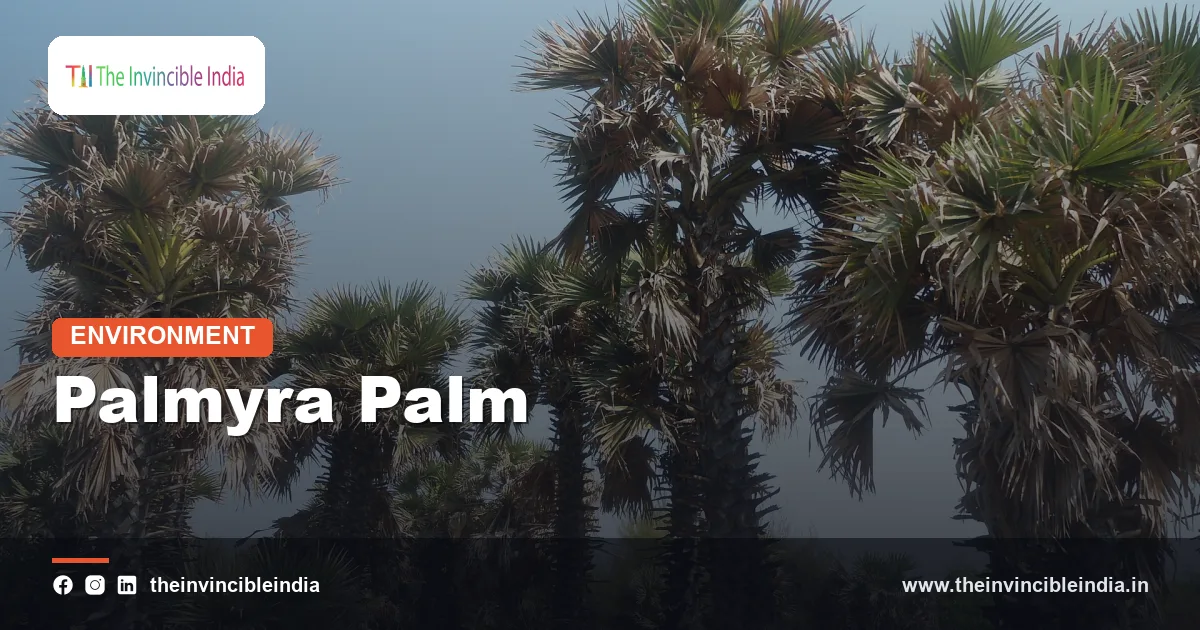
The palmyra palm (Borassus flabellifer) is a tall, fan-leaved palm of the dry plains of southern and eastern India, known as the “tree of life” because its sap, fruit, leaves, trunk and roots all have uses, from neera and palm jaggery to ice apple and palm-leaf manuscripts. It is the state tree of Tamil Nadu and a familiar silhouette across the dry coastal and inland landscapes of the south and east.
Few trees in India are as closely tied to rural livelihoods, literature and food. This explainer covers what the palmyra palm is, where it grows, how its sap and fruit are harvested, the traditions built around it, and the pressures that have thinned its stands.
Quick Facts
| Attribute | Detail |
|---|---|
| Scientific name | Borassus flabellifer |
| Family | Arecaceae (palm family) |
| Common names | Palmyra palm, toddy palm, sugar palm; tal or taad (Hindi, Bengali, Marathi), panai (Tamil), thati (Telugu), karimpana (Malayalam), tala (Odia) |
| Native range | Tropical South and Southeast Asia |
| Key Indian regions | Tamil Nadu, Andhra Pradesh, Odisha, West Bengal, Karnataka, Kerala, Maharashtra coast |
| Typical height | About 15 to 30 metres, with a dark, rough trunk |
| Sexes | Dioecious: male and female flowers grow on separate trees |
| Official status | State tree of Tamil Nadu |
| Famous products | Neera, toddy, palm jaggery (karuppatti), palm candy, ice apple (nungu), leaf manuscripts |
Key Takeaways
- The palmyra palm (Borassus flabellifer) is the state tree of Tamil Nadu and is called the “tree of life” because nearly every part of it is used.
- The palmyra palm is dioecious, meaning separate male and female trees bear different flowers, and both sexes are tapped for sap.
- Fresh palmyra sap is called neera or padaneer, and it ferments into toddy within hours unless it is collected in lime-coated pots or kept cold.
- Ice apple, known as nungu in Tamil, is the translucent, jelly-like young seed kernel of the palmyra fruit and is a popular summer food.
- Palm leaves of the palmyra were the writing material for centuries of South Indian and Odisha manuscripts, inscribed with an iron stylus.
- A palmyra palm may take around 15 years or more to flower and can live for many decades, so each felled tree takes a very long time to replace.
What is the palmyra palm?
The palmyra palm is a tall, slow-growing fan palm, Borassus flabellifer, with a straight trunk and a rounded crown of stiff, fan-shaped leaves. It belongs to the family Arecaceae and is native to tropical South and Southeast Asia, where it has been used for sugar, building material and writing for thousands of years.
The English name “palmyra” comes from the Portuguese word for palm, palmeira, and has no connection with the ancient Syrian city of Palmyra, although the two are often confused. In many Indian languages the tree is named after its use as a sugar or toddy source, such as “tal” in Hindi and Bengali and “panai” in Tamil.
The palm thrives in dry, hot, sandy and sometimes saline conditions, which is why it is such a prominent sight in the dry plains of Tamil Nadu, coastal Andhra Pradesh, Odisha and Bengal.
Where does the palmyra palm grow in India?
The palmyra palm grows mainly in the dry and semi-arid plains and coastal belts of southern and eastern India, with the densest and most culturally important stands in Tamil Nadu. It is also common in coastal Andhra Pradesh, Odisha, West Bengal, northern Karnataka, parts of Kerala and the coastal stretches of Maharashtra and Gujarat.
Within Tamil Nadu, the southern districts around Thoothukudi, Tirunelveli, Ramanathapuram and Kanniyakumari are especially associated with palmyra tapping and with the jaggery and candy industries built on it. Large numbers of palmyra palms line bunds, village boundaries, temple tanks and fields in these districts, and the total in the state is often estimated to be in the tens of millions.
Why does the palmyra palm suit dry regions?
The palmyra palm suits dry regions because it has a deep taproot-like root system that reaches water far below the surface, tolerates long dry spells, heat and poor sandy soils, and needs little care once established. These traits make it a useful tree for soil binding, windbreaks and shelterbelts along coasts and dunes, and for farmland boundaries where few other tall trees survive.
How does the palmyra palm grow and reproduce?
The palmyra palm grows slowly from seed and reproduces through separate male and female trees, with female trees producing the fruit. Seedlings put out a long underground shoot before the stem emerges, so the palm spends its first years building roots, and a trunk becomes visible only after several years.
- Time to flowering: usually in the range of 12 to 20 years, so the tree is a very long-term investment.
- Male trees: bear long, finger-like catkins of small flowers that release pollen and are tapped for sap.
- Female trees: bear shorter, thicker flower clusters that develop into heavy bunches of fruit and can also be tapped, though tapping reduces fruiting.
- Fruit: a large, rounded, dark purple-brown fruit about the size of a small coconut, usually containing three seeds.
- Lifespan: commonly many decades, with old trees reported to live a century or more.
Because the palm is dioecious and slow to flower, farmers cannot easily tell the sex of a young palm. Only when flowering begins do they know whether a tree will give fruit, sap or both.
What is neera and how is palmyra sap tapped?
Neera, also called padaneer in Tamil, is the fresh, sweet, unfermented sap collected from the cut flower stalk of the palmyra palm. Skilled climbers tap the sap by cutting the tip of the young flower stalk, bruising it gently, and tying a clay pot or container beneath it to collect the sap that oozes out through the day and night.
How does neera turn into toddy?
Neera turns into toddy because wild yeasts in the air and on the container start fermenting the natural sugar within hours of collection, especially in the heat. Toddy is mildly alcoholic and is regulated by state excise laws. To keep the sap sweet and non-alcoholic, collectors coat the inside of the pot with slaked lime or keep the sap cool, and neera is often consumed fresh in the early morning.
What is palm jaggery and palm candy?
Palm jaggery, known as karuppatti in Tamil Nadu and panai vellam, is a dark, unrefined sugar made by boiling palmyra neera until it thickens and sets, while palm candy (panang kalkandu) is a crystallised form that is whiter and used in sweets and traditional remedies. Both are widely used in South Indian kitchens, especially in sweets, in sweetening coffee and in rituals.
The tapping season is generally in the hotter, drier months of the year, roughly from about February until the rains. Tappers climb tall trunks many times a day, which is physically demanding and risky work, and the number of experienced climbers has declined in recent decades.
What is ice apple (nungu) and how is it eaten?
Ice apple, called nungu in Tamil, is the translucent, jelly-like soft kernel found inside young palmyra fruits, eaten fresh as a cooling summer treat. Vendors cut open the green-to-purple fruit with a sickle, scoop out the soft, slightly sweet, water-filled kernels, and sell them in small portions from roadside stalls in summer.
The kernels are mostly water and contain small amounts of sugars and minerals, which is why they are popular as a hot-weather refreshment. Ice apple is known by other names across the country, including taal shansh in Bengali, thati munjalu in Telugu and tadgola in Marathi. As the fruit ripens, the pulp turns orange-yellow and fibrous. In Bengal, the ripe pulp is mixed with flour and jaggery and fried to make taler bora, a sweet fritter associated with festival days such as Janmashtami.
Claims that ice apple or neera cure specific diseases are not backed by strong evidence. They are best viewed as traditional foods, not as medicines.
What are the traditional uses of the palmyra palm?
The traditional uses of the palmyra palm include food, drink, sugar, building timber, thatching, writing material, fibre and fuel, and this breadth of use is why it is called the “tree of life”. Every part of the tree has been used by rural communities, as the table below summarises.
| Part of the palm | Traditional use |
|---|---|
| Flower-stalk sap | Neera, toddy, palm jaggery, palm candy and vinegar |
| Young fruit kernel | Ice apple (nungu), eaten fresh in summer |
| Ripe fruit pulp | Cooked into sweets such as taler bora; pulp also used as a food flavouring |
| Germinated seedling tubers | Boiled or roasted as a starchy food (known in Tamil as panangkizhangu) |
| Leaves | Thatching, mats, baskets, fans, hats and palm-leaf manuscripts |
| Leaf stalk and fibre | Fencing, brushes, cordage and fuel |
| Trunk | Hard, dense timber for rafters, beams, posts and water channels |
The palm also supported entire craft traditions. Weaving of baskets, mats and boxes from palm leaf is a household craft in southern Tamil Nadu, and leaf-based products are now being marketed to a wider urban audience as eco-friendly alternatives.
Why are palmyra leaves important in Indian manuscript tradition?
Palmyra leaves are important in Indian manuscript tradition because they served as the principal writing material of South India and Odisha for many centuries, carrying texts on religion, literature, medicine and astronomy. Scribes cut the leaves into long narrow strips, boiled and dried them, wrote or incised letters with an iron stylus, and then rubbed lamp-black or ink into the scratches so the letters stood out.
Collections of palm-leaf manuscripts are held in libraries and archives such as the Saraswati Mahal Library in Thanjavur and the Government Oriental Manuscripts Library in Chennai, and in Odisha the tradition continues in palm-leaf engraving and illustrated leaf art. The scholar U. V. Swaminatha Iyer is remembered for gathering and editing old Tamil literary texts from palm-leaf manuscripts in the late nineteenth century, helping to bring classical Tamil works back to print.
Palm-leaf manuscripts are fragile, and conservators treat them with natural oils to slow their ageing, a specialised preservation task that heritage institutions continue.
How does the palmyra palm appear in culture and literature?
The palmyra palm appears throughout South Asian culture as a symbol of endurance, generosity and livelihood. In classical Indian epics, the god Balarama, elder brother of Krishna, is described as Taladhwaja, “he whose banner is the palm tree”. In Tamil Sangam-era poetry, the palm appears in descriptions of the landscape, and the Chera rulers are associated with garlands of palm flowers.
In Tamil folk life, the palm is a source of proverbs and songs, and its tall silhouette marks villages in the dry south. Many families describe their ancestral livelihoods in terms of palm tapping and palm jaggery making. The Tamil Nadu government’s choice of the palmyra as the state tree reflects this deep cultural association.
What threatens the palmyra palm today?
The palmyra palm faces threats from felling, the decline of traditional tapping and changing land use, although it is not listed as globally endangered. Palm trunks were widely felled for use as timber and for fuel in brick kilns, and each tree takes more than a decade to flower and decades to mature, so losses are slow to recover.
- Felling for timber and fuel: a major cause of thinning stands in parts of Tamil Nadu.
- Shortage of tappers: climbing is hard and dangerous, and younger workers often prefer other occupations.
- Legal and market barriers: toddy is regulated, and neera and palm jaggery markets are small and uneven.
- Loss of agricultural land: expansion of towns, industry and irrigated farming removes palms from field boundaries.
Efforts to revive the palm include promotion of neera, palm jaggery and palm candy as healthy, local sugars, welfare schemes for palm workers in Tamil Nadu, and planting of palm seeds along tank bunds and coastlines. Palmyra jaggery is still sugar, so it should be consumed in moderation, even though it is less refined than white sugar.
Bottom Line
The palmyra palm is one of India’s most versatile trees, giving sap, sugar, fruit, fibre, timber and the leaves that carried much of South India’s written heritage. Protecting existing palms, supporting tappers and developing markets for neera and palm jaggery are the practical ways to keep this “tree of life” part of the landscape.
Frequently Asked Questions
Why is the palmyra palm called the tree of life?
The palmyra palm is called the tree of life because almost every part of it has a use. Its sap gives neera, toddy and palm jaggery, its fruit gives ice apple, its leaves give thatch, mats and manuscripts, and its trunk gives timber. Rural communities in South India have depended on it for food, shelter and income.
Which state has the palmyra palm as its state tree?
Tamil Nadu has the palmyra palm as its state tree. The palm is closely tied to the state’s culture, economy and literature, especially in the southern districts. Its products, such as karuppatti and nungu, are widely recognised.
What is the difference between neera and toddy?
Neera is the fresh, unfermented sweet sap of the palm, while toddy is the same sap after it has fermented and become mildly alcoholic. Fermentation begins within hours at warm temperatures. Collectors prevent it by coating the pots with slaked lime or keeping the sap cool.
What is ice apple?
Ice apple is the soft, translucent, jelly-like kernel inside the young fruit of the palmyra palm. It is eaten fresh in summer and is known as nungu in Tamil. It is mostly water with small amounts of sugars and minerals, and it is valued as a cooling hot-weather food.
How long does a palmyra palm take to flower?
A palmyra palm usually takes about 12 to 20 years to flower, and sometimes longer. Because the palm is dioecious, only female trees bear fruit, and the sex of a tree is known only after flowering. This long wait is why felled palms are so slow to replace.
Were old Indian manuscripts really written on palmyra leaves?
Yes, many old South Indian and Odia manuscripts were written on palmyra leaves. Scribes cut and dried the leaves, then scratched letters with an iron stylus and rubbed in ink or lamp-black. Libraries such as the Saraswati Mahal Library in Thanjavur hold large collections of such palm-leaf texts.
{“@context”:”https://schema.org”,”@graph”:[{“@type”:”FAQPage”,”mainEntity”:[{“@type”:”Question”,”name”:”Why is the palmyra palm called the tree of life?”,”acceptedAnswer”:{“@type”:”Answer”,”text”:”The palmyra palm is called the tree of life because almost every part of it has a use. Its sap gives neera, toddy and palm jaggery, its fruit gives ice apple, its leaves give thatch, mats and manuscripts, and its trunk gives timber. Rural communities in South India have depended on it for food, shelter and income.”}},{“@type”:”Question”,”name”:”Which state has the palmyra palm as its state tree?”,”acceptedAnswer”:{“@type”:”Answer”,”text”:”Tamil Nadu has the palmyra palm as its state tree. The palm is closely tied to the state’s culture, economy and literature, especially in the southern districts. Its products, such as karuppatti and nungu, are widely recognised.”}},{“@type”:”Question”,”name”:”What is the difference between neera and toddy?”,”acceptedAnswer”:{“@type”:”Answer”,”text”:”Neera is the fresh, unfermented sweet sap of the palm, while toddy is the same sap after it has fermented and become mildly alcoholic. Fermentation begins within hours at warm temperatures. Collectors prevent it by coating the pots with slaked lime or keeping the sap cool.”}},{“@type”:”Question”,”name”:”What is ice apple?”,”acceptedAnswer”:{“@type”:”Answer”,”text”:”Ice apple is the soft, translucent, jelly-like kernel inside the young fruit of the palmyra palm. It is eaten fresh in summer and is known as nungu in Tamil. It is mostly water with small amounts of sugars and minerals, and it is valued as a cooling hot-weather food.”}},{“@type”:”Question”,”name”:”How long does a palmyra palm take to flower?”,”acceptedAnswer”:{“@type”:”Answer”,”text”:”A palmyra palm usually takes about 12 to 20 years to flower, and sometimes longer. Because the palm is dioecious, only female trees bear fruit, and the sex of a tree is known only after flowering. This long wait is why felled palms are so slow to replace.”}},{“@type”:”Question”,”name”:”Were old Indian manuscripts really written on palmyra leaves?”,”acceptedAnswer”:{“@type”:”Answer”,”text”:”Yes, many old South Indian and Odia manuscripts were written on palmyra leaves. Scribes cut and dried the leaves, then scratched letters with an iron stylus and rubbed in ink or lamp-black. Libraries such as the Saraswati Mahal Library in Thanjavur hold large collections of such palm-leaf texts.”}}]}]}


