

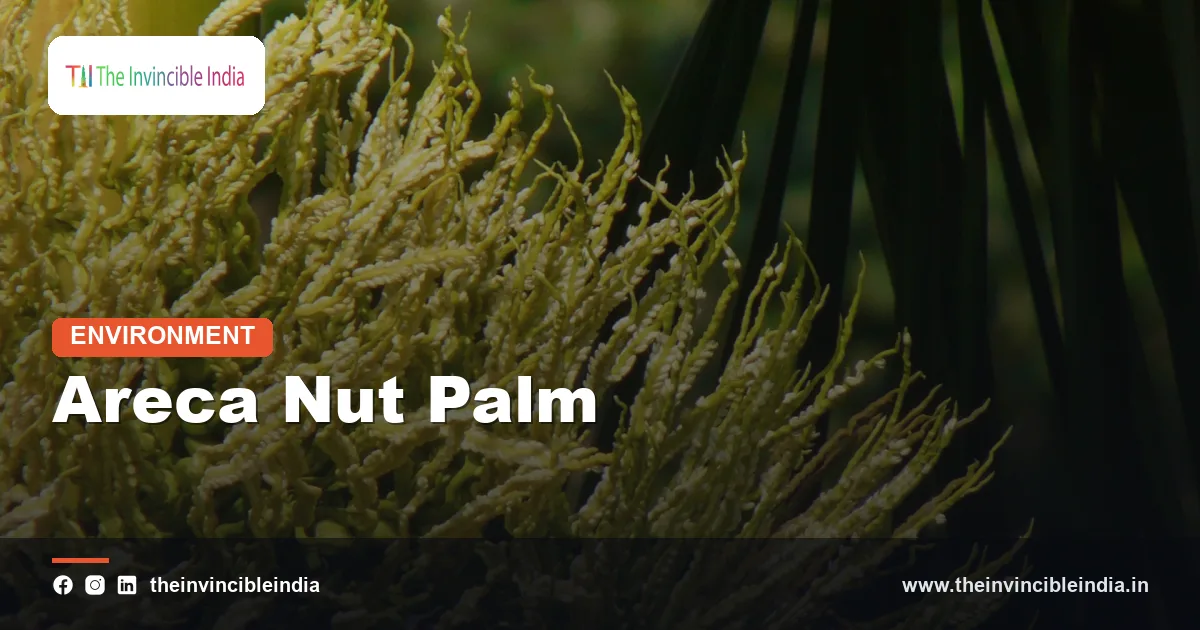
The areca nut palm (Areca catechu) is a tall, slender, unbranched palm of the family Arecaceae whose seed, called areca nut or supari, is grown as a plantation crop in Karnataka, Kerala, Assam and other humid parts of India and is widely chewed with betel leaf, a habit that carries well-documented health risks. The palm has been cultivated in South and Southeast Asia for thousands of years and is one of the most important plantation crops of coastal and Malnad India.
In India, the areca nut palm supports millions of farm families, a large marketing cooperative network and a ritual tradition in which supari is offered in worship, weddings and hospitality. This explainer covers what the palm is, where and how it is grown, the products made from it, its cultural role and the health caution that every account of the crop must include.
Quick Facts
| Attribute | Detail |
|---|---|
| Scientific name | Areca catechu |
| Family | Arecaceae (palm family) |
| Common names | Supari (Hindi), adike (Kannada), adakka (Malayalam), pakku (Tamil), vakka (Telugu), tamul (Assamese) |
| Native range | Tropical Asia and the Pacific, probably the Malay region |
| Main Indian growing states | Karnataka (largest), Kerala, Assam, West Bengal, Meghalaya, Tamil Nadu |
| Typical height | About 12 to 20 metres, with a slim ringed trunk |
| First bearing | Roughly 5 to 8 years after planting; economic life of several decades |
| Research institution | ICAR-Central Plantation Crops Research Institute (CPCRI), Kasaragod, Kerala |
| Health classification | Areca nut is classified as carcinogenic to humans (Group 1) by the International Agency for Research on Cancer (IARC) |
Key Takeaways
- The areca nut palm (Areca catechu) is a slender, unbranched palm whose seed, the supari, is a widely chewed stimulant in South Asia and an essential ritual offering in India.
- Karnataka is the largest areca nut producing state in India, with the Malnad and coastal districts around Shivamogga, Dakshina Kannada, Uttara Kannada and Chikkamagaluru forming the core belt.
- An areca palm usually begins to yield nuts about five to eight years after planting and can remain productive for several decades.
- The International Agency for Research on Cancer classifies areca nut as carcinogenic to humans, and chewing it is linked to oral submucous fibrosis and oral cancer.
- Supari is a standard offering in Hindu rituals, where a whole nut tied with sacred thread often represents Lord Ganesha in a household puja.
- Koleroga (fruit rot) and yellow leaf disease are the two best-known threats to areca plantations in southern India.
What is the areca nut palm?
The areca nut palm is a single-stemmed tropical palm, Areca catechu, grown for the hard seed inside its egg-shaped fruit, which is sold as areca nut or supari. The palm belongs to the same family as the coconut palm, date palm and palmyra palm, but it is a smaller and slimmer tree than the coconut and has a very different economic role.
The word “catechu” in the scientific name refers to the astringent, tannin-rich extract that was historically obtained from the nut and used in tanning and dyeing. The English name “betel nut” is a common misnomer, because the betel plant (Piper betle) is a separate vine whose leaf is the wrapper in paan. The areca nut and the betel leaf are two different plants that are chewed together.
The palm is also confused with an ornamental “areca palm” sold as a houseplant. That houseplant is usually the golden cane palm (Dypsis lutescens), a clumping Madagascan species that produces no chewing nut. The true areca nut palm is a single-trunked tree grown on farms.
Where does the areca nut palm grow in India?
The areca nut palm grows mainly in the humid tropical belts of southern and north-eastern India, with Karnataka as the leading state, followed by Kerala and Assam. Within Karnataka, the districts of Shivamogga, Chikkamagaluru, Dakshina Kannada, Uttara Kannada, Davanagere and Tumakuru are major growing areas, and the Malnad hill region has the traditional garden-style plantations.
Kerala grows areca nut chiefly in its northern and central districts, while Assam, Meghalaya, West Bengal (including parts of the Cooch Behar and Jalpaiguri region) and Tamil Nadu have smaller but significant areas. In the north-east, the nut is called tamul and is central to local customs of hospitality.
Why does the palm need a humid climate?
The areca nut palm needs a warm, humid climate with well-distributed rainfall or dependable irrigation because its shallow root system and large crown lose water quickly in dry weather. It grows best from sea level to roughly 1,000 metres, in deep, well-drained loamy soils with plenty of organic matter. Water stress during the dry months causes nut drop, so growers in drier tracts depend on wells, tanks and drip irrigation.
What does the areca nut palm look like?
The areca nut palm has a straight, slender, grey-green trunk marked with close leaf-scar rings, topped by a crown of long feather-shaped (pinnate) leaves. A smooth green “crown shaft”, formed by tightly overlapping leaf bases, sits just below the leaves and is a quick way to tell areca from other palms.
- Trunk: unbranched, usually 12 to 20 metres tall but only about 20 to 30 centimetres thick, which makes plantations look like dense forests of poles.
- Leaves: pinnate, about 1.5 to 2 metres long, arching from the crown shaft; old leaves fall with a large sheath that has its own uses.
- Flowers: borne in branched clusters (inflorescences) below the crown, with tiny male flowers above and larger female flowers at the base of each branch, so one palm carries both sexes.
- Fruit: ovoid, about 3 to 5 centimetres long, green when young and orange to red when ripe, with a fibrous husk around a single hard seed.
- Seed: the areca nut itself, marbled brown and white inside, which is the product that is dried, cut and sold.
How is the areca nut palm cultivated?
The areca nut palm is cultivated as a long-lived garden or plantation crop, planted from seedlings raised in nurseries and spaced at roughly 2.7 metres in each direction. Growers choose fully ripe, heavy nuts as seed, sow them in beds, and transplant the seedlings after about a year or more when they have several leaves.
How are plantations managed?
Plantations are managed as mixed gardens in which the tall palms provide partial shade for other crops. Banana is commonly planted among young palms for shade and early income, and black pepper vines are often trained up the mature trunks. Cocoa, cardamom, ginger and vegetables are other common intercrops in Karnataka and Kerala. This layered system makes the areca garden one of the more diversified plantation systems in India and gives farmers income from more than one crop.
When are the nuts harvested?
The nuts are harvested when the bunches turn yellow-orange to red, usually in the post-monsoon months from about October to January, although harvest timing varies by region and by the product being made. Skilled climbers, or workers using long poles with sickles, cut the bunches. In recent years, mechanical climbing devices and tree-climbing machines have been developed to ease the shortage of climbers and to reduce the risk of falls.
After harvest, the husk is removed and the nuts are dried, boiled or sliced according to the grade being made. The palm continues to bear every year once established, and a well-kept garden can remain productive for decades.
What products and grades are made from areca nut?
Areca nut is sold in several processed grades, the two broad classes being white (chali) supari made from fully ripe nuts and red (kempu) supari made from boiled tender nuts. Local trade names for grades vary by state and by market, and traders also sort the nuts by size, colour and cut surface.
| Product | How it is made | Typical use |
|---|---|---|
| Chali (white supari) | Fully ripe nuts are dehusked and sun-dried, then peeled | Cut or sliced for chewing with betel leaf and as a ritual offering |
| Kempu (red supari) | Tender nuts are boiled, often with an extract, then dried | Chewing, particularly in parts of Karnataka and the south |
| Flavoured or sweetened supari | Cut nut is roasted and mixed with sugar, spices or scents | Mouth freshener sold in packets |
| Areca leaf sheath plates | Fallen leaf sheaths are cleaned, softened and pressed | Biodegradable plates and bowls |
| Husk | The fibrous fruit coat is separated before drying the nut | Fuel, mulch and fibre |
The areca nut economy is therefore not only about chewing. Plates made from the fallen leaf sheath have become a recognised eco-friendly tableware product, and the husk, which was once discarded, is used as fuel and in small-scale fibre products.
Why is supari important in Indian culture and rituals?
Supari is important in Indian culture because it is a standard offering in Hindu worship, a symbol of hospitality and an essential part of the paan tradition. In many households a whole supari is placed on a mound of rice or on a betel leaf and tied with red sacred thread (kalawa or mauli) to represent Lord Ganesha at the start of a puja, so that the ritual can begin with his invocation.
The nut is also part of tambula, the offering of betel leaf, areca nut and a coin or gift that accompanies many ceremonies, including weddings, thread ceremonies and housewarmings. In Assam, tamul-pan is offered to guests as a gesture of respect, and in parts of southern India a plate of betel leaf and areca nut is presented at festivals and engagement rituals. The social and religious meaning of the nut is a major reason that the crop remains so widely grown and consumed.
Because the ritual use and the habitual chewing use are different things, many people who never chew paan still keep supari in the house for puja.
Is chewing areca nut harmful to health?
Yes, chewing areca nut is harmful to health, and the International Agency for Research on Cancer (IARC), the cancer agency of the World Health Organization, classifies areca nut as carcinogenic to humans. Habitual chewing is associated with oral submucous fibrosis, a condition that stiffens the lining of the mouth and limits mouth opening, and with a higher risk of oral cancer, especially when the nut is chewed with tobacco, as in many quids and packaged mixtures.
The nut contains alkaloids, notably arecoline, which stimulates the nervous system and can lead to dependence. Regular chewing also stains teeth and can damage gums. Doctors and public health bodies advise against chewing areca nut in any form, whether plain, sweetened or mixed with tobacco, and advise anyone who notices white patches, mouth ulcers that do not heal, or difficulty opening the mouth to seek medical care promptly.
What is the legal position on products containing areca nut?
The legal position is that India prohibits tobacco and nicotine as ingredients in food products under food safety regulations, and many states have banned the sale of gutkha and similar chewing mixtures. Plain supari used in rituals or sold as cut nut remains legal and is regulated mainly as an agricultural and food commodity. Rules differ between states, so exact restrictions depend on local notifications.
What diseases and challenges affect areca plantations?
The two best-known threats to areca plantations are koleroga (also called mahali or fruit rot) and yellow leaf disease, along with market and labour challenges. Koleroga is a fungal-like disease caused by Phytophthora that rots tender nuts during the wet monsoon, and farmers protect bunches by spraying Bordeaux mixture before and during the rains.
- Koleroga (fruit rot): causes premature nut fall in humid, rainy weather; managed by pre-monsoon spraying and good drainage.
- Yellow leaf disease: linked to a phytoplasma, it yellows and withers the crown and has damaged gardens in parts of Kerala and Karnataka.
- Basal stem rot (Anabe roga): a fungal rot at the base of the trunk that can kill palms in waterlogged or poorly drained soils.
- Climbing labour shortage: fewer skilled climbers are available, so mechanical climbers are gaining acceptance.
- Price swings and imports: prices respond to cheaper imported nuts, which is why India uses import duties and a minimum import price to support growers.
How is the areca nut economy organised in India?
The areca nut economy in India is organised through small farm holdings, regional cooperatives and central research and development agencies. Most growers have small plots, and a large share of the crop is marketed through cooperatives and local mandis.
- CAMPCO: the Central Arecanut and Cocoa Marketing and Processing Cooperative Limited, headquartered at Mangaluru and established in 1973, buys areca nut from member farmers and supports price stability.
- ICAR-CPCRI: the Central Plantation Crops Research Institute at Kasaragod, with roots in 1916, carries out research on areca nut, coconut and cocoa, including a regional station at Vittal in Karnataka.
- Directorate of Arecanut and Spices Development (DASD): based at Kozhikode and part of the central agriculture ministry, it promotes the development of areca nut and spices.
- State agriculture and horticulture departments: provide subsidies for irrigation, planting material and plant protection.
India is both one of the world’s largest producers and one of the largest consumers of areca nut, and it also imports nuts from neighbouring producing countries, which is why trade policy affects farm prices directly.
What other uses does the areca palm have?
The areca palm has several uses beyond the nut, the most important being leaf-sheath tableware, building and household material, and tannin products. The large fallen leaf sheaths are pressed into plates, cups and trays that are marketed as biodegradable alternatives to plastic, and the process needs no felling of trees because the sheaths fall naturally.
- Trunks of old palms, split into halves or poles, are used as rafters, posts, fencing and water channels in rural areas.
- Dried husk serves as fuel and as mulch, and its fibre can be made into coarse mats and ropes.
- Tannin-rich extract from the nut has been used traditionally in dyeing and tanning.
- Young leaves and inflorescence parts are used in some local rituals and decorations.
Bottom Line
The areca nut palm is a major plantation crop of Karnataka, Kerala and the north-east, valued for supari, ritual use and leaf-sheath products. Its social importance is real, but chewing the nut is a recognised cause of oral disease and cancer, so it is best treated as a ritual and agricultural product, not a health food.
Frequently Asked Questions
What is an areca nut palm?
An areca nut palm is a tall, slender, single-stemmed palm, Areca catechu, grown for its seed, which is sold as areca nut or supari. It belongs to the palm family Arecaceae and is a major plantation crop in southern and north-eastern India. The palm is different from the betel vine, whose leaf is chewed with the nut.
Which state produces the most areca nut in India?
Karnataka is the largest areca nut producing state in India. Its Malnad and coastal districts, including Shivamogga, Dakshina Kannada, Uttara Kannada and Chikkamagaluru, form the main belt. Kerala and Assam follow as the other major producers.
How long does an areca palm take to bear nuts?
An areca palm usually begins to bear nuts about five to eight years after planting. Once established, it yields every year and can stay productive for several decades. Good irrigation, shade management and disease control affect how well and how long it yields.
Is areca nut harmful?
Yes, chewing areca nut is harmful. The International Agency for Research on Cancer classifies it as carcinogenic to humans, and chewing is linked to oral submucous fibrosis and oral cancer, particularly when the nut is mixed with tobacco. Health authorities advise against chewing it in any form.
Why is supari used in Hindu rituals?
Supari is used in Hindu rituals because it is a traditional offering and a symbol of auspiciousness and hospitality. A whole nut tied with sacred thread commonly represents Lord Ganesha at the start of a puja. It is also part of the tambula offering of betel leaf, nut and a coin at weddings and festivals.
Is the areca palm sold as a houseplant the same as the areca nut palm?
No, the houseplant sold as an areca palm is usually the golden cane palm, Dypsis lutescens, not the nut-bearing Areca catechu. The golden cane palm grows in clumps and has no chewing nut. The true areca nut palm is a single-trunked plantation tree.
{“@context”:”https://schema.org”,”@graph”:[{“@type”:”FAQPage”,”mainEntity”:[{“@type”:”Question”,”name”:”What is an areca nut palm?”,”acceptedAnswer”:{“@type”:”Answer”,”text”:”An areca nut palm is a tall, slender, single-stemmed palm, Areca catechu, grown for its seed, which is sold as areca nut or supari. It belongs to the palm family Arecaceae and is a major plantation crop in southern and north-eastern India. The palm is different from the betel vine, whose leaf is chewed with the nut.”}},{“@type”:”Question”,”name”:”Which state produces the most areca nut in India?”,”acceptedAnswer”:{“@type”:”Answer”,”text”:”Karnataka is the largest areca nut producing state in India. Its Malnad and coastal districts, including Shivamogga, Dakshina Kannada, Uttara Kannada and Chikkamagaluru, form the main belt. Kerala and Assam follow as the other major producers.”}},{“@type”:”Question”,”name”:”How long does an areca palm take to bear nuts?”,”acceptedAnswer”:{“@type”:”Answer”,”text”:”An areca palm usually begins to bear nuts about five to eight years after planting. Once established, it yields every year and can stay productive for several decades. Good irrigation, shade management and disease control affect how well and how long it yields.”}},{“@type”:”Question”,”name”:”Is areca nut harmful?”,”acceptedAnswer”:{“@type”:”Answer”,”text”:”Yes, chewing areca nut is harmful. The International Agency for Research on Cancer classifies it as carcinogenic to humans, and chewing is linked to oral submucous fibrosis and oral cancer, particularly when the nut is mixed with tobacco. Health authorities advise against chewing it in any form.”}},{“@type”:”Question”,”name”:”Why is supari used in Hindu rituals?”,”acceptedAnswer”:{“@type”:”Answer”,”text”:”Supari is used in Hindu rituals because it is a traditional offering and a symbol of auspiciousness and hospitality. A whole nut tied with sacred thread commonly represents Lord Ganesha at the start of a puja. It is also part of the tambula offering of betel leaf, nut and a coin at weddings and festivals.”}},{“@type”:”Question”,”name”:”Is the areca palm sold as a houseplant the same as the areca nut palm?”,”acceptedAnswer”:{“@type”:”Answer”,”text”:”No, the houseplant sold as an areca palm is usually the golden cane palm, Dypsis lutescens, not the nut-bearing Areca catechu. The golden cane palm grows in clumps and has no chewing nut. The true areca nut palm is a single-trunked plantation tree.”}}]}]}


