

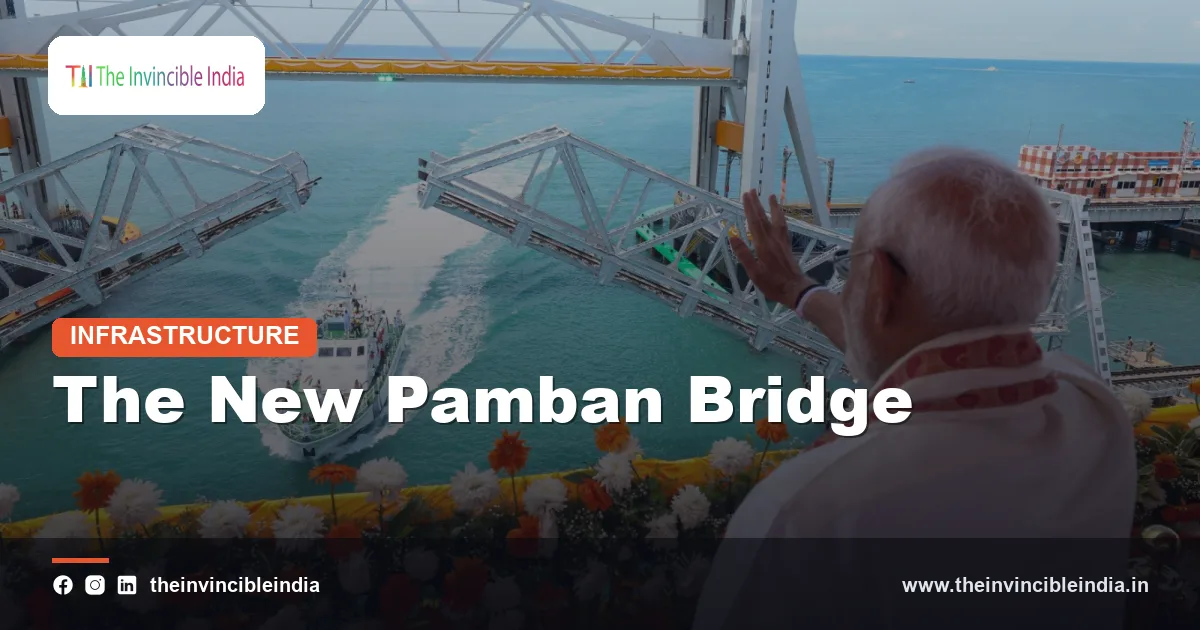
The new Pamban Bridge is India’s first vertical-lift sea railway bridge, a roughly two-kilometre rail link in Tamil Nadu that carries trains across the sea channel between the mainland at Mandapam and Rameswaram island. It replaces the century-old Pamban bridge of 1914, which was India’s first sea bridge, and it has a central span that rises vertically to let ships pass beneath.
The new bridge was built beside the old one by Rail Vikas Nigam Limited (RVNL) for Indian Railways and was opened in 2025. It matters because Rameswaram is one of the country’s most important pilgrimage towns and because the old bridge, after more than a hundred years of service in a salty marine environment, had reached the end of its safe working life.
| Quick Facts | Details |
|---|---|
| Name | New Pamban Railway Bridge (Pamban Bridge) |
| Location | Pamban Channel, Ramanathapuram district, Tamil Nadu, between Mandapam and Rameswaram island |
| Body of water | Pamban Channel, linking the Gulf of Mannar and the Palk Strait region |
| Type | Railway sea bridge with a central vertical-lift span |
| Length | Roughly 2 kilometres, with 99 spans |
| Builder / owner | Rail Vikas Nigam Limited (RVNL) for Indian Railways (Southern Railway) |
| Old bridge | Opened in 1914; India’s first sea bridge; Scherzer rolling lift span |
| New bridge opened | 2025, after a foundation stone laid in 2019 |
| Notable first | India’s first vertical-lift railway sea bridge |
Key Takeaways
- The new Pamban Bridge is India’s first vertical-lift sea railway bridge, with a central span that lifts straight upwards to allow ships and boats to pass.
- The new Pamban Bridge replaces the 1914 Pamban bridge, which was India’s first sea bridge and served rail traffic to Rameswaram for over a century.
- The new Pamban Bridge is about two kilometres long, built with 99 spans and a movable vertical-lift section of roughly 72 metres.
- Corrosion-resistant materials, protective coatings and welded joints were chosen for the new Pamban Bridge because the sea air and salt water had badly affected the old structure.
- The new Pamban Bridge was designed for heavier, faster trains than the old bridge and for a double-track, electrified railway.
- The new Pamban Bridge restores a safe, reliable rail connection to Rameswaram, a major pilgrimage destination for Hindu devotees from across India.
What is the new Pamban Bridge?
The new Pamban Bridge is a railway bridge over the Pamban Channel in Tamil Nadu that connects the mainland railway station area of Mandapam with Pamban and Rameswaram on the island. It is built alongside the old bridge and does the same job with a more modern design.
The structure is notable for one feature above all: its movable section is a vertical-lift span. When a ship needs to pass, the middle section rises like a lift, so that boats can sail beneath, and then it comes back down to rail level for trains.
The bridge belongs to the Mandapam to Rameswaram section of the Southern Railway network. It also stands near the Pamban road bridge, officially the Indira Gandhi Road Bridge, which opened in 1988 and is a separate structure for road traffic.
What was the old Pamban bridge?
The old Pamban bridge was a railway bridge, opened in 1914, that connected Rameswaram island to mainland India and is regarded as the country’s first sea bridge. It was a significant engineering achievement of the early twentieth century, built over a stretch of open sea with strong winds and tides.
Its signature feature was a Scherzer rolling lift span, a type of bascule bridge in which a section of the track hinges and rolls upwards to form a “double-leaf” opening. The span was lifted by hand using a cranking mechanism, and it was opened when ships needed to cross the channel. The bridge was originally laid for metre-gauge trains and was later brought into the broad-gauge network.
The old bridge became a landmark. It appeared in photographs, films and travel stories, and for many pilgrims the train crossing was part of the Rameswaram experience. It also survived the severe cyclone of December 1964, which destroyed the railway line to Dhanushkodi; the damaged Pamban bridge was repaired in a short time afterwards.
| Feature | Old Pamban bridge (1914) | New Pamban Bridge |
|---|---|---|
| Opened | 1914 | 2025 |
| Opening span | Scherzer rolling lift (double-leaf) | Vertical-lift span |
| Operation of span | Manual cranking | Mechanised, electro-mechanical lifting |
| Main material | Steel girders and masonry piers | Stainless steel reinforcement, protective paint, welded steel and concrete |
| Track design | Single track | Built to support double track and electrification |
| Ship clearance | Lower navigational clearance | Higher clearance when the span is raised |
| Status | Heritage structure beside the new bridge | Working rail link |
Why did India build a new Pamban bridge?
India built a new Pamban bridge because the old structure had deteriorated from over a century of exposure to salt water and sea wind, and its manual opening mechanism could not support modern traffic. Repeated repairs had kept it running, but the cost and the risk kept rising.
Several reasons came together.
- Corrosion: marine air causes steel to rust faster than inland conditions, and years of repainting and patching had limits.
- Slow and manual opening: the old rolling-lift span needed workers to crank it open, which was slow and labour-intensive.
- Restrictions on speed and load: because of its age, the old bridge could carry only limited speeds and weights.
- Safety concerns: after structural concerns were raised, train services on the old bridge were stopped in late 2022 while the new one was being completed.
- Growth in pilgrim and local traffic: more people travel to Rameswaram than a century ago, and fishing and coastal vessels also use the channel.
The new bridge was therefore planned as a long-term replacement, taking the same alignment but using modern materials and a better opening system.
How does the vertical-lift span of the Pamban Bridge work?
The vertical-lift span of the Pamban Bridge works by raising a central steel section straight up between two towers, using a mechanised system of counterweights, ropes and motors, so that vessels can pass under it. When no ship needs to pass, the span stays at rail level and trains use it like any other part of the track.
The lifting section is about 72 metres long, and it can be raised by roughly 17 metres, which gives ships far more vertical clearance than the old bridge allowed. The mechanism is electrically operated and controlled from a cabin on the bridge, which makes the opening faster and more predictable than hand cranking.
Why a vertical lift?
A vertical-lift design suits a channel with regular boat traffic because the whole opening is cleared at once and the track remains level when it is down. A vertical lift also avoids the large hinged leaves of a bascule bridge, which need more complex foundations. Railway signalling is linked to the span, so that a train cannot enter the bridge while the span is raised.
What engineering features make the new Pamban Bridge durable?
The new Pamban Bridge is made durable through corrosion-resistant design choices, which include stainless steel reinforcement in key concrete parts, a special protective paint system for steel, and welded rather than riveted joints. These measures target the main enemy of any sea bridge, which is salt-laden air and water.
- Stainless steel reinforcement: corrosion-resistant bars are used in places where ordinary steel would rust inside concrete.
- Protective coating: steel parts carry a multi-layer coating designed to resist marine conditions and to last for many years between repaints.
- Welded joints: welding reduces the number of exposed bolts and rivets, which are common starting points for corrosion.
- Deep foundations: piers rest on pile foundations driven into the seabed to resist currents, waves and cyclonic winds.
- Higher deck level: the bridge sits higher above sea level than the old one, giving more room for vessels and reducing the effect of waves.
- Modern railway standards: the structure is designed for heavier loads and higher speeds, and for future double-tracking and electrification.
Engineers also plan regular inspection and maintenance, because even a corrosion-resistant sea bridge needs ongoing care.
How is the new Pamban Bridge better than the old one?
The new Pamban Bridge is better than the old bridge in speed, safety, capacity and ease of operation. It can carry faster and heavier trains, it opens more quickly for ships, and it needs less manual labour at the moving span.
The higher deck and the greater lift also help the many boats that use the Pamban Channel. Fishing craft, coastal vessels and small cargo boats move under the bridge regularly, and a larger opening means fewer delays and less risk of collision with the structure.
Another benefit is the future-ready design. Because the new bridge allows for double track and electrification, the Rameswaram line can be upgraded later without rebuilding the bridge again. This is a significant advantage for a link that is expected to serve for many decades.
Why does the Pamban Bridge matter for pilgrims and connectivity?
The Pamban Bridge matters because it is the rail gateway to Rameswaram, a major pilgrimage centre, and it supports the local economy of the whole island. Rameswaram is home to the Ramanathaswamy Temple, which is among the best-known Hindu shrines in India and is associated with the Char Dham and Jyotirlinga traditions.
Pilgrims, tourists, fishers, traders and local residents all depend on this connection. A reliable rail line makes the journey cheaper and easier than road travel for many people, particularly for travellers from distant states who arrive by long-distance trains.
- Pilgrimage: year-round visitors and festival crowds rely on trains to reach the island.
- Tourism: Rameswaram, Dhanushkodi and nearby sites draw travellers, and rail is a key way to reach them.
- Fishing and local trade: fish, supplies and passengers move across the channel by road and rail.
- Regional development: a dependable link supports hotels, transport services and small businesses on the island.
The bridge also strengthens the Southern Railway network by restoring the final stretch of a historic line that links Rameswaram with Madurai, Chennai and other major cities.
How was the new Pamban Bridge built and who built it?
The new Pamban Bridge was built by Rail Vikas Nigam Limited (RVNL), a public sector enterprise under the Ministry of Railways, working on behalf of Indian Railways. The foundation stone was laid in 2019, and the bridge was opened to the public in 2025.
Construction took place in the sea next to the old bridge. Work in a marine setting is difficult because of tides, strong winds, salt air and the limited number of working days in good weather, and the project also had to avoid disturbing the operation of the existing line while it was in use. Cyclone season and the disruption caused by the COVID-19 pandemic further affected the schedule.
The bridge was built in a modular way, with large steel girders fabricated on land and then lifted into place. The vertical-lift section was assembled separately and installed between its towers, an operation that needed careful planning.
What is the future of the old Pamban bridge?
The old Pamban bridge remains standing beside the new one as a heritage structure, and its future use as a historic or tourist feature has been widely discussed. It is protected in the public mind as a symbol of early Indian railway engineering.
Heritage experts often argue that old bridges of this kind should be preserved in some form, because they tell the story of how railways connected India’s remote coasts. Whether it becomes a viewing point, a museum feature or only a preserved structure depends on safety assessments and official decisions.
Bottom Line
The new Pamban Bridge is a roughly two-kilometre vertical-lift railway bridge in Tamil Nadu that replaces the 1914 Pamban bridge, India’s first sea bridge. With corrosion-resistant materials, a mechanised lifting span and a modern track design, it gives pilgrims, fishers and residents of Rameswaram a safer and more future-ready rail connection to the mainland.
Frequently Asked Questions
What is special about the new Pamban Bridge?
The new Pamban Bridge is India’s first vertical-lift sea railway bridge. Its central span rises straight up to let ships pass and then returns to rail level. It was built beside the 1914 bridge and opened in 2025.
Where is the Pamban Bridge located?
The Pamban Bridge is located in Ramanathapuram district of Tamil Nadu, over the Pamban Channel. It connects the mainland near Mandapam to Pamban and Rameswaram on the island. The channel lies between the Gulf of Mannar and the Palk Strait region.
Why was the old Pamban bridge replaced?
The old Pamban bridge was replaced because more than a century of exposure to salt air had caused serious corrosion and its hand-operated lifting span was slow. Its age also limited the speed and weight of trains. Train services on it were stopped in late 2022 while the new bridge was being completed.
When was the first Pamban bridge built?
The first Pamban bridge was opened in 1914 and was India’s first sea bridge. It carried the railway to Rameswaram and had a Scherzer rolling lift span that was opened by hand. It served for more than a hundred years.
How does the vertical-lift span work?
The vertical-lift span works by raising a central steel section between two towers using motors and counterweights. The span lifts by roughly 17 metres so that ships can pass underneath, then lowers to rail level for trains. Signals prevent trains from entering while the span is up.
Who built the new Pamban Bridge?
The new Pamban Bridge was built by Rail Vikas Nigam Limited (RVNL) for Indian Railways. The foundation stone was laid in 2019 and the bridge opened in 2025. It was constructed in the sea next to the old bridge.
{“@context”:”https://schema.org”,”@graph”:[{“@type”:”FAQPage”,”mainEntity”:[{“@type”:”Question”,”name”:”What is special about the new Pamban Bridge?”,”acceptedAnswer”:{“@type”:”Answer”,”text”:”The new Pamban Bridge is India’s first vertical-lift sea railway bridge. Its central span rises straight up to let ships pass and then returns to rail level. It was built beside the 1914 bridge and opened in 2025.”}},{“@type”:”Question”,”name”:”Where is the Pamban Bridge located?”,”acceptedAnswer”:{“@type”:”Answer”,”text”:”The Pamban Bridge is located in Ramanathapuram district of Tamil Nadu, over the Pamban Channel. It connects the mainland near Mandapam to Pamban and Rameswaram on the island. The channel lies between the Gulf of Mannar and the Palk Strait region.”}},{“@type”:”Question”,”name”:”Why was the old Pamban bridge replaced?”,”acceptedAnswer”:{“@type”:”Answer”,”text”:”The old Pamban bridge was replaced because more than a century of exposure to salt air had caused serious corrosion and its hand-operated lifting span was slow. Its age also limited the speed and weight of trains. Train services on it were stopped in late 2022 while the new bridge was being completed.”}},{“@type”:”Question”,”name”:”When was the first Pamban bridge built?”,”acceptedAnswer”:{“@type”:”Answer”,”text”:”The first Pamban bridge was opened in 1914 and was India’s first sea bridge. It carried the railway to Rameswaram and had a Scherzer rolling lift span that was opened by hand. It served for more than a hundred years.”}},{“@type”:”Question”,”name”:”How does the vertical-lift span work?”,”acceptedAnswer”:{“@type”:”Answer”,”text”:”The vertical-lift span works by raising a central steel section between two towers using motors and counterweights. The span lifts by roughly 17 metres so that ships can pass underneath, then lowers to rail level for trains. Signals prevent trains from entering while the span is up.”}},{“@type”:”Question”,”name”:”Who built the new Pamban Bridge?”,”acceptedAnswer”:{“@type”:”Answer”,”text”:”The new Pamban Bridge was built by Rail Vikas Nigam Limited (RVNL) for Indian Railways. The foundation stone was laid in 2019 and the bridge opened in 2025. It was constructed in the sea next to the old bridge.”}}]}]}


