

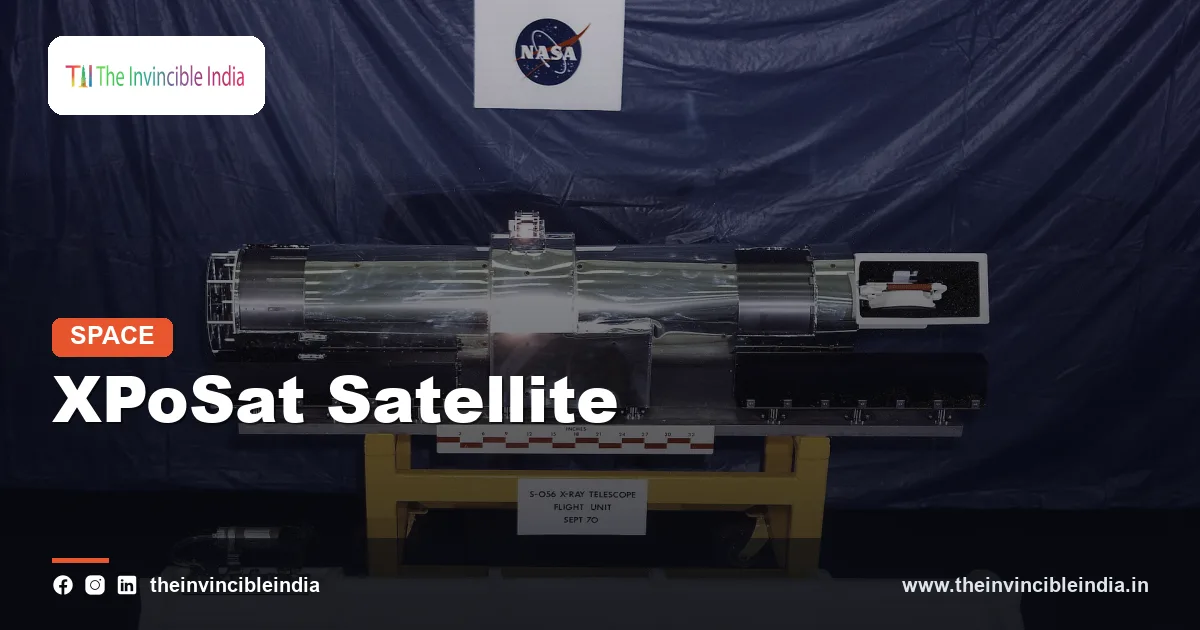
XPoSat, short for the X-ray Polarimeter Satellite, is India’s first dedicated space observatory for measuring the polarisation of X-rays from cosmic sources such as black holes, neutron stars and pulsars. It was launched by the Indian Space Research Organisation (ISRO) on a Polar Satellite Launch Vehicle (PSLV) from Sriharikota on 1 January 2024, and it is the world’s second dedicated X-ray polarimetry mission after NASA’s Imaging X-ray Polarimetry Explorer (IXPE).
XPoSat carries two scientific instruments, POLIX for polarimetry and XSPECT for spectroscopy, which together let astronomers study both the direction in which X-ray light vibrates and its energy. This information reveals the geometry and magnetic fields of some of the most extreme objects in the universe, and it makes XPoSat an important step for Indian astronomy.
| Quick Facts | Details |
|---|---|
| Full name | X-ray Polarimeter Satellite (XPoSat) |
| Agency | Indian Space Research Organisation (ISRO) |
| Launch date | 1 January 2024 |
| Launch vehicle | PSLV-C58 from Satish Dhawan Space Centre, Sriharikota |
| Orbit | Near-circular low-Earth orbit of roughly 650 km, at a low inclination |
| Payloads | POLIX (polarimetry) and XSPECT (spectroscopy) |
| Instrument builders | POLIX: Raman Research Institute (RRI), Bengaluru; XSPECT: U R Rao Satellite Centre (URSC), ISRO |
| Planned mission life | About five years |
| Notable first | India’s first dedicated polarimetry mission; world’s second dedicated X-ray polarimetry mission |
Key Takeaways
- XPoSat is the X-ray Polarimeter Satellite launched by ISRO on a PSLV on 1 January 2024 to study the polarisation of X-rays from bright cosmic sources.
- XPoSat is the world’s second dedicated X-ray polarimetry mission, after NASA’s Imaging X-ray Polarimetry Explorer (IXPE) launched in 2021.
- XPoSat carries two payloads: POLIX, built by the Raman Research Institute, which measures X-ray polarisation, and XSPECT, built by the U R Rao Satellite Centre, which measures X-ray spectra.
- Polarisation of X-rays from black holes, neutron stars and pulsars helps scientists understand the geometry of the emitting region and the strength and direction of magnetic fields.
- XPoSat operates in a low-Earth orbit at roughly 650 km altitude, and its planned mission life is about five years.
- XPoSat gives Indian astronomers their own dedicated platform for studying X-ray sources that were earlier observed mainly with foreign missions or with the Indian multi-wavelength observatory AstroSat.
What is XPoSat?
XPoSat is an Indian space observatory designed to measure the polarisation of X-rays arriving from distant astronomical sources. It weighs a few hundred kilograms, which makes it a small satellite by the standard of space observatories, and it was built under ISRO’s programme for scientific missions.
The satellite studies bright X-ray emitters in the Milky Way and beyond, including accreting black holes, neutron stars, pulsars, supernova remnants and the cores of active galaxies. Its main aim is to add a new kind of information, polarisation, to what astronomers already learn from the brightness, timing and energy of X-rays.
What is X-ray polarimetry and why does it matter?
X-ray polarimetry is the measurement of the direction in which the electric field of X-ray light oscillates, and it matters because that direction carries clues about the shape and magnetic structure of the source that emits it. Light is called polarised when its waves vibrate preferentially in one direction instead of in all directions at random.
Most cosmic X-ray observations measure only how bright a source is, how it changes over time and how its light is spread across energies. Polarisation provides a fourth kind of data. Two very different physical models of the same black hole might predict identical spectra but different polarisation, so polarimetry can separate the models.
Polarisation can be produced when light scatters off electrons, when charged particles spiral in a magnetic field, or when light passes through very strong magnetic fields. Measuring the degree and angle of the polarisation therefore indicates which process is at work and how the emitting matter is arranged.
How does XPoSat study X-ray polarisation?
XPoSat studies X-ray polarisation by pointing its instruments at a bright source for long observations while POLIX records how the incoming X-rays scatter and XSPECT records the energy spectrum of the same source. Stable pointing for long periods is essential, because polarisation signals are weak and need many photons to detect.
The satellite is meant to observe several dozen of the brightest X-ray sources over its mission, spending extended time on each. Between observations, it can also use its pointing to build up a long-term picture of how sources change in polarisation as they change in brightness or state.
What are the two payloads of XPoSat?
The two payloads of XPoSat are POLIX, the Polarimeter Instrument in X-rays, and XSPECT, the X-ray Spectroscopy and Timing instrument. POLIX is the principal payload and measures polarisation, while XSPECT supports it with spectral and timing measurements.
| Feature | POLIX | XSPECT |
|---|---|---|
| Full name | Polarimeter Instrument in X-rays | X-ray Spectroscopy and Timing |
| Purpose | Measure X-ray polarisation | Measure X-ray spectra and variability |
| Energy range | About 8 to 30 keV (medium-energy X-rays) | About 0.8 to 15 keV (soft X-rays) |
| Built by | Raman Research Institute (RRI), Bengaluru, with ISRO | U R Rao Satellite Centre (URSC), ISRO |
| Method | Scattering of X-rays and detection with gas proportional counters | Silicon-based X-ray detector tracking energy of each photon |
| Main output | Degree and angle of polarisation | Spectrum and light curve of the source |
POLIX
POLIX works on the principle of Thomson scattering. X-rays enter the instrument, scatter off a block of low-atomic-number material (a scatterer), and are then detected by proportional counters placed around it. If the incoming X-rays are polarised, the scattered photons are not distributed evenly around the scatterer, and the pattern reveals both the degree and the direction of polarisation. The Raman Research Institute (RRI), an autonomous institute funded by the Department of Science and Technology, developed POLIX in collaboration with ISRO centres.
XSPECT
XSPECT is a spectroscopy instrument that measures the energy of individual soft X-ray photons and the timing of their arrival. The U R Rao Satellite Centre (URSC) of ISRO in Bengaluru built it. Its data tell scientists how the source’s X-ray colours change, which is important for linking a polarisation result to the physical state of the object.
Why is XPoSat called the world’s second dedicated X-ray polarimetry mission?
XPoSat is called the world’s second dedicated X-ray polarimetry mission because only one earlier spacecraft, NASA’s Imaging X-ray Polarimetry Explorer (IXPE), was built entirely for this purpose before it. IXPE launched in December 2021 as a joint project of NASA and the Italian Space Agency.
The two missions are complementary, not duplicates. IXPE works at lower X-ray energies of about 2 to 8 keV and produces polarisation images of extended sources. XPoSat’s POLIX works at higher energies of about 8 to 30 keV, which allows astronomers to compare how polarisation changes between the two energy ranges for the same source.
| Aspect | XPoSat (India) | IXPE (NASA with Italy) |
|---|---|---|
| Launch | 1 January 2024 | December 2021 |
| Launch vehicle | PSLV-C58 | Falcon 9 |
| Polarimetry energy band | About 8 to 30 keV | About 2 to 8 keV |
| Imaging capability | Non-imaging polarimeter | Imaging polarimetry |
| Companion instrument | XSPECT spectroscopy payload | Not applicable |
Earlier balloon and rocket experiments, and a few instruments on general-purpose satellites, had measured X-ray polarisation in limited ways, but XPoSat and IXPE are the two spacecraft designed from the beginning for the task.
What can XPoSat reveal about black holes, neutron stars and pulsars?
XPoSat can reveal the geometry and magnetic fields around black holes, neutron stars and pulsars by showing how the X-rays they emit are polarised. These objects are too small and distant to be photographed in detail in X-rays, so polarisation offers an indirect way to learn about their structure.
- Black holes: in an accreting black hole, hot gas spirals inwards in a disc and forms a hot corona. The polarisation of the X-rays shows whether the corona is shaped like a thin layer, a sphere or a jet base.
- Neutron stars: these dense remnants of massive stars have strong magnetic fields. Polarisation shows how matter flows along the field lines and where the X-rays are produced.
- Pulsars: rotating neutron stars that emit beams of radiation. Polarisation helps scientists understand where and how the radiation is generated and how particles are accelerated.
- Supernova remnants and pulsar wind nebulae: the polarisation of X-rays from objects such as the Crab Nebula reveals the structure of the magnetic field and the acceleration of electrons.
- Active galactic nuclei: supermassive black holes at the centres of galaxies launch jets, and polarisation can show how those jets are magnetised.
Such results can test theories about extreme gravity, matter at very high density and magnetic fields far stronger than anything on Earth.
How was XPoSat launched and where does it orbit?
XPoSat was launched on 1 January 2024 aboard ISRO’s PSLV-C58 rocket from the Satish Dhawan Space Centre at Sriharikota, and it was placed in a near-circular low-Earth orbit at an altitude of roughly 650 kilometres. The orbit has a low inclination to the equator, which suits long, steady observations.
The launch was the first Indian orbital launch of the year 2024. The PSLV is ISRO’s reliable workhorse rocket, with a long record of delivering scientific and commercial payloads. After XPoSat was released, the rocket’s final stage was reused as an orbital experiment platform, called POEM-3, carrying additional experiments from various Indian institutions and start-ups. This demonstrated a way to extract more science from a single launch.
Who built XPoSat?
XPoSat was built by ISRO, with the Raman Research Institute (RRI) providing the POLIX payload and the U R Rao Satellite Centre (URSC) providing the satellite platform and the XSPECT payload. The mission therefore combines an academic research institute with ISRO’s satellite-building expertise.
The partnership shows a model that India has used in other science missions: ISRO centres handle spacecraft systems, launch and operations, while research institutions design instruments and lead the scientific analysis. Data from the mission is processed at ISRO’s facilities and is meant to be shared with the scientific community.
Why does XPoSat matter for Indian astronomy?
XPoSat matters for Indian astronomy because it gives Indian scientists a dedicated tool for a new field, X-ray polarimetry, and positions India among the few countries with a mission in this area. It builds on the experience gained with AstroSat, India’s first multi-wavelength space observatory, launched in 2015.
- New capability: polarimetry was once a niche area, and XPoSat creates a base of expertise in India for designing and analysing such instruments.
- Training for researchers: students and scientists at institutes and universities gain access to rare data and new research problems.
- Global collaboration: combining results with IXPE and with ground-based and other space telescopes can give a fuller picture of each source.
- Technology development: detectors, electronics and calibration methods developed for the mission can be reused in later space instruments.
- Public engagement: a distinctive mission with an easy-to-explain goal helps increase interest in space science.
The mission also shows ISRO’s ability to run focused, relatively compact science missions alongside its larger launch and human spaceflight programmes.
What are the limitations of XPoSat?
The main limitations of XPoSat are its non-imaging polarimeter, its limited sensitivity to faint sources, and the need for long observations of each target. Polarisation measurements require many photons, so only the brightest X-ray sources can be studied in detail.
POLIX measures the combined polarisation from everything in its field of view, so it cannot separate polarisation from different parts of an extended object, as an imaging polarimeter can. For this reason, XPoSat is most useful for bright point-like sources, and its results are often best used together with data from other telescopes.
Bottom Line
XPoSat is ISRO’s X-ray Polarimeter Satellite, launched on a PSLV on 1 January 2024, and it is the world’s second dedicated X-ray polarimetry mission after NASA’s IXPE. By combining POLIX polarimetry with XSPECT spectroscopy, it helps astronomers decode the geometry and magnetic fields of black holes, neutron stars and pulsars, and it strengthens India’s role in space-based astronomy.
Frequently Asked Questions
What is XPoSat?
XPoSat is the X-ray Polarimeter Satellite, an ISRO space observatory that measures the polarisation of X-rays from cosmic sources. It was launched on 1 January 2024 on a PSLV rocket. It studies objects such as black holes, neutron stars and pulsars.
What are the payloads on XPoSat?
XPoSat carries two payloads, POLIX and XSPECT. POLIX, built by the Raman Research Institute, measures X-ray polarisation in the energy range of about 8 to 30 keV. XSPECT, built by the U R Rao Satellite Centre, measures X-ray spectra and timing in the soft X-ray range.
Is XPoSat the first X-ray polarimetry mission in the world?
No, XPoSat is the world’s second dedicated X-ray polarimetry mission. NASA’s Imaging X-ray Polarimetry Explorer (IXPE), launched in December 2021 with the Italian Space Agency, came first. The two missions cover different energy ranges and complement each other.
Why is X-ray polarisation important?
X-ray polarisation is important because it reveals the geometry and magnetic fields of the sources that emit the X-rays. Brightness and spectra alone cannot always distinguish between competing physical models. Polarisation adds an independent measurement that can settle such questions.
Which rocket launched XPoSat and when?
XPoSat was launched by ISRO’s PSLV-C58 rocket on 1 January 2024 from the Satish Dhawan Space Centre, Sriharikota. The satellite was placed in a low-Earth orbit of roughly 650 kilometres. The rocket’s final stage was then used as an orbital experiment platform.
How long will XPoSat operate?
XPoSat has a planned mission life of about five years. During this time it is intended to observe several dozen bright X-ray sources for long periods. Actual operation can continue longer or shorter depending on the health of the satellite.
{“@context”:”https://schema.org”,”@graph”:[{“@type”:”FAQPage”,”mainEntity”:[{“@type”:”Question”,”name”:”What is XPoSat?”,”acceptedAnswer”:{“@type”:”Answer”,”text”:”XPoSat is the X-ray Polarimeter Satellite, an ISRO space observatory that measures the polarisation of X-rays from cosmic sources. It was launched on 1 January 2024 on a PSLV rocket. It studies objects such as black holes, neutron stars and pulsars.”}},{“@type”:”Question”,”name”:”What are the payloads on XPoSat?”,”acceptedAnswer”:{“@type”:”Answer”,”text”:”XPoSat carries two payloads, POLIX and XSPECT. POLIX, built by the Raman Research Institute, measures X-ray polarisation in the energy range of about 8 to 30 keV. XSPECT, built by the U R Rao Satellite Centre, measures X-ray spectra and timing in the soft X-ray range.”}},{“@type”:”Question”,”name”:”Is XPoSat the first X-ray polarimetry mission in the world?”,”acceptedAnswer”:{“@type”:”Answer”,”text”:”No, XPoSat is the world’s second dedicated X-ray polarimetry mission. NASA’s Imaging X-ray Polarimetry Explorer (IXPE), launched in December 2021 with the Italian Space Agency, came first. The two missions cover different energy ranges and complement each other.”}},{“@type”:”Question”,”name”:”Why is X-ray polarisation important?”,”acceptedAnswer”:{“@type”:”Answer”,”text”:”X-ray polarisation is important because it reveals the geometry and magnetic fields of the sources that emit the X-rays. Brightness and spectra alone cannot always distinguish between competing physical models. Polarisation adds an independent measurement that can settle such questions.”}},{“@type”:”Question”,”name”:”Which rocket launched XPoSat and when?”,”acceptedAnswer”:{“@type”:”Answer”,”text”:”XPoSat was launched by ISRO’s PSLV-C58 rocket on 1 January 2024 from the Satish Dhawan Space Centre, Sriharikota. The satellite was placed in a low-Earth orbit of roughly 650 kilometres. The rocket’s final stage was then used as an orbital experiment platform.”}},{“@type”:”Question”,”name”:”How long will XPoSat operate?”,”acceptedAnswer”:{“@type”:”Answer”,”text”:”XPoSat has a planned mission life of about five years. During this time it is intended to observe several dozen bright X-ray sources for long periods. Actual operation can continue longer or shorter depending on the health of the satellite.”}}]}]}


