

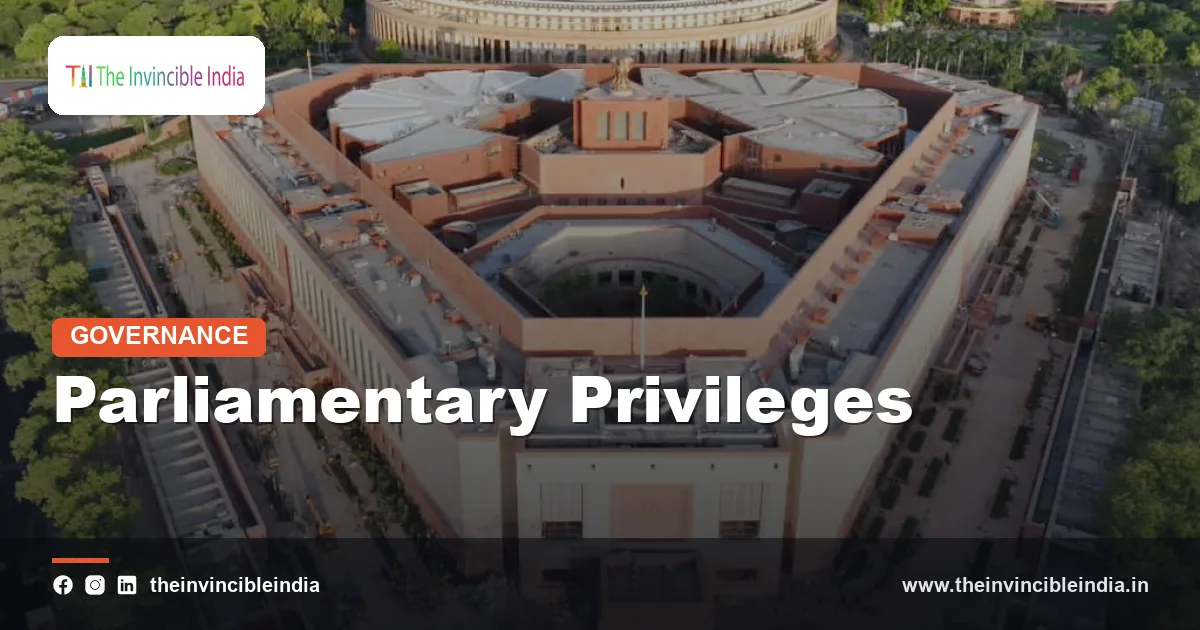
When a member of Parliament rises to speak, press a point or cast a vote, the law gives that member a layer of protection that ordinary citizens do not have. These protections are known as parliamentary privileges, and they exist so that legislators can discharge their duties without fear of court cases, intimidation or interference. The idea is not to place lawmakers above the law, but to make sure the legislature as a whole can debate freely, hold the executive to account and manage its own affairs.
In India, parliamentary privileges are rooted in Article 105 for Parliament and Article 194 for the state legislatures. They borrow heavily from the practice of the British House of Commons, and, remarkably, they have never been fully written into a single code. This explainer sets out what the privileges are, who enjoys them, how a breach is dealt with, which landmark cases have shaped them, and why the relationship between privileges and press freedom remains debated.
Quick Facts
| Feature | Details |
|---|---|
| Source for Parliament | Article 105 of the Constitution |
| Source for state legislatures | Article 194 of the Constitution |
| Core protection | Freedom of speech in the House and immunity from court proceedings for words spoken or votes cast |
| Civil arrest | Members are exempt from arrest in civil cases during the session and for 40 days before and after it |
| Criminal cases | No privilege against arrest in criminal cases or under preventive detention |
| Codification | Not codified by Parliament; derived from the Constitution, rules and precedent |
| Enforcing bodies | The House itself, the Presiding Officer and the Committee of Privileges |
| Model | Privileges of the House of Commons of the United Kingdom |
What Are Parliamentary Privileges?
Parliamentary privileges are special rights, immunities and exemptions enjoyed by each House of Parliament, its committees and its members. They are meant to secure the independence and dignity of the legislature. Without them, a member who criticised a powerful interest might be sued, harassed or prosecuted for words spoken in debate, and the House would struggle to carry out its constitutional role.
The word privilege here has a technical meaning. It does not refer to perks such as salary or housing but to legal protections that are necessary for effective legislative work. Broadly, they fall into two groups. Individual privileges belong to members as persons, while collective privileges belong to each House as an institution. Both are essential, because a House cannot function properly if its members are intimidated, nor can it command respect if outsiders can obstruct or insult it without consequence.
Who Enjoys Them
Under Article 105(4), the privileges extend beyond elected members to those persons who are entitled to speak and take part in the proceedings of a House or its committees. This includes the Attorney General of India and ministers who may not be members of that House. The President, though an integral part of Parliament, is not covered by Article 105 but enjoys a separate immunity under Article 361.
Constitutional Basis: Articles 105 and 194
Article 105 contains four clauses that together form the backbone of the system. The first guarantees freedom of speech in Parliament, subject to the Constitution and to the rules and standing orders regulating its procedure. The second protects members from any court proceedings for anything said or any vote given in Parliament or any committee, and protects any person from liability for publishing a report, paper, vote or proceeding by or under the authority of either House.
The Third Clause and the Commons Link
The third clause is the most significant for debates on codification. It says that, in other respects, the powers, privileges and immunities of each House and its members shall be such as Parliament may define by law. Until Parliament does so, they remain what they were under the House of Commons at the time the relevant clause took effect. The Forty-fourth Amendment of 1978 revised the wording of this clause, but the underlying idea remains the same: in the absence of a law, British parliamentary precedent fills the gap.
Mirror Provisions for States
Article 194 reproduces these provisions for the legislative assemblies and councils of the states, their members and committees. Articles 122 and 212 add that the validity of proceedings in Parliament or a State Legislature cannot be questioned in court on the ground of an alleged irregularity of procedure. This reinforces the autonomy of each House over how it conducts its business.
Individual Privileges of Members
Individual privileges protect the member while carrying out legislative duties. The most important are the following.
Freedom of Speech in the House
A member may speak freely in the House without being held legally liable for the contents of the speech, though this freedom is subject to the Constitution and the rules of the House. It is distinct from the general freedom of speech under Article 19(1)(a), which is subject to the reasonable restrictions listed in Article 19(2). The parliamentary freedom is wider within the chamber, but it is also bounded by the discipline of the House, as the Presiding Officer can stop a member who breaks rules, and a member who uses unparliamentary language may see the words expunged.
Immunity from Court Proceedings
No member can be taken to court for anything said or any vote given in Parliament or its committees. The courts have held that this protection is absolute for what is said inside the House, even if the speech is defamatory. It does not cover statements made outside the House, such as in a press conference or a public rally, nor does it protect a member from being punished by the House itself.
Exemption from Arrest in Civil Cases
Under the Code of Civil Procedure, a member cannot be arrested in a civil matter during the continuance of the House, and for forty days before and after a session or a meeting of a committee. This privilege does not apply to criminal cases, to preventive detention, or to arrests under laws concerning offences against the state. A member who is arrested on a criminal charge must be promptly reported to the Presiding Officer, so that the House knows why a seat is vacant in the chamber.
Other Individual Protections
- Exemption from attending court as a witness while the House is in session.
- Exemption from jury service during the session.
- Freedom from obstruction while attending or leaving the House.
Collective Privileges of the House
Collective privileges belong to each House as a body. They are meant to protect its authority and independence and, in some respects, are even more important than the individual protections.
- Right to publish debates: The House may publish its proceedings and report, and may prohibit others from publishing them without permission. Article 361A, inserted in 1978, protects the publication of substantially true reports of the proceedings.
- Right to exclude strangers: A House may exclude outsiders from its galleries and may hold a secret sitting.
- Right to regulate internal affairs: A House can frame rules for its own procedure and decide questions arising within its walls without outside interference.
- Right to punish for contempt: A House can punish members and, in certain cases, outsiders for breach of its privileges or for contempt.
- Right to receive immediate information on arrest: A House must be informed whenever a member is arrested, detained or released.
- Right to prohibit inquiry into proceedings: Courts cannot inquire into the proceedings of the House on the ground of irregularity.
- Power over committees: The House may appoint committees, require witnesses to appear and call for papers.
The power to punish extends to outsiders in specified situations, such as those who obstruct a member or publish a distorted account of proceedings. The punishment can range from a reprimand to a short term of confinement within the limits of the session.
Breach of Privilege and Contempt of the House
A breach of privilege occurs when any individual or authority disregards or attacks any of the privileges, rights and immunities of a member or of the House. Contempt of the House is a somewhat wider idea. It refers to any act or omission which obstructs or impedes either House in performing its functions, or which obstructs a member or officer in the discharge of duty, or which tends to produce such a result directly or indirectly.
Examples of Breach and Contempt
- Casting reflections on the character or conduct of the House or the Presiding Officer.
- Misrepresenting the proceedings in the press in a way that is malicious.
- Giving false evidence before a committee, or refusing to testify when summoned.
- Molesting or threatening a member for something said or done in the House.
- Bribing, or attempting to bribe, a member in connection with the parliamentary role.
- Disobeying a lawful order or direction of the House.
Punishments Available
A House may admonish or reprimand an offender, who may be called to the bar of the House to hear the censure. It may imprison an offender for the duration of the session. A member found guilty may be suspended or, in serious cases, expelled. The House cannot, however, impose a punishment that extends beyond the life of the session or the House.
The Committee of Privileges
Allegations of breach are usually handled through the Committee of Privileges. A member who believes that a privilege has been violated gives notice to the Speaker in the Lok Sabha or to the Chairman in the Rajya Sabha, and a matter of privilege is raised by the member with the consent of the Presiding Officer.
How the Process Works
- The member gives written notice, and the Presiding Officer decides whether the matter qualifies as a question of privilege.
- If the Presiding Officer agrees, the House may be asked to consider the matter, or the question may be referred directly to the Committee of Privileges.
- The committee examines the issue, may call witnesses and papers, and gives the person concerned a chance to be heard.
- It reports to the House with recommendations.
- The House decides whether to accept the report and what penalty, if any, to impose.
In the Lok Sabha, the committee is made up of members nominated by the Speaker, while in the Rajya Sabha the committee is chaired by the Deputy Chairman. The committee works on principles of natural justice, since its findings can affect the freedom or reputation of a person.
Landmark Cases That Shaped Privileges
Courts have repeatedly been asked to draw the boundary between legislative privilege and fundamental rights. The decisions below are among the most cited.
| Case | Year | Main point |
|---|---|---|
| M.S.M. Sharma v. Shri Krishna Sinha (Searchlight case) | 1959 | Privilege to prohibit publication of proceedings was held to prevail over the freedom of the press under Article 19(1)(a), because Article 194(3) was treated as a saving provision. |
| Special Reference No. 1 of 1964 (Keshav Singh case) | 1964-65 | A clash between the Uttar Pradesh Assembly and the Allahabad High Court led to a Presidential reference; the Supreme Court affirmed that courts retain a role where fundamental rights are at stake. |
| Tej Kiran Jain v. N. Sanjiva Reddy | 1970 | Immunity for words spoken in the House was held to be absolute. |
| P.V. Narasimha Rao v. State (CBI/SPE) | 1998 | Members were held immune from prosecution for votes in the House, even where bribery was alleged. |
| Raja Ram Pal v. Hon’ble Speaker, Lok Sabha | 2007 | Expulsion of members in the cash-for-query matter was upheld, while the Court affirmed that the exercise of privilege is open to limited judicial review. |
| Sita Soren v. Union of India | 2024 | A seven-judge Bench overruled the Narasimha Rao view and held that bribery is not protected by parliamentary privilege. |
Why Privileges Have Never Been Codified
Although Article 105(3) invites Parliament to define privileges by law, it has not done so. The result is a hybrid system built from constitutional text, the rules of procedure of each House, decisions of the Presiding Officers, judicial rulings and the persuasive weight of House of Commons practice.
Arguments for Codification
Supporters of a statute argue that citizens, journalists and officials cannot be expected to guard against breaching privileges that have never been clearly defined. They point out that uncodified privileges leave much to the discretion of the House, and that a defined list would increase fairness, clarity and predictability.
Arguments Against
Opponents argue that codification would freeze the law and invite litigation, and that Houses need flexibility to deal with new forms of obstruction. They also note that a statute passed by a simple majority could itself be politicised, and that the existing combination of rules, precedent and judicial review has functioned adequately for decades. Committees and commentators have discussed the matter on several occasions, but no comprehensive law has so far emerged.
Privileges and the Freedom of the Press
The most sensitive debate around privileges concerns journalism. A free press reports on and criticises legislators, and sometimes its reporting may be perceived by the House as contemptuous. This creates a potential conflict between Article 105 and the freedom guaranteed under Article 19(1)(a).
In the Searchlight case of 1959, the Supreme Court held that a House could prohibit publication of certain proceedings, and that Article 19(1)(a) could not override Article 194(3) in the circumstances. The Forty-fourth Amendment later added Article 361A to protect the publication of substantially true reports of the proceedings of Parliament and state legislatures, unless the publication is proved to be made with malice.
Where the Balance Lies Today
Press freedom advocates argue that privilege should not be used to punish ordinary criticism, since public scrutiny of lawmakers is a core element of democracy. Defenders of privilege respond that a House has a legitimate interest in preventing malicious misreporting. In practice, modern Presiding Officers tend to be cautious about using the contempt power against the press, and the question is generally approached through the principle that robust reporting must be tolerated while deliberate falsehood and obstruction need not be.
Limits and Judicial Review
Privileges are not unlimited. They are subordinate to some constitutional provisions, and their exercise can be reviewed by the courts to a limited extent. In particular, the Supreme Court has held that the House must act within the Constitution, that fundamental rights such as personal liberty must be respected, and that courts can examine whether a power has been exercised in a mala fide, perverse or illegal manner.
At the same time, internal parliamentary proceedings enjoy protection from challenge on grounds of mere procedural irregularity. The practical result is a careful balance. Courts do not sit in judgement over the way a debate is conducted, but they will not allow a House to detain a person or punish a citizen without regard to constitutional safeguards. The recent Supreme Court holding that bribery in connection with legislative votes is not covered by privilege shows that the courts are willing to define the boundaries of immunity when public integrity is at issue.
Conclusion
Parliamentary privileges are a vital but frequently misunderstood part of India’s constitutional design. They protect the ability of legislators to speak and vote without fear, and they protect the authority of each House. At the same time, they must be exercised in harmony with fundamental rights, with the freedom of the press and with the rule of law. The fact that they remain uncodified means that clarity comes from precedent, judicial decisions and the good sense of Presiding Officers. As India’s democracy matures, the conversation about how to keep these privileges meaningful, accountable and proportionate will continue.
Frequently Asked Questions
What are parliamentary privileges in India?
They are special rights and immunities enjoyed by the Houses of Parliament, their committees and members so that they can function without outside interference. Article 105 covers Parliament, while Article 194 provides the same for state legislatures. They include freedom of speech in the House and immunity from court proceedings for words and votes in the House.
Can a member of Parliament be sued for something said in the House?
No. Article 105(2) protects members from any proceedings in court for anything said or any vote given in Parliament or its committees. The protection covers the House proceedings only, and does not extend to statements made outside Parliament.
Are MPs exempt from arrest?
Only partly. Members are exempt from arrest in civil cases during the session and for forty days before and after it. There is no such exemption in criminal cases or in preventive detention, although the Presiding Officer must be informed promptly of any arrest.
What is the difference between breach of privilege and contempt of the House?
A breach of privilege is a violation of a specific right or immunity of a member or the House. Contempt of the House is wider and covers any act that obstructs the House or its members in the performance of their duties, or that lowers the authority and dignity of the House.
Who decides whether a privilege has been breached?
The question is raised with the Speaker in the Lok Sabha or the Chairman in the Rajya Sabha, who may refer it to the Committee of Privileges. The committee examines the matter and reports to the House, which takes the final decision about any punishment.
Why have parliamentary privileges not been codified?
Article 105(3) invites Parliament to define them by law, but this has not been done. Supporters of the present system say it offers flexibility, while critics argue that codification would bring clarity and protect citizens and the press from uncertainty.
{“@context”:”https://schema.org”,”@graph”:[{“@type”:”FAQPage”,”mainEntity”:[{“@type”:”Question”,”name”:”What are parliamentary privileges in India?”,”acceptedAnswer”:{“@type”:”Answer”,”text”:”They are special rights and immunities enjoyed by the Houses of Parliament, their committees and members so that they can function without outside interference. Article 105 covers Parliament, while Article 194 provides the same for state legislatures. They include freedom of speech in the House and immunity from court proceedings for words and votes in the House.”}},{“@type”:”Question”,”name”:”Can a member of Parliament be sued for something said in the House?”,”acceptedAnswer”:{“@type”:”Answer”,”text”:”No. Article 105(2) protects members from any proceedings in court for anything said or any vote given in Parliament or its committees. The protection covers the House proceedings only, and does not extend to statements made outside Parliament.”}},{“@type”:”Question”,”name”:”Are MPs exempt from arrest?”,”acceptedAnswer”:{“@type”:”Answer”,”text”:”Only partly. Members are exempt from arrest in civil cases during the session and for forty days before and after it. There is no such exemption in criminal cases or in preventive detention, although the Presiding Officer must be informed promptly of any arrest.”}},{“@type”:”Question”,”name”:”What is the difference between breach of privilege and contempt of the House?”,”acceptedAnswer”:{“@type”:”Answer”,”text”:”A breach of privilege is a violation of a specific right or immunity of a member or the House. Contempt of the House is wider and covers any act that obstructs the House or its members in the performance of their duties, or that lowers the authority and dignity of the House.”}},{“@type”:”Question”,”name”:”Who decides whether a privilege has been breached?”,”acceptedAnswer”:{“@type”:”Answer”,”text”:”The question is raised with the Speaker in the Lok Sabha or the Chairman in the Rajya Sabha, who may refer it to the Committee of Privileges. The committee examines the matter and reports to the House, which takes the final decision about any punishment.”}},{“@type”:”Question”,”name”:”Why have parliamentary privileges not been codified?”,”acceptedAnswer”:{“@type”:”Answer”,”text”:”Article 105(3) invites Parliament to define them by law, but this has not been done. Supporters of the present system say it offers flexibility, while critics argue that codification would bring clarity and protect citizens and the press from uncertainty.”}}]}]}


