

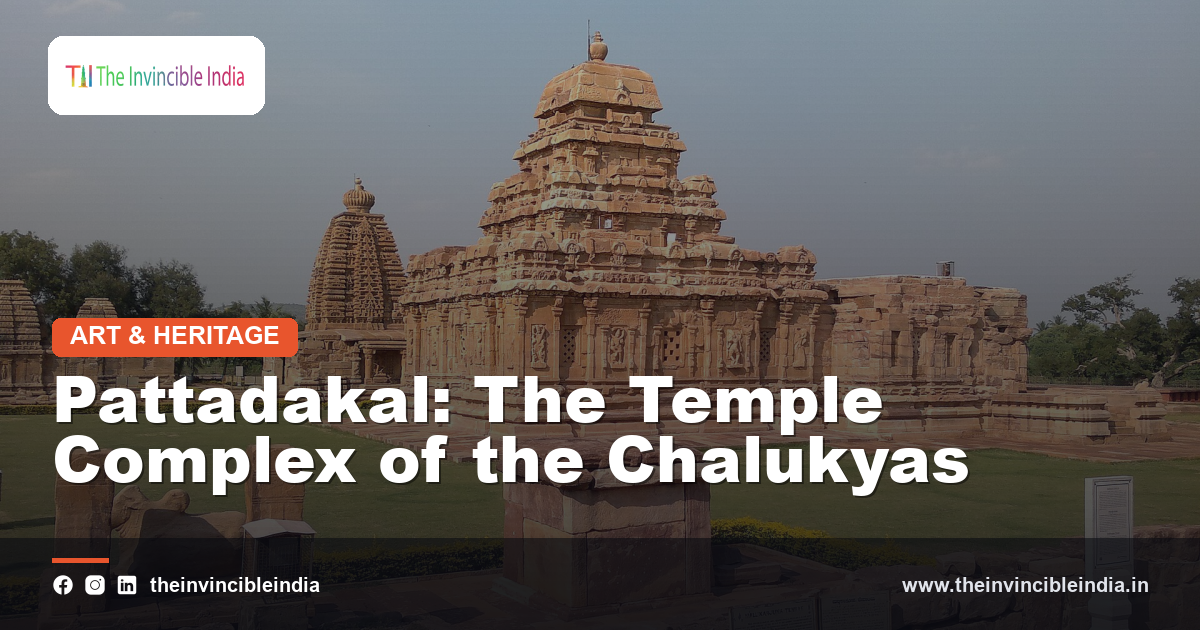
Pattadakal is a village on the bank of the Malaprabha river in northern Karnataka that holds one of the most important groups of early temples in India. Built largely under the Chalukya dynasty of Badami, the complex is celebrated for the way it brings together the northern Nagara and southern Dravida styles of temple architecture in a single sacred precinct. Inscribed as a UNESCO World Heritage Site, it is regarded as a laboratory of temple design and a milestone in Indian art. Like the monuments described in the guide to Dravidian temple architecture, its shrines reveal how experiment and tradition shaped the sacred landscape of the subcontinent.
Quick Facts
| Detail | Information |
|---|---|
| Location | Bagalkot district, Karnataka |
| River | Malaprabha |
| Dynasty | Chalukyas of Badami (later Rashtrakuta additions) |
| Period | Seventh to eighth century |
| Styles | Nagara and Dravida temple architecture |
| Recognition | UNESCO World Heritage Site |
A Sacred Ground on the Malaprabha
Pattadakal lies on a gentle stretch of the Malaprabha river in the Bagalkot region of Karnataka, in a landscape of red sandstone hills and open fields. The river here turns toward the north, a feature regarded as auspicious in Indian tradition, and this may help explain why the site was chosen as a place of sacred importance. The temples stand close together in a walled enclosure, forming a compact open-air museum of early architecture. Because the buildings are grouped within a small area, visitors can compare different designs by walking a few steps from one shrine to the next. The setting is quiet and unhurried, with the temples glowing in the changing light of the day. Pattadakal thus offers both a spiritual atmosphere and an unrivalled opportunity to study the evolution of temple building in the early medieval period.
The Meaning of the Name Pattadakal
The name Pattadakal is commonly understood in the Kannada language as the stone of coronation, a reference to the role the place played in the royal life of the Chalukyas. Tradition holds that rulers of the dynasty were crowned or ceremonially anointed here, and the site was therefore regarded as a place of political as well as religious significance. This dual character helps to explain the scale and ambition of the temples built within it. A coronation ground required monuments of dignity, and the Chalukya patrons responded by commissioning shrines of great beauty. The name connects the village to the ceremonial life of the dynasty and reminds visitors that temple building in early India was closely tied to kingship. Pattadakal was a place where power, ritual and architecture came together.
The Chalukyas of Badami and Their World
The Chalukyas of Badami ruled a large part of the Deccan during the sixth, seventh and eighth centuries, and their kingdom was one of the leading powers of its age. Their capital at Badami, together with nearby Aihole and Pattadakal, formed a triangle of centres in which an extraordinary amount of early temple architecture was created. The dynasty is remembered for its patronage of Hindu and Jain institutions, for its rock-cut caves and for its freestanding stone temples. Chalukya rulers were in contact with kingdoms to the north and south, which exposed their craftsmen to varied architectural ideas. This openness helped to produce an environment of experimentation. Pattadakal reflects the confidence and cosmopolitan outlook of the Chalukya court, and its temples record a period in which the foundations of later regional styles were being laid.
Aihole, Badami and Pattadakal as a Group
Pattadakal cannot be fully understood without its neighbours. Aihole, a short distance away, is often described as a cradle of Indian temple architecture, with a large number of early shrines showing the first experiments in stone construction. Badami is known for its cave temples cut into sandstone cliffs and for its picturesque lake. Pattadakal represents the more mature stage of this development, in which the lessons of earlier experiments were applied to monumental structures of confident design. Together the three sites trace a sequence from tentative beginnings to refined achievement. Scholars frequently treat them as a single cultural landscape, since the same patrons, workshops and ideas moved among them. Seen in this wider context, Pattadakal emerges as the culminating expression of the Chalukya architectural programme in the heartland of the dynasty.
Where Two Styles Meet
The most celebrated feature of Pattadakal is the presence of both northern and southern temple styles in the same precinct. The northern Nagara tradition is recognised by its curving tower, called a rekha-nagara shikhara, while the southern Dravida tradition is marked by a pyramidal tower built in storeys, known as a vimana. At Pattadakal temples of both kinds stand side by side, sometimes within a few paces of each other. This combination does not occur by accident; it reflects the Chalukya role as a bridge between the north and south of the subcontinent. Craftsmen worked in several idioms, and patrons were willing to commission each. The site is therefore a rare and instructive place where the visitor can see two great architectural families in direct comparison, and understand how they developed from shared roots.
The Virupaksha Temple
The Virupaksha Temple is the largest and most famous monument at Pattadakal and a masterpiece of the southern Dravida style. Dedicated to Shiva, it consists of a sanctum, a pillared hall and a gateway, set within a walled courtyard. According to tradition it was built by a Chalukya queen to commemorate a royal victory, and its design is thought to have been inspired by a great temple in the Pallava capital of Kanchipuram. The tower rises in clearly defined storeys, and the walls are enlivened with carved panels and ornamental windows. A large Nandi pavilion stands before the temple, as is usual for Shiva shrines. The Virupaksha Temple demonstrates how Chalukya builders absorbed the southern tradition and gave it new vigour, creating a temple of great dignity and proportion.
The Mallikarjuna Temple and Royal Patronage
Close to the Virupaksha Temple stands the Mallikarjuna Temple, which follows a very similar design and is traditionally linked to another queen of the same royal family. The two temples are often described as companions, built in the same spirit and with the same architectural vocabulary. Both display a graceful balance between mass and ornament, with a pillared hall leading to a sanctum beneath a storeyed tower. Sculpted panels on the pillars illustrate episodes from epic literature and scenes of devotion. The existence of such twin monuments reflects the importance of royal women as patrons in the Chalukya court. The Mallikarjuna Temple therefore adds a human dimension to the architectural story, showing how personal piety and dynastic pride were expressed through the building of great stone shrines.
The Sangameshvara Temple and the Early Phase
Among the oldest temples at Pattadakal is the Sangameshvara Temple, also known by the earlier name of Vijayeshvara, which belongs to the first period of building at the site. It is a temple in the Dravida style, with a simpler and more compact design than the later Virupaksha, and it shows the stage of development that preceded the great monuments. The structure includes a sanctum, an assembly hall and a modest porch, built of carefully dressed sandstone. Its proportions are solid and its decoration restrained. Because it is an earlier work, it helps scholars to understand how the temple form matured over a few generations. The Sangameshvara Temple stands as an important reference point, demonstrating that the splendour of Pattadakal was the result of steady refinement rather than a sudden flowering.
The Papanatha Temple and Its Northern Influences
The Papanatha Temple is one of the most interesting buildings at Pattadakal because it blends elements from both northern and southern traditions. Its tower follows the curvilinear northern form, yet the plan and parts of the structure show southern features. The walls carry well-executed sculpture, including scenes drawn from the great epics, which are among the finest narrative reliefs at the site. The temple is notable for its large pillared hall and for the lively quality of its figures. Inscriptions and design details suggest the involvement of craftsmen familiar with several regions. The Papanatha Temple is therefore a prime example of the cross-fertilisation of ideas that characterises Pattadakal. It shows how builders drew on a wide architectural repertoire, combining forms to create something new and richly expressive.
The Jain Narayana Temple and Later Additions
Pattadakal also includes later structures such as the Jain temple, often called the Jaina Narayana, built after the Chalukya period by the Rashtrakuta rulers who succeeded them in the region. Its presence shows that the site continued to attract patronage after the fall of its original dynasty, and that it served more than one religious community. Other later shrines, such as the Kashi Vishwanatha temple, add further variety to the group. These additions extend the story of the complex, showing continuity of building traditions across political change. The Jain temple is built in a style that echoes the southern manner, with a modest but dignified design. The presence of different faiths and dynasties at Pattadakal underlines its character as a shared sacred landscape and a record of changing patronage over several centuries.
Sculpture and Narrative Relief
Sculpture at Pattadakal is one of its greatest glories. Pillars, panels and ceilings are carved with figures from Hindu mythology, including scenes from the Ramayana and Mahabharata, together with representations of Shiva, Vishnu and attendant deities. The figures are modelled with fluid movement and a lively sense of drama, and they are carefully integrated into the architectural framework. Some pillars display continuous narrative bands, so that a story can be followed as the eye moves along the surface. Decorative motifs such as floral scrolls, mythical beasts and graceful couples add to the richness of the walls. This sculptural programme shows that Chalukya artists were as accomplished in figure carving as in structural design. The carved stone of Pattadakal serves as a visual library of the myths and beliefs that inspired the culture of its builders.
Inscriptions and the Voices of the Builders
Several temples at Pattadakal carry inscriptions that record details about their patrons, builders and the circumstances of construction. Written in early forms of script and language, these texts provide valuable evidence for historians, since they connect the monuments to named individuals and events. Some inscriptions praise the ruling family and commemorate royal victories, while others record the names of artisans who worked on the buildings. The presence of craftsmen’s names is especially valuable, because it acknowledges the human skill behind the architecture. These records help to fix the monuments in history and to confirm their association with the Chalukya court. Inscriptions at Pattadakal therefore transform the temples from anonymous structures into documented works of identifiable patronage, and they enrich our understanding of the society that produced them.
Construction, Stone and Craft Technique
The temples of Pattadakal are built of a fine-grained sandstone that could be cut precisely and carved in detail. Blocks were quarried, dressed and fitted together with great accuracy, forming walls and towers that have endured for more than a thousand years. The builders understood how to carry the weight of heavy superstructures on pillared halls, and they used carefully proportioned supports to create wide interior spaces. Surface carving was often completed after the structure had been raised, allowing sculptors to work on the finished walls. The skill displayed in these methods shows a mature craft tradition with established workshops and shared technical knowledge. The durability and finish of the masonry are a tribute to the engineers and carvers of the Chalukya age, whose technique laid the groundwork for later achievements in stone.
Recognition as a World Heritage Site
In the late twentieth century, the group of monuments at Pattadakal was inscribed on the UNESCO World Heritage List in recognition of its outstanding universal value. The recognition highlights the site as a remarkable example of the blending of architectural styles and as a testimony to a flourishing cultural tradition. It also brought wider attention to the need for careful conservation. Protection of the site involves the Archaeological Survey of India, which maintains the monuments and manages the surroundings. World Heritage status places Pattadakal in the company of the great sites of human civilisation, and it affirms the importance of the Chalukya contribution to world art. The designation encourages research, education and sustainable visitor access, helping to ensure that the temples remain available to future generations as shared heritage.
The Pattadakal Dance Festival
Pattadakal is also known for an annual cultural festival that takes place amid the temples, bringing together classical dancers and musicians from across India. Performances are staged against the backdrop of the ancient shrines, linking the living arts to the heritage setting. The festival recalls the traditional role of temples as centres of music and dance, where art was offered as part of devotion. For performers, appearing before the carved stone walls is a source of inspiration, and for audiences it creates a vivid sense of continuity. The event has helped to raise public awareness of Pattadakal and to support the local community. It shows that the monuments are not only archaeological remains but also meaningful cultural spaces in which artistic tradition continues to be celebrated and renewed.
Pattadakal Today
Today Pattadakal stands as one of the finest and most instructive temple complexes in India, valued by scholars, pilgrims and travellers alike. Its temples record the moment when northern and southern architectural traditions met and enriched each other, and its sculpture preserves the stories and beliefs of an early medieval kingdom. The site remains quiet and contemplative, offering a close encounter with architecture at a formative stage. It forms part of the wider heritage circuit of northern Karnataka, together with Badami and Aihole. Careful conservation and public appreciation continue to protect the monuments. As both a coronation ground and a school of design, Pattadakal remains a landmark of Indian cultural history and a lasting tribute to the creative energy of the Chalukya dynasty.
Sources & Further Reading
- Archaeological Survey of India (asi.nic.in).
- UNESCO World Heritage Centre (whc.unesco.org).
Frequently Asked Questions
Where is Pattadakal located?
Pattadakal is a village in the Bagalkot district of northern Karnataka, on the bank of the Malaprabha river. It lies close to the heritage sites of Badami and Aihole.
Why is Pattadakal a UNESCO World Heritage Site?
The temple complex was recognised for its outstanding blend of northern and southern architectural styles and for its testimony to the creativity of the Chalukya dynasty. It is considered a landmark in the development of Indian temple architecture.
What does the name Pattadakal mean?
The name is commonly understood in Kannada as the stone of coronation. It reflects the tradition that the site was used for the ceremonial crowning of Chalukya rulers.
Which is the most famous temple at Pattadakal?
The Virupaksha Temple is the largest and best known, a masterpiece of the southern Dravida style dedicated to Shiva. It is traditionally linked to a Chalukya queen and is admired for its proportions and sculpture.
Which architectural styles can be seen at Pattadakal?
Both the northern Nagara style, with its curved tower, and the southern Dravida style, with its storeyed pyramidal tower, are found in the complex. Some temples, such as the Papanatha, blend features of both traditions.


