

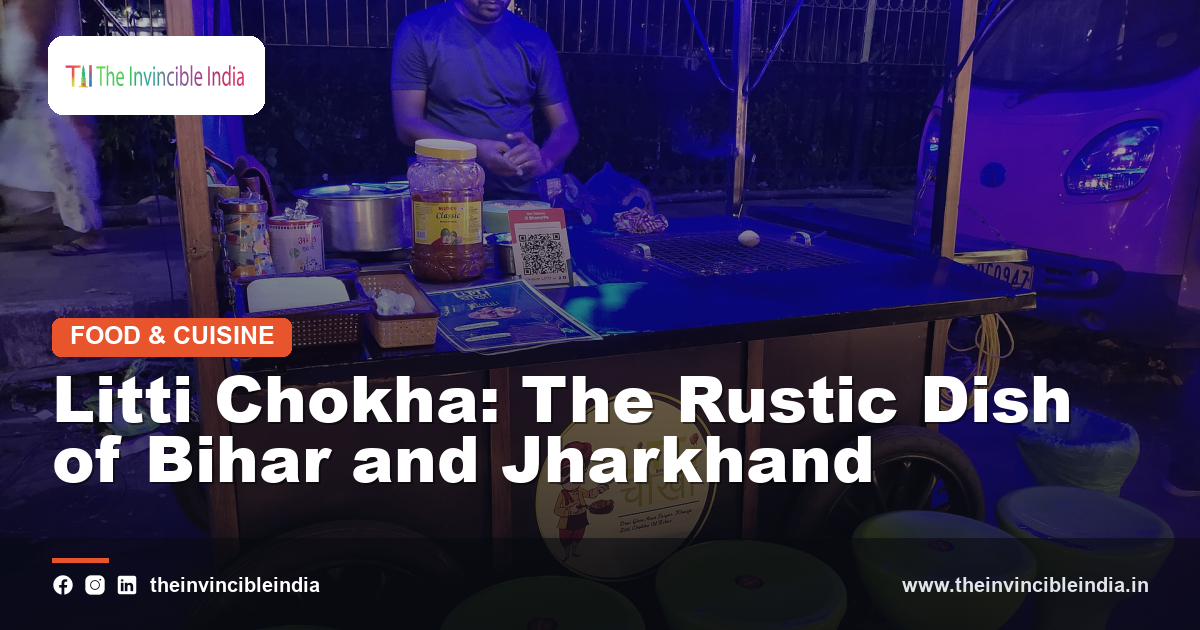
Litti chokha is the most recognisable meal of Bihar and Jharkhand, a rustic combination of roasted wheat dough balls filled with spiced sattu, or roasted gram flour, served with chokha, a smoky mash of roasted vegetables seasoned with mustard oil. The litti is baked over embers until its crust is firm and flecked with char, then dipped in ghee before it is eaten. The dish is simple in its materials and bold in its flavour, and it is cherished as a food of the people, equally at home in village courtyards and city restaurants. Alongside the rice-and-lentil meals described in the guide to the Indian thali, it represents the earthy heart of eastern Indian cooking.
Quick Facts
| Detail | Information |
|---|---|
| Type | Roasted stuffed wheat balls with a vegetable mash |
| Region | Bihar, Jharkhand and eastern Uttar Pradesh |
| Filling | Spiced sattu, or roasted gram flour |
| Chokha | Roasted brinjal, tomato and potato mash |
| Cooking method | Roasted over embers, coal or in an oven |
| Served with | Ghee, dal, chutney and pickle |
What Litti Chokha Is
Litti chokha is a two-part dish in which litti, a round dough ball of whole wheat flour stuffed with a spiced filling, is paired with chokha, a mash of roasted vegetables seasoned with raw mustard oil and aromatics. The litti is baked or roasted until its exterior is hard, brown and lightly charred, giving it a rustic crust that is cracked open and drenched in ghee. The chokha provides a smoky, tangy and slightly fiery counterpart to the dry, nutty litti. Together they make a filling meal that is inexpensive, nourishing and full of character. Litti chokha is therefore a complete and balanced dish in which each component supports the other, and it is widely regarded as the signature food of the region.
Roots in Bihar and Jharkhand
Litti chokha belongs to the cooking traditions of Bihar and the neighbouring state of Jharkhand, and it is also eaten in adjoining parts of eastern Uttar Pradesh. The dish grew out of the rural life of the Gangetic plain, where wheat, gram and vegetables grown in local fields were turned into portable, filling meals that could be prepared with little equipment. Different parts of the region have their own variations, but the central idea of a stuffed, roasted wheat ball with a roasted vegetable mash is consistent. The food is deeply identified with local pride, and people from Bihar who live elsewhere in India often speak of it with great affection. Its origins are therefore agrarian and regional, and its identity is bound to the soil of the middle Gangetic basin.
Stories of Origin
As with many traditional foods, litti is surrounded by popular stories about its beginnings. Some link it with the ancient Magadha region, now part of Bihar, while others associate it with travellers, soldiers and farmers who needed durable food that could be cooked over a simple fire and kept for long periods without spoiling. These accounts are part of local lore and should be treated as such rather than as documented history. What they reveal, however, is a genuine quality of the dish, which is its practicality. A hard-crusted roasted ball that keeps well and fills the stomach is exactly the sort of food that would have suited people on the move. The stories therefore reflect the character of the food even if their details cannot be verified.
The Wheat Dough
The outer shell of the litti is made from a simple dough of whole wheat flour, water and salt, often enriched with a spoonful of ghee or a little oil and sometimes a pinch of carom seeds. The dough is kneaded until firm and then rested so that it becomes easy to shape around the filling. It is deliberately stiffer than the dough used for ordinary flatbreads, since the litti must hold its shape and develop a firm crust when roasted. The simplicity of the dough keeps the focus on the fragrant filling and the smoky flavour from roasting. Whole wheat gives the litti a nutty, wholesome taste. The humble dough thus forms a sturdy and honest casing for the delights inside.
Sattu, the Soul of the Filling
The filling of litti is made from sattu, a flour obtained by roasting chickpeas or Bengal gram and grinding them into a fine, nutty powder. Sattu is a long-standing staple of Bihar and Jharkhand, valued for its filling quality and its ability to be stored and prepared with little effort. For litti it is mixed with raw mustard oil, chopped onion, garlic, green chilli, ginger, lemon juice, carom seeds, fennel and sometimes a pickle masala to produce a crumbly, aromatic and sharply flavoured stuffing. The balance of tang, pungency and nuttiness is what defines the taste of a good litti. Sattu is therefore the soul of the dish, and its roasted fragrance is inseparable from the identity of the litti.
Spices and Seasoning of the Stuffing
The seasoning of the sattu stuffing is bold and distinctive, relying on raw rather than cooked spices. Raw mustard oil lends a sharp, pungent edge that is characteristic of the eastern Indian kitchen, while finely chopped onion and garlic add crunch and bite. Carom seeds and fennel provide a gentle digestive aroma, green chillies add heat and lemon juice brings an essential freshness. Many families add a spoonful of the mixed pickle masala known in the region, giving the filling a tangy, spicy depth. The stuffing is not cooked before use, so these flavours remain fresh and lively. It is this combination of raw and roasted elements that gives the litti its memorable character, a theme that also appears in the guide to Indian spices.
Shaping and Roasting the Litti
To make a litti, a ball of dough is flattened into a small cup, a portion of the sattu mixture is placed inside and the edges are drawn together and sealed to form a closed sphere. The balls are then roasted, traditionally over a fire of coals or dried cow-dung cakes, turned frequently so that they brown evenly and develop a firm crust. This slow roasting allows the filling to cook through gently within its casing and imparts a smoky aroma to the shell. In modern kitchens an oven, a tandoor or a gas flame is often used instead, although many people feel the embers give the best result. The patient roasting is essential to the dish, producing a crust that is firm outside and fragrant within.
The Ghee Dip
No account of litti is complete without mentioning ghee, for the roasted balls are traditionally dipped or even soaked in melted clarified butter before they are served. The ghee softens the hard crust slightly, adds a rich, nutty flavour and balances the dryness of the sattu filling. In rural homes and in the best eateries, the generosity of the ghee is a sign of hospitality, and a litti served without it would be thought incomplete. The golden fat running over the crumbling crust is one of the most appetising sights in Bihari food. Ghee thus completes the litti, turning a plain roasted ball into a rich and satisfying meal.
What Chokha Means
Chokha is a rustic mash prepared from vegetables that are roasted whole over an open flame or embers and then peeled and mashed with seasonings. The word is used for several variations, the best known being baingan chokha, made from brinjal, as well as versions made with potato, tomato or a combination of vegetables. After roasting, the vegetables are mashed with raw mustard oil, chopped onion, garlic, green chilli, coriander and salt, producing a rough, flavourful mixture. The smoky aroma from roasting is the defining quality of a good chokha. It is eaten as an accompaniment to litti but also with plain rice or flatbread. The chokha, in this way, is a simple yet unforgettable expression of the power of roasting.
Baingan, Tomato and Potato Chokha
The standard plate of litti chokha usually includes more than one kind of chokha, most often brinjal, tomato and potato. The brinjal, roasted until its skin is blackened and its flesh turns soft and smoky, yields a creamy mash with a deep, almost meaty flavour. Roasted tomato gives a tangy, slightly sweet and fiery version, while potato chokha, mashed with onion and mustard oil, offers a milder, comforting option. Each is seasoned with the same raw ingredients but tastes different because of the vegetable beneath. Eating them together creates a varied and satisfying plate. The trio of chokhas demonstrates how a few vegetables and a flame can produce a remarkable range of flavours.
The Role of Mustard Oil
Raw mustard oil is the key seasoning in both the litti filling and the chokha, contributing a pungent, nose-tingling sharpness that is deeply rooted in the food of eastern India. Used uncooked, it retains its full strength, which cuts across the richness of ghee and the earthiness of roasted vegetables and sattu. Cooks in Bihar use it with confidence and in generous quantity, since its character is considered essential. The flavour can be startling to those unaccustomed to it, yet it quickly becomes part of the taste memory of anyone who grows up with it. Mustard oil is thus a defining element of the dish, giving it a fiery, distinctive finish that no other fat could provide.
Dal, Chutney and Pickle
A full plate of litti chokha often includes further accompaniments, such as a simple lentil dal, a fresh chutney made from coriander or tomato and a spoonful of tangy pickle. The dal provides a soft, soothing contrast to the firm litti, which can be broken into it so that the crust absorbs the liquid. Chutneys and pickles add sharp, fresh notes that enliven the plate and balance the richness of the ghee. Sliced onion, green chilli and a wedge of lemon are also commonly served alongside. These additions turn a simple dish into a full meal with a wide range of tastes and textures. They show how the humble litti can serve as the centre of a satisfying and complete spread.
Litti Chokha as Street and Fair Food
In Bihar and Jharkhand litti chokha is sold at roadside stalls, railway stations, fairs and festivals, where vendors roast littis over glowing coals and serve them hot with chokha and ghee. The smell of the roasting balls is one of the most familiar and appealing scents of public life in the region. Its low cost, speed and filling nature make it an everyday meal for working people and a popular snack for travellers. Fairs such as the Sonepur cattle fair and the bustle around pilgrimage sites are traditionally places where one can find such food. Litti chokha thus serves as both a working person’s meal and a festive pleasure, bridging the ordinary and the celebratory.
Litti Chokha Beyond the Region
Over the years litti chokha has travelled well beyond Bihar and Jharkhand, carried by migrants who took their food with them to cities across India and abroad. Restaurants specialising in Bihari food have appeared in major cities, and the dish now features at food festivals and in menus devoted to regional Indian cooking. Some chefs present reinvented forms, such as bite-sized littis, baked versions with a lighter touch of ghee or even fusion variants with new fillings. While these innovations attract curious diners, many people maintain that the true taste lies in the smoky, coal-roasted original. The spread of litti chokha shows how a rustic regional dish can win wide appreciation without losing its essential identity.
Litti Chokha Today
Today litti chokha is celebrated as a proud emblem of Bihari and Jharkhandi identity and has gained a place among the best-known regional dishes of India. It continues to be prepared in homes on festive and relaxed occasions, in the traditional style over embers or in modern ovens, and remains a favourite at gatherings where friends and family share a meal. The growing interest in regional cuisines and in wholesome, traditional ingredients such as sattu has brought fresh attention to the dish. Its simple materials, bold seasonings and smoky character endure from generation to generation. Litti chokha today is a reminder that some of the most memorable food in India is also the simplest and most rustic.
Sources & Further Reading
- Ministry of Tourism, Government of India, on the cuisines of India (tourism.gov.in).
- Ministry of Culture, Government of India (indiaculture.gov.in).
Frequently Asked Questions
What is litti chokha?
Litti chokha is a traditional dish of Bihar and Jharkhand consisting of roasted whole wheat balls stuffed with spiced sattu, served with a smoky mash of roasted vegetables called chokha. It is usually eaten with plenty of ghee.
What is sattu?
Sattu is a flour made by roasting chickpeas or Bengal gram and grinding them into a fine powder. It is a long-standing staple in Bihar and Jharkhand and forms the filling of the litti.
What is chokha made of?
Chokha is made from vegetables such as brinjal, tomato or potato that are roasted over a flame, peeled and mashed with raw mustard oil, onion, garlic, green chilli and salt. The roasting gives it a distinctive smoky flavour.
How is litti traditionally cooked?
Litti is traditionally roasted over embers or coals, with the balls turned frequently so that they brown evenly and form a firm, lightly charred crust. Today many people also use an oven or a tandoor.
Why is litti dipped in ghee?
The ghee softens the hard crust, adds richness and nutty flavour and balances the dryness of the sattu filling. Serving litti without ghee is generally thought to leave the dish incomplete.


