

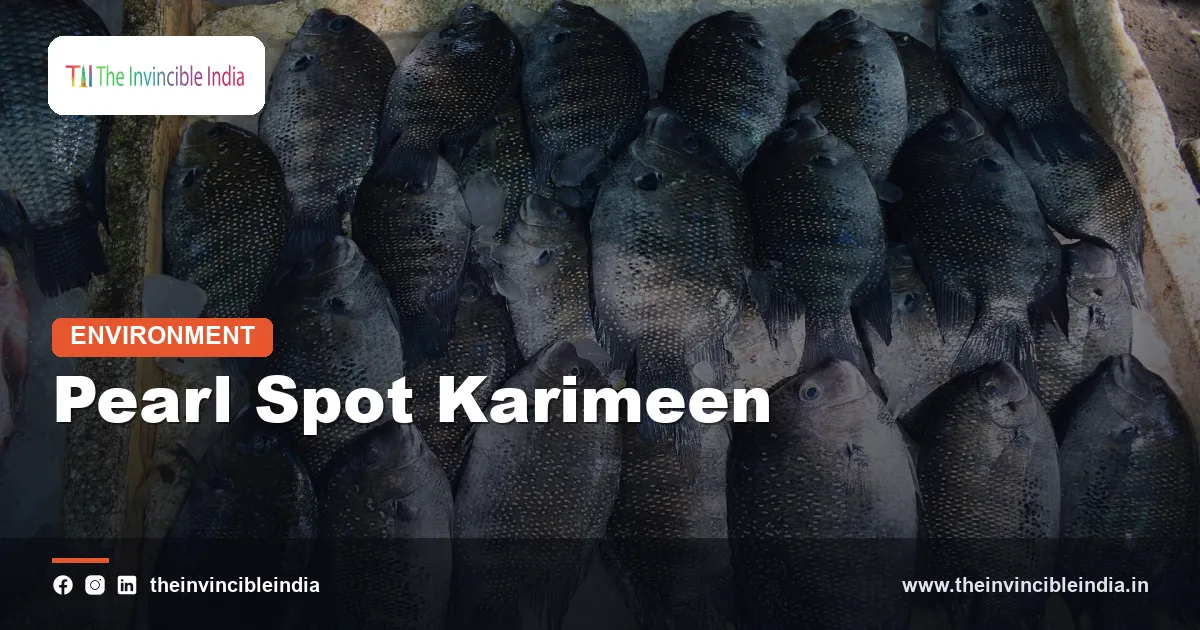
The pearl spot (Etroplus suratensis), known as karimeen in Malayalam, is a deep-bodied, olive-green cichlid fish of the brackish backwaters and estuaries of southern India, and it is the official state fish of Kerala. Prized for its firm, flavourful flesh, the pearl spot is the star of the famous Kerala dish karimeen pollichathu.
Unlike most food fish, the pearl spot is a devoted parent, with both partners guarding eggs and fry. This explainer covers where the fish lives, how it breeds and feeds, why Kerala adopted it as a symbol, how it is cooked, and how its growing aquaculture is changing the backwater economy.
| Quick Facts | Details |
|---|---|
| Scientific name | Etroplus suratensis (Bloch, 1790) |
| Family | Cichlidae (cichlids) |
| Other names | Karimeen (Malayalam), green chromide, banded pearl spot |
| Native range | Coastal peninsular India, mainly Kerala, Tamil Nadu and Karnataka, and Sri Lanka |
| Habitat | Brackish backwaters, estuaries, lagoons and some freshwater lakes |
| Size | Commonly 20 to 30 cm; larger fish can reach about 40 cm |
| Breeding | Pairs lay eggs on hard surfaces and both parents guard eggs and young |
| Official status | State fish of Kerala, declared in 2010 |
| Signature dish | Karimeen pollichathu, cooked in banana leaf |
Key Takeaways
- The pearl spot (Etroplus suratensis) is a cichlid fish native to the coastal waters of southern India and Sri Lanka, and its Malayalam name is karimeen.
- The pearl spot was declared the state fish of Kerala in 2010 and is closely tied to the identity of the Vembanad and Kuttanad backwaters.
- The pearl spot tolerates a wide range of salinity, living in water from almost fresh to strongly salty.
- Pearl spot pairs look after their eggs and young together, which is unusual among food fish and helps the young survive.
- Karimeen pollichathu, in which marinated pearl spot is fried and roasted in banana leaf, is Kerala’s best-known fish dish.
- Hatchery seed production and cage and pond farming of the pearl spot have grown, but wild populations remain under pressure from overfishing, pollution and changes to backwater flow.
What is the pearl spot fish?
The pearl spot is a medium-sized brackish-water fish of the cichlid family, scientifically named Etroplus suratensis, found along the southern coast of India and in Sri Lanka. It is the largest of the three species in the genus Etroplus and the only one of them that is a major food fish.
Cichlids are better known worldwide as aquarium fish from Africa and South America, so the pearl spot is a rare example of a cichlid that is a prized table fish in Asia. It is a hardy species that can live in lagoons, estuaries and some inland lakes, and it forms the backbone of small-scale fisheries around Kerala’s backwaters.
Its scientific name refers to Surat in Gujarat, the place named in the original eighteenth-century description, although the fish is now best known from Kerala.
Why is the pearl spot called karimeen?
The pearl spot is called karimeen in Malayalam because the name means “black fish”, describing the dark, olive-black cast of its body, while the English name pearl spot refers to the pale, pearly spots on its scales. The English term “green chromide” describes its greenish sheen.
The names reflect how people see the fish:
- Karimeen: “kari” means black and “meen” means fish in Malayalam.
- Pearl spot: small, light-coloured spots scattered along the flanks look like pearls against the darker body.
- Green chromide: an older English name used in fish literature.
In everyday life across Kerala, karimeen is used for the fish at markets, in restaurants and in homes, and the Malayalam name is also widely used by visitors to the state.
Where is the pearl spot found?
The pearl spot is found in the backwaters, estuaries, coastal lagoons and tidal creeks of Kerala, Tamil Nadu and Karnataka, and also in Sri Lanka, and it can live in everything from nearly fresh water to strongly salty water. Famous habitats include the Vembanad Lake and the Ashtamudi Lake in Kerala.
Its habitat has these features:
- Shallow, sheltered water with muddy or sandy bottoms and aquatic plants.
- Submerged structures such as rocks, shells, roots and fallen wood for laying eggs.
- Tidal mixing of fresh and sea water, which gives brackish conditions.
The ability to cope with changing salinity, which scientists call euryhaline tolerance, helps the pearl spot survive monsoon floods that freshen the backwaters and summer drying that increases salt levels.
What does a pearl spot look like?
A pearl spot looks like a deep-bodied, laterally flattened fish with an olive-green to dark body, faint vertical bars on its sides, and many tiny pale spots scattered across the scales. Its compact, oval shape and long dorsal fin set it apart from the slimmer carps.
Notable points of appearance include:
- Body: greenish to brown, with a golden or silvery tint in some lights.
- Spots: pale, pearl-like dots on the scales, which are most visible in the living fish.
- Fins: a long dorsal fin with strong spines in front, and an anal fin with spines too, a typical cichlid feature.
- Size: usually 20 to 30 cm in the catch, with a few larger individuals.
During breeding, the body colour becomes darker and the fish take on a more marked pattern, which signals that a pair is guarding a nest.
What does the pearl spot eat?
The pearl spot is an omnivore that eats algae, aquatic plants, detritus and small invertebrates such as insect larvae, worms and tiny crustaceans. Its diet gives its flesh a clean, mild flavour that cooks well with strong spices.
The fish feeds mostly in shallow water, grazing on plant matter and picking small organisms from the bottom and from submerged surfaces. Young fish take more animal food, and adults eat more plant material.
This mixed diet is useful in aquaculture. Farmers can raise pearl spot in ponds and cages with a combination of natural food and supplementary feed, and the species can also be raised alongside shrimp or other fish in carefully managed brackish ponds.
How does the pearl spot care for its young?
The pearl spot cares for its young through biparental care, meaning that both the male and the female guard the eggs and the fry. This devoted behaviour is the best-known biological feature of the species and is typical of many cichlids.
The process runs in stages:
- Pair formation: a male and female form a pair and choose a hard surface, such as a rock, shell or piece of wood.
- Egg laying: the female lays eggs in rows on the cleaned surface, and the male fertilises them.
- Guarding: the parents fan the eggs with their fins to keep them oxygenated and chase away predators.
- Caring for fry: after hatching, the parents shepherd the young in a school, and the fry have been reported to nibble mucus on the parents’ bodies for food.
Because parents guard their offspring, more young survive than in fish that scatter eggs, so pearl spot produce fewer eggs than carps but enjoy better odds for each.
Why is the pearl spot the state fish of Kerala?
The pearl spot is the state fish of Kerala because it is closely linked to the state’s backwaters, cuisine and fishing communities, and the government formally declared karimeen the state fish in 2010. The choice recognised the cultural and economic value of the species.
Several reasons support the status:
- The fish is abundant in Vembanad, Ashtamudi and other backwaters that define Kerala’s landscape.
- Karimeen dishes are central to Kerala’s coastal and backwater food culture and to its tourism.
- The fish is a livelihood for thousands of fishers and, increasingly, for fish farmers.
- Its conservation reflects the health of the backwaters themselves.
Visitors to Alappuzha, Kumarakom and the Kuttanad region often seek out pearl spot as their first taste of Kerala cuisine.
What is karimeen pollichathu?
Karimeen pollichathu is a Kerala dish in which a whole pearl spot is marinated in spices, shallow-fried, covered with an onion and tomato masala, wrapped in a banana leaf and cooked until the flavours blend. The word “pollichathu” refers to this style of cooking in a leaf.
The basic method has these steps:
- Clean the fish and make shallow cuts on both sides.
- Marinate with chilli, turmeric, pepper, ginger, garlic, salt and a souring agent such as lime or tamarind.
- Fry lightly in coconut oil.
- Prepare a masala of shallots or onion, tomato, curry leaves and spices.
- Place the fish and the masala on a banana leaf, wrap, and cook on a pan or in an oven until aromatic.
Other popular pearl spot dishes include karimeen fry, karimeen mappas (in coconut milk) and spicy curries in earthen pots. Recipes differ by household, so these steps give only a general outline.
How is the pearl spot farmed?
The pearl spot is farmed in brackish ponds, cages and paddy-shrimp fields, using seed produced in hatcheries or collected from the wild, and it is raised for the high-value market. The Central Marine Fisheries Research Institute (CMFRI) at Kochi and other institutions in Kerala have worked on breeding and farming techniques for this species.
Farm systems include:
- Pond culture: stocking fingerlings in brackish ponds with natural food and supplementary feed.
- Cage culture: rearing fish in floating or fixed cages in backwaters.
- Integrated farming: raising pearl spot with shrimp or in traditional pokkali fields, where paddy and fish are produced in rotation.
The fish grows more slowly than carps and needs good water quality, so farmers rely on careful management. The strong market price, however, makes it attractive, and demand often exceeds supply.
How does the pearl spot compare with related fish?
The pearl spot is one of three fish in the genus Etroplus, which are cichlids found in southern India and Sri Lanka. The table compares them.
| Species | Common name | Habitat | Notes |
|---|---|---|---|
| Etroplus suratensis | Pearl spot, green chromide, karimeen | Brackish backwaters and estuaries | Largest species; important food fish |
| Etroplus maculatus | Orange chromide | Brackish and fresh water | Small; popular in the aquarium trade |
| Etroplus canarensis | Canara pearl spot | Freshwater streams of the Western Ghats | Restricted to a small area and considered threatened |
Only the pearl spot is a large commercial species. The other two are mainly of interest for ornamental use or conservation.
Is the pearl spot threatened?
The pearl spot is still caught in large numbers, but wild stocks in some backwaters have declined because of overfishing, pollution and changes to water flow. Conservation concern has grown in Kerala, where catches have fluctuated and fish kills have been reported.
The main pressures are:
- Overfishing: including the capture of young fish and fishing during the breeding period.
- Pollution: from untreated sewage, agricultural run-off and industrial effluent.
- Habitat change: reclamation, mangrove loss and structures that alter salinity and tidal flow, such as barrages.
- Disease and kills: sudden drops in oxygen or sharp changes in salinity can cause deaths.
Hatchery-reared seed released into backwaters, closed seasons and better water management are among the measures used to support wild populations.
Bottom Line
The pearl spot is more than a tasty fish: it is a symbol of Kerala’s backwaters, a model of parental devotion and a growing aquaculture crop. Protecting the estuarine habitat that it depends on will matter as much as farming it.
Frequently Asked Questions
What is a pearl spot fish?
A pearl spot is a brackish-water cichlid fish, scientifically named Etroplus suratensis, found in the backwaters and estuaries of southern India and Sri Lanka. It is known as karimeen in Malayalam and is the state fish of Kerala. Pale pearl-like spots on its olive-green body give it its English name.
What does karimeen mean?
Karimeen means “black fish” in Malayalam, from kari for black and meen for fish. The name describes the dark, olive-black colour of the pearl spot. It is the common name for the fish across Kerala.
Is the pearl spot a freshwater or saltwater fish?
The pearl spot is mainly a brackish-water fish, but it tolerates a wide range of salinity. It lives in estuaries and backwaters where fresh and sea water mix, and also in some freshwater lakes. This flexibility helps it survive monsoon floods and dry-season changes.
What is karimeen pollichathu?
Karimeen pollichathu is a Kerala dish of pearl spot marinated in spices, fried, topped with an onion and tomato masala and cooked wrapped in banana leaf. The leaf gives the dish a distinctive aroma. It is one of the best-known fish dishes in Kerala cuisine.
Why is the pearl spot the state fish of Kerala?
The pearl spot is the state fish of Kerala because of its close link with the backwaters, cuisine and fishing communities of the state. Kerala declared karimeen the state fish in 2010. The title recognises its cultural and economic importance.
Can the pearl spot be farmed?
Yes, the pearl spot can be farmed in brackish ponds, cages and integrated paddy-shrimp fields, using seed from hatcheries or the wild. Research institutions such as CMFRI have developed breeding and culture methods. The fish grows slowly, but its high price makes farming worthwhile.
{“@context”:”https://schema.org”,”@graph”:[{“@type”:”FAQPage”,”mainEntity”:[{“@type”:”Question”,”name”:”What is a pearl spot fish?”,”acceptedAnswer”:{“@type”:”Answer”,”text”:”A pearl spot is a brackish-water cichlid fish, scientifically named Etroplus suratensis, found in the backwaters and estuaries of southern India and Sri Lanka. It is known as karimeen in Malayalam and is the state fish of Kerala. Pale pearl-like spots on its olive-green body give it its English name.”}},{“@type”:”Question”,”name”:”What does karimeen mean?”,”acceptedAnswer”:{“@type”:”Answer”,”text”:”Karimeen means “black fish” in Malayalam, from kari for black and meen for fish. The name describes the dark, olive-black colour of the pearl spot. It is the common name for the fish across Kerala.”}},{“@type”:”Question”,”name”:”Is the pearl spot a freshwater or saltwater fish?”,”acceptedAnswer”:{“@type”:”Answer”,”text”:”The pearl spot is mainly a brackish-water fish, but it tolerates a wide range of salinity. It lives in estuaries and backwaters where fresh and sea water mix, and also in some freshwater lakes. This flexibility helps it survive monsoon floods and dry-season changes.”}},{“@type”:”Question”,”name”:”What is karimeen pollichathu?”,”acceptedAnswer”:{“@type”:”Answer”,”text”:”Karimeen pollichathu is a Kerala dish of pearl spot marinated in spices, fried, topped with an onion and tomato masala and cooked wrapped in banana leaf. The leaf gives the dish a distinctive aroma. It is one of the best-known fish dishes in Kerala cuisine.”}},{“@type”:”Question”,”name”:”Why is the pearl spot the state fish of Kerala?”,”acceptedAnswer”:{“@type”:”Answer”,”text”:”The pearl spot is the state fish of Kerala because of its close link with the backwaters, cuisine and fishing communities of the state. Kerala declared karimeen the state fish in 2010. The title recognises its cultural and economic importance.”}},{“@type”:”Question”,”name”:”Can the pearl spot be farmed?”,”acceptedAnswer”:{“@type”:”Answer”,”text”:”Yes, the pearl spot can be farmed in brackish ponds, cages and integrated paddy-shrimp fields, using seed from hatcheries or the wild. Research institutions such as CMFRI have developed breeding and culture methods. The fish grows slowly, but its high price makes farming worthwhile.”}}]}]}


