

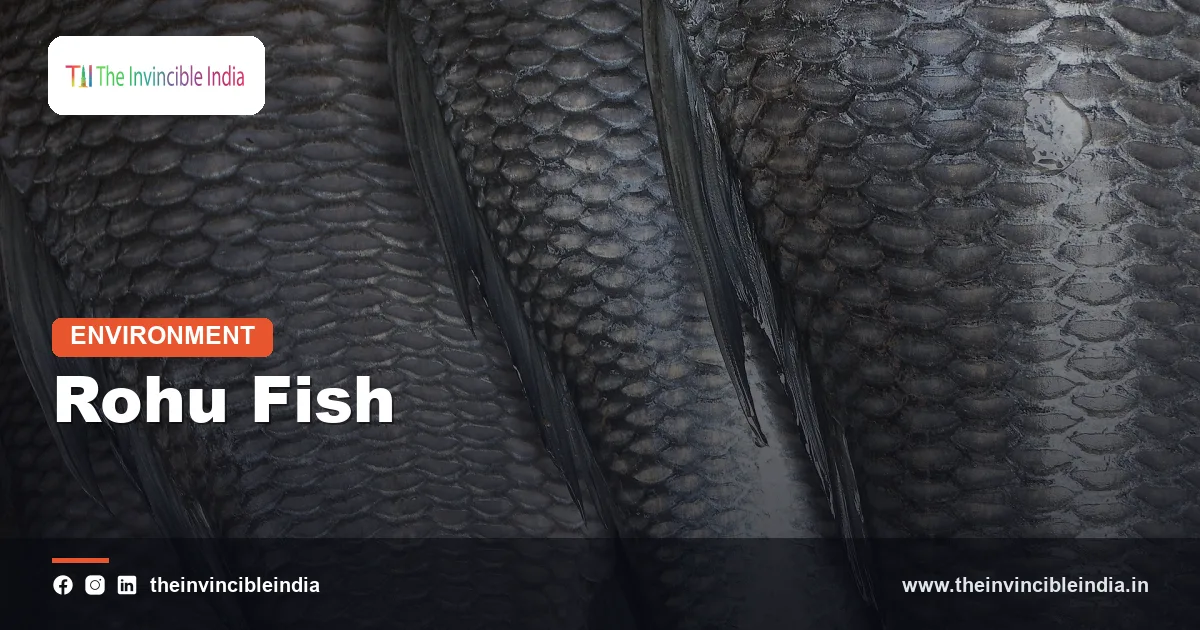
The rohu (Labeo rohita) is a large, silvery freshwater carp native to the rivers of northern, central and eastern India, and it is the country’s most important freshwater food fish. Known as rui in Bengali and rohi in Odia, the rohu is raised in ponds across India alongside catla and mrigal, and it is a staple of Bengali, Odia and Assamese cooking.
This explainer covers the rohu’s biology, how it breeds, how it is farmed in the composite carp system that feeds millions of people, its place in regional cuisine, and the risks it faces from disease and weak hatchery practices.
| Quick Facts | Details |
|---|---|
| Scientific name | Labeo rohita (Hamilton, 1822) |
| Family | Cyprinidae (carps and minnows) |
| Group | Indian major carp, together with catla and mrigal |
| Native range | River systems of northern, central and eastern India, and neighbouring Nepal, Bangladesh, Pakistan and Myanmar |
| Common names | Rohu or rohi (Hindi, Odia), rui (Bengali), rou (Assamese), ravu (Telugu) |
| Feeding habit | Mostly a column feeder on plankton, plant matter and detritus |
| Spawning | In rivers and floodplains during the monsoon; induced breeding in hatcheries since 1957 |
| Growth in ponds | Commonly around 1 kg in about a year under good management |
| Main role | Mainstay of Indian freshwater aquaculture and eastern Indian cuisine |
Key Takeaways
- The rohu (Labeo rohita) is an Indian major carp of the family Cyprinidae and the most widely farmed freshwater fish in India.
- Rohu feeds mainly in the middle layer of the water, so it can share a pond with catla, which feeds near the surface, and mrigal, which feeds near the bottom.
- Rohu breeds naturally in rivers during the monsoon, and induced breeding by hormone injection was developed in India in 1957 at Cuttack, which made large-scale seed production possible.
- Composite carp culture, which stocks rohu with catla, mrigal and sometimes other carps, is the standard method of freshwater fish farming in India.
- Rohu is central to Bengali, Odia and Assamese cuisine, appearing in dishes such as rui macher jhol, rui kalia and muri ghonto.
- Rohu farming faces risks from diseases such as epizootic ulcerative syndrome (EUS) and from declining quality of hatchery brood stock.
What is the rohu fish?
The rohu is a freshwater carp, scientifically named Labeo rohita, that grows large, has a silvery body and is the best-known of the three Indian major carps. It was described scientifically in the early nineteenth century by the Scottish naturalist Francis Hamilton from fish of the Ganges region.
The fish has long been caught in rivers, lakes and floodplains of the Gangetic plain and has been cultured in ponds for centuries. In modern times it has become the foundation of inland fish farming. Rohu has also been introduced to other countries in Asia and beyond for aquaculture, so it is now farmed well outside its native range.
The International Union for Conservation of Nature (IUCN) has generally assessed the rohu as a species of lower conservation concern, but wild populations in some rivers have declined through overfishing, dams and pollution.
Where is the rohu found?
The rohu is native to the river systems of northern, central and eastern India, including the Ganga, Yamuna, Brahmaputra and Mahanadi basins, and it also occurs naturally in Nepal, Bangladesh, Pakistan and Myanmar. Today the species is farmed in nearly every Indian state with suitable ponds, tanks and reservoirs.
Within its range the rohu lives in:
- Slow to moderate rivers and their floodplains.
- Oxbow lakes, wetlands and large ponds.
- Reservoirs and irrigation tanks, where it is often stocked.
The fish prefers warm, well-oxygenated, freshwater conditions and does best at temperatures common in tropical and subtropical India. Seasonal floods carry young rohu into flooded fields and wetlands, which act as nurseries.
What does a rohu look like?
A rohu looks like a deep-bodied, laterally flattened carp with a small head, a silvery body with a bluish or brownish back, and reddish tinges on the fins and around the eyes. Adults develop a streamlined shape and large, firm scales.
The main identification features are:
- Mouth: small, slightly downward-pointing, with thick fringed lips, typical of the genus Labeo.
- Head: short and rounded, in contrast to the broad, large head of the catla.
- Scales: large and silvery, with a darker edge on those along the back.
- Fins: a single dorsal fin and a forked tail, with reddish colour on the pectoral and pelvic fins in many adults.
Fully grown rohu in the wild can exceed a metre in length and weigh tens of kilograms, although fish in markets are usually much smaller.
What does the rohu eat?
The rohu is mainly a column feeder, which means it takes food from the middle layer of the water, and it eats plankton, decaying plant matter, algae and small organisms. Young rohu feed on microscopic zooplankton, then shift gradually to plant-based foods as they grow.
This feeding habit matters for farming. In a pond the three major carps use different parts of the habitat:
- Catla feeds mostly near the surface, on zooplankton.
- Rohu feeds in the middle layers.
- Mrigal feeds near the bottom, on detritus and settled organisms.
Because the fish occupy different feeding zones, farmers can stock them together and use the natural food in the whole water column. Supplementary feed such as rice bran and oil cake is added to speed up growth.
How does the rohu breed?
The rohu breeds in rivers and floodplains during the monsoon, when rising water and rain trigger spawning, and females lay very large numbers of small eggs. A single female can release several lakh eggs in a season, and the fertilised eggs drift in the current before hatching in a day or so.
In ponds, rohu usually does not breed naturally. For decades fish farmers relied on collecting wild spawn from rivers, which was uncertain. A turning point came in 1957, when scientists at the Pond Culture Division at Cuttack in Odisha, led by Hiralal Chaudhuri and associates, successfully induced Indian major carps to spawn by injecting pituitary gland extract. This technique, called hypophysation, made hatchery production dependable.
Today hatcheries use synthetic hormone preparations instead of pituitary extract. Brood fish are selected, injected, allowed to spawn in tanks, and their eggs are hatched in controlled conditions.
Why is the rohu important to Indian aquaculture?
The rohu is important to Indian aquaculture because it grows fast, accepts simple feeds, fetches a steady price and thrives in the polyculture system used in most freshwater ponds. India is among the world’s leading fish producers, and freshwater aquaculture, based largely on the Indian major carps, supplies a large share of the country’s farmed fish.
Several reasons explain its popularity:
- Consumers in the east and many other regions strongly prefer its taste and texture.
- Seed is widely available from hatcheries, mostly in states such as West Bengal, Andhra Pradesh and Odisha.
- The fish tolerates ordinary pond conditions and needs modest inputs.
- It lets small and marginal farmers earn income from village ponds and tanks.
Government schemes, research institutes such as the Central Institute of Freshwater Aquaculture (CIFA) at Bhubaneswar and the Central Inland Fisheries Research Institute (CIFRI) at Barrackpore have supported the sector with seed, training and breeding programmes.
What is composite carp culture, and where does the rohu fit?
Composite carp culture is a method of raising several carp species together in one pond so that each species uses a different food zone, and the rohu is its middle-layer component. The traditional combination uses the three Indian major carps, and farms often add exotic carps as well.
| Species | Scientific name | Feeding zone | Main food |
|---|---|---|---|
| Catla | Catla catla | Surface | Zooplankton |
| Rohu | Labeo rohita | Middle (column) | Plankton, plant matter, detritus |
| Mrigal | Cirrhinus mrigala | Bottom | Detritus, decaying matter |
| Silver carp | Hypophthalmichthys molitrix | Surface (introduced) | Phytoplankton |
| Grass carp | Ctenopharyngodon idella | All layers (introduced) | Aquatic plants |
| Common carp | Cyprinus carpio | Bottom (introduced) | Insects, detritus |
Stocking ratios vary with pond conditions and farm management. The goal is to use all the natural food available while limiting competition between species.
How is the rohu farmed?
The rohu is farmed by stocking fingerlings in a prepared pond, feeding them both natural and supplementary food, and harvesting them after roughly a year, when they commonly weigh around a kilogram. Growth depends on the water, the feed, the stocking density and the weather.
The usual steps are:
- Pond preparation: drying or treating the pond, adding lime and manure or fertiliser to encourage plankton.
- Seed stocking: buying spawn from a hatchery, rearing it to fry and fingerlings in nursery ponds and then moving fingerlings to the grow-out pond.
- Feeding: giving mixtures such as rice bran and oil cake or commercial pellets, while maintaining plankton.
- Health management: watching water quality, dissolved oxygen and signs of disease.
- Harvest: netting the pond once fish reach market size, often with partial harvests along the way.
Selective breeding has also been tried. An improved strain known as Jayanti rohu was developed by CIFA in collaboration with a Norwegian institute and released in the late 1990s, to offer faster growth than ordinary hatchery stock.
Why is the rohu so important in Bengali and eastern Indian cuisine?
The rohu is important in Bengali and eastern Indian cuisine because it is the everyday, affordable and widely loved freshwater fish of these regions, served at family meals and at festivals. In Bengali homes, rui is the standard fish for the daily lunch, and a whole decorated rui or similar large fish is a traditional gift at weddings.
Well-known dishes include:
- Rui macher jhol: a light curry of rohu with potatoes, turmeric and cumin.
- Rui kalia: a richer, spicier preparation with a thick gravy.
- Muri ghonto: a dish in which rice is cooked with the fish head, ghee and spices.
- Doi maach: rohu cooked in a yoghurt-based gravy.
- Masor tenga (Assam): a sour curry, often made with rohu, lemon or tomato.
- Rohi besara (Odisha): fish cooked in a mustard-based sauce.
The fish has many fine intermuscular bones, so cooks cut it into pieces that are easier to eat or fry them until crisp.
What are the health and nutrition aspects of eating rohu?
Rohu is a good source of protein and provides vitamins and minerals, with a lower fat content than many oily marine fish. Like other freshwater carps, it offers moderate amounts of omega-3 fatty acids, though fewer than fatty fish such as sardines or mackerel.
Points to keep in mind include:
- Fish should be fresh, cleaned well and cooked thoroughly.
- Fine bones need care, especially when feeding children.
- Farm practices such as clean water, careful feed use and sensible medication determine the quality and safety of the fish.
Nutrient values differ with the size of the fish, the season and the way it is cooked, so readers needing precise figures should consult official food composition tables.
What problems does rohu farming face?
Rohu farming faces three main problems: disease, declining quality of hatchery stock and pressure on water and land. Together these threaten both yields and the genetic health of the species.
The main risks are:
- Disease: epizootic ulcerative syndrome (EUS), parasites such as Argulus, and bacterial infections can cause heavy losses, especially in cold or poorly managed ponds.
- Inbreeding: hatcheries that reuse a small number of brood fish risk weakening growth and survival.
- Water pressure: pollution, drought and competition for land and water affect ponds and rivers alike.
- Wild stocks: dams and barrages, over-fishing and habitat loss reduce natural breeding in rivers.
Responses include better brood stock management, genetic improvement programmes, good pond hygiene and conservation of river habitats.
Bottom Line
The rohu is the backbone of India’s freshwater fish farming and a beloved food fish in the east of the country. Keeping hatchery stock healthy, managing ponds well and protecting river habitats will determine whether the rohu continues to feed millions of people.
Frequently Asked Questions
What is a rohu fish?
A rohu is a large, silvery freshwater carp, scientifically named Labeo rohita, that is native to rivers of northern, central and eastern India. It is one of the three Indian major carps, along with catla and mrigal. It is the most widely farmed and eaten freshwater fish in India.
What is the Bengali name for rohu?
The Bengali name for rohu is rui. In Odia it is called rohi, in Assamese rou and in Telugu ravu. Hindi speakers commonly use the name rohu.
What does the rohu eat?
The rohu eats plankton, algae, decaying plant matter and other small organisms from the middle layer of the water. Young fish feed on zooplankton and gradually shift to plant-based food. In farms, it is also given supplementary feed such as rice bran and oil cake.
How long does a rohu take to grow in a farm pond?
A rohu commonly takes about a year to reach roughly one kilogram in a well-managed pond. Growth varies with water temperature, feed, stocking density and pond conditions. Fish kept longer can grow much larger.
What is composite carp culture?
Composite carp culture is a fish farming method in which several carp species, usually rohu, catla and mrigal, are raised together in one pond. Each species feeds in a different layer of the water, which makes full use of the natural food. It is the standard system of freshwater aquaculture in India.
Is rohu a healthy fish to eat?
Yes, rohu is a nutritious fish that provides protein, vitamins and minerals and is relatively low in fat. It has fewer omega-3 fatty acids than oily fish such as sardines. It should be well cooked, and its fine bones need care when eaten.
{“@context”:”https://schema.org”,”@graph”:[{“@type”:”FAQPage”,”mainEntity”:[{“@type”:”Question”,”name”:”What is a rohu fish?”,”acceptedAnswer”:{“@type”:”Answer”,”text”:”A rohu is a large, silvery freshwater carp, scientifically named Labeo rohita, that is native to rivers of northern, central and eastern India. It is one of the three Indian major carps, along with catla and mrigal. It is the most widely farmed and eaten freshwater fish in India.”}},{“@type”:”Question”,”name”:”What is the Bengali name for rohu?”,”acceptedAnswer”:{“@type”:”Answer”,”text”:”The Bengali name for rohu is rui. In Odia it is called rohi, in Assamese rou and in Telugu ravu. Hindi speakers commonly use the name rohu.”}},{“@type”:”Question”,”name”:”What does the rohu eat?”,”acceptedAnswer”:{“@type”:”Answer”,”text”:”The rohu eats plankton, algae, decaying plant matter and other small organisms from the middle layer of the water. Young fish feed on zooplankton and gradually shift to plant-based food. In farms, it is also given supplementary feed such as rice bran and oil cake.”}},{“@type”:”Question”,”name”:”How long does a rohu take to grow in a farm pond?”,”acceptedAnswer”:{“@type”:”Answer”,”text”:”A rohu commonly takes about a year to reach roughly one kilogram in a well-managed pond. Growth varies with water temperature, feed, stocking density and pond conditions. Fish kept longer can grow much larger.”}},{“@type”:”Question”,”name”:”What is composite carp culture?”,”acceptedAnswer”:{“@type”:”Answer”,”text”:”Composite carp culture is a fish farming method in which several carp species, usually rohu, catla and mrigal, are raised together in one pond. Each species feeds in a different layer of the water, which makes full use of the natural food. It is the standard system of freshwater aquaculture in India.”}},{“@type”:”Question”,”name”:”Is rohu a healthy fish to eat?”,”acceptedAnswer”:{“@type”:”Answer”,”text”:”Yes, rohu is a nutritious fish that provides protein, vitamins and minerals and is relatively low in fat. It has fewer omega-3 fatty acids than oily fish such as sardines. It should be well cooked, and its fine bones need care when eaten.”}}]}]}


