

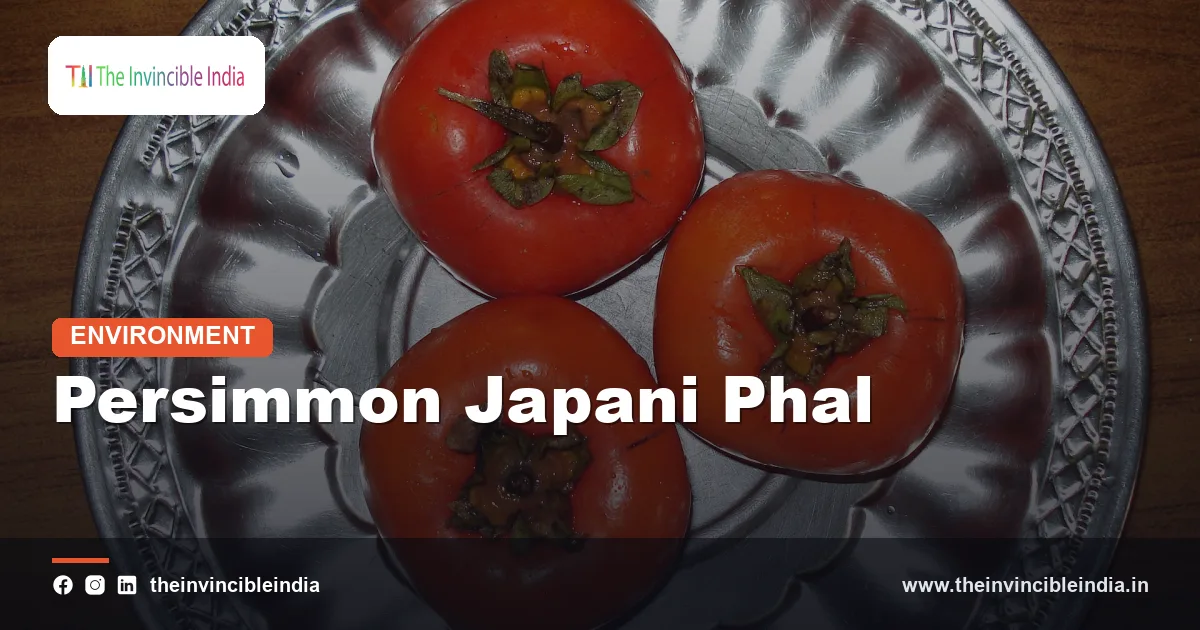
The persimmon is the orange, tomato-shaped fruit of the deciduous tree Diospyros kaki, a member of the ebony family that ripens in the cool, bright weeks of autumn, and in India it is known as japani phal (“Japanese fruit”) or amlok. The tree is native to China, was refined over centuries in Japan and Korea, and reached the Indian hills in the colonial period, where it settled into orchards in Himachal Pradesh, Jammu and Kashmir, Uttarakhand and the Nilgiris.
A persimmon tree is easy to recognise in late October and November. Its leaves turn red and fall, but the heavy, glowing fruits stay hanging on bare branches like lanterns. This article explains what the persimmon is, how it grows, why some types are astringent and others are not, where it is cultivated in India, how it is eaten and what it offers nutritionally.
Quick Facts
| Common names | Persimmon, Japanese persimmon, kaki; japani phal and amlok in Hindi-speaking regions |
|---|---|
| Scientific name | Diospyros kaki |
| Family | Ebenaceae (the ebony family) |
| Native region | China, with long cultivation in Japan and Korea |
| Where grown in India | Mid-hill areas of Himachal Pradesh, Jammu and Kashmir, Uttarakhand, parts of Punjab foothills and the Nilgiri hills |
| Season | Flowers in spring; fruit ripens roughly from October to December |
| Part used | Ripe fruit, eaten fresh or dried; leaves in some traditional teas |
| Main uses | Table fruit, dried fruit, pulp for puddings and jams, ornamental autumn tree |
| Importance | A valued temperate fruit for hill farmers that ripens late, when little other fruit is available |
Key Takeaways
- The persimmon (Diospyros kaki) is a deciduous fruit tree of the ebony family, and its orange fruit ripens in autumn after the leaves have fallen.
- Persimmon types are divided into astringent varieties, which must be fully soft or treated before eating, and non-astringent varieties, which can be eaten while still firm.
- Persimmon is called japani phal or amlok in India and is grown mainly in the temperate and sub-temperate hills of the north and in the Nilgiris.
- The astringency of a persimmon comes from soluble tannins, which become insoluble as the fruit ripens or is treated, making the fruit sweet.
- Persimmon fruit is a good source of beta-carotene, vitamin C and dietary fibre, and is a low-fat fruit.
- Persimmon trees are long-lived and bear heavily, but they need some winter chill, well-drained soil and careful handling because ripe fruit bruises easily.
What is a persimmon?
A persimmon is the fleshy berry of a tree in the genus Diospyros, and the cultivated Asian species Diospyros kaki produces the large, smooth, orange fruit sold in markets. Botanically the fruit is a berry, though it looks like a small pumpkin or a flattened tomato, and it is topped with a leafy, four-lobed cap called the calyx that stays attached after harvest.
The genus Diospyros contains hundreds of species, mostly in the tropics and subtropics. Its name comes from Greek words meaning “fruit of the gods”, an old compliment to the sweetness of well-ripened fruit. Many of its relatives are valued for timber: ebony, the black heartwood prized for carving and musical instruments, comes from Diospyros trees, and so does the tendu tree (Diospyros melanoxylon) of central India, whose leaves are used to wrap bidis.
The persimmon grown for fruit is a medium-sized tree, usually between six and ten metres tall in an orchard if left unpruned, though growers keep it lower to make picking easier. Its leaves are broad, glossy and leathery, and the bark is dark and finely cracked into small blocks. In India it is a temperate-zone fruit, which means it is largely a crop of hills rather than plains.
Why is the persimmon called japani phal in India?
The persimmon is called japani phal in India because Indian growers and traders associated the fruit with Japan, where the kaki persimmon is a national favourite and where the most widely planted varieties were selected. In Hindi the phrase simply means “Japanese fruit”, while the name amlok is used in several northern regions for the same fruit.
The tree itself did not originate in Japan. Its wild ancestors are thought to come from central and eastern China, where it has been cultivated for well over a thousand years. Japanese and Korean growers then developed many named varieties, and it is these selections that most exporting countries and Indian orchards inherited. The English word persimmon, in contrast, comes from an Algonquian language of North America, where a different native species, the American persimmon (Diospyros virginiana), grows wild.
Because common names vary from district to district, it is worth noting that “amlok” and “japani phal” sometimes also refer to related Diospyros fruits, such as the small date-plum (Diospyros lotus), which is used by nurseries as a rootstock. The large orange table fruit, however, is the Asian persimmon.
How is a persimmon tree grown?
A persimmon tree is grown from a grafted sapling planted in deep, well-drained loamy soil in a place that gets a cool winter, plenty of sunshine and protection from strong wind. Gardeners rarely raise it from seed, because seedlings vary widely in fruit quality and take many years to bear.
Climate and soil
Persimmon prefers a mild temperate climate and needs a period of winter chill so that its buds break evenly in spring. It tolerates a wider range of conditions than apples or pears, which is one reason it has done well in sub-temperate valleys. Heavy waterlogging is its main enemy, so orchards are laid out on slopes or raised beds with good drainage.
Propagation and rootstock
Almost all commercial trees are grafted. The scion, which is the fruiting variety, is joined to a rootstock such as Diospyros lotus or Diospyros kaki seedlings. The rootstock decides how well the tree handles drought, cold and soil problems, while the scion decides the fruit’s size, colour and taste.
Flowering and pollination
Persimmon flowers are small, cream or pale yellow, and sit under the leaves in late spring. Many varieties bear only female flowers and still produce fruit without pollination, a trait called parthenocarpy. Some varieties set a heavier crop and develop darker, sweeter flesh when they are pollinated, so growers sometimes plant a few pollinizer trees.
Care and yield
Young trees are trained to a low open-vase shape, and annual pruning removes weak shoots. Persimmon trees tend to bear heavily in alternate years if they are not thinned, so growers remove part of the young fruit to keep fruit size and yearly yield steady. A healthy, mature tree can live for decades and bears a substantial crop each season.
What is the difference between astringent and non-astringent persimmons?
Astringent persimmons contain high levels of soluble tannins that make the unripe flesh intensely dry and mouth-puckering until the fruit is completely soft, whereas non-astringent persimmons lose that quality while still firm and can be eaten like an apple. This single trait divides almost every variety in the world into two broad groups.
The tannins responsible are phenolic compounds. As an astringent fruit ripens, or when it is treated, these compounds bind with each other and become insoluble, so they no longer coat the tongue. The pulp then tastes honey-sweet with a soft, jelly-like texture. Non-astringent types have a genetic trait that makes tannins insoluble early in fruit development.
| Feature | Astringent type | Non-astringent type |
|---|---|---|
| Typical example | Hachiya, a large acorn-shaped fruit | Fuyu, a flat, squat, tomato-shaped fruit |
| When to eat | Only when fully soft and jelly-like, or after treatment | While firm and crisp, or when soft |
| Texture when ready | Very soft pulp, usually spooned out | Crunchy, like a firm apple, or soft if left to ripen |
| Best uses | Puddings, pulp, drying, jams | Fresh slices, salads, snacking |
| Handling | Bruises very easily once ripe | Keeps and transports better |
The traditional Indian hill orchards grow both groups. Astringent types are typically left to soften on the shelf or deliberately treated, while non-astringent fruits are easier for markets to sell because buyers can eat them straight away.
Where is persimmon grown in India?
Persimmon is grown in India mainly in the mid-hill areas of Himachal Pradesh, Jammu and Kashmir and Uttarakhand, with smaller plantings in the Nilgiri hills and the sub-montane tracts of Punjab. It remains a minor fruit by national production, qualified by the fact that no major official statistics treat it as a headline crop, but it is locally important in the places where it thrives.
Within the Himalayan states, districts such as Kullu, Mandi, Shimla and Sirmaur in Himachal Pradesh and parts of the Kashmir valley and Jammu region are known for trees growing in home orchards, along terraces and beside apple farms. The fruit often matures after the apple harvest, allowing growers to stretch their marketing season. In the Nilgiris, cooler altitudes support trees close to the tea and vegetable belts.
- Himachal Pradesh: orchards and home gardens in the lower and middle hills, where the tree is also used as a shade and border tree.
- Jammu and Kashmir: planted in sub-tropical Jammu foothills as well as mild valley locations.
- Uttarakhand: hill farms at moderate elevation.
- Nilgiris and similar southern hills: a small area of long-established trees.
- Punjab and Haryana foothills: scattered plantings where winters are cool enough.
Persimmon is not a plains fruit because plain regions of India generally lack enough winter chill and suffer from high summer heat and humidity, which cause poor flowering and fruit drop.
When does the persimmon season begin and how is the fruit harvested?
The persimmon season in India begins in October and runs through November and often into December, when the fruits colour from green-yellow to deep orange and the tree sheds its leaves. This makes the persimmon one of the last tree fruits of the year, filling a gap between the autumn apple and winter citrus harvests.
Growers pick fruit by hand, snipping the stalk with the calyx attached, because pulling the fruit loosens the cap and leaves a wound. Non-astringent varieties are harvested firm and coloured, while astringent varieties are harvested at full colour but still hard and then ripened off the tree. Fruit is placed in shallow layers, since ripe persimmons are so soft that a thick pile crushes the lower fruit.
Ripening and removing astringency
Astringent persimmons can be softened in a few ways:
- Leaving the fruit in a warm room with ripe bananas or apples, which release ethylene gas that speeds ripening.
- Enclosing the fruit in an airtight container with a small amount of alcohol vapour or carbon dioxide, a method used commercially in several countries.
- Freezing the fruit and thawing it, which breaks down the tannins and gives a smooth sorbet-like pulp.
- Drying peeled fruit in sun and air, which concentrates the sugars and removes astringency.
Fruit that has been ripened properly keeps for only a few days at room temperature, but firm non-astringent fruit can be stored in cold storage for several weeks.
What are the main varieties of persimmon?
The main persimmon varieties grown in India are Hachiya, an astringent acorn-shaped fruit, and Fuyu, a non-astringent flat fruit, along with local selections and other Japanese introductions such as Tanenashi. Variety names in the hill orchards are often loose, because trees raised in nurseries are sometimes sold under a local name rather than a formal cultivar name.
- Hachiya: large, glossy, deep orange and pointed at the tip; astringent and best when jelly-soft.
- Fuyu: medium-sized, flat and round, with a firm crisp texture; non-astringent and favoured for fresh eating.
- Tanenashi: a seedless, astringent type with a conical fruit, widely used for drying in Japan.
- Local hill selections: variable in size and flavour, often grown from earlier introductions and propagated by grafting.
Choosing the right variety matters for the market. A grower selling in a nearby town may prefer a non-astringent type for convenience, while one aiming to dry fruit or supply pulp can grow an astringent type that has high sugar content.
Is persimmon good for health?
Persimmon is a nutritious fruit that provides vitamin A in the form of beta-carotene, vitamin C, dietary fibre and several minerals, while being low in fat and moderate in natural sugars. As with any fruit, its benefits come from eating it as part of a varied diet rather than from any single property.
Its orange colour comes from carotenoids, plant pigments that the body can convert into vitamin A and that also act as antioxidants. The fibre, including pectin, supports digestion, and the fruit contains potassium and manganese. A persimmon is sweeter than an apple, with a higher sugar content, so people monitoring their sugar intake generally eat it in modest portions.
A caution about unripe astringent fruit
Eating large amounts of unripe astringent persimmon, particularly on an empty stomach, can lead to a hard mass of plant material forming in the stomach, known medically as a diospyrobezoar. This is uncommon and easy to avoid: astringent varieties should be eaten only when completely soft, and anyone with digestive problems or earlier stomach surgery should take advice before eating a lot of the fruit.
How is persimmon eaten and used?
Persimmon is eaten fresh, dried or cooked into pulp-based dishes, and the fruit’s soft, honey-like flesh suits both sweet and mildly savoury preparations. Non-astringent fruit is usually sliced like an apple, while soft ripe astringent fruit is eaten with a spoon straight from the skin.
- Fresh: sliced into fruit salads, added to yoghurt, or eaten whole once ripe.
- Dried: peeled, hung and dried until the surface is coated with a natural sugar bloom, a practice known as hoshigaki in Japan and used in several Asian cuisines.
- Pulp: blended into smoothies, ice cream, puddings and baked goods such as cakes and breads.
- Preserves: jams, chutneys and fruit leather made from soft pulp.
- Leaves: in East Asian traditions the leaves are steeped as a herbal tea, though this is not common in Indian practice.
Outside the kitchen, the tree is valued as an ornamental. Its glossy summer leaves, scarlet autumn colour and bright fruit make it a favourite garden tree in hill stations.
What problems affect persimmon trees?
Persimmon trees are comparatively robust and have fewer pests than many other temperate fruit trees, but they can still be affected by fruit flies, mealybugs, fungal leaf spots and fruit drop caused by water stress or heavy crops. These problems are generally manageable with orchard hygiene and good planting practice.
- Fruit flies: lay eggs in ripening fruit, which is handled through trapping and by picking up fallen fruit.
- Mealybugs and scale insects: suck sap from twigs and calyx, weakening the tree.
- Fungal diseases: leaf spots and fruit blemishes appear in humid weather.
- Premature fruit drop: caused by irregular irrigation, nutrient imbalance or overloaded branches.
- Bird and animal damage: ripe fruit left hanging after the leaves fall is highly visible and attracts birds, monkeys and bears in some regions.
Because the tree is deciduous, winter pruning and cleaning of fallen leaves are simple ways to cut disease carry-over from one season to the next.
Why does the persimmon matter?
The persimmon matters because it adds a late-season, high-value fruit to hill agriculture, gives farmers an alternative to apple monoculture and brings a rich source of beta-carotene to autumn diets. The tree also contributes to the landscape, with its autumn colour supporting garden and hill-station tourism.
For smallholders on terraced hill land, persimmon offers a durable tree crop that needs less labour than many annual crops, tolerates marginal soils better than apples and produces for decades. Its market is still developing in India, which means better storage, grading and processing, such as drying and pulp extraction, could extend its value further. Awareness is also a factor: many urban consumers know the fruit only as an occasional seasonal curiosity.
Bottom Line
The persimmon, or japani phal, is an autumn fruit of the Indian hills whose sweetness depends on whether its tannins have turned insoluble, so knowing whether a variety is astringent or non-astringent is the key to enjoying it. Grown mainly in Himachal Pradesh, Jammu and Kashmir, Uttarakhand and the Nilgiris, it is a modest but rewarding crop that rounds off the fruit year.
Frequently Asked Questions
What is a persimmon called in Hindi?
The persimmon is commonly called japani phal or amlok in Hindi-speaking regions. Japani phal literally means “Japanese fruit”, reflecting the tree’s close association with Japan. Names vary by district, so the same words are occasionally used for related Diospyros fruits.
Why does persimmon make my mouth feel dry?
Unripe astringent persimmon makes the mouth feel dry because it contains soluble tannins that bind to proteins in saliva. The effect disappears once the fruit becomes completely soft and the tannins turn insoluble. Non-astringent varieties such as Fuyu do not have this problem and can be eaten firm.
Where is persimmon grown in India?
Persimmon is grown mainly in the mid-hill regions of Himachal Pradesh, Jammu and Kashmir and Uttarakhand, with small plantings in the Nilgiris and some Punjab foothills. It needs a cool winter, so it does not thrive in the hot plains. It remains a minor fruit nationally but is locally valued.
When is persimmon in season in India?
Persimmon is in season in India from about October to December. The fruit ripens in autumn while the leaves fall from the tree. Exact timing depends on altitude, variety and the year’s weather.
How do you ripen an astringent persimmon?
An astringent persimmon is ripened by leaving it at room temperature until it turns completely soft, and the process is faster if the fruit is kept near ripe bananas or apples. Freezing and thawing the fruit also removes the astringency. Drying peeled fruit is another traditional method.
Is persimmon good for you?
Persimmon is a healthy fruit that supplies beta-carotene, vitamin C and dietary fibre with little fat. It is relatively sweet, so portions matter for people watching sugar intake. Unripe astringent fruit should be avoided, especially in large quantities.
{“@context”:”https://schema.org”,”@graph”:[{“@type”:”FAQPage”,”mainEntity”:[{“@type”:”Question”,”name”:”What is a persimmon called in Hindi?”,”acceptedAnswer”:{“@type”:”Answer”,”text”:”The persimmon is commonly called japani phal or amlok in Hindi-speaking regions. Japani phal literally means “Japanese fruit”, reflecting the tree’s close association with Japan. Names vary by district, so the same words are occasionally used for related Diospyros fruits.”}},{“@type”:”Question”,”name”:”Why does persimmon make my mouth feel dry?”,”acceptedAnswer”:{“@type”:”Answer”,”text”:”Unripe astringent persimmon makes the mouth feel dry because it contains soluble tannins that bind to proteins in saliva. The effect disappears once the fruit becomes completely soft and the tannins turn insoluble. Non-astringent varieties such as Fuyu do not have this problem and can be eaten firm.”}},{“@type”:”Question”,”name”:”Where is persimmon grown in India?”,”acceptedAnswer”:{“@type”:”Answer”,”text”:”Persimmon is grown mainly in the mid-hill regions of Himachal Pradesh, Jammu and Kashmir and Uttarakhand, with small plantings in the Nilgiris and some Punjab foothills. It needs a cool winter, so it does not thrive in the hot plains. It remains a minor fruit nationally but is locally valued.”}},{“@type”:”Question”,”name”:”When is persimmon in season in India?”,”acceptedAnswer”:{“@type”:”Answer”,”text”:”Persimmon is in season in India from about October to December. The fruit ripens in autumn while the leaves fall from the tree. Exact timing depends on altitude, variety and the year’s weather.”}},{“@type”:”Question”,”name”:”How do you ripen an astringent persimmon?”,”acceptedAnswer”:{“@type”:”Answer”,”text”:”An astringent persimmon is ripened by leaving it at room temperature until it turns completely soft, and the process is faster if the fruit is kept near ripe bananas or apples. Freezing and thawing the fruit also removes the astringency. Drying peeled fruit is another traditional method.”}},{“@type”:”Question”,”name”:”Is persimmon good for you?”,”acceptedAnswer”:{“@type”:”Answer”,”text”:”Persimmon is a healthy fruit that supplies beta-carotene, vitamin C and dietary fibre with little fat. It is relatively sweet, so portions matter for people watching sugar intake. Unripe astringent fruit should be avoided, especially in large quantities.”}}]}]}


