

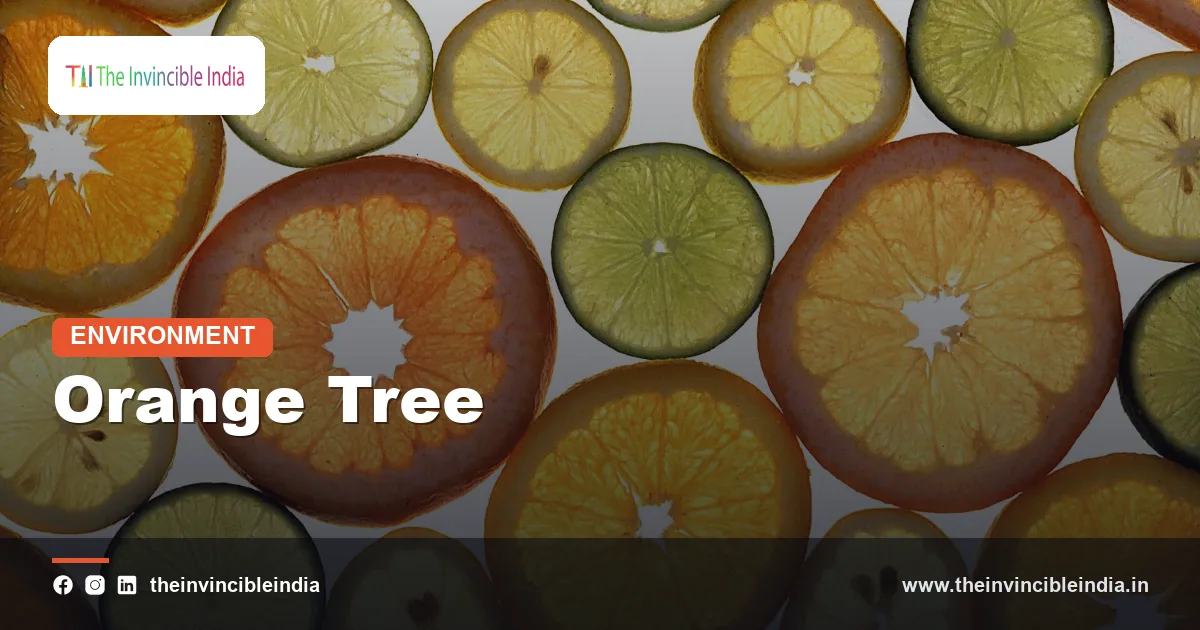
The orange is the round, juicy, segmented fruit of an evergreen citrus tree, and in India the word covers both the true sweet orange (Citrus sinensis) and the loose-skinned mandarin oranges, such as the famous Nagpur santra, that are sold across the country each winter. The orange tree is prized for its fragrant white blossom, glossy dark leaves and vitamin C-rich fruit, and it is one of the most widely grown citrus trees in the tropics and subtropics.
India has several distinct orange-growing belts, from the plateau around Nagpur in Maharashtra to the hills of Coorg in Karnataka, the Khasi hills of Meghalaya and the slopes of Darjeeling and Sikkim. This article explains what an orange tree is, how it grows, what separates a mandarin from a sweet orange, where the main belts lie, how the fruit is harvested and what its nutrition and uses are.
Quick Facts
| Common names | Orange, sweet orange, mandarin orange; santra and narangi in Hindi; mosambi for a common sweet orange type |
|---|---|
| Scientific names | Citrus sinensis (sweet orange); Citrus reticulata (mandarin, including Nagpur and Khasi types) |
| Family | Rutaceae (the rue or citrus family) |
| Native region | Southern China and the eastern Himalayan and Southeast Asian region |
| Where grown in India | Maharashtra (Nagpur belt), Karnataka (Coorg), Madhya Pradesh, Punjab, Rajasthan, Andhra Pradesh, Telangana, Meghalaya, Assam, Sikkim and Darjeeling |
| Season | Fruit ripens mainly in winter, from about November to February, depending on the belt and crop cycle |
| Part used | Fruit pulp and juice; peel for zest and oil; blossom for scent |
| Main uses | Fresh fruit, juice, marmalade, peel oil, flavouring, fragrance |
| Importance | Among the leading fruit crops by area in India, and a key income source for Vidarbha and hill farmers |
Key Takeaways
- The orange tree is an evergreen citrus tree of the family Rutaceae that bears fragrant white flowers and round, segmented fruit rich in vitamin C.
- The sweet orange (Citrus sinensis) is an ancient hybrid of pomelo and mandarin, while the Nagpur orange is botanically a mandarin (Citrus reticulata).
- India’s best-known orange belts include Nagpur in Maharashtra, Coorg in Karnataka, the Khasi hills of Meghalaya, Darjeeling and Sikkim.
- The English word orange traces back through Persian and Arabic to the Sanskrit word naranga.
- Orange trees are propagated by budding onto hardy rootstocks and need warm weather, good drainage and careful water management.
- Citrus greening disease, citrus canker and virus diseases are among the main threats to orange orchards in India.
What is an orange tree?
An orange tree is a small to medium evergreen tree in the genus Citrus, usually between five and ten metres tall, that bears round fruits with a thick, oil-bearing rind and juicy interior divided into segments. The tree belongs to the Rutaceae family, which also includes lemons, limes, pomelos, grapefruit and curry leaf.
Its leaves are oval, leathery and dark green, with a winged leaf stalk typical of many citrus species. The flowers are white, five-petalled and strongly scented, and the oil glands in leaves and peel give the whole plant its distinctive fragrance. Many orange trees carry blossom, young green fruit and ripe fruit at the same time in some seasons.
Botanically the orange is a special kind of berry called a hesperidium: the juicy flesh is made of fluid-filled vesicles inside segments, enclosed in a leathery skin that includes the coloured flavedo and the white spongy albedo (pith). Orange fruits can be green or yellow-green and still be perfectly ripe in warm tropical areas, because the orange colour of the peel develops mainly when nights are cool.
Where does the orange come from and why is it called orange?
The orange originated in the region stretching from southern China through the eastern Himalayan foothills and Southeast Asia, and the English word orange comes from the Sanskrit naranga through Persian and Arabic. The word travelled westward with the fruit along trade routes, eventually reaching Europe as arancia and orange.
The sweet orange is understood to be an ancient natural hybrid of the pomelo and the mandarin, selected and propagated by cultivators in China. Some early citrus fruits were bitter, and the bitter orange (Citrus aurantium) arrived in the Mediterranean world before sweet oranges did. Portuguese traders later spread sweet oranges widely, and in several languages the fruit is still called “Portugal” or something similar.
North-eastern India is regarded as part of the original home of citrus diversity. Wild and semi-wild citrus species grow in Meghalaya, Assam, Nagaland and neighbouring areas, which is why the Khasi mandarin is a long-established local fruit rather than a recent introduction.
What is the difference between a mandarin and a sweet orange?
A mandarin has a loose, easily peeled skin and a flattened shape, whereas a sweet orange has a tighter skin, usually needs a knife or careful peeling and has a rounder form. In everyday Indian speech both are called orange, but botanists treat them as different species with different histories.
| Feature | Mandarin (santra) | Sweet orange (mosambi and similar) |
|---|---|---|
| Botanical name | Citrus reticulata | Citrus sinensis |
| Skin | Loose, easy to peel, strongly aromatic | Tighter, often needs a knife |
| Shape | Slightly flattened to round | Round to oval |
| Typical Indian examples | Nagpur santra, Coorg mandarin, Khasi mandarin, Darjeeling orange | Mosambi, Sathgudi, Malta, Jaffa, Valencia types |
| Flavour | Sweet-tart, strongly fragrant | Mild sweet, juicier, often used for juice |
| Main belts | Vidarbha, Coorg, north-east hills | Marathwada, Andhra Pradesh, Telangana, Punjab and Rajasthan plains |
The distinction matters in Indian markets because “Nagpur orange” is actually a mandarin type, while the green-skinned mosambi sold for juice is a sweet orange. Both are citrus trees and both are grown using similar orchard methods.
Where are oranges grown in India?
Oranges, taken together with mandarins, are grown in India mainly in Maharashtra, Madhya Pradesh, Karnataka, Punjab, Rajasthan, Andhra Pradesh, Telangana and the north-eastern and Himalayan hills. Citrus as a whole is among the leading fruit groups in India by area, and mandarin oranges form a large part of that, although exact production figures change from year to year.
The Nagpur belt
The Nagpur orange is a mandarin grown on the Deccan plateau of Vidarbha in Maharashtra, especially in districts around Nagpur, Amravati and Wardha. Its loose skin, sweet-sour juice and aroma made it the benchmark orange of central India, and it has received a Geographical Indication (GI) tag that identifies its regional origin.
Coorg and the Western Ghats
Coorg, or Kodagu, in Karnataka grows a mandarin variety often called the Coorg orange, usually found as a shade-tolerant intercrop in coffee estates. The cool, misty hill climate suits the tree, and the fruit ripens in the winter months.
North-eastern and eastern Himalayan hills
The Khasi mandarin of Meghalaya and Assam, the mandarins of Sikkim and the Darjeeling orange grow on steep hill slopes and are usually harvested between November and January. In these hills, orchards are often family-owned and mixed with other crops.
Sweet orange regions
Sweet orange types such as Sathgudi, Mosambi and Malta are grown in the drier plains of Andhra Pradesh, Telangana, Maharashtra’s Marathwada and parts of Punjab and Rajasthan, where irrigation supports the trees.
How does an orange tree grow?
An orange tree grows best in a warm subtropical climate with well-drained, slightly acidic to neutral loam, regular watering and protection from frost. Commercial trees are grown from budded saplings, begin bearing fruit in a few years and then crop annually for a few decades with proper care.
Propagation
Orange trees raised from seed vary widely and take long to bear, so orchards use budded plants. A bud of the desired variety is grafted onto a rootstock such as rough lemon, Rangpur lime or trifoliate-orange hybrids. The rootstock influences vigour, drought tolerance and resistance to soil diseases such as gummosis.
Flowering and bahar
In India, orange growers speak of bahar, meaning a flowering and fruiting season. The orchard can be induced to flower in different seasons by withholding water for a short period before the flush, which forces the tree into a rest period. In the Nagpur belt the fruit from the main flowering season is harvested during the cool months, and growers choose which bahar to take based on market prices and water availability.
Water, nutrition and pruning
Citrus trees need steady moisture during flowering and fruit set, and uneven watering causes flower drop and fruit splitting. Nitrogen, potassium and micronutrients such as zinc and iron are usually supplied through fertiliser. Light pruning removes dead wood and crowded branches, improving air movement and light inside the canopy.
When is the orange harvested?
The orange is harvested mainly in the winter months, roughly from November to February, although the exact window depends on the variety, the bahar chosen and the altitude. Pickers cut fruit with clippers, leaving a short stalk, because pulling can tear the peel and invite rot.
Unlike many fruits, oranges do not ripen further once picked; their sugars do not increase after harvest. Growers therefore pick when the sugar-to-acid ratio and juice content reach market standards, not when the peel turns bright orange. In hot regions, ripe fruit may stay yellowish green, and traders sometimes use ethylene degreening treatments to give the fruit an even colour.
- Fruit is graded by size and appearance, then packed in crates or boxes.
- Washing and waxing help reduce water loss in some packhouses.
- Cold storage can hold well-handled fruit for several weeks.
- Rough handling is the main cause of loss, because bruised oranges rot quickly.
What nutrients does an orange provide?
An orange provides vitamin C, dietary fibre, folate and potassium, and one medium fruit supplies a large share of the daily vitamin C requirement of an adult. It is also low in fat and contains natural plant compounds such as flavonoids, including hesperidin.
Vitamin C is the best-known nutrient in the orange and is needed by the body to make collagen, support wound healing and help the absorption of iron from plant foods. Eating the whole fruit rather than only the juice keeps the fibre, which slows sugar absorption and helps digestion. Juice remains a useful drink but contains fewer fibres and should be taken in moderation.
Oranges are not a cure for illness, and stories that attribute dramatic medical effects to them should be treated carefully. They are best understood as a wholesome fruit that contributes to a balanced diet.
How is the orange used?
The orange is used mainly as fresh fruit and juice, and its peel, oil and blossom are also used in food, cosmetics and traditional products. Almost every part of the fruit has some use, which is why citrus processing units extract several products from a single harvest.
- Fresh eating: the loose-skinned mandarin is a favourite winter snack across north and central India.
- Juice: sweet oranges such as mosambi are pressed in street stalls and packaged as juice and squash.
- Marmalade and candies: peel and pulp are cooked with sugar to make preserves.
- Peel oil: pressed from the rind and used in flavouring, perfumery and cleaning products.
- Zest: grated rind adds aroma to cakes and desserts.
- Dried peel: used in some traditional household remedies and flavouring.
- Blossom: the scent is used in perfumery, and neroli oil is extracted from bitter orange flowers.
Pressed peel and pulp left over from juicing can be used as cattle feed or processed for pectin, an ingredient that sets jams.
What diseases and pests affect orange trees?
The main threats to orange trees in India are citrus greening (huanglongbing), citrus canker, citrus tristeza virus, gummosis and pests such as the citrus psylla, leaf miner and fruit-sucking moths. Orchard decline in several belts has been linked to a combination of these diseases and poor water management.
- Citrus greening: a bacterial disease spread by the Asian citrus psylla that causes yellow shoots and small, lopsided, bitter fruit.
- Citrus canker: a bacterial disease that produces raised corky lesions on leaves, twigs and fruit.
- Tristeza virus: spread by aphids and infected planting material, causing decline in trees on susceptible rootstocks.
- Gummosis: a fungal disease of the trunk base, encouraged by waterlogging and deep planting.
- Leaf miner and psylla: insects that damage young shoots and spread disease.
The most effective protection is starting with disease-free budded plants from certified nurseries, planting at the right depth, controlling insect vectors and removing infected trees promptly.
Why does the orange tree matter to India?
The orange tree matters to India because it supports lakhs of farm families, supplies a major winter fruit and links agriculture with processing and trade across several states. In regions like Vidarbha, orange cultivation is a central part of the horticultural economy, while in the north-eastern hills it provides one of the few cash crops suited to steep land.
Yet the crop faces challenges. Water scarcity, disease pressure, ageing orchards and fluctuating prices have affected growers, and improvements in nursery quality, drip irrigation, grading and processing are widely seen as important. Citrus research institutions in India, such as the ICAR-Central Citrus Research Institute in Nagpur, work on better rootstocks, disease management and varieties.
Bottom Line
The orange tree is a fragrant evergreen whose fruit has become a staple of India’s winter, whether it is the loose-skinned Nagpur santra or the juicy mosambi. Knowing the difference between mandarins and sweet oranges, and the importance of healthy planting material and water, explains much about how the fruit reaches Indian tables.
Frequently Asked Questions
Is the Nagpur orange a true orange?
The Nagpur orange is botanically a mandarin (Citrus reticulata) rather than a sweet orange (Citrus sinensis). It is called an orange in everyday speech because it has an orange colour and a citrus flavour. Its loose skin and aromatic sweet-sour taste are typical of mandarins.
Where does the word orange come from?
The word orange comes from the Sanskrit naranga, which passed through Persian and Arabic and then into European languages. It originally named the tree and fruit, and later became the name of the colour. The route shows how citrus spread westward from Asia.
Which Indian states grow the most oranges?
Maharashtra, Madhya Pradesh, Karnataka, Punjab, Andhra Pradesh and Telangana are among the main orange and mandarin growing states, with the north-eastern hills also important. Exact rankings vary with the year and with whether mandarins and sweet oranges are counted separately. Nagpur in Maharashtra is the best-known single belt.
When is orange season in India?
Orange season in India runs mostly from November to February. The timing varies by region, variety and the flowering cycle chosen by the grower. Some sweet orange types are available in other months as well.
How long does an orange tree take to bear fruit?
A budded orange tree usually begins bearing fruit within three to five years of planting, and reaches full production several years later. Trees grown from seed take longer and give uneven fruit. With good care an orchard can remain productive for many years.
Is orange juice as healthy as the whole fruit?
Orange juice provides vitamin C and potassium but has less fibre than the whole fruit. The fibre in whole oranges slows sugar absorption and helps digestion. Juice is best taken in moderate portions, and whole fruit is usually the better everyday choice.
{“@context”:”https://schema.org”,”@graph”:[{“@type”:”FAQPage”,”mainEntity”:[{“@type”:”Question”,”name”:”Is the Nagpur orange a true orange?”,”acceptedAnswer”:{“@type”:”Answer”,”text”:”The Nagpur orange is botanically a mandarin (Citrus reticulata) rather than a sweet orange (Citrus sinensis). It is called an orange in everyday speech because it has an orange colour and a citrus flavour. Its loose skin and aromatic sweet-sour taste are typical of mandarins.”}},{“@type”:”Question”,”name”:”Where does the word orange come from?”,”acceptedAnswer”:{“@type”:”Answer”,”text”:”The word orange comes from the Sanskrit naranga, which passed through Persian and Arabic and then into European languages. It originally named the tree and fruit, and later became the name of the colour. The route shows how citrus spread westward from Asia.”}},{“@type”:”Question”,”name”:”Which Indian states grow the most oranges?”,”acceptedAnswer”:{“@type”:”Answer”,”text”:”Maharashtra, Madhya Pradesh, Karnataka, Punjab, Andhra Pradesh and Telangana are among the main orange and mandarin growing states, with the north-eastern hills also important. Exact rankings vary with the year and with whether mandarins and sweet oranges are counted separately. Nagpur in Maharashtra is the best-known single belt.”}},{“@type”:”Question”,”name”:”When is orange season in India?”,”acceptedAnswer”:{“@type”:”Answer”,”text”:”Orange season in India runs mostly from November to February. The timing varies by region, variety and the flowering cycle chosen by the grower. Some sweet orange types are available in other months as well.”}},{“@type”:”Question”,”name”:”How long does an orange tree take to bear fruit?”,”acceptedAnswer”:{“@type”:”Answer”,”text”:”A budded orange tree usually begins bearing fruit within three to five years of planting, and reaches full production several years later. Trees grown from seed take longer and give uneven fruit. With good care an orchard can remain productive for many years.”}},{“@type”:”Question”,”name”:”Is orange juice as healthy as the whole fruit?”,”acceptedAnswer”:{“@type”:”Answer”,”text”:”Orange juice provides vitamin C and potassium but has less fibre than the whole fruit. The fibre in whole oranges slows sugar absorption and helps digestion. Juice is best taken in moderate portions, and whole fruit is usually the better everyday choice.”}}]}]}


