

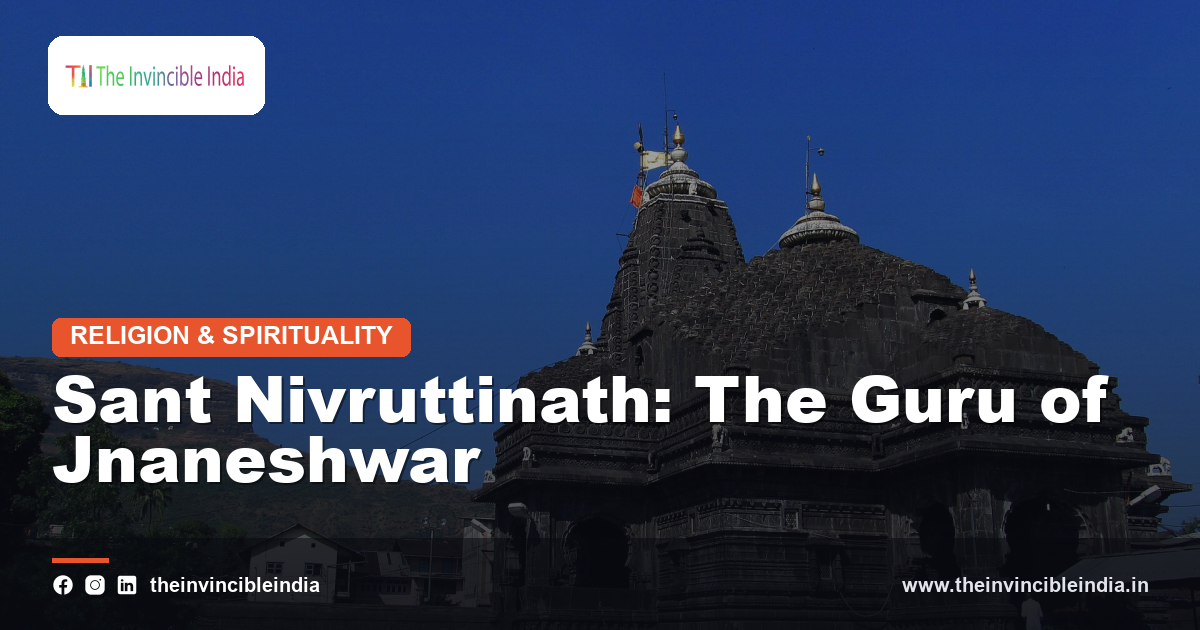
Sant Nivruttinath, also written Nivrutti Nath, Nivruttinatha or Nivrittinath, is the eldest of the four saintly siblings of Maharashtra and the spiritual teacher of Sant Jnaneshwar, also spelled Dnyaneshwar. Tradition remembers him as a disciple in the Nath lineage who carried the discipline of yoga into a family that would become the foundation of the Varkari movement. His name suggests withdrawal and inner stillness, and his quiet authority still shapes how Maharashtra thinks about the guru. His story belongs to the wider current of devotion explored in the Bhakti movement, in which saints gave the divine a voice in the language of ordinary people.
Quick answer: Sant Nivruttinath is a medieval saint of Maharashtra, the eldest of the four siblings Nivruttinath, Jnaneshwar, Sopandev and Muktabai, and the guru of Jnaneshwar. Tradition places him in the Nath sampradaya through his teacher Gahininath, and honours him as the one who encouraged Jnaneshwar to write the Marathi commentary on the Bhagavad Gita. His samadhi is at Trimbakeshwar in Nashik district, where an annual yatra in the winter month of Paush draws Varkari pilgrims.
Key Takeaways
- Sant Nivruttinath is the eldest of the four saintly siblings of Maharashtra and the guru of Sant Jnaneshwar.
- Tradition links him to the Nath sampradaya through the teacher Gahininath, a lineage associated with yoga and inward discipline.
- He is honoured as the guide who encouraged Jnaneshwar to compose the Marathi commentary on the Bhagavad Gita.
- His samadhi shrine is at Trimbakeshwar in Nashik district, close to the source of the Godavari river.
- An annual yatra at Trimbakeshwar in the month of Paush draws Varkari pilgrims who walk in devotional processions.
- Many accounts of his life are devotional tradition rather than documented history and are best read as sacred biography.
The sections below explain the life, works, teachings and continuing legacy in more detail.
Quick Facts
| Detail | Information |
|---|---|
| Also known as | Nivrutti Nath, Nivruttinatha, Nivrittinath |
| Tradition | Nath sampradaya and Varkari sampradaya of Maharashtra |
| Family | Eldest of Nivruttinath, Jnaneshwar, Sopandev and Muktabai |
| Teacher | Gahininath (traditional account) |
| Best-known disciple | His younger brother Sant Jnaneshwar |
| Samadhi | Trimbakeshwar, Nashik district, Maharashtra |
| Language of tradition | Marathi |
| Era | Medieval period (traditionally the thirteenth century) |
Who Was Sant Nivruttinath?
Sant Nivruttinath was a medieval saint of Maharashtra and the eldest of the four siblings whom tradition honours as the saintly children of Alandi. He is remembered chiefly as the guru of his younger brother Jnaneshwar, the author of the Marathi commentary on the Bhagavad Gita. Through this role he stands at the beginning of a remarkable chain of Marathi spiritual literature.
The life of Nivruttinath is preserved mostly in devotional memory and in the later writings of Marathi saint-poets. Because the accounts are largely traditional, they are best treated as sacred biography rather than as a precise historical record. What remains consistent across the stories is the image of a calm, disciplined and compassionate teacher who guided his family through hardship toward wisdom.
What Does the Name Nivruttinath Mean?
The name Nivruttinath combines nivritti, meaning withdrawal or cessation, with nath, meaning lord or master. In Indian spiritual thought nivritti describes the path of turning inward and letting go of worldly pursuit, in contrast to pravritti, which describes active engagement with the world. The name therefore points to a master of inner renunciation.
This meaning suits the way tradition pictures him, as a yogi who found stillness within and then passed that stillness to a disciple who spoke to the whole of society. The name also reminds listeners that the Nath path places inner discipline at the centre of spiritual life. In this way the name itself summarises the character that devotees attribute to him.
Who Were His Parents and Siblings?
Tradition names his parents as Vitthalpant and Rukminibai, a pious couple whose story is told with sympathy in Maharashtra. The children were Nivruttinath, Jnaneshwar, Sopandev and Muktabai, and the four are revered together as one holy household. They are said to have grown up under social hardship and to have found strength in devotion and learning.
Nivruttinath, as the eldest, is pictured as the steady figure who shaped the spiritual life of the family. Jnaneshwar became the celebrated commentator, Sopandev is remembered as a saint of Saswad, and Muktabai is honoured as a woman saint-poet. Together the siblings show how a single family could shape the religious imagination of an entire region, and Nivruttinath stands at its head.
What Is the Nath Sampradaya?
The Nath sampradaya is an ascetic and yogic tradition of India that traces its teaching to Adinath, with Matsyendranath and Gorakhnath counted among its great masters. It emphasises disciplined practice, inner awakening and the guidance of a living teacher. The tradition spread widely across the subcontinent and left a lasting mark on the spiritual life of Maharashtra.
In the Maharashtra lineage that devotees remember, Gahininath is counted as a disciple in this stream and as the teacher of Nivruttinath. The Nath path gave the siblings a vocabulary of yoga and self-knowledge that later blended with the open devotion of the Varkari path. For this reason the Nath sampradaya is regarded as one of the roots of Marathi spiritual literature.
How Did Nivruttinath Meet His Guru Gahininath?
Tradition says that Nivruttinath received initiation from Gahininath near the hills around Trimbakeshwar, a region sacred to many pilgrims. In one popular account the boy was separated from his family during a pilgrimage circuit and found refuge in the hill country, where the teacher accepted him as a disciple. The episode is told as a devotional narrative and not as a documented event.
The story serves to show that the call to the path came early and was received with humility. It also explains how the eldest sibling gained the yogic grounding that later flowed to Jnaneshwar. Whatever its exact details, the account expresses the Nath ideal that a sincere seeker is met by the right teacher at the right time.
How Did Nivruttinath Guide Jnaneshwar?
Nivruttinath guided Jnaneshwar as his teacher and elder brother, and the bond between them is among the best-known relationships in Marathi tradition. According to the accounts devotees preserve, he passed on the teaching he had received and encouraged his brother to speak about it in the common language of the people. This guidance shaped the whole direction of Jnaneshwar’s work.
The relationship is valued because it joins family love with the formal bond of guru and disciple. Jnaneshwar speaks of his teacher with deep reverence in the tradition, while the elder brother appears as a patient and unassuming presence. The pair show how spiritual instruction can pass through ties of kinship without losing its seriousness or depth.
What Is His Connection to the Jnaneshwari?
The Jnaneshwari is the Marathi commentary on the Bhagavad Gita composed by Jnaneshwar, and tradition credits Nivruttinath with inspiring and encouraging the work. The text explains the Gita in flowing Marathi verse of the ovi form and is counted among the foundational works of Marathi literature. Devotees see Nivruttinath as the silent source behind its composition.
The tradition says that the commentary was composed at Nevasa in Ahmednagar district and that the teacher’s blessing stood behind it. In the opening passages of the work the author honours his guru, which devotees take as a sign of the lineage that produced it. The Jnaneshwari therefore carries, in the tradition’s eyes, the imprint of both brothers.
How Did the Siblings Travel and Teach?
Tradition describes the siblings as travelling together to holy places and meeting other saints along the way. Their journeys are remembered through pilgrimages that connected Alandi, Pandharpur and many other centres of devotion. In these stories Nivruttinath is the quiet elder who walks with his brothers and sister and holds the group together.
One much-loved account tells of the meeting between the siblings and Sant Namdev at Pandharpur, which devotees see as a joining of the great voices of the age. As with other episodes, these are narratives of tradition and their details vary between tellers. The shared message is that the saints of the time were bound together by common devotion across differences of background and temperament.
What Is His Place in the Varkari Tradition?
Nivruttinath holds an honoured place in the Varkari tradition as a teacher of the family from which its literature began. The Varkari path is centred on the worship of Vitthal at Pandharpur and on the regular pilgrimage known as the vari. Its followers sing abhangs, walk in processions and treat devotion as open to every person.
His link with the Nath lineage shows how the Varkari tradition absorbed earlier streams of yoga and philosophy. The result was a path that combined inner discipline with warm devotion. In this sense Nivruttinath represents the meeting point of two great currents of Maharashtra, and Varkaris honour him in their prayers along with Jnaneshwar, Sopandev and Muktabai.
Where Is the Samadhi of Nivruttinath?
The samadhi of Sant Nivruttinath is at Trimbakeshwar, a town in Nashik district of Maharashtra, where a shrine devoted to him draws pilgrims throughout the year. Samadhi in this sense means the memorial shrine marking the place where a saint is believed to have entered final meditation. The shrine is a simple and dignified place of worship.
Devotees travelling to Trimbakeshwar often pay respects here along with their visit to the famous temple of Shiva. The siblings of Alandi each have a samadhi site in Maharashtra, and the shrines together form a circuit of memory for Varkari pilgrims. The site at Trimbakeshwar stands as the resting place of the eldest and the first teacher of the family.
What Is Trimbakeshwar Known For?
Trimbakeshwar is known as a sacred town near the Brahmagiri hills where the Godavari river is traditionally said to rise. It is home to the Trimbakeshwar Shiva temple, which is counted among the twelve jyotirlingas honoured across India. Pilgrims also visit the town for rituals connected with ancestors and for the large gatherings of the Kumbh Mela cycle at Nashik.
The presence of Nivruttinath’s samadhi adds a layer of Varkari devotion to a place already rich in Shaiva and river-based sanctity. The setting shows how different streams of Hindu practice share the same holy geography. For this reason the town is a fitting resting place for a saint who stood between the Nath and Varkari traditions.
What Is the Nivruttinath Yatra?
The Nivruttinath yatra is an annual pilgrimage to Trimbakeshwar held in the winter month of Paush, when devotional processions known as dindis arrive from many parts of Maharashtra. The pilgrims sing abhangs, carry banners and walk together in the Varkari manner. The gathering honours the saint at his samadhi with prayer, singing and communal meals.
The yatra is one of several seasonal pilgrimages linked to the saints of Maharashtra, each marked by simplicity and collective devotion. It keeps the memory of Nivruttinath alive among ordinary families who may travel long distances on foot. The event shows how a medieval saint continues to shape living religious practice through shared journey and song.
What Did Nivruttinath Teach?
The teaching associated with Nivruttinath stresses inner stillness, discipline and the guidance of a true teacher. Tradition presents him as someone who valued practice over display and who trusted a sincere disciple to carry the teaching further. His approach joins yogic self-mastery with devotion to the divine.
The themes that recur in the stories about him are humility, patience and detachment. These ideas echo the larger message of the Bhakti saints, who placed sincere love and self-knowledge above ritual and status. The teaching is valued for being practical, since it asks the seeker to look inward before seeking approval outside. In this way his message remains a clear and gentle guide for devotees.
What Verses Are Attributed to Him?
A small number of abhangs and devotional verses are attributed to Nivruttinath in the Marathi tradition, though they are fewer than those of Jnaneshwar or Tukaram. The verses speak of surrender to the divine, the value of the guru and the quiet joy of inner realisation. They are sung in Varkari gatherings alongside the compositions of other saints.
Scholars of old devotional literature note that the attribution of verses to early saints can be uncertain, and the same caution applies here. Even so, the tone of the verses fits the character that tradition gives him, one of calm and authority. They are cherished less for ornament than for the clarity with which they point to the divine presence within.
Why Is the Guru Tradition Important in This Story?
The guru tradition is important in this story because Indian spiritual life has long held that knowledge passes best from teacher to disciple. Nivruttinath embodies this principle by receiving teaching from Gahininath and passing it on to Jnaneshwar. The chain of transmission is a central theme of Nath and Varkari memory.
The story also shows that a guru may be a family member and still be revered as a true teacher. The mutual respect between the brothers gives the tradition a human warmth that sets it apart from stories of distant ascetics. The example continues to inspire the idea that wisdom grows through humility on both sides of the teacher-student relationship.
Nivruttinath Today
Nivruttinath today is honoured as a guru of gurus in Maharashtra, remembered every year at Trimbakeshwar and in the prayers of the Varkari community. Pilgrims continue to visit his samadhi, and his name is invoked together with those of Jnaneshwar, Sopandev and Muktabai whenever the siblings are remembered. His story reminds modern readers of the quiet influence of a teacher who shapes others without seeking recognition.
For students of Indian religion, his life illustrates how the Nath and Varkari traditions met and enriched each other. The accounts that survive are traditional, and respectful readers treat them as sacred narrative that carries real devotional truth. His legacy lives on in the Marathi language, in the songs of the vari and in the pilgrim paths that lead to Trimbakeshwar.
Sources & Further Reading
- Ministry of Culture, Government of India (indiaculture.gov.in).
- Sahitya Akademi, India’s National Academy of Letters (sahitya-akademi.gov.in).
Frequently Asked Questions
Who was Sant Nivruttinath?
Sant Nivruttinath was the eldest of the four saintly siblings of Maharashtra and the guru of Sant Jnaneshwar. Tradition links him to the Nath sampradaya through his teacher Gahininath.
Who was the guru of Nivruttinath?
The guru of Nivruttinath was Gahininath according to the traditional account. Gahininath is counted in the Nath lineage that traces back to Matsyendranath and Gorakhnath.
Where is the samadhi of Nivruttinath?
The samadhi of Nivruttinath is at Trimbakeshwar in Nashik district of Maharashtra. Pilgrims visit it along with the nearby Trimbakeshwar Shiva temple.
What is the relationship between Nivruttinath and Jnaneshwar?
Nivruttinath was the elder brother and the guru of Jnaneshwar. Tradition says that he encouraged his brother to compose the Marathi commentary on the Bhagavad Gita, now known as the Jnaneshwari.
What is the Nivruttinath yatra?
The Nivruttinath yatra is an annual pilgrimage to Trimbakeshwar held in the winter month of Paush. Varkari processions arrive from many parts of Maharashtra to honour the saint with singing and prayer.
What is the Nath sampradaya?
The Nath sampradaya is an ascetic and yogic tradition of India that emphasises inner discipline and the guidance of a teacher. Great masters such as Matsyendranath and Gorakhnath are counted among its leaders.


