

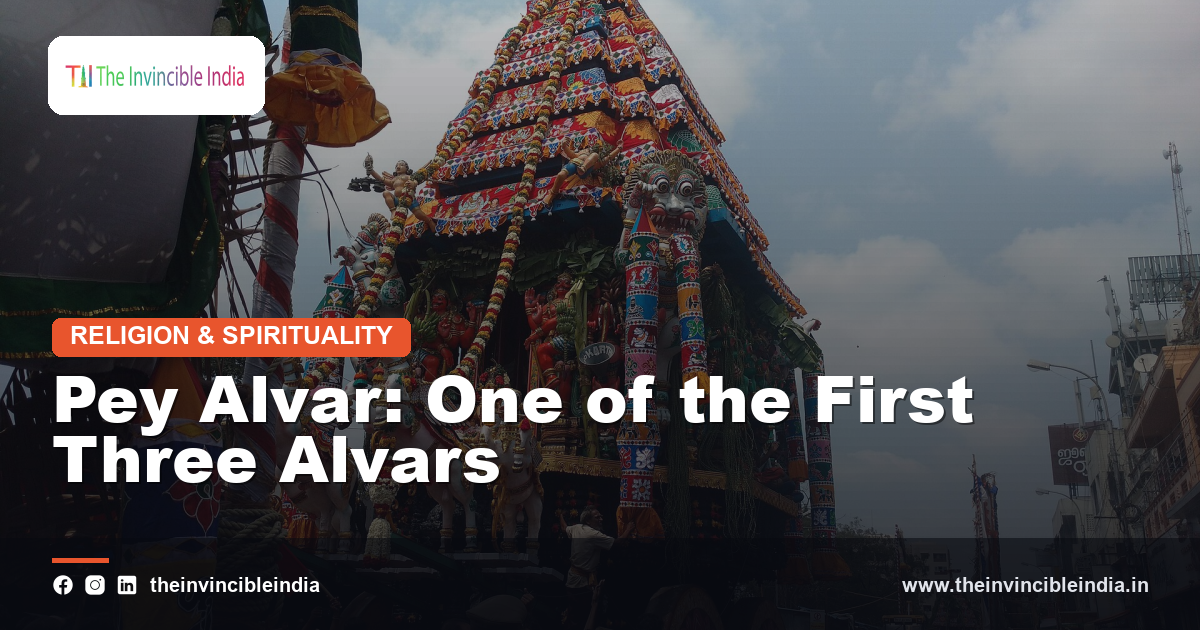
Pey Alvar is the third of the first three Alvar saints of Tamil Vaishnavism, the group honoured together as the Mudhal Alvars, meaning the first Alvars. Together with Poygai Alvar and Bhutath Alvar, he is remembered as a pioneer of the Tamil devotional poetry that would grow into the great tradition of the twelve Alvars. He is associated with Mylapore, the ancient locality in Chennai, Tamil Nadu, and is honoured as the composer of the third of the three Tiruvandadi hymns. His verses belong to the wider world of Vaishnavism, the worship of Vishnu, and though his life is known chiefly through tradition, his place among the earliest Alvars is firmly held.
Quick answer: Pey Alvar is the third of the first three Alvar saints of Tamil Vaishnavism, known together as the Mudhal Alvars or first Alvars. Associated with Mylapore in Chennai, Tamil Nadu, he is honoured as the composer of the third Tiruvandadi, a hymn in praise of Vishnu. With Poygai Alvar and Bhutath Alvar he is remembered as a pioneer whose early Tamil verses helped shape the later tradition of the twelve Alvars.
Key Takeaways
- Pey Alvar is the third of the first three Alvars, known together as the Mudhal Alvars.
- He is associated with Mylapore, an ancient locality in the city of Chennai, Tamil Nadu.
- He is honoured as the composer of the third of the three Tiruvandadi hymns.
- His companions among the first Alvars are Poygai Alvar and Bhutath Alvar.
- His hymn is said to describe a vision of Vishnu with his consort and attributes.
- His verses in praise of Vishnu form part of the Sri Vaishnava Divya Prabandham.
The sections below explain his life as told by tradition, the group of the first Alvars, his Tiruvandadi hymn, his link with Mylapore and his continuing place in Sri Vaishnava devotion.
Quick Facts
| Detail | Information |
|---|---|
| Also known as | Pey Alvar, Peyalvar |
| Tradition | Alvars of Tamil Vaishnavism, Bhakti movement |
| Era | Early period, traditionally dated |
| Region | Mylapore, Chennai, Tamil Nadu |
| Language of works | Tamil |
| Principal work | The third Tiruvandadi |
| Deity | Vishnu |
| Group | One of the three Mudhal (first) Alvars |
Who Was Pey Alvar?
Pey Alvar was one of the earliest poet-saints of Tamil Vaishnavism, counted as the third of the first three Alvars who are honoured together as the Mudhal Alvars, the first Alvars. He is remembered as a pioneer of the Tamil devotional verse that would grow into the tradition of the twelve Alvars.
Tradition links him with Mylapore, an ancient locality of what is now the city of Chennai. He is honoured as the composer of the third of the three early hymns known as the Tiruvandadi. Although the details of his life come from sacred biography rather than documented record, his verses survive within the collected Tamil hymns and reveal a saint whose devotion to Vishnu, and whose vision of the Lord, helped lay the foundation of the whole Alvar tradition.
Who Are the Mudhal Alvars, the First Three Alvars?
The Mudhal Alvars are the first three Alvar saints of Tamil Vaishnavism, namely Poygai Alvar, Bhutath Alvar and Pey Alvar, who are grouped together as the earliest of the twelve. The word mudhal means first, and tradition regards them as the pioneers of the devotional movement.
These three are closely associated with one another and are said to have shared a special experience of the Lord’s presence that bound them together. Each is honoured as the composer of one of the three Tiruvandadi hymns, which open the collected poetry of the Alvars. Their verses set the pattern of Tamil devotion to Vishnu that the later Alvars would develop. Pey Alvar holds his place as the third of these three foundational saints, often remembered for the vision described in his hymn.
What Does the Name Pey Alvar Mean?
The name Pey Alvar identifies the saint within the group of the first Alvars and helps readers recognise him across texts and temples. Like the other early Alvars, he is known by a single traditional name linked with the accounts of his origins and devotion.
The names of the three first Alvars are often explained through the circumstances of their birth as told in sacred biography, which associates each with a particular place and setting. In Sri Vaishnava hymnody and temple tradition Pey Alvar appears under this name, distinguished from his companions Poygai Alvar and Bhutath Alvar. Keeping the three names in mind helps a reader follow the tradition of the Mudhal Alvars and appreciate the distinct contribution of each of the three pioneering saints to the devotion to Vishnu.
When and Where Did Pey Alvar Live?
Pey Alvar is traditionally placed among the earliest of the Alvars, and the precise dates are not fixed in the sources, so it is wise to describe his era in general terms rather than assign an exact year. He is associated with Mylapore, an ancient locality in the city of Chennai in Tamil Nadu.
Mylapore is one of the oldest parts of Chennai, long known for its temples and its place in the religious life of the Tamil country. The association of Pey Alvar with Mylapore gives his memory a firm setting in this historic quarter. Because his life is handed down chiefly through sacred biography, careful writers speak of his region and his associated locality with confidence while leaving the exact chronology open, in keeping with the respectful caution the sources invite.
What Is the Story of the First Three Alvars Meeting?
One of the best-loved traditions of the Mudhal Alvars concerns a meeting of the three first Alvars, told as devotional tradition rather than documented history. The story relates that Poygai, Bhutath and Pey Alvar came together on a dark and stormy night and took shelter in a narrow space.
As they stood pressed close in the darkness, tradition says they became aware of a fourth presence among them, which they understood to be the Lord Vishnu himself drawn by their devotion. Tradition holds that Pey Alvar, the third, described a vision of the Lord with his consort and his shining attributes. Moved by the experience, each of the three composed one of the three Tiruvandadi hymns. The episode is cherished as an image of how sincere devotion draws the presence of God.
What Is the Tiruvandadi of Pey Alvar?
Pey Alvar is honoured as the composer of the third of the three Tiruvandadi hymns, an early work of Tamil devotional poetry in praise of Vishnu. The three Tiruvandadi hymns of the first Alvars open the collected sacred verse of the tradition.
Tradition holds that his hymn opens with the saint declaring that he has beheld the Lord, his consort Lakshmi and his radiant form and attributes, a vision cherished as the fruit of the meeting of the first three Alvars. The word andadi refers to the linked poetic form in which the ending of one verse begins the next. Pey Alvar’s hymn praises the greatness and beauty of Vishnu and expresses the joy of the devotee who has seen the Lord. It is recited and honoured within the Sri Vaishnava tradition as part of the early core of the Divya Prabandham.
What Vision Does Pey Alvar Describe?
Pey Alvar is especially remembered for the vision of Vishnu described at the opening of his hymn, in which the saint declares that he has seen the Lord together with his consort and his glorious attributes. This vision is cherished as a high point of the tradition of the first Alvars.
Tradition connects this vision with the experience of the Lord’s presence shared by the three first Alvars on the stormy night. The saint speaks of beholding the goddess Lakshmi at the Lord’s side, his golden form and the emblems he bears. For devotees this account expresses the reward of sincere devotion, the grace of a direct sight of God. The vision of Pey Alvar gives his hymn a special place among the early Alvar poems and is treasured as an image of the goal of the devotional life.
What Is the Andadi Poetic Form?
The andadi is a Tamil poetic form in which the word or syllable that ends one verse becomes the word or syllable that opens the next, linking the whole hymn in a continuous chain. The three first Alvars each composed a hymn in this form, giving the Tiruvandadi hymns their name.
This linking device binds the verses together and helps them to be remembered and recited in sequence, which suited the devotional use of the hymns. The form also expresses a sense of continuity and wholeness that mirrors the unbroken devotion of the saint. Pey Alvar’s use of the andadi places his hymn within this shared tradition of the first Alvars. The form is admired both for its craft and for the way it carries the flow of devotion from verse to verse.
How Is Pey Alvar Linked to Mylapore?
Pey Alvar is linked above all to Mylapore, the ancient locality in Chennai that tradition associates with his origins and devotion. Mylapore is one of the oldest and most sacred quarters of the city, long known for its temples.
The association of Pey Alvar with Mylapore gives his memory a firm setting in this historic part of the Tamil country, and the locality honours its link with the saint. For pilgrims and devotees the connection with Mylapore is a reminder of the earliest days of the Alvar tradition in a place that remains a living centre of worship. The bond between Pey Alvar and Mylapore keeps alive the link between the pioneering saint and the devotion to Vishnu celebrated in the city to this day.
What Themes Appear in Pey Alvar's Hymn?
Pey Alvar’s hymn is marked above all by the joy of beholding the Lord and by praise of the greatness and beauty of Vishnu, expressed in the flowing andadi verse. The tone is one of wonder and fulfilment, celebrating the vision of God with his consort and attributes.
Like the hymns of his companions among the first Alvars, his verses dwell on the glory of Vishnu and on the devotion of the saint who seeks and finds the Lord. The imagery draws on the forms and emblems of the Lord as known to the tradition. For devotees these early verses carry a freshness and a sense of attainment that mark the beginning of the Alvar tradition. They are valued both as devotion and as the foundation on which the later hymns of the Alvars were built.
How Do the First Alvars Relate to the Later Alvars?
The first Alvars, including Pey Alvar, relate to the later Alvars as pioneers whose early hymns set the pattern that the greater and more numerous later saints would develop. Together all twelve form the single tradition of the Alvars of Tamil Vaishnavism.
Where the first three composed the opening Tiruvandadi hymns, the later Alvars, among them Nammalvar, Periyalvar and Andal, produced longer and richer works that deepened the devotion to Vishnu. Yet the later saints built on the foundation laid by the first three. Seeing this relationship helps a reader appreciate the unity of the whole Alvar corpus and the special honour due to the pioneers. Pey Alvar’s place as the third of the first lends his verses a particular dignity within the tradition.
How Are the Mudhal Alvars Honoured Together?
The Mudhal Alvars are honoured together in Sri Vaishnava tradition as a group of three pioneering saints, and their shared story of the meeting on the stormy night binds them in the memory of devotees. Their three Tiruvandadi hymns are recited and studied as a unit.
In temple shrines and festivals the three first Alvars are often remembered side by side, and their images may be venerated together. The tradition values them collectively as those who first gave voice to the devotion to Vishnu in Tamil, with Pey Alvar remembered for the vision of the Lord in his hymn. This joint veneration expresses the sense of fellowship among the saints and the unity of the devotional movement they helped to begin.
How Is Pey Alvar Depicted in Tradition?
Pey Alvar is depicted in Sri Vaishnava tradition as one of the three first Alvars, honoured together with Poygai and Bhutath Alvar in temple shrines where devotees pay their respects. His image appears among those of the Alvars in Vishnu temples.
The art and tradition express his character as an early and devoted singer of the Lord’s praise, remembered especially for his vision of Vishnu, rather than any worldly rank. Representations of the Mudhal Alvars help worshippers remember the pioneers of the tradition as living models of devotion. The care given to Pey Alvar and his companions in temple veneration reflects the reverence in which the first Alvars are held, and keeps their memory present in the devotional life of the community.
Why Does Pey Alvar Still Matter Today?
Pey Alvar still matters today because he is honoured as one of the pioneers of Tamil Vaishnava devotion, whose early hymn and cherished vision of the Lord helped open the great tradition of the Alvars. His Tiruvandadi is recited and studied as part of the sacred Tamil hymns.
For devotees he is a founding voice whose devotion was rewarded with a direct sight of the Lord, as the tradition of the meeting on the stormy night relates. Scholars value the early Alvar hymns as landmarks in the history of Tamil devotional poetry, while worshippers treasure them as the beginning of their tradition. Careful readers honour the context of his tradition and treat the sacred stories of his life as devotional belief, while recognising his lasting importance among the first Alvars.
Pey Alvar Today
Pey Alvar today is remembered as the third of the three first Alvars, the Mudhal Alvars, honoured with his companions Poygai and Bhutath Alvar and associated with the historic locality of Mylapore in Chennai. His Tiruvandadi remains part of the living recitation of the Sri Vaishnava hymns.
Through his early verses, and above all through the vision of the Lord described in his hymn, he helped to found the tradition of Tamil devotion to Vishnu. Many details of his life are tradition, yet the survival and use of his hymn give a clear portrait of a pioneering saint devoted to the Lord. His legacy endures as a reminder that the great Alvar tradition began with the sincere devotion of the first three saints and their experience of the divine presence.
Sources & Further Reading
- Ministry of Culture, Government of India (indiaculture.gov.in).
- Sahitya Akademi general references on Tamil devotional literature.
Frequently Asked Questions
Who was Pey Alvar?
Pey Alvar was the third of the first three Alvar saints of Tamil Vaishnavism, known together as the Mudhal Alvars. He is associated with Mylapore in Chennai and is honoured as the composer of the third Tiruvandadi, which describes a vision of Vishnu.
Who are the Mudhal Alvars?
The Mudhal Alvars are the first three Alvar saints, Poygai Alvar, Bhutath Alvar and Pey Alvar, regarded as the earliest and pioneering saints of the tradition. Each composed one of the three Tiruvandadi hymns in praise of Vishnu.
What vision is Pey Alvar known for?
Pey Alvar is known for the vision of Vishnu described at the opening of his hymn, in which the saint declares that he has seen the Lord with his consort Lakshmi and his radiant attributes. This vision is cherished as devotional tradition and as the fruit of the meeting of the first three Alvars.
What did Pey Alvar compose?
Pey Alvar is honoured as the composer of the third of the three Tiruvandadi hymns, an early work of Tamil devotional poetry praising Vishnu. It is written in the linked andadi form and forms part of the Divya Prabandham.
Where is Pey Alvar associated?
Pey Alvar is associated with Mylapore, an ancient locality in the city of Chennai in Tamil Nadu, which tradition links with his origins. Mylapore is one of the oldest and most sacred quarters of the city.
What is the story of the first three Alvars?
Tradition tells that the three first Alvars sheltered together on a stormy night and became aware of the presence of Vishnu among them, drawn by their devotion. Pey Alvar is said to have described a vision of the Lord, and each composed one of the three Tiruvandadi hymns.


