

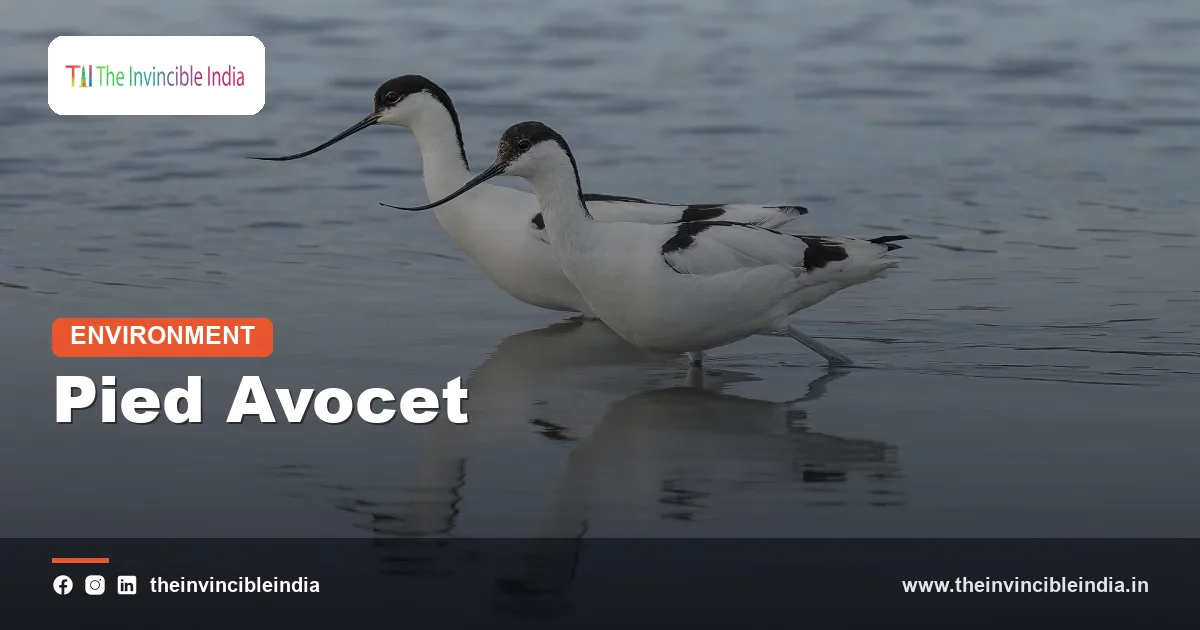
The pied avocet (Recurvirostra avosetta) is an elegant black-and-white wading bird with long bluish-grey legs and a slender, sharply upcurved black bill that it sweeps from side to side through shallow water to catch food, and it is a regular winter visitor to wetlands across India. In a few places, such as the salt marshes of Gujarat, small numbers also stay to breed.
The avocet is one of the easiest waders to recognise at a glance: its clean pied plumage and curved bill are unlike those of any other Indian shorebird. The sections below explain what the pied avocet looks like, where and when it is found in India, how its unusual bill works, what it eats, how it breeds, and how it differs from the black-winged stilt and other similar waders.
| Attribute | Details |
|---|---|
| Common name | Pied avocet |
| Scientific name | Recurvirostra avosetta |
| Family | Recurvirostridae (stilts and avocets) |
| Size | About 42 to 46 cm long, with a wingspan of roughly 67 to 77 cm |
| India range and habitat | Winter visitor mainly to the north-west, west and coasts, found on shallow lakes, saline lagoons, saltpans, reservoirs, estuaries and tidal mudflats |
| Diet | Aquatic insects and larvae, small crustaceans, worms, molluscs and occasionally tiny fish and seeds |
| Breeding and migration | Breeds on open shallow wetlands in Europe, Central Asia and parts of Africa, usually in colonies; mostly arrives in India from about October and leaves by March-April |
| Conservation status | Least Concern on the IUCN Red List |
Key Takeaways
- The pied avocet is a large, black-and-white wader of the family Recurvirostridae, about 42 to 46 cm long, that winters on shallow wetlands and coasts across northern, western and coastal India.
- The pied avocet is identified by its pure white body, black cap and nape, black bands on the wings and its thin, upcurved black bill.
- The pied avocet feeds by sweeping its bill from side to side through shallow water, catching insects, crustaceans and worms by touch.
- The pied avocet usually breeds in colonies on open, shallow, saline or brackish wetlands, laying about three or four eggs in a ground scrape.
- The pied avocet is listed as Least Concern by the International Union for Conservation of Nature (IUCN), though it depends on a network of shallow wetlands and saltpans.
- The pied avocet is the emblem of the Royal Society for the Protection of Birds (RSPB) in the United Kingdom, where its return as a breeding bird became a conservation success story.
What is the pied avocet?
The pied avocet is a large wading bird in the family Recurvirostridae, the family of stilts and avocets. Its scientific name Recurvirostra avosetta is built from Latin words meaning “bent-back bill”, and “avocet” itself comes from an Italian word for the bird. “Pied” means patterned in two contrasting colours, here black and white.
It is the only avocet found regularly in Asia, Europe and Africa. Three other avocets live elsewhere: the American avocet, the red-necked avocet of Australia and the Andean avocet of South America. In India, the species is often called simply the avocet in field guides and bird checklists.
Within the family Recurvirostridae, the pied avocet’s closest relatives in India are the black-winged stilt (Himantopus himantopus) and, more distantly, the ibisbill (Ibidorhyncha struthersii) of Himalayan river valleys. All are specialised waders with long legs and unusual bills.
How do you identify a pied avocet?
A pied avocet is identified by its bold black-and-white plumage, its long bluish-grey legs and its slim, black bill that curves upward at the tip. No other Indian wader combines these features, so the identification is usually immediate.
Plumage
The head and body are mostly white. A neat black cap covers the crown and extends down the back of the neck. The wings show black bands along the shoulders and on the outer wing, with white between them, creating a bold pied pattern on the folded wing. The wing tips are black, and the underparts are white. Males and females look alike, though the female’s bill is slightly shorter and more strongly curved. Young birds are similar but have browner tones where the adults are black and have buffy edges to the back feathers.
Bill and legs
The bill is long, thin, flexible and curved upward along most of its length, ending in a fine tip. The legs are long and bluish-grey, and the feet are partly webbed, which enables the bird to swim and to stand on soft mud without sinking. In flight the legs trail well beyond the tail.
Flight and voice
In flight the black-and-white pattern becomes even more striking, with black wing tips, a black band across the shoulders and white inner wings and body. The common call is a clear, fluty “kluit” or “kloo-it”, often repeated when the bird is alarmed.
Where does the pied avocet live in India?
The pied avocet lives in India on shallow, open wetlands, especially saline and brackish ones, including lakes, lagoons, saltpans, reservoirs, estuaries and tidal flats. It is most numerous in the north-west and west of the country, including Gujarat, Rajasthan and Haryana, and along parts of the east and west coasts.
Habitats and examples include:
- Saline and alkaline lakes in Rajasthan, such as Sambhar Lake
- The Rann of Kutch, Little Rann of Kutch and Nal Sarovar regions of Gujarat
- Freshwater and brackish wetlands such as Keoladeo National Park and Sultanpur
- Coastal lagoons and saltpans on the Gujarat, Maharashtra and Tamil Nadu coasts
- Chilika Lake in Odisha and other east-coast lagoons
- Large reservoirs and village tanks with shallow, muddy edges
The bird prefers open sites with no tall vegetation, where it can see approaching danger and feed in a few centimetres of water. Seasonal wetlands that dry out and are re-flooded can be very attractive, because they produce flushes of insects and crustaceans. It is rarely seen in dense reedbeds or forest-fringed water.
When does the pied avocet arrive in India?
The pied avocet generally arrives in India from about October and stays until March or April, with the largest numbers present between November and February. Early birds may appear in September, while stragglers sometimes linger into the summer.
Most of the wintering birds are migrants from the colder parts of their range in Central Asia and Eastern Europe. They tend to appear at a favoured wetland within a short window each year, often in tight flocks of a few dozen to a few hundred. Their numbers at a site can change quickly with water levels, since a lowering lake that exposes shallow flats can draw large groups of feeding birds within days.
Where does the pied avocet breed, and does it breed in India?
The pied avocet breeds on shallow, open wetlands from Western Europe through Central Asia and in parts of Africa, and in India it breeds only locally. The best-known Indian breeding areas are in the salt flats and marshes of Gujarat, including the Rann of Kutch region, where small colonies can nest in suitable years.
Breeding in India depends on water levels. The birds nest on bare ground or low islands, and a sudden flood or a sudden drying of the site can cause the colony to fail. Breeding birds are scarce compared with the large winter population, and most of the avocets seen in India are visitors that do not nest in the country.
Why does the pied avocet have an upturned bill?
The pied avocet has an upturned bill because the shape allows it to sweep the bill tip just below the water surface while the head moves side to side, a method called scything. The curve keeps the tip parallel to the bottom and lets the bird sense food without lifting its head.
The bill is thin, flattened and flexible, with a sensitive tip. As the bird walks forward through shallow water, it lowers the bill almost to the horizontal and swings it from side to side like a scythe. When tiny crustaceans, insects or larvae touch the bill, a quick snap closes on them. The bird mostly relies on touch rather than sight, which allows it to feed in murky water and at night.
The same bill shape is used for other methods. In deeper water the bird can swim, upend like a duck and reach the bottom, and it may also pick prey from the surface. This flexibility is unusual among waders, most of which use only one or two feeding methods.
What does the pied avocet eat?
The pied avocet eats mainly small aquatic animals, including insects and their larvae, crustaceans, worms and molluscs, which it collects from the water surface or the soft bottom. On saline wetlands it often feeds on brine shrimp and other small crustaceans that live in salty water.
The main foods include:
- Aquatic insects, such as water bugs, beetles and midge and fly larvae
- Small crustaceans, including brine shrimp, amphipods and tiny shrimps
- Marine and freshwater worms
- Small snails and other molluscs
- Occasionally small fish and plant seeds
Avocets feed in flocks and often form a line to work through the shallows together. Because they depend on shallow food-rich water, they are sensitive to changes in salinity, water depth and pollution. They are also known to drink salty water and to excrete the excess salt through glands near the eyes, an adaptation shared by many coastal birds.
How does the pied avocet behave?
The pied avocet is a social, noisy and rather bold bird that feeds, roosts and breeds in groups. Flocks wade in loose lines through shallow water, sweeping their bills in unison, and they often mix with stilts, shovelers and other waterbirds.
The bird swims readily thanks to its webbed feet and sometimes feeds while swimming. It rests standing on one leg, with the bill tucked among the back feathers. When an intruder comes near, the birds give loud alarm calls and take off together. During nesting, avocets are famously aggressive: they dive-bomb and mob predators, including gulls, crows, foxes and even people, and they perform distraction displays to lead enemies away from the nest.
How does the pied avocet breed?
The pied avocet breeds in colonies on open ground beside shallow water, laying about three or four eggs in a shallow scrape lined with a little vegetation or debris. Colonial nesting helps the birds defend the area together against predators.
The main points of its breeding cycle are:
- Pairs build a simple scrape on bare mud, a low island or sparse vegetation.
- The eggs are pale buff with dark blotches, blending with the ground.
- Both parents incubate for roughly three weeks.
- The downy chicks leave the nest within hours and feed themselves, guided by their parents.
- The young can fly at around five to six weeks of age.
Breeding takes place in spring and early summer in the northern parts of the range. In India, the small breeding population in the Gujarat region nests in the dry season when salt flats are exposed. Success depends on stable water levels and low disturbance.
How is the pied avocet different from similar birds?
The pied avocet differs from similar black-and-white waders in its curved bill, short blue-grey legs and strongly patterned wings. Most birds that look superficially alike are stilts or oystercatchers, so the comparison below may help.
| Species | Key difference from the pied avocet |
|---|---|
| Black-winged stilt (Himantopus himantopus) | Extremely long pink-red legs, a straight needle-like black bill and wholly black wings |
| Eurasian oystercatcher (Haematopus ostralegus) | Heavier build, a straight orange-red bill, red legs and a black back |
| Ibisbill (Ibidorhyncha struthersii) | Grey plumage, a downcurved red bill, and a habitat of Himalayan gravel rivers |
| Crab-plover (Dromas ardeola) | Heavy, straight black bill, black and white plumage, and a coastal habit on the western coast and islands |
| Northern lapwing (Vanellus vanellus) | Black crest, green-glossed back and short straight bill |
The black-winged stilt is the species most often found alongside the avocet. The stilt’s legs are much longer and pinker, its bill is straight, and its wings are entirely black, whereas the avocet shows black and white bands on the wings.
Is the pied avocet threatened?
The pied avocet is not globally threatened; the IUCN lists it as Least Concern because of its large range and stable overall population. Local declines and shifts occur, however, wherever shallow wetlands and saltpans are lost or altered.
The main pressures include:
- Drainage and conversion of shallow wetlands for agriculture, housing and industry
- Changes in the management of saltpans and aquaculture ponds
- Predation and disturbance at breeding colonies
- Pollution and changes in water levels, which affect food supplies
- Sea-level rise and coastal development, which affect coastal flats
The avocet became a symbol of conservation in the United Kingdom, where it disappeared as a breeding bird in the nineteenth century and returned to the East Anglian coast in the 1940s. The Royal Society for the Protection of Birds (RSPB) later adopted it as its emblem, and the story shows how protected, managed wetlands can bring a species back.
How can you watch pied avocets in India?
Pied avocets can be watched by visiting shallow saline or brackish wetlands between November and February and scanning open water for flocks of black-and-white birds sweeping their bills side to side. A spotting scope helps for distant flocks.
- Choose open shallow lakes, lagoons, saltpans and tidal flats rather than deep or reed-fringed water.
- Look for groups feeding in lines, with heads low and bills swinging from side to side.
- Check the bill shape and the wing pattern to separate avocets from stilts.
- Visit early in the morning, when feeding is most active and the light is good.
- Keep a good distance from colonies and roosting flocks, because disturbance can cause nest failure and wastes birds’ energy.
Popular sites include the Rann of Kutch, Nal Sarovar, Sambhar Lake, Sultanpur, Keoladeo National Park, Chilika Lake and coastal saltpans in Gujarat and Tamil Nadu.
Bottom Line
The pied avocet is a graceful black-and-white wader with an upcurved bill, which sweeps shallow water for food and visits India mainly in winter. It is easy to identify, widely distributed in suitable wetlands and currently secure, but it relies on the continued availability of shallow saline and brackish wetlands.
Frequently Asked Questions
Why does the pied avocet have an upturned bill?
The upturned bill lets the pied avocet sweep the tip just below the water surface with a side-to-side motion and sense food by touch. The curve keeps the bill tip level with the bottom, so the bird can feed in murky water.
Is the pied avocet a resident or a migrant in India?
The pied avocet is mainly a winter migrant in India, arriving from about October and leaving by March or April. A small number breed locally, notably in the salt marshes of Gujarat, but most of the birds seen are visitors.
What does the pied avocet eat?
The pied avocet eats aquatic insects, small crustaceans, worms and molluscs, and it often takes brine shrimp on saline wetlands. It catches them by sweeping its bill through shallow water or by upending in deeper water.
How can I tell a pied avocet from a black-winged stilt?
The pied avocet has an upcurved bill, bluish-grey legs and black-and-white bands on the wings. The black-winged stilt has a straight needle-like bill, very long pink-red legs and entirely black wings.
Where can I see pied avocets in India?
Pied avocets can be seen at shallow, open wetlands such as the Rann of Kutch, Nal Sarovar, Sambhar Lake, Keoladeo National Park, Sultanpur and Chilika Lake. The best months are November to February.
Is the pied avocet endangered?
No, the pied avocet is classed as Least Concern by the IUCN because it has a very large range and a stable overall population. Local losses can occur where shallow wetlands and saltpans are drained, polluted or built over.
{“@context”:”https://schema.org”,”@graph”:[{“@type”:”FAQPage”,”mainEntity”:[{“@type”:”Question”,”name”:”Why does the pied avocet have an upturned bill?”,”acceptedAnswer”:{“@type”:”Answer”,”text”:”The upturned bill lets the pied avocet sweep the tip just below the water surface with a side-to-side motion and sense food by touch. The curve keeps the bill tip level with the bottom, so the bird can feed in murky water.”}},{“@type”:”Question”,”name”:”Is the pied avocet a resident or a migrant in India?”,”acceptedAnswer”:{“@type”:”Answer”,”text”:”The pied avocet is mainly a winter migrant in India, arriving from about October and leaving by March or April. A small number breed locally, notably in the salt marshes of Gujarat, but most of the birds seen are visitors.”}},{“@type”:”Question”,”name”:”What does the pied avocet eat?”,”acceptedAnswer”:{“@type”:”Answer”,”text”:”The pied avocet eats aquatic insects, small crustaceans, worms and molluscs, and it often takes brine shrimp on saline wetlands. It catches them by sweeping its bill through shallow water or by upending in deeper water.”}},{“@type”:”Question”,”name”:”How can I tell a pied avocet from a black-winged stilt?”,”acceptedAnswer”:{“@type”:”Answer”,”text”:”The pied avocet has an upcurved bill, bluish-grey legs and black-and-white bands on the wings. The black-winged stilt has a straight needle-like bill, very long pink-red legs and entirely black wings.”}},{“@type”:”Question”,”name”:”Where can I see pied avocets in India?”,”acceptedAnswer”:{“@type”:”Answer”,”text”:”Pied avocets can be seen at shallow, open wetlands such as the Rann of Kutch, Nal Sarovar, Sambhar Lake, Keoladeo National Park, Sultanpur and Chilika Lake. The best months are November to February.”}},{“@type”:”Question”,”name”:”Is the pied avocet endangered?”,”acceptedAnswer”:{“@type”:”Answer”,”text”:”No, the pied avocet is classed as Least Concern by the IUCN because it has a very large range and a stable overall population. Local losses can occur where shallow wetlands and saltpans are drained, polluted or built over.”}}]}]}


