

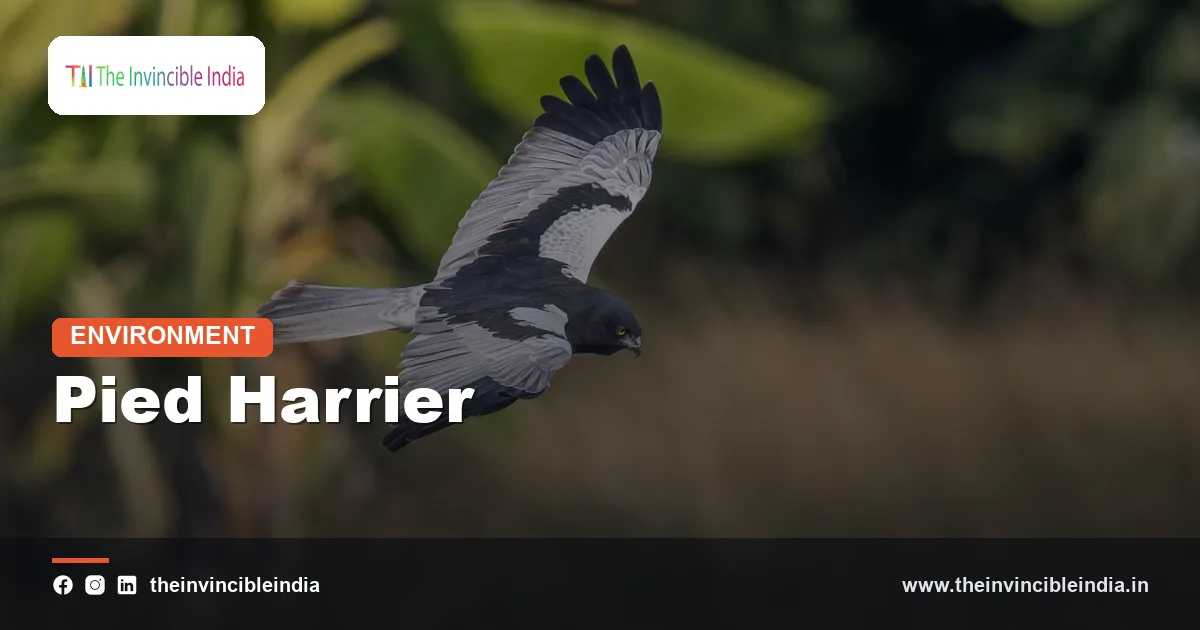
The pied harrier (Circus melanoleucos) is a slim, long-winged bird of prey, the male striking in black and white and the female brown, that breeds in eastern Asia and spends the winter in India, quartering low over grasslands, marshes and paddy fields in search of small prey. It is one of the most handsome of the harriers that visit the subcontinent between autumn and spring.
Unlike most birds of prey, the pied harrier hunts by flying slowly just above the vegetation, listening and looking for movement below. It is not a threatened species, but it depends on open grassland and wetland, which are shrinking in many parts of India. This guide covers how to recognise the bird, where it winters and how it lives.
Pied Harrier Quick Facts
| Common name | Pied harrier |
|---|---|
| Scientific name | Circus melanoleucos |
| Family | Accipitridae (hawks, eagles, kites and harriers) |
| Size | About 41 to 46 cm long, with a wingspan of roughly 100 to 120 cm; females are slightly larger than males |
| Habitat in India | Grasslands, marshes, reedbeds, paddy fields and other open wet or dry farmland |
| Range in India | Winter visitor, mostly in the north-east, east and north, with scattered records in other regions |
| Diet | Small birds, rodents, frogs, lizards and large insects such as grasshoppers |
| Breeding and migration | Breeds on the ground in marshy country of eastern Asia; present in India from about October to March |
| Conservation status | Least Concern on the IUCN Red List |
Key Takeaways
- The pied harrier is a migratory bird of prey that breeds in eastern Asia and winters in India from about October to March.
- The male pied harrier has a black head, back and chest, a white belly and a silvery wing, which makes it unmistakable among Indian harriers.
- The female pied harrier is brown and streaked with a white patch at the base of the tail, and she is harder to separate from other female harriers.
- The pied harrier hunts by flying low and slowly over open ground, taking small birds, rodents, frogs and insects.
- The pied harrier roosts on the ground in groups, often with other harriers, in grasslands, reedbeds and crop fields.
- The pied harrier is not globally threatened, but it depends on grasslands and wetlands that are being lost or converted.
What does a pied harrier look like?
A pied harrier looks like a slender, long-winged, long-tailed raptor, and the adult male is boldly patterned in black and white while the female is mostly brown. Harriers have a light, buoyant build and an owl-like facial disc that helps them locate prey by sound.
The male
The adult male has a black head, throat, neck, upper back and chest, which forms a dark hood and bib. The belly and flanks are white, the rump is white, and the wings are silvery grey with black wingtips and a black bar across the shoulder. The tail is pale grey. In the field the combination of black and white is unmistakable, and the bird looks almost like a miniature magpie in flight.
The female and young
The female is brown above, with a pale grey tinge on the wings, and she has a white patch on the rump just above the base of a barred tail. Her underparts are pale buff and heavily streaked with brown. Young birds resemble the female but have warmer, more rufous underparts. Females and juveniles are harder to identify, and observers often rely on the combination of size, flight style and the white rump.
Size
The bird measures about 41 to 46 cm in length with a wingspan of 100 to 120 cm. It is therefore smaller than a marsh harrier but roughly the same size as other grey harriers. Like other harriers, the female is larger than the male.
Where does the pied harrier come from and why does it visit India?
The pied harrier comes from the breeding grounds of eastern Asia, including south-eastern Siberia, Mongolia and north-eastern China, and it visits India to escape the severe northern winter. It is a short- to medium-distance migrant that spends the cold months in warm, open habitats across southern and south-eastern Asia.
The bird leaves its breeding marshes after the summer and travels south, arriving in India from about September or October. Most birds that reach the subcontinent settle in the north-east, the east and the northern plains, although a smaller number are seen farther south. By March and April they begin to return to the breeding grounds.
India provides everything the bird needs in winter: plentiful rodents and insects in harvested fields, tall grass for roosting and plenty of open space for hunting. Many individuals return to the same wintering areas year after year.
Where can you see pied harriers in India?
You can see pied harriers in open grasslands, wetlands and agricultural fields across India in winter, particularly in the north-east, eastern and northern parts of the country. The bird favours wide, flat country with low vegetation.
- North-east India: grasslands and floodplains in Assam and neighbouring states, including the Brahmaputra floodplain
- Eastern India: paddy fields and marshes in West Bengal, Odisha and Bihar
- Northern plains: grassland and farmland in Uttar Pradesh, Haryana and Punjab
- Western and central India: occasional birds at grassland reserves such as Velavadar in Gujarat and Tal Chhapar in Rajasthan, which are better known for harrier roosts
- Southern India: scattered records in open fields and wetland margins
The best viewing is in the early morning and late afternoon, when harriers hunt actively and fly in to roost. Watching from a quiet spot near a stretch of grass or crop field often brings good views.
How does the pied harrier hunt?
The pied harrier hunts by flying slowly and low over open ground, often only a few metres above the grass, with its wings held in a shallow V, and dropping suddenly onto prey it has spotted or heard. This method is called quartering.
The bird flaps lazily and glides, tilting from side to side as it follows the contours of the ground. It relies on both sight and hearing, and the facial disc, which resembles that of an owl, helps to channel faint sounds to the ears. When it detects a movement it hovers briefly, then pounces with outstretched talons.
What does it eat?
The pied harrier eats small birds, rodents such as field mice and voles, frogs, lizards and large insects such as grasshoppers and locusts. In paddy fields and marshes it takes frogs and fledgling waterbirds. Its prey is taken from the ground and low vegetation, rarely from the air.
Hunting style compared with other raptors
Unlike eagles and falcons, the pied harrier does not rely on speed or height. Its success comes from surprise, silence and patience, and it may cover a large area of grassland in a single hunting session. It sometimes follows farm machinery or fires to catch fleeing prey.
How can you tell a pied harrier from other harriers in India?
You can tell a male pied harrier from other harriers by its black head, back and chest and white belly, because no other harrier in India has this pattern. Females and young are harder to separate, so it helps to compare the bird against the other regular harriers.
| Harrier | Adult male | Female or young |
|---|---|---|
| Pied harrier | Black hood and chest, white belly, silvery wings with black tips and shoulder bar | Brown, streaked buff underparts, white rump and barred tail |
| Pallid harrier | Pale grey above, whitish below, black wedge at the wingtip and no dark bar on the wing | Brown with a white rump and a pale collar |
| Montagu’s harrier | Grey with a thin black bar across the wing and rufous streaks on the belly | Brown with a white rump and a streaked belly |
| Hen harrier | Grey above, white below, with a white rump and black wingtips | Brown with a prominent white rump and barred tail |
| Eurasian marsh harrier | Larger, with brown body, grey tail and a three-tone wing pattern | Dark brown with a pale cream crown and throat |
A female pied harrier tends to be slightly larger and bulkier than a female Montagu’s or pallid harrier, with a more extensive dark streaking on the underparts. Observers often use the shape of the wing and tail, the flight pattern and the precise facial markings to confirm an identification.
How does the pied harrier breed?
The pied harrier breeds on the ground in marshes, wet meadows and reedbeds of eastern Asia, laying several eggs in a nest of grass and reeds. It does not breed in India, so Indian observers see only wintering birds.
The nest is a simple platform of plant material hidden in dense vegetation. The female typically lays three to five eggs and does most of the incubating, while the male hunts and brings food to her. After hatching, the male continues to provide food, often passing it to the female in mid-air. The young leave the nest after several weeks and then learn to hunt.
Because the nest is on the ground, it is exposed to flooding, trampling by livestock and ground predators. Breeding success therefore depends on the condition of the wetlands in the northern breeding range.
Where does the pied harrier roost?
The pied harrier roosts on the ground in tall grass, reeds or crop fields, often in groups with other harrier species. Communal roosting is a distinctive habit of harriers in winter.
Just before dusk, birds fly in from the surrounding countryside and settle in dense vegetation, sometimes in large numbers. These roosts provide protection from predators and the cold, and they also offer a good opportunity for observers to count and compare harriers. Well-known harrier roost sites in India include grassland reserves in Gujarat and Rajasthan, although the pied harrier is more regular in the eastern and north-eastern parts of the country.
Roosts are sensitive to disturbance, burning of grass and conversion to cultivation. Visitors should observe them from a distance, avoid entering the roosting area and keep dogs and vehicles away.
Is the pied harrier threatened?
No, the pied harrier is classed as Least Concern by the International Union for Conservation of Nature (IUCN), but it depends on open habitats that are declining in many areas. Its large breeding and wintering range helps to keep the population stable overall.
- Loss of grasslands and wetlands: Drainage, conversion to agriculture and development remove both hunting and roosting grounds.
- Burning and mowing: Burning of grass and reeds in winter destroys roost sites.
- Pesticides: Chemicals used on farmland can accumulate in rodents, birds and insects that the harrier eats.
- Disturbance and shooting: Harriers are sometimes disturbed or shot, especially when they are mistaken for pests.
- Climate and habitat change: Changes to wetlands on the breeding grounds could reduce nesting success.
The pied harrier is protected under the Wildlife (Protection) Act, 1972, and India is a participant in international arrangements for migratory raptors.
Why do harriers matter to farmland and grassland ecosystems?
Harriers matter to farmland and grassland ecosystems because they act as natural controllers of rodents and insects and as indicators of the health of open habitats. A pied harrier hunting over a field removes pests that would otherwise damage crops.
Their presence suggests that a landscape still has enough grass, small prey and low disturbance to support a food chain. Grasslands are among the least protected habitats in India, and conserving them benefits harriers along with blackbuck, bustards, grassland owls and many other species.
How can you watch pied harriers responsibly?
You can watch pied harriers responsibly by observing from a distance, staying outside roosting areas and visiting open grasslands and fields in the morning and late afternoon during the winter months.
- Use binoculars from a roadside or a raised bank, and avoid walking through roost sites.
- Scan low over the grass for a bird flying with its wings in a V.
- Look for the black-and-white male first, then check nearby for brown females.
- Avoid flushing the birds, and keep dogs and vehicles away from roosts.
- Record your sightings on citizen-science platforms to help track the winter population.
Bottom Line
The pied harrier is a graceful winter visitor that turns Indian grasslands and paddy fields into hunting grounds from October to March. The male is easy to recognise by his black-and-white plumage, and the species remains common enough to enjoy, provided that open habitats and quiet roosting sites are kept intact.
Frequently Asked Questions
What is a pied harrier?
A pied harrier is a slender bird of prey that breeds in eastern Asia and winters in India and Southeast Asia. The male is black and white with silvery wings, while the female is brown and streaked. It hunts low over grasslands, marshes and fields.
When can you see pied harriers in India?
You can see pied harriers in India from about October to March, with the best chances in the cooler winter months. They leave for their breeding grounds in eastern Asia in spring. They do not breed in India.
What does the pied harrier eat?
The pied harrier eats small birds, rodents, frogs, lizards and large insects such as grasshoppers. It catches most of its prey on the ground or in low vegetation. It finds prey by flying slowly over open land and listening and looking for movement.
How can you tell a male pied harrier from other harriers?
A male pied harrier has a black head, back and chest, a white belly and silvery wings with black tips, which no other Indian harrier shows. Males of the pallid, Montagu’s and hen harriers are pale grey without a black hood. The pied harrier is the only one that looks black and white.
Is the pied harrier endangered?
No, the pied harrier is classed as Least Concern by the IUCN. However, it depends on grasslands, marshes and farmland that are under pressure from drainage, conversion and burning. It is protected in India under the Wildlife (Protection) Act, 1972.
Where do pied harriers roost?
Pied harriers roost on the ground in tall grass, reeds or crop fields, often together with other harriers. They fly in near dusk and settle in dense cover. Roosts need quiet, undisturbed grassland and should be watched only from a distance.
{“@context”:”https://schema.org”,”@graph”:[{“@type”:”FAQPage”,”mainEntity”:[{“@type”:”Question”,”name”:”What is a pied harrier?”,”acceptedAnswer”:{“@type”:”Answer”,”text”:”A pied harrier is a slender bird of prey that breeds in eastern Asia and winters in India and Southeast Asia. The male is black and white with silvery wings, while the female is brown and streaked. It hunts low over grasslands, marshes and fields.”}},{“@type”:”Question”,”name”:”When can you see pied harriers in India?”,”acceptedAnswer”:{“@type”:”Answer”,”text”:”You can see pied harriers in India from about October to March, with the best chances in the cooler winter months. They leave for their breeding grounds in eastern Asia in spring. They do not breed in India.”}},{“@type”:”Question”,”name”:”What does the pied harrier eat?”,”acceptedAnswer”:{“@type”:”Answer”,”text”:”The pied harrier eats small birds, rodents, frogs, lizards and large insects such as grasshoppers. It catches most of its prey on the ground or in low vegetation. It finds prey by flying slowly over open land and listening and looking for movement.”}},{“@type”:”Question”,”name”:”How can you tell a male pied harrier from other harriers?”,”acceptedAnswer”:{“@type”:”Answer”,”text”:”A male pied harrier has a black head, back and chest, a white belly and silvery wings with black tips, which no other Indian harrier shows. Males of the pallid, Montagu’s and hen harriers are pale grey without a black hood. The pied harrier is the only one that looks black and white.”}},{“@type”:”Question”,”name”:”Is the pied harrier endangered?”,”acceptedAnswer”:{“@type”:”Answer”,”text”:”No, the pied harrier is classed as Least Concern by the IUCN. However, it depends on grasslands, marshes and farmland that are under pressure from drainage, conversion and burning. It is protected in India under the Wildlife (Protection) Act, 1972.”}},{“@type”:”Question”,”name”:”Where do pied harriers roost?”,”acceptedAnswer”:{“@type”:”Answer”,”text”:”Pied harriers roost on the ground in tall grass, reeds or crop fields, often together with other harriers. They fly in near dusk and settle in dense cover. Roosts need quiet, undisturbed grassland and should be watched only from a distance.”}}]}]}


