

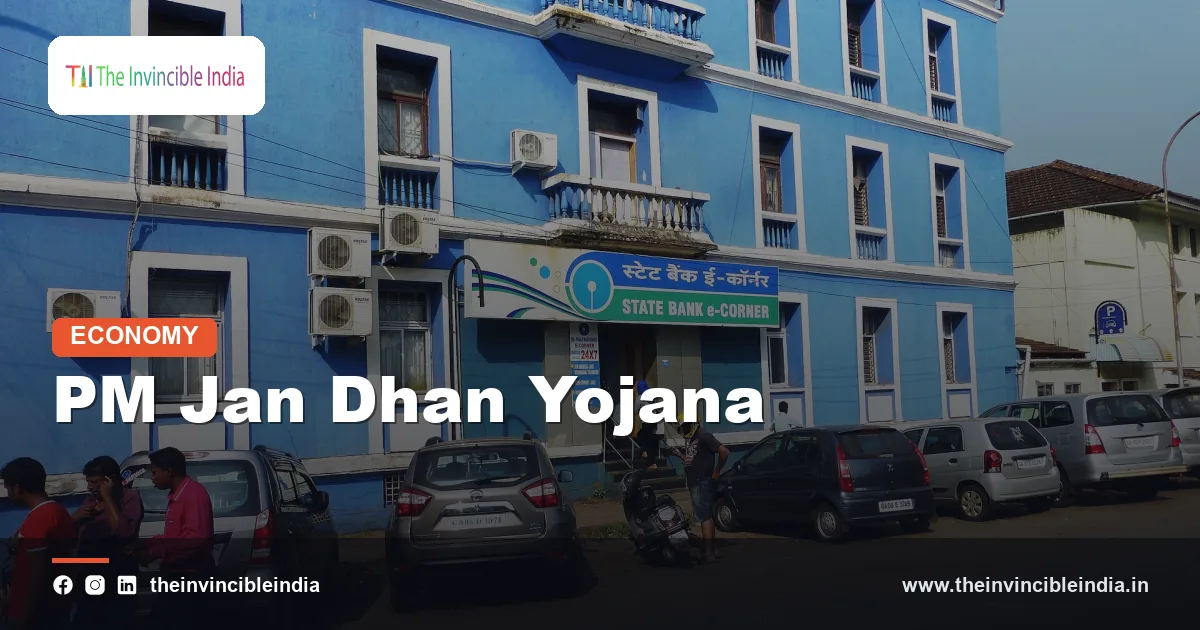
The Jan Dhan Yojana, formally the Pradhan Mantri Jan Dhan Yojana (PMJDY), is India’s flagship national mission for financial inclusion. Announced from the ramparts of the Red Fort on 15 August 2014 and formally launched on 28 August 2014, it set out to ensure that every household in the country had access to at least one basic bank account, along with a path to credit, insurance and pensions. It is widely described as the largest financial-inclusion drive in the world.
For decades, a large share of Indians, especially in villages and among the poor, lived entirely outside the formal banking system. They saved in cash, jewellery or livestock and borrowed from local moneylenders at punishing rates. This explainer covers why the scheme was needed, how the accounts work, the JAM Trinity that made direct benefit transfer possible, the wider inclusion ecosystem, and the challenges that remain. Figures are approximate and dated, and they keep changing, so treat them as milestones rather than live statistics.
Quick Facts
| Full name | Pradhan Mantri Jan Dhan Yojana (PMJDY) |
|---|---|
| Announced | 15 August 2014 (Independence Day speech) |
| Launched | 28 August 2014 |
| Nodal ministry | Department of Financial Services, Ministry of Finance |
| Core aim | A bank account for every unbanked household and adult |
| Account type | Basic savings bank deposit account with zero balance and no minimum balance |
| Card | RuPay debit card with built-in accident insurance cover |
| Scale | Over 50 crore accounts opened (as of around 2023), a majority held by women |
| Companion architecture | JAM Trinity: Jan Dhan, Aadhaar and Mobile |
The Problem: India Before Jan Dhan
Independent India had tried to widen banking for many years. The nationalisation of major banks in 1969, the creation of Regional Rural Banks in 1975, the SHG-Bank Linkage Programme from the early 1990s and the “no-frills” accounts encouraged by the Reserve Bank of India in the mid-2000s all helped. Yet by the early 2010s a huge number of adults still had no account. The World Bank’s Global Findex survey for 2011 suggested that only about a third of Indian adults held an account at a formal financial institution.
Why so many were left out
- Distance: many villages had no branch nearby, and travelling to one cost a day’s wages.
- Documentation: opening an account demanded address and identity proof that migrants and the poor often lacked.
- Minimum balance and charges: a poor household could not afford to lock up money.
- Distrust and unfamiliarity: first-generation customers found bank forms and counters intimidating.
The cost of staying outside
Without an account, savings sat as cash at home, exposed to theft and fire, and earned no interest. Borrowing meant informal lenders charging steep rates. Government subsidies often travelled through long chains of intermediaries, so a share of the money never reached the intended beneficiary. This combination of exclusion and leakage is the problem Jan Dhan was designed to attack.
Launch and Objectives of the Scheme
Prime Minister Narendra Modi announced the mission in his first Independence Day address in 2014, calling for a national mission to bring every household into the banking fold. The formal launch followed on 28 August 2014, with camps held across the country. Banks were given a first target of about 7.5 crore accounts by January 2015, and the opening drive attracted enormous attention. About 1.8 crore accounts were reported opened in the first week, a feat recognised by Guinness World Records.
Six pillars of the mission
The original design rested on a set of linked objectives:
- Universal access to banking facilities through a branch or a nearby banking outlet.
- Basic savings accounts with a RuPay debit card and accident insurance cover.
- Financial literacy so that new customers understand saving, borrowing and insurance.
- A credit guarantee fund to encourage lending to new account holders.
- Micro-insurance for protection against life and accident risks.
- An unorganised-sector pension scheme for old-age security.
From households to adults
The first phase ran from 2014 to 2018 and focused on covering households. From 15 August 2018 the programme was extended, shifting the focus from every household to every unbanked adult, and revising several benefits upward.
Key Features of Jan Dhan Accounts
A Jan Dhan account is a basic savings bank deposit account. It can be opened at a bank branch or through a business correspondent, with simplified know-your-customer norms. A person lacking full documents could open a “small account” with limited conditions, and Aadhaar or other officially valid documents made the process quicker.
| Feature | What it offers |
|---|---|
| Zero balance | The account can be opened with no money and does not require a minimum balance |
| Interest | Interest is paid on the deposit balance as on regular savings accounts |
| RuPay debit card | Issued free to account holders, usable at ATMs and merchants |
| Accident insurance | Cover bundled with the RuPay card, raised for accounts opened after 28 August 2018 |
| Overdraft | A facility for eligible, well-conducted accounts, initially Rs 5,000 and later raised to Rs 10,000 |
| Direct benefit transfers | Subsidies and wages can be credited straight to the account |
| Access to other schemes | Gateway to micro-insurance, pensions and micro-credit |
Insurance and overdraft in brief
The accident cover attached to the RuPay card was originally Rs 1 lakh and was doubled to Rs 2 lakh for accounts opened after 28 August 2018, provided the card was used within a stipulated period. An earlier life cover of Rs 30,000 applied to accounts opened in the initial window. The overdraft let a responsible account holder meet small emergency needs without turning to a moneylender.
Scale and Reach: How Big Is the Programme
The scale of Jan Dhan is its defining feature. The account tally crossed 10 crore within a few months, then rose steadily year after year. By around August 2023, when the programme marked nine years, the number of accounts had passed 50 crore, a milestone the government highlighted. Deposits in these accounts have grown to well over Rs 2 lakh crore, which is a striking amount considering that the accounts began with zero balance.
Who holds the accounts
- Women: a majority of the accounts, well over half, are held by women, many of whom had never before had a bank account in their own name.
- Rural and semi-urban India: a clear majority of accounts are in rural and semi-urban branches.
- Public sector banks: most accounts sit with public sector banks and Regional Rural Banks, with private banks holding a smaller share.
The wider national picture
The Global Findex survey recorded a sharp rise in account ownership among Indian adults, from about a third in 2011 to roughly four-fifths by 2017. Jan Dhan was a major contributor, though digital payments, Aadhaar-based onboarding and other efforts also played a role. These are broad indicators, and the exact percentages vary by survey round and method.
The JAM Trinity Explained
The JAM Trinity is the idea that made Jan Dhan more than a banking campaign. The term was popularised in the Economic Survey of 2014-15, which argued that combining bank accounts, a unique biometric identity and ubiquitous mobile phones could transform the delivery of welfare. Each element solves a different problem.
| Element | What it is | Problem it solves |
|---|---|---|
| J: Jan Dhan | A basic bank account for every adult | Gives every beneficiary a place to receive money |
| A: Aadhaar | A 12-digit biometric-based identity number issued by the UIDAI | Proves identity, removes ghost and duplicate beneficiaries |
| M: Mobile | A mobile phone linked to the account | Provides alerts, banking access and digital payments |
Why the three work together
An account alone only stores money, and an identity number alone proves who you are. Linked together, they allow the state to identify a person, send money to a verified account and tell the beneficiary by text message that the payment arrived. The Aadhaar Act of 2016 later gave the identity layer a statutory footing.
Direct Benefit Transfer and Plugging Leakages
Direct Benefit Transfer (DBT) was introduced in January 2013, but it spread rapidly once Jan Dhan accounts and Aadhaar seeding created a large base of verified accounts. Instead of passing through multiple layers of officials and dealers, funds are credited directly into the beneficiary’s account.
Major examples of DBT
- LPG subsidy: the PAHAL scheme moved cooking gas subsidy into bank accounts, and it became nationwide in January 2015.
- Pensions: social security pensions for the elderly, widows and disabled are paid into accounts.
- Scholarships: student scholarships are routed through the National Scholarship Portal into accounts.
- MGNREGA wages: rural employment wages are paid electronically rather than in cash.
- Farm support: PM-KISAN, launched in 2019, sends income support to farmer families in instalments.
The COVID-19 test
The architecture was tested during the pandemic. In March 2020, under the Pradhan Mantri Garib Kalyan package, cash assistance was credited into the accounts of women Jan Dhan holders, alongside payments to farmers, pensioners and others. Money reached millions of households within days, without queues at distribution points. The government has claimed substantial savings from removing duplicate and fake beneficiaries, though economists continue to debate the exact size of those savings.
The Wider Financial Inclusion Ecosystem
Accounts need services around them to be useful. Jan Dhan therefore sits within a wider set of institutions and technologies aimed at bringing banking to people instead of expecting people to travel to banks.
Business correspondents and bank mitras
The Reserve Bank allowed banks to appoint business correspondents from 2006. Often called “bank mitras” or banking friends, they are local agents who operate small outlets in villages, handle deposits and withdrawals and help new customers open accounts. Jan Dhan greatly expanded this network, with the aim of a banking outlet within a short distance of every village.
MicroATMs and India Post Payments Bank
Business correspondents carry handheld devices called microATMs, which use biometric authentication, often through the Aadhaar-enabled Payment System. The India Post Payments Bank, launched on 1 September 2018, uses the vast network of post offices and postmen to deliver banking at the doorstep.
RuPay and UPI
The RuPay card network, created by the National Payments Corporation of India, gave Jan Dhan holders a domestic card. The Unified Payments Interface, launched in April 2016, then allowed instant mobile payments between accounts. For many first-time account holders, UPI became the bridge from simply holding an account to actually using it for everyday digital payments.
Impact: Inclusion, Women and the Savings Habit
The most visible result of Jan Dhan is the sheer reach of formal banking. Tens of crores of people now have an account who had none before, and the proportion of adults with access to banking has risen dramatically.
Women’s empowerment
For many women, a Jan Dhan account was the first financial asset in their own name. Having an account lets a woman receive wages, pensions and relief payments directly, keep some savings out of sight and take part in household financial decisions. Studies and field reports link account ownership with greater financial agency, although outcomes differ across states and communities.
Formal savings and a foundation for credit
The deposit balances accumulated in these accounts show a growing habit of formal saving, even in small amounts. An account also creates a transaction record, which forms the first step toward a credit history. Banks can use this data to offer overdrafts, small loans and insurance, bringing people into mainstream credit instead of leaving them dependent on informal lenders.
Reduced leakage
By paying the beneficiary directly, DBT cut out middlemen, fake names and duplicate claims, and it made payments faster and more traceable.
Challenges and Criticisms
Like any large programme, Jan Dhan has faced real difficulties. A balanced view needs to acknowledge them alongside the achievements.
Dormant and zero-balance accounts
A significant portion of accounts remained inactive or carried very low balances, particularly in the early years. Opening an account is not the same as using it. Banks have since run campaigns to encourage use, including linking benefits to the accounts, and the share of zero-balance accounts has fallen from its early peak.
Duplicate accounts and data quality
Some people opened more than one account, partly because of the intense drive to meet targets. Aadhaar seeding, periodic re-KYC and data cleaning are used to tackle duplication and to keep records accurate.
Last-mile infrastructure
Poor connectivity, unreliable biometric authentication, cash shortages at village outlets and limited agent incomes can undermine service in remote areas. Customers sometimes still travel long distances for cash.
Financial literacy and fraud
New users may not understand charges, insurance conditions or digital safety. Awareness of cyber fraud, rules for card usage and the process for grievances therefore matters as much as the account itself.
Related Schemes: Insurance, Credit and Pensions
Jan Dhan accounts are the platform on which several other social-security and credit schemes operate. Three of them were launched together on 9 May 2015, and Mudra followed on 8 April 2015.
| Scheme | Purpose | Key points |
|---|---|---|
| PM Suraksha Bima Yojana (PMSBY) | Accident insurance | Annual premium of about Rs 20, cover of Rs 2 lakh for accidental death or full disability, age group 18 to 70 |
| PM Jeevan Jyoti Bima Yojana (PMJJBY) | Life insurance | Yearly renewable cover of Rs 2 lakh, age group 18 to 50, premium auto-debited from the account |
| Atal Pension Yojana (APY) | Old-age pension | Guaranteed monthly pension of Rs 1,000 to Rs 5,000 after age 60, for those joining between 18 and 40 |
| Pradhan Mantri Mudra Yojana | Collateral-free micro-credit | Loans in Shishu, Kishor and Tarun categories for small and micro enterprises, up to Rs 10 lakh |
Together these schemes extend the idea of inclusion beyond a savings account, offering protection against accidents and death, security in old age and access to enterprise credit. Premiums are small and are debited automatically from the linked account, which is why having an active account is so important.
Conclusion
The Jan Dhan Yojana changed the basic question of Indian banking from “who has an account?” to “how well is the account being used?” By bringing over 50 crore people into the formal system, it built the base for direct benefit transfer, digital payments and micro-insurance. The JAM Trinity demonstrated how identity, accounts and mobile phones can deliver welfare quickly and traceably, as the COVID-19 relief payments showed.
The next stage of work is about depth rather than numbers: keeping accounts active, improving last-mile service, strengthening financial literacy and linking savers to affordable credit. Last updated: 1 October 2026.
Frequently Asked Questions
When was the Jan Dhan Yojana launched and what is its goal?
The Pradhan Mantri Jan Dhan Yojana was announced on 15 August 2014 and formally launched on 28 August 2014. Its goal is to give every unbanked household and adult access to a basic bank account, along with insurance, credit and pension services.
What are the main benefits of a Jan Dhan account?
The account can be opened with zero balance and needs no minimum balance. It comes with a free RuPay debit card that carries accident insurance cover, an overdraft facility for eligible accounts, interest on deposits and the ability to receive government benefits directly.
What is the JAM Trinity?
JAM stands for Jan Dhan, Aadhaar and Mobile. Jan Dhan provides the bank account, Aadhaar provides a verified identity and the mobile phone provides access and alerts. Together they allow subsidies and welfare payments to be transferred directly to the right person.
How many Jan Dhan accounts have been opened?
The number crossed 50 crore around 2023, and a majority of the accounts are held by women and by people in rural and semi-urban areas. The figure keeps changing, so the latest numbers are best checked on the official PMJDY portal.
What is Direct Benefit Transfer and how is it linked to Jan Dhan?
Direct Benefit Transfer sends subsidies, pensions, wages and scholarships straight into a beneficiary’s bank account instead of passing through intermediaries. Jan Dhan accounts gave millions of people a verified account to receive these payments, which helped reduce leakage and delays.
What are the main challenges of the scheme?
Key challenges include dormant or low-balance accounts, duplicate accounts, patchy last-mile banking infrastructure in remote areas and limited financial literacy. Banks and the government address them through re-KYC, Aadhaar seeding, business correspondents and awareness campaigns.


