

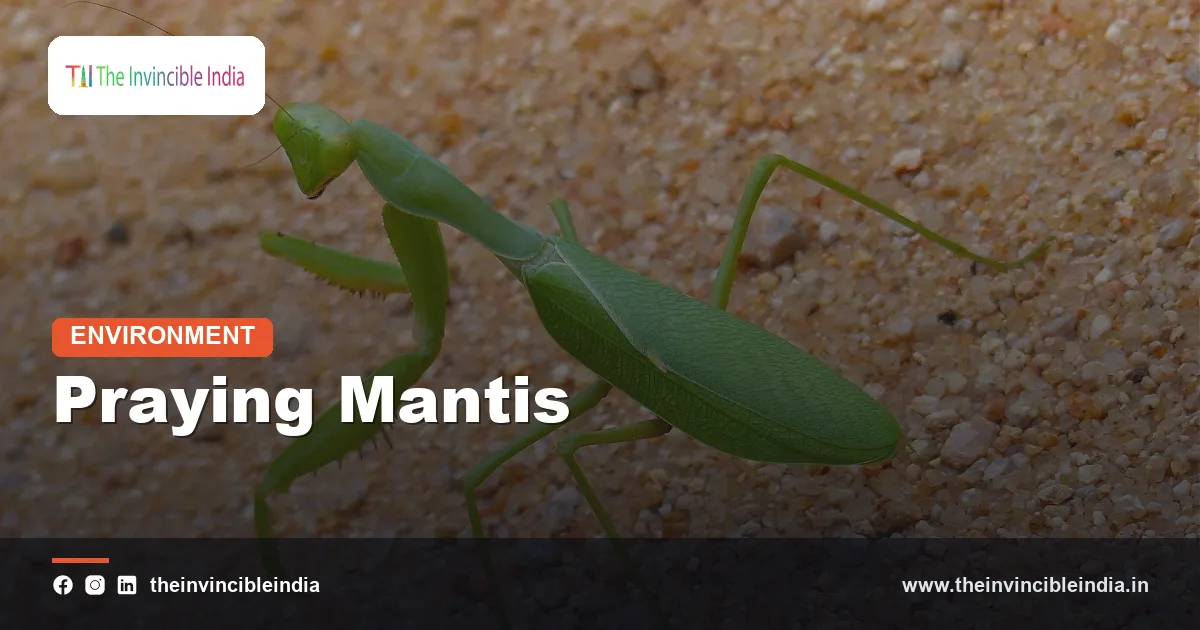
The praying mantis is a predatory insect of the order Mantodea, recognised by its grasping, spiked front legs, its triangular head that swivels freely, and its habit of waiting motionless for prey to come within reach. Praying mantises are common across India, living in gardens, grasslands, farms and forests, where they catch flies, moths, grasshoppers and many other insects.
The praying mantis is harmless to humans, has no venom and cannot sting, and it is generally beneficial because it removes insects from gardens and fields. This explainer describes how the praying mantis hunts, how it hides, what its foamy egg case (ootheca) is, whether the famous cannibalism story is true, and how to treat a mantis you find at home.
Quick Facts
| Attribute | Detail |
|---|---|
| Group | Insects of the order Mantodea (mantises) |
| Name origin | Mantis comes from a Greek word for seer or prophet; praying refers to the folded-forelegs posture |
| Number of species | About 2,400 described worldwide; India has well over a hundred recorded species |
| Typical size in India | Roughly 4 to 10 cm for the commonly seen species, with some tiny and some very long-bodied forms |
| Diet | Live insects and other small animals, caught with the spiny forelegs |
| Key features | Raptorial forelegs, a head that turns through a wide arc, large compound eyes, excellent camouflage |
| Development | Incomplete metamorphosis: egg (in an ootheca), nymph, adult |
| Danger to humans | None; no venom, no sting, no disease transmission |
| Garden role | Natural predator of many insects, including several crop and household pests |
Key Takeaways
- The praying mantis is an insect of the order Mantodea that catches prey with spined, grasping forelegs after waiting motionless in ambush.
- A praying mantis can turn its head through a very wide arc and has large compound eyes, which help it judge distance precisely before striking.
- The praying mantis lays its eggs inside a hardened foam case called an ootheca, which is often attached to twigs, fences and walls.
- Sexual cannibalism in the praying mantis is real but is often exaggerated, since many matings end with the male escaping unharmed.
- A praying mantis is harmless to people; it has no venom and cannot sting, and at worst it may pinch with its foreleg spines.
- Mantises help control garden insects, but they eat almost any insect they can catch, including butterflies and bees, so they are helpers and not a complete pest-control solution.
What does a praying mantis look like?
A praying mantis has a long, slender body, a triangular head with two large compound eyes, and a pair of strong forelegs folded in front of its chest. The folded forelegs give the insect its prayerful look, but they are actually weapons equipped with rows of sharp spines.
The body is divided into the head, a long prothorax (the neck-like segment that carries the forelegs), the rest of the thorax and the abdomen. Most Indian mantises are green or brown. The wings lie flat over the back, and in many species the females are bulkier and less inclined to fly than the slimmer males.
Special features of the praying mantis
- Flexible head: The praying mantis is one of very few insects that can turn its head sideways through a wide arc and look over its shoulder.
- Binocular vision: The two large eyes face forward and overlap, and experiments with tiny 3D glasses have shown that mantises can judge depth, an ability once believed to be absent in insects.
- Single ear: Many mantises have one ear on the underside of the thorax, which helps them detect the ultrasonic calls of hunting bats and dive to safety in flight.
- Antennae: The antennae are thin and thread-like, used to sense smell and touch.
How does a praying mantis hunt?
A praying mantis hunts by ambush, staying nearly motionless on a leaf, flower or twig until an insect comes within reach and then snapping out its forelegs to seize it. The strike is extremely fast, taking only a small fraction of a second, which is quicker than the blink of a human eye.
The mantis relies on sight, not smell. It sometimes sways gently from side to side, which scientists think helps it judge the distance to prey by observing movement against the background. Once the target is within range, the spiked tibia snaps shut against the femur like the blade of a folding knife, pinning the victim in place.
Steps of a mantis attack
- The mantis spots an insect and slowly turns its head to fix on it.
- It creeps closer or waits for the prey to approach.
- The forelegs shoot forward and clamp around the prey.
- The mantis begins eating at once, usually starting with the head or soft parts, and cleans its forelegs afterwards.
Most prey consists of flies, mosquitoes, moths, crickets, grasshoppers, bugs and caterpillars. Large mantises may sometimes catch small lizards, frogs or even a hummingbird in other countries, but such cases are rare and insects make up almost the whole diet.
How does a praying mantis camouflage itself?
A praying mantis camouflages itself by matching the colour, shape and posture of the vegetation around it, so that it looks like a leaf, a twig, a flower petal or a piece of bark. This crypsis lets the mantis hide from birds and lizards that hunt it and from the insects it hopes to catch.
India has many examples. The grass mantis, with its narrow green body and pointed head, is nearly invisible among blades of grass. Flower mantises of the genus Creobroter, sometimes seen on blossoms, match pale petals and may flash eye-like spots on their wings when threatened. Leaf-like species such as the large Hierodula mantises stay green in the monsoon and often become browner during drier months.
Defensive displays
When camouflage fails, a praying mantis often switches to bluff. It rears up, spreads its forelegs and wings and sometimes rustles or hisses, a behaviour called a deimatic display, designed to make the insect look bigger and more dangerous. The display is theatre only, and the mantis is usually trying to avoid a fight.
Where are praying mantises found in India?
Praying mantises are found throughout India, from the plains and coasts to the Western Ghats, the north-east and the lower Himalayan slopes, wherever there is vegetation and enough insect prey. They are most conspicuous during and after the monsoon, when insects are abundant and nymphs hatch.
Many species share Indian gardens and fields. The table below lists a few of the best-known mantis groups that appear in Indian natural-history records.
| Mantis group | Typical appearance | Where it is often seen |
|---|---|---|
| Hierodula species (giant Asian mantises) | Large, green or brown, with a robust body | Gardens, shrubs and farm edges |
| Creobroter species (flower mantises) | Small to medium, pale body, eye-like spots on the wings | Flowering shrubs and herbs |
| Gongylus gongylodes (Indian flower or wandering violin mantis) | Slim, with leaf-like flaps on the legs and thorax | Dry scrub and open woodland |
| Schizocephala species (grass mantises) | Slender, with a horn-like extension on the head | Tall grasslands and paddy bunds |
| Statilia and Tenodera species | Medium-sized, brown or green, often with a long narrow body | Grassy patches and hedges |
Species identification can be difficult without a close look, so naturalists often photograph a mantis and upload it to community platforms such as iNaturalist, which helps build Indian distribution records.
What is a mantis egg case, or ootheca?
An ootheca is the protective egg case of a praying mantis, produced as a frothy secretion that hardens into a foam-like capsule around the eggs. A female mantis attaches the ootheca to a twig, stem, fence post, rock or wall, where it dries into a firm, light brown structure.
Each ootheca holds from a few dozen to a few hundred eggs, depending on the species. The case is built in layers, and a series of small channels or flaps lets the tiny nymphs escape when they hatch. The foam works as insulation against heat and cold, and it also helps protect the eggs from rain and from many small enemies, although parasitic wasps can still lay eggs in some ootheca.
How do you recognise an ootheca?
- It looks like a small, hardened, brownish blob of dried foam, often oval or rounded and a few centimetres long.
- Its surface shows a ridged or layered pattern.
- It is firmly attached to a plant stem, twig, wall corner or fence.
Hatching usually takes several weeks. Dozens or hundreds of tiny nymphs emerge together, hang briefly from silken threads, and then disperse. Many are eaten by spiders, ants and birds, and a few may eat one another, which is why only a small fraction reach adulthood.
Do female praying mantises really eat their mates?
Female praying mantises do sometimes eat their mates, a behaviour called sexual cannibalism, but it is far from universal and happens much less often in nature than popular stories claim. In many field observations the male mates and leaves unharmed, and the high rates reported in some laboratory studies reflect the stress and hunger of captivity.
When cannibalism does occur, the female usually seizes the male’s head and continues eating while mating proceeds. Reports from early experiments showed that the nerve centres in the abdomen of a male mantis can keep the mating movements going even after the head is lost. Some researchers think the extra meal gives the female nutrients that help her produce more eggs, which would benefit the male’s offspring.
What is myth and what is fact?
| Popular claim | What research shows |
|---|---|
| Every female mantis eats her mate | False; most matings do not end in cannibalism, especially in wild habitats |
| The male is always decapitated first | False; males often survive, and some species show almost no cannibalism |
| Males cannot mate without being eaten | False; males approach carefully from behind and often escape after mating |
| Cannibalism helps the female produce more eggs | Partly supported; in some studies well-fed females laid more eggs after eating a mate |
What is the life cycle of a praying mantis?
The praying mantis passes through three stages: egg, nymph and adult, in a pattern called incomplete metamorphosis. The nymph looks like a tiny, wingless version of the adult and grows by shedding its skin several times, gaining wings only at the final moult.
The entire life span of most Indian mantises is about six months to a year. Nymphs hatch from the ootheca during warm, humid weather, hunt tiny insects such as fruit flies and aphids, and eat larger prey as they grow. Before each moult, the nymph stops eating, hangs upside down from a twig, splits its old skin and slowly pulls free, a vulnerable moment that can take an hour or more. After the last moult the adult is ready to mate, and the females then lay one or more oothecae before dying at the end of the season.
Why do mantis nymphs hang upside down?
Nymphs hang upside down during moulting so that gravity helps them pull the body out of the old skin. A mantis disturbed during moulting may be deformed or die, so it is best not to touch or move a hanging mantis.
Is a praying mantis dangerous to humans?
A praying mantis is not dangerous to humans, because it has no venom, no stinger and no ability to transmit disease. A large mantis may grip a finger with its forelegs and the spines may prick slightly, but the effect is trivial and does not require medical care.
The mantis is a gentle insect when handled calmly. Most mantises climb onto a hand and sit on it, and they are used in schools and nature camps to teach children about insects. If a mantis is held by the body too tightly, however, it can be injured, so it is best to let the insect walk onto the hand by itself and to release it soon on a shrub.
Common mistakes to avoid
- Do not pull a mantis from a branch by its legs, since they break easily.
- Do not spray pesticides near a mantis or an ootheca.
- Do not keep wild mantises in a closed box without food and air.
- Do not put several mantises together, because they will attack each other.
Are praying mantises good for pest control in gardens?
Praying mantises are useful predators in gardens, because they eat many flies, mosquitoes, moths, caterpillars, grasshoppers and bugs that damage plants or annoy people. They are best seen as a helpful part of a wider garden food web and not as a guaranteed pest-control solution.
A mantis is a generalist, meaning it eats almost any insect that moves within reach. That includes butterflies, bees and even other beneficial predators such as ladybirds, so its overall effect on pests is limited and unpredictable. Specialist natural enemies such as ladybirds, lacewings and parasitic wasps often do more targeted work against aphids and caterpillars.
How to encourage mantises in a garden
- Stop or reduce pesticide spraying, which kills mantises and their prey.
- Grow a variety of shrubs, grasses and flowering plants that offer cover and perching spots.
- Leave some corners untidy, with tall grass and dry stems, where females lay oothecae.
- Avoid removing egg cases during pruning; if a branch must be cut, tie it upright elsewhere in the garden.
Why is the praying mantis called by that name?
The praying mantis is called by that name because it holds its spiked forelegs folded in front of its body, as if it were in prayer, and because the word mantis comes from an ancient Greek word meaning prophet or seer. Early observers likened the still, upright posture of the insect to a person praying or foretelling the future.
Cultural references to mantises appear in many countries. In East Asia, the mantis is celebrated in martial arts and in proverbs about courage, while in other parts of the world it appears in folk tales as a symbol of patience. In India, the insect is widely known as a farmer’s helper, and many village communities regard it with curiosity and respect more than fear. Scientists value the mantis for another reason: its vision, hunting and defence behaviours have inspired research in robotics and neuroscience.
Bottom Line
The praying mantis is a patient, camouflaged, harmless predator that helps keep insect numbers in check across Indian gardens and fields. Protecting its egg cases, avoiding pesticides and leaving a little wild vegetation in the garden is the simplest way to keep this fascinating insect around.
Frequently Asked Questions
What is a praying mantis?
A praying mantis is a predatory insect of the order Mantodea, known for its spined, grasping forelegs and swivelling triangular head. It waits motionless in ambush and seizes passing insects. India is home to well over a hundred species, and all are harmless to humans.
Is a praying mantis poisonous or dangerous to humans?
A praying mantis is not poisonous, has no venom and cannot sting. It may grip a finger with its spiny forelegs, which can feel like a mild prick, but this is harmless. The insect does not carry diseases that affect humans.
What does a praying mantis eat?
A praying mantis eats live insects, such as flies, mosquitoes, moths, crickets and grasshoppers. Large species may occasionally take small lizards or frogs, but this is uncommon. Young nymphs feed on very small insects such as aphids and fruit flies.
Do female praying mantises always eat the male?
Female praying mantises do not always eat their mates. Sexual cannibalism does occur, but it is much less common in the wild than in captive conditions, and many males mate and escape. Some studies suggest that the extra meal can help a female produce more eggs.
What is a mantis egg case and what should I do if I find one?
A mantis egg case, called an ootheca, is a hardened foam capsule that holds dozens to hundreds of eggs and is stuck to twigs, fences or walls. If you find one, it is best to leave it alone, since the nymphs will hatch on their own. If it must be moved, cut the supporting twig and tie it in a shaded shrub in the garden.
Are praying mantises good for my garden?
Praying mantises are generally good for a garden because they eat many insects, including flies, moths and caterpillars. They are generalist hunters, so they also eat some helpful insects such as bees and butterflies. A garden with mantises, native plants and no harsh pesticides usually has a healthier insect balance.
{“@context”:”https://schema.org”,”@graph”:[{“@type”:”FAQPage”,”mainEntity”:[{“@type”:”Question”,”name”:”What is a praying mantis?”,”acceptedAnswer”:{“@type”:”Answer”,”text”:”A praying mantis is a predatory insect of the order Mantodea, known for its spined, grasping forelegs and swivelling triangular head. It waits motionless in ambush and seizes passing insects. India is home to well over a hundred species, and all are harmless to humans.”}},{“@type”:”Question”,”name”:”Is a praying mantis poisonous or dangerous to humans?”,”acceptedAnswer”:{“@type”:”Answer”,”text”:”A praying mantis is not poisonous, has no venom and cannot sting. It may grip a finger with its spiny forelegs, which can feel like a mild prick, but this is harmless. The insect does not carry diseases that affect humans.”}},{“@type”:”Question”,”name”:”What does a praying mantis eat?”,”acceptedAnswer”:{“@type”:”Answer”,”text”:”A praying mantis eats live insects, such as flies, mosquitoes, moths, crickets and grasshoppers. Large species may occasionally take small lizards or frogs, but this is uncommon. Young nymphs feed on very small insects such as aphids and fruit flies.”}},{“@type”:”Question”,”name”:”Do female praying mantises always eat the male?”,”acceptedAnswer”:{“@type”:”Answer”,”text”:”Female praying mantises do not always eat their mates. Sexual cannibalism does occur, but it is much less common in the wild than in captive conditions, and many males mate and escape. Some studies suggest that the extra meal can help a female produce more eggs.”}},{“@type”:”Question”,”name”:”What is a mantis egg case and what should I do if I find one?”,”acceptedAnswer”:{“@type”:”Answer”,”text”:”A mantis egg case, called an ootheca, is a hardened foam capsule that holds dozens to hundreds of eggs and is stuck to twigs, fences or walls. If you find one, it is best to leave it alone, since the nymphs will hatch on their own. If it must be moved, cut the supporting twig and tie it in a shaded shrub in the garden.”}},{“@type”:”Question”,”name”:”Are praying mantises good for my garden?”,”acceptedAnswer”:{“@type”:”Answer”,”text”:”Praying mantises are generally good for a garden because they eat many insects, including flies, moths and caterpillars. They are generalist hunters, so they also eat some helpful insects such as bees and butterflies. A garden with mantises, native plants and no harsh pesticides usually has a healthier insect balance.”}}]}]}


