

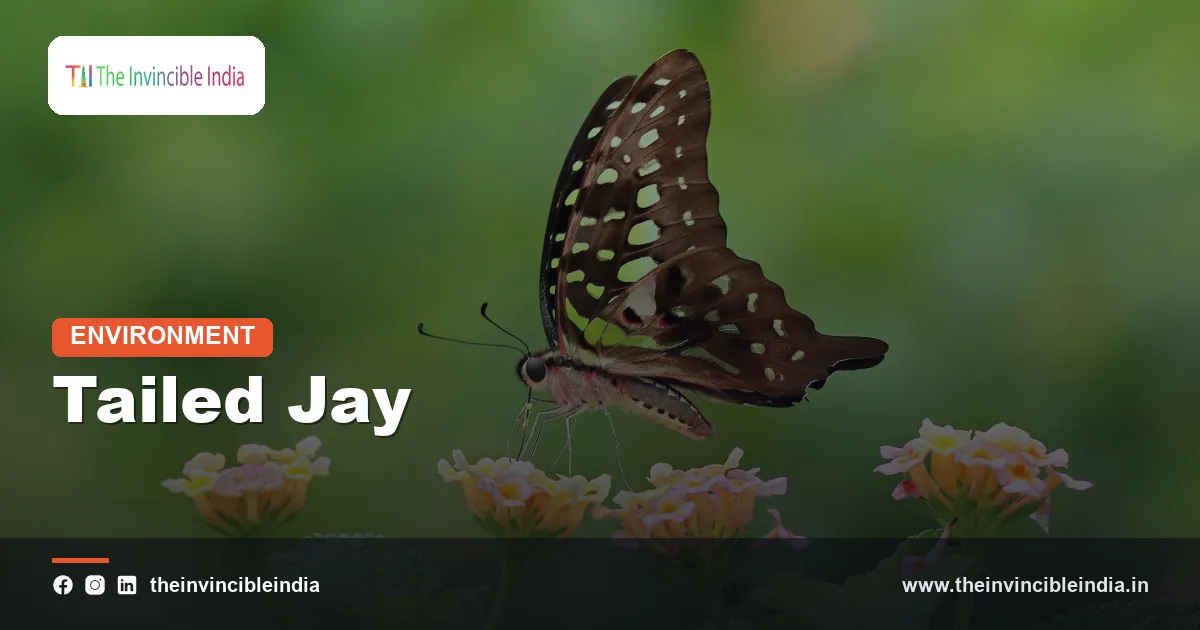
The tailed jay (Graphium agamemnon) is a fast-flying, restless swallowtail butterfly of the family Papilionidae, easily recognised by the bright green spots scattered across its dark wings and the short tails on its hindwings. The tailed jay is a common sight in Indian gardens, forest edges and tree-lined avenues, where it dashes from flower to flower and seldom stays still for more than a moment.
The tailed jay is completely harmless to people, crops and gardens. Its caterpillars feed on a small group of ornamental and fruit trees, and the adult butterflies act as pollinators while they feed on nectar. This explainer covers what the tailed jay looks like, where it lives in India, what it eats, how its life cycle works, and how to welcome it to a garden.
Quick Facts
| Attribute | Detail |
|---|---|
| Common name | Tailed jay (also called the green-spotted triangle in Australia) |
| Scientific name | Graphium agamemnon (Linnaeus, 1758) |
| Family | Papilionidae (swallowtails) |
| Wingspan | Roughly 75 to 90 mm |
| Key identification marks | Dark brownish-black wings with bright green spots; short tails on the hindwings |
| Caterpillar host plants | Trees and climbers of the custard-apple family (Annonaceae), such as the Ashoka tree (Polyalthia longifolia), and also champa (Michelia champaca) of the magnolia family |
| Range | India, Sri Lanka, Southeast Asia, New Guinea, northern Australia and several Pacific islands |
| Habitat in India | Forest edges, gardens, parks, plantations and urban avenues, mostly in humid and well-wooded areas |
| Conservation outlook | Common and widespread; not regarded as a threatened species |
Key Takeaways
- The tailed jay (Graphium agamemnon) is a swallowtail butterfly with bright green spots on dark wings and short tails on the hindwings.
- The tailed jay flies so quickly and restlessly that it usually feeds with its wings still fluttering instead of settling down.
- Tailed jay caterpillars feed on plants of the custard-apple family (Annonaceae), including the widely planted Ashoka tree, Polyalthia longifolia.
- Adult tailed jays drink flower nectar and gather on wet mud and damp sand to take up salts and minerals, a habit called mud-puddling.
- The tailed jay is harmless to humans, does not sting or bite, and is a beneficial pollinator in Indian gardens and forests.
- The tailed jay is common across much of India, and a garden with a few host trees and nectar flowers can support breeding populations.
What does a tailed jay look like?
A tailed jay is a medium-large swallowtail whose wings are dark brown to black on the upper side and marked with bright, pale green or bluish-green spots arranged in rows. The spots look almost like small patches of glowing glass when the butterfly catches the sun, which is why the species is easy to pick out even at a distance.
The forewings are triangular and the hindwings carry short, blunt tails at the rear edge. These tails are much shorter than the long streamers seen on some other swallowtails, so the tailed jay is sometimes mistaken for a tail-less species at first glance. A wingspan of roughly 75 to 90 mm makes the tailed jay noticeably larger than common garden butterflies such as the Lemon Pansy or the Common Grass Yellow.
The underside
The underside of a tailed jay is quite different from the top. It is paler, with a brownish or olive ground colour, pale green markings and a few reddish or ochre spots near the base of the hindwing. Because the butterfly rarely folds its wings while feeding, observers often see the underside only in photographs or when the butterfly briefly rests on a leaf.
Males and females
Male and female tailed jays look broadly alike, so the green-spotted pattern is not a reliable way to tell the sexes apart in the field. Females tend to be slightly larger, and in many individuals the wing edges look more rounded. Observers usually separate the sexes only by behaviour, since males patrol more actively in search of mates and females spend their time near host plants.
Where is the tailed jay found in India?
The tailed jay is found across large parts of India, with its strongest populations in humid, well-wooded regions such as the Western Ghats, the southern peninsula, the north-east and the Andaman and Nicobar Islands. It also occurs in the Himalayan foothills and in many cities across the plains, wherever suitable host trees and flowering plants grow.
Outside India the tailed jay ranges through Sri Lanka, Southeast Asia, the Indonesian and Philippine islands, New Guinea, northern Australia and some Pacific islands. This broad distribution shows that the species adapts well to different climates, provided there is warmth, moisture and a supply of host plants.
Habitats the tailed jay prefers
- Edges of evergreen and moist deciduous forests, where host trees and flowering shrubs grow together.
- Gardens, parks and campuses that contain planted Ashoka trees, custard-apple trees or champa.
- Roadside avenues and urban green belts, since the Ashoka tree is a very common avenue plant in Indian towns.
- Streams, wet ground and river banks, where adults gather to drink moisture and minerals from damp soil.
The tailed jay is scarcer in very dry regions of north-western India, where the host plants are less common. In southern and north-eastern India the butterfly can be seen in most months, with numbers often rising during and after the monsoon, when fresh young leaves appear on the host trees.
Why does the tailed jay rarely sit still?
The tailed jay rarely sits still because it is a powerful, fast flier that feeds while hovering and fluttering instead of landing with its wings closed. The butterfly approaches a flower, holds on lightly with its legs, keeps its wings quivering and drinks nectar through its long tube-like mouthpart, called the proboscis, before moving on to the next flower within seconds.
This behaviour is common among swallowtails and is thought to help the butterfly stay warm and ready to flee from predators. Constant wing vibration keeps the flight muscles at working temperature, and a butterfly that never fully settles can escape quickly if a bird, lizard or mantis approaches.
How to photograph a tailed jay
Photographers often find the tailed jay one of the harder butterflies to capture. Patience at a favourite flowering shrub, early morning visits when the butterfly is slower, and fast shutter speeds work best. Many naturalists also watch muddy patches beside streams, where tailed jays sometimes settle for longer while puddling.
What does the tailed jay eat?
An adult tailed jay eats liquid food, mainly flower nectar, and also drinks water and mineral-rich moisture from wet soil. The caterpillar, in contrast, eats only leaves of its host plants.
Adult tailed jays visit a wide variety of nectar sources. Common choices include lantana, ixora, jasmine-type flowers, bougainvillea, zinnia and many wild flowering shrubs. The butterfly prefers bright, clustered flowers with a tubular shape that its long proboscis can reach.
Mud-puddling explained
Mud-puddling is the habit of butterflies gathering on wet sand, mud or animal dung to sip fluid containing salts and minerals, especially sodium. Male tailed jays in particular join other swallowtails at damp patches beside streams and drains. The minerals are thought to improve the male butterflies’ reproductive success and general health, and they cannot be obtained from nectar alone.
Watching a mud-puddling gathering is a good way to see several species together. Tailed jays are often joined by Common Mormons, Common Rose butterflies, Blue Tigers, Lime butterflies and many pierids, so one damp patch can become a mini butterfly festival.
Which plants do tailed jay caterpillars feed on?
Tailed jay caterpillars feed mainly on plants of the custard-apple family, Annonaceae, and also on some members of the magnolia family, Magnoliaceae. In Indian towns the most familiar host is the Ashoka tree, Polyalthia longifolia, which is often called the false Ashoka and is planted along roads and in compounds because of its tall, slender, evergreen form.
The butterfly lays its round, pale eggs singly on tender young leaves. A female tailed jay uses her sense of smell and touch, detected through her feet and antennae, to recognise the correct host plant, and she places each egg where the newly hatched caterpillar will find soft food.
Common host plants
| Host plant | Plant family | Where it is seen in India |
|---|---|---|
| Ashoka tree (Polyalthia longifolia) | Annonaceae | Avenues, school and office campuses, temple grounds and home gardens |
| Custard apple or sitaphal (Annona squamosa) | Annonaceae | Orchards, village homesteads and dry-zone plantations |
| Bullock’s heart or ramphal (Annona reticulata) | Annonaceae | Gardens and home orchards, mainly in humid regions |
| Hooked climber, or manoranjini (Artabotrys hexapetalus) | Annonaceae | Gardens and fences, grown for its scented flowers |
| Champa (Michelia champaca) | Magnoliaceae | Temple gardens, parks and forest edges in humid regions |
Caterpillar feeding does not seriously harm these trees. The caterpillars eat only a few leaves, and healthy Ashoka and custard-apple trees put out new growth quickly. Gardeners who want butterflies should accept some chewed leaves as a sign that the garden is working as habitat.
How does the tailed jay life cycle work?
The tailed jay passes through four stages, egg, caterpillar, pupa and adult, in a process called complete metamorphosis. In warm Indian conditions the whole cycle takes roughly a month, which allows several generations in a year wherever food plants stay green.
Egg
The female lays tiny, round, pale eggs one at a time on young leaves of the host plant. Eggs hatch after a few days, and the tiny caterpillar eats its eggshell before starting on the leaf.
Caterpillar
The caterpillar grows through several stages, called instars, shedding its skin between each. Older caterpillars are green and smooth-bodied, which helps them blend into leaves. Like all swallowtail caterpillars, the tailed jay larva has a forked, fleshy organ behind its head called the osmeterium. The caterpillar everts this orange-red structure when disturbed, releasing a strong odour that deters ants, wasps and small predators.
Pupa
When fully grown, the caterpillar stops feeding, finds a sheltered spot on a stem or leaf, and turns into a pupa, also called a chrysalis. The pupa is held upright by a silk girdle around its middle and by a small anchor of silk at the tail end. Its green or brownish colour and angular shape make it look like part of a plant.
Adult
The adult butterfly emerges after about one to two weeks, dries its wings and takes off, usually in the morning. Adult tailed jays live for a few weeks, during which they feed, mate and lay eggs.
How can you tell a tailed jay from similar butterflies?
A tailed jay is separated from its look-alikes by its separate, well-defined green spots and its short hindwing tails. Several other swallowtails in the same genus, Graphium, show blue-green or pale markings, so a quick comparison helps beginners avoid confusion.
| Butterfly | Pattern on upper side | Tails |
|---|---|---|
| Tailed jay (Graphium agamemnon) | Dark wings with distinct bright green spots in rows | Short tails on hindwings |
| Common bluebottle (Graphium sarpedon) | Broad, continuous blue-green band across both wings | Very short or absent |
| Common jay (Graphium doson) | Dark wings with pale blue-green spots and patches, smaller and daintier than the tailed jay | Short tails |
| Lime butterfly (Papilio demoleus) | Black wings with yellowish-cream bands and spots | None |
Size and flight also help. The tailed jay is usually larger and flies with strong, quick wingbeats, while the Lime butterfly has a more floating flight in gardens and the Common bluebottle often glides rapidly near the tree canopy.
Is the tailed jay harmful, rare or protected?
The tailed jay is not harmful to people, domestic animals or crops, and it is not generally considered rare. The butterfly has no sting, no bite and no toxic chemistry that affects humans, and its caterpillars do not feed on any major food crop in India other than occasional use of custard-apple leaves.
Because the tailed jay is adaptable and uses commonly planted trees, its overall population is considered stable in most of its range. Local numbers do fall when native forest is cleared, when host trees are cut, or when gardens are sprayed with broad-spectrum pesticides. Indian law protects many butterflies listed in the Wildlife (Protection) Act, 1972, and collecting or trading insects from forests and protected areas can require permission, so naturalists enjoy butterflies through photography and observation.
What threatens butterflies like the tailed jay?
- Loss of forest edges and native flowering plants.
- Heavy use of insecticides in gardens and farms.
- Removal of host trees such as Ashoka and custard apple without replanting.
- Bright artificial lights and heavy traffic along some urban roads.
How can you attract tailed jays to a garden?
A garden attracts tailed jays when it combines host trees for the caterpillars, nectar flowers for the adults and a damp patch for puddling. Planting even one young Ashoka tree, a custard-apple tree or a champa in a sunny, sheltered spot can bring breeding tailed jays to a home or campus within a few seasons.
- Plant at least one host tree from the custard-apple family, such as Polyalthia longifolia or Annona squamosa.
- Add nectar plants like lantana, ixora, zinnia and other flowers that bloom through the season.
- Keep a shallow dish of damp sand or soil, topped up regularly, as a mud-puddling station.
- Avoid pesticides, and handpick pests instead of spraying.
- Leave some chewed leaves and caterpillars alone, since they are the next generation of butterflies.
Schools and housing societies across India are creating small butterfly gardens using this approach. Such gardens double as living classrooms where children can watch every stage of the tailed jay life cycle without going to a forest.
Why does the tailed jay matter to the ecosystem?
The tailed jay matters because it pollinates flowers, forms part of the food chain and acts as a visible indicator of healthy green spaces. As the butterfly moves from bloom to bloom, it carries pollen on its body, helping many wild and ornamental plants set seed.
Tailed jay eggs, caterpillars and adults are eaten by birds, lizards, spiders, mantises and parasitic wasps, so the species supports many other animals. Butterflies are also valued by scientists as bioindicators, because their numbers respond quickly to changes in vegetation, climate and pollution. A healthy local population of tailed jays suggests that a locality still has flowering plants, host trees and relatively clean air.
The species also has cultural appeal. Linnaeus gave it the name agamemnon in 1758, following his habit of naming many swallowtails after heroes of the Trojan War, and the vivid green-spotted wings continue to feature in Indian butterfly guides, postage stamps and nature-education material.
Bottom Line
The tailed jay is a harmless, beautiful and ecologically useful swallowtail that thrives wherever Annonaceae host trees and nectar flowers grow together. Planting an Ashoka or custard-apple tree, avoiding pesticides and leaving a patch of damp soil is usually enough to see this restless green-spotted butterfly in an Indian garden.
Frequently Asked Questions
What is a tailed jay butterfly?
A tailed jay is a swallowtail butterfly, Graphium agamemnon, with bright green spots on dark wings and short tails on the hindwings. It belongs to the family Papilionidae and is common in gardens, forest edges and avenues across much of India. The butterfly is harmless to people and plants.
Why does the tailed jay never sit still?
The tailed jay seldom sits still because it feeds on flowers while hovering with quivering wings and moves on within seconds. Constant wing vibration keeps its flight muscles warm and ready to escape predators such as birds and lizards. It only rests longer when it is puddling on mud or roosting at night.
Which plants do tailed jay caterpillars eat?
Tailed jay caterpillars eat the leaves of plants in the custard-apple family (Annonaceae), notably the Ashoka tree (Polyalthia longifolia), custard apple (Annona squamosa) and bullock’s heart (Annona reticulata). They also feed on champa (Michelia champaca), which belongs to the magnolia family. The damage to the trees is minor and temporary.
Is the tailed jay butterfly poisonous or harmful?
The tailed jay is neither poisonous nor harmful to people, pets or crops. It has no sting and does not bite, and its caterpillars cause only light leaf damage on host trees. The caterpillar’s orange-red osmeterium gives off a mild odour to deter predators, but it does not affect humans.
How can I attract tailed jays to my garden?
You can attract tailed jays by planting host trees such as Ashoka or custard apple, adding nectar flowers like lantana and ixora, and providing a tray of damp sand for mud-puddling. Avoiding pesticides is equally important. Tolerating some chewed leaves allows the caterpillars to grow into the next generation of butterflies.
What is mud-puddling and why do tailed jays do it?
Mud-puddling is the habit of butterflies gathering on wet mud, sand or dung to drink fluids rich in salts and minerals. Tailed jays, especially males, do this to obtain sodium and other minerals that nectar does not supply in sufficient amounts. The behaviour is harmless and is common among many Indian swallowtails.
{“@context”:”https://schema.org”,”@graph”:[{“@type”:”FAQPage”,”mainEntity”:[{“@type”:”Question”,”name”:”What is a tailed jay butterfly?”,”acceptedAnswer”:{“@type”:”Answer”,”text”:”A tailed jay is a swallowtail butterfly, Graphium agamemnon, with bright green spots on dark wings and short tails on the hindwings. It belongs to the family Papilionidae and is common in gardens, forest edges and avenues across much of India. The butterfly is harmless to people and plants.”}},{“@type”:”Question”,”name”:”Why does the tailed jay never sit still?”,”acceptedAnswer”:{“@type”:”Answer”,”text”:”The tailed jay seldom sits still because it feeds on flowers while hovering with quivering wings and moves on within seconds. Constant wing vibration keeps its flight muscles warm and ready to escape predators such as birds and lizards. It only rests longer when it is puddling on mud or roosting at night.”}},{“@type”:”Question”,”name”:”Which plants do tailed jay caterpillars eat?”,”acceptedAnswer”:{“@type”:”Answer”,”text”:”Tailed jay caterpillars eat the leaves of plants in the custard-apple family (Annonaceae), notably the Ashoka tree (Polyalthia longifolia), custard apple (Annona squamosa) and bullock’s heart (Annona reticulata). They also feed on champa (Michelia champaca), which belongs to the magnolia family. The damage to the trees is minor and temporary.”}},{“@type”:”Question”,”name”:”Is the tailed jay butterfly poisonous or harmful?”,”acceptedAnswer”:{“@type”:”Answer”,”text”:”The tailed jay is neither poisonous nor harmful to people, pets or crops. It has no sting and does not bite, and its caterpillars cause only light leaf damage on host trees. The caterpillar’s orange-red osmeterium gives off a mild odour to deter predators, but it does not affect humans.”}},{“@type”:”Question”,”name”:”How can I attract tailed jays to my garden?”,”acceptedAnswer”:{“@type”:”Answer”,”text”:”You can attract tailed jays by planting host trees such as Ashoka or custard apple, adding nectar flowers like lantana and ixora, and providing a tray of damp sand for mud-puddling. Avoiding pesticides is equally important. Tolerating some chewed leaves allows the caterpillars to grow into the next generation of butterflies.”}},{“@type”:”Question”,”name”:”What is mud-puddling and why do tailed jays do it?”,”acceptedAnswer”:{“@type”:”Answer”,”text”:”Mud-puddling is the habit of butterflies gathering on wet mud, sand or dung to drink fluids rich in salts and minerals. Tailed jays, especially males, do this to obtain sodium and other minerals that nectar does not supply in sufficient amounts. The behaviour is harmless and is common among many Indian swallowtails.”}}]}]}


